More brumbies

More brumbies

Eighteen months ago Allporus posted a piece on the brumby, what Australians call wild horses, specifically the controversy over the NSW Government passing the Kosciuszko Wild Horse Heritage Bill 2018 that gives protected status to feral horses in the national park. This is a law protects a known driver of biodiversity loss.

It was one of the more bizarre decisions that politics is capable of throwing up and is another example of the worrying trend to ignore science whenever it suits.

A few months after that post came out an aerial wildlife survey of the alpine national parks and surrounding state forests in NSW and Victoria was conducted, a follow up to a similar survey of the same area five years earlier.

In that time between surveys, the feral horse population has more than doubled from 9,187 in 2014 to 25,318 in 2019.

This is a growth rate of 24% per year.

It’s a great ‘I told you so’ story.

These animals are introduced. They are not native, repeat, not native.

They are big, bulky and hard-hoofed grazing animals, features that no other herbivore in these habitats has. The last big herbivores were browsers, the Diprotodons that likely died out 12,000 years ago.

Horses will alter vegetation. It will mean some sensitive plant species will be lost along with the invertebrates that go with them. Other plants will come in on the back of the disturbance and some of them will be invasive themselves.

More importantly than this, the ecological integrity of the alpine systems will be altered by horses.

And we now know who promoted it.


Since this little whinge was written the politicians of all hues have been standing next to scientists, patting them on the back and seeking out their learned advice; as they should.

The politicians who are not listening to their health professionals will have a big problem getting re-elected after COVID-19 has passed through the world on its first journey. The epidemiologists know what they are talking about, they know what it takes to slow a pandemic and the logistics folk know what the limits are to the capacity and capability of the health systems.

The problems of a pandemic are acute and affect everyone. The public expects that all sensible advice should be consulted and heeded.

The thing is that the conservation scientists, the biodiversity specialists and the wildlife biologists, well, they know their shit too. Just because their knowledge might save non-human lives, even whole species, of native plants and animals, it is no less valid as science.

So here is the truth.

Remember that all political decisions are value-based. They are not based on science unless the science aligns with the dominant value.

We are grateful that it does when human lives and livelihoods are at stake.

When the human stakes are lower we would do well to be grateful for science then too.
Is the economic imperative sustainable?

Is the economic imperative sustainable?

This post was written before the COVID-19 conundrum changed a few things… and yet it still applies.


The Australian economy is in a funk. We are told that annual growth in retail trade of 2.4% in trend terms is the lowest since December 2017.

Throughout 2019 households have not increased their volume of retail purchases at all.

In short, we are all strapped for cash and are not buying stuff.

Woh, hold on. Not quite.

Of course, we are consuming, we do it each and every week.

The problem for the economy is that we are not doing more of it than we did last year. Consumption is going on all the time, it is just not growing in percentage terms.

So it’s not consumption that economist’s are worried about, it is growth in consumption. Growth is considered essential for without it everything collapses in a heap. At least that is what we are told.

Let’s just look at that 2.4% again.

In 2019, retail trade — selling merchandise in the state that it is purchased, generally to a customer base of private individuals — will be double what it was in the year 2000.

When ABBA were in the charts in 1974 consumer spending by Australians was four times less than it is today. There are more people on Australia now than in the mullet and square shoulder days, but to quadruple spending in 40 odd years.

Come on, think about it.

Growth is not sustainable. It cannot go on forever. Not least because there will be nothing left for me to consume. I’d be consumed out.

Unless prices skyrocket there is a physical limit to the stuff that one person can consume even if I am littering, throw away, who gives a shit kind of consumer.

Sooner or later everyone has all the things they can think of and wish to possess. Does it mean that they just keep going round and round upgrading every time? Are we really that shallow — maybe!

Endless growth is just an extraordinary premise when you really examine it.

It is obvious why it is there.

Companies have to keep selling or they go out of business. Unless there are new people around to buy your widgets you will need your current customers to buy widget 2.0 or you diversify into insurance and the airline business.

A business can get away with it if prices rise. Their unit costs might go up but so does the retail prices and so growth is maintained. Indeed inflation is part of the growth deal, too little being as bad as too much.

So we teeter on the delicate balance of perpetual growth being imperative to our survival


Teetering a lot

Recently there was a step-change in the Australian continent.

An extended drought in the east created hot, dry conditions in spring when frontal systems create strong westerly winds. Dry air, hot temperatures, tinder-dry forests and strong winds produced devastating bushfire.

At the time of writing more than 11 million ha of bushland has burnt in NSW alone, an order of magnitude more than the whole of the previous fire season. Across Australia, an area the size of the Netherlands and Belgium has burnt in just a few hot, scary and brutal months.

Many of the forests that went up in flames, sometimes 70m tall, were supposed to be wet, they are even called rainforest and rarely burn, some of them not for hundreds of years.

This year they did. Several of the fires are 500,000 ha each.

It will take a while to assess the consequences but I suspect that these events have nullified decades worth of conservation effort and billions of dollars worth of natural resource management actions.

It should also be a wake up to the economists who are going OMG “annual growth in retail trade of 2.4% in trend terms is the lowest since December 2017″.

If the countryside burns like it has this summer the economy will struggle to achieve any growth at all for a long time.


And now the virus

So here we are in mid-March 2020 and COVID-19 is about to be declared a pandemic.

Australians have cleared the supermarket shelves of toilet rolls because they are absolutely bonkers — the toilet roll supply for the country comes from Adelaide, not Wuhan — and are about to freak out good and proper.

Already global markets have freaked out too and taken a massive plunge. This is actually a necessary correction from an over-inflated bull run that has gone on from the GFC, partly a response to the cash injections from jurisdictions. But ni matter, we can blame nature.

This new virus will not cease economic growth. The flu virus does something similar every year, this one is just more acute. People’s reactions to this unknown make a recession is a given. 


Postscript

Even though there are confirmed cases of COVID-19 in the US, most people are more likely to catch and spread influenza.

In the 2019 flu season, there were nearly 30 million cases of flu and 17,000 deaths.


It would be great if you liked this post enough to share it on your social network.

Dust storm consequence that’s not so obvious

Dust storm consequence that’s not so obvious

Every now and again Sydney gets a dust storm.

Red dirt descends on the harbour city leaving a stain on all exposed surfaces and forces asthma suffers indoors. The cloud usually passes within a few hours on the strong westerlies that brought the problem with them.

The typical conditions that bring this occasional event are simple enough: drought in the centre of the continent and a deep low tracking through the Tasman sea. Winds whip up topsoil and keep it aloft long enough for it to travel far and wide, sometimes even to New Zealand.

Dust storms like this are not common in Sydney. There is a major one every few years that creates a temporary nuisance. After a day it is forgotten and the next rain shower removes the evidence.

Severe thunderstorms, floods and bushfires along with their smoke are the more familiar of nature’s challenges.

However, suppose that the dust storm deposits 0.1 mm of dust across Sydney. Just a thin film of silty redness; nothing that the rain cannot wash away.

Suppose further that this happens at least once every 4 years.

In the lifetime of the current crop of university students, some 0.5 mm has landed and washed away. Not much to write home about — although most university students live at home these days so could just shout to their mums in the kitchen

Since the time past when shiploads of convicts founded Sydney and began to spread out into the hinterlands, these irregular storms have deposited 5.75 mm of dust or a little under a quarter of an inch.

Again not much, but you could scrape it together into piles and make enough soil to sprout some bamboo shoots.

Now assuming the same rates and amounts occurred since the first humans reached Australia, say a minimum of 60,000 years ago by most genetic estimates, then we are looking at around 150 cm of deposited dust, roughly 4 feet 11 inches of the stuff, more than enough to grow things in.

In fact, 4 feet 11 inches is the average height of a modern 12-year-old kid.

What this should tell you is that wind erosion is serious business.

Wind can move soil from a source area and deposit it somewhere else. It can do this very quickly, well within the time bounds of human societies. Give it a bit longer and it can shape landscapes.

If the paddocks in the west of NSW are bare when the pressure discrepancy hits then the wind does its thing even faster. Soil and nutrient exit stage left.

If this is alarming to you it should be.

At a time when we need every gram of nutrient to stay on the paddocks to nurture the plants that we want to eat, it is continuing to blow away on the wind.

Also, know that wind erosion is a perfectly natural process. It has contributed to the flattening of mountain ranges on earth for millions of years. It is not something humans can stop as, despite our biblical edicts of dominion, we can’t stop drought and we can’t prevent air pressure systems from moving around the planet.

We can be smart though and reduce the effects of wind through management. This is a very simple principle — keep groundcover.

That is, don’t leave bare soil anywhere.

Easy to say, not so easy to do. If your livestock are starving under drought conditions and need to eat whatever is left on the paddock there is a strong temptation to let them. Keeping plant cover on the ground requires advanced planning for the dry times so that the livestock are elsewhere or fed from other sources.

Again, really easy to say — especially by a blogger from the city — really hard to do on the farm.


A kicker

In old, already heavily eroded soils like those over much of the Australian inland, the last thing you need to happen is topsoil loss.

Old soils tend to have fewer primary minerals especially k-feldspars (orthoclase, sanidine, and microcline) and micas (muscovite, glauconite and illite). These minerals are called active because they have a high capacity to hold onto and exchange nutrients with plant roots.

Primary minerals act as an important reservoir for potassium (K), with over 90% of K in soils existing in the structure of these minerals. Significant amounts of calcium (Ca), sodium (Na), and silica (Si) and smaller amounts of copper (Cu) and manganese (Mn) are also present in the feldspars. Micas and illite are the most important source of K in many soils, and they also contain magnesium (Mg), iron (Fe), Ca, Na, Si, and a number of micronutrients

This makes growing plants in older soils a challenge as the nutrients exchange is far less than it is in younger soils.


Another kicker

I am writing this update in late January 2020.

It has been an apocalyptic summer on the east coast of Australia. More than 11 million hectares of bushland has burnt, temperature records have been smashed — where I live the daily maximum recorded temperature for December was exceeded by over half a degree Celcius and then in January by a full degree, it was 16.5 degrees above the long term average that day.

Combine the heat with the smoke and even the healthy are calling it. Then the dust storm, a big one. When it passed through Orange in the centre of the NSW it turned day into night and was the worst anyone could remember.

Then the rain came, briefly and yet with such ferocity the lightning strikes took your eardrums out.

This is climate change, my dear readers. All of these severe weather stories are the consequence of more energy in the atmosphere, even the deep chill last winter in the US that the POTUS joked about.

Again we can’t ‘fix’ climate change but we sure as hell should be doing everything we can to mitigate against it.


If you like this post please pass it on to your social peeps.

Never leave a number alone

Never leave a number alone

Is 90,000 a big number?

It could be.

If 90,000 were the number of…

  • children who died from preventable diseases in the last month it would be both big and tragic and unacceptable
  • passengers aloft in commercial airliners at any given time, then a whole heap of airlines would go bust overnight given there are roughly a million people in the air at any one time
  • potholes per km of road you would be in Zambia

The problem is that on its own 90,000 has no context or comparison. It is meaningless.

I could tell you that 90,000 ha of native vegetation cleared for agriculture is a policy review trigger. Farmers apply to legally manage or clear native vegetation on their properties and when the cumulative area of approvals reaches 90,000 ha it is agreed in advance to take a close look at the policy. Noting that during the policy development any agreement on the trigger number was hard-fought, for there are advocates for zero hectares and those who believe that no number is big enough.

At least this 90,000 has context. It represents an area of land and has a purpose.

Even with context 90,000 will have advocates who claim the economic progress from agricultural development and detractors who lament the loss of native plants from the landscape. On its own, 90,000 ha just garners opinions, even as a trigger number.

What 90,000 really needs is some company.

To know its place and find meaning in its existence the 90,000 needs to have some other numbers. For example, the area of native vegetation under conservation, restoration or active management (12,863,450 ha), the area of winter crop for 2018 (3,100,000 ha) or a string of numbers such as the area converted to arable agriculture each year for the last 50 years (curiously this value is difficult to pin down). Only when 90,000 ha has other numbers can it find itself, make sense and contribute to society.

This is true of almost all reported numbers.

Suppose a Minister announces with great fanfare a further $4 million in funding for schools. Not bad you might think. It would take the average Joe a couple of working lifetimes or a lottery win to get that kind of cash.

In Australia, $4 million is enough for the salaries and overheads of roughly 40 teachers for one year. These teachers would be expected to look after 560 students, quite a few it would seem. Only there are 1.52 million high school students in Australia making 560 a tiny proportion of those seeking erudition and selfies.

So the 40 extra teachers recruited from the Minister’s largess would teach 0.036% of the high school population for one year.

After that, the Minister would need to make another announcement.

Now back to the 90,000 ha.

It is certainly a precautionary number in its context of area treated under a native vegetation policy. As a proportion of the area of NSW (80.9 million ha) it is minuscule, even as a proportion of area under arable production it is small.

Then there is an unprecedented fire season and over 5 million hectares is burnt by bushfires that rage for months, the largest covering more than 800,000 hectares of continuous forest.

This time 90,000 ha has a very different context. Fire is not the same as clearing for most trees will recover from fire and seedlings will establish in the ash beds when it rains but the point is that the area needs context.

It is worth discussion if the trigger is just 10% of the area of a single fire.

Comparison is always critical when dealing with numbers. On its own, a number makes no sense, its naked, self-conscious and insecure. It needs some context for clothing and some friends to compare against.

Next time there is an argument over a single number — like there will be over the 5 million+ hectares of bushland burnt in the NSW summer of 2019 — remember you can’t leave it on its own.


It would be great if you passed this post onto your social networks.

Activism might actually work this time

Activism might actually work this time

Whenever something frightening is real and present, people tend to cooperate. This is remarkable.

All that needs to happen for cohesion to overtake personal gain is danger felt by everyone… within the same tribe.

Cohesion through connection with others when the going is tough appears to be a hard-wired behaviour that probably saved the species more than once over a tortuous evolution.

I have experienced the feeling when a bushfire, whipped into house felling ferocity by a windstorm, passed close by our home and then, turning back on itself, came into our neighbourhood. People were scared. Everyone feared for their lives and their possessions, even as they helped each neighbour, in turn, protect theirs.

Honest cooperation is contagious enough when a threat is real and you look similar enough to the folk needing or giving help.

This behaviour is exploited by activists the world over. The threat of this, the fight against that, dangerous climate change, the death of the oceans.

Wait. That last one isn’t dangerous to me, surely.

The idea being that if enough danger is realised by each individual then emotions are triggered and we all get together to fight the good fight.

Unfortunately with the environment, it fails every time.

The fight is only in the extreme and for many of the most serious environmental issues, such as running out of rock phosphorus — ah-ha not expecting that one, hey — there is no personal extreme.

This systemic rather than acute pain applies to climate change, biodiversity loss, ocean pollution, soil degradation and a host of other issues.

It is very hard to fight something that you cannot see.

So the activists latch onto the koala, the tiger or the manatee.

At least you can get a visual on these critters and imagine the loss of cuteness.

This need for personal danger or at least a visual that is relatable, is starting to happen in the climate change debate.

This is partly through the ‘climate emergency’ idea that is declared by an increasing number of jurisdictions and organisations. It is also, more tellingly, through the very real feeling among the youngsters that the current system is mortgaging their future. That their parents are letting the powers that be, political or otherwise, raid their legacy for profit under the notion that economic growth is a necessity.

It also helps that forests are burning into suburbs and whole cities are choked with toxic air from the smoke.

The logical and the morals of this premise are now in the frame as much as the nebulous and unrelatable 3 degrees of warming.

It means we can get real activism. The sort of thing that will bring people together and bring forth leaders with progressive thinking and a sense of urgency. Not through the current generation of stupid white men who have a disproportionate impact on the world, but the kids who will grow up to take their place.

For the first time in a long while, there is hope that leaders will not be predominantly white or men or stupid.


If you enjoyed this and other Alloporus posts please consider reposting to you social networks… It’s lonely out in space.

Misleading claims for the future of koalas

Misleading claims for the future of koalas

“to ensure the future of koalas we are planting a tree for every new home insurance policy”

NRMA television advertisement

So says the Australian insurance company NRMA.

What a complete load of cobblers.

This is a complete and total lie. There is no way that the planting of trees at this scale will make any difference to the survival of this species. This would be true even if the koala was actually in real danger of extinction. It isn’t by the way.

Let’s just run some numbers to uncover the lie.

There are roughly 9 million private dwellings in Australia. Let’s be generous and assume that they all have the need for insurance and owners who are prepared to pay the premiums. Now we can be generous to NRMA and say the brand has 20% of the home insurance market. Then let’s say that 10% of the market turns over each year with the opportunity for ‘new’ policies and NRMA grows their book at 5% each year – they would be stoked with that level of new business growth given most people are either already well insured or can’t afford insurance on the first place.

9 million policies all up, 1.8 million for NRMA with 90,000 new policies each year.

So what will 90,000 trees look like for a koala? It sounds like a lot.

Roughly 20 mature eucalypt trees are needed by one koala. This is an arbitrary amount that tries to combine what space they need, what shelter they must have from the elements and predators, and, of course, food supply.

It looks like NRMA could, if the trees they promise are planted and grow to maturity in a hurry, supply trees for 4,500 koalas.

Not bad.

We don’t actually know how many koala are living wild in Australia right now. The estimates vary by two orders of magnitude with the lowest at 43,000 and the commonly expected 100,000 to anything over a million. So again, let’s be generous and assume the lower number of 43,000.

NRMA tree planting, once the trees are mature in 20 to 30 years time, will provide enough food and shelter for 10% of the koala population.

Again this is not bad, the caveat that the trees need a coupe of decades to get big enough. Maybe they will save the species after all. Perhaps I was too hasty.

Adding 10% to the population — although it could be as little as 4% or even 0.5% — may happen as long as we can also assume that the trees planted are the right species and that they are in habitats that koalas like and that they grow really fast.

We will also assume considerable skill in ecological restoration and that the people planting have these skills so that the right trees are planted in the right places with a high chance of survival.

And the koala has the patience to wait for the trees to mature.

A 10% risk buffer in 20 years time is noble. Better than not trying but the greenwash is palpable for with or without those insurance trees, the koala will not go extinct any time soon. It’s a generalist survivor after all.

Then we come to the fire season in 2019.

At the time of writing, it’s early January 2020 and there are months of the fire season left. So far over 5 million hectares of bushland has burned in NSW alone, one fire to the north-west of Sydney has incinerated 846,000 ha of wilderness forest.

At a conservative rate of 200 trees per hectare, this one fire has damaged at least 169 million trees. Most of these will recover through epicormic growth and there will be recruitment from seeds when the rain comes. Good for future koalas but not so great for those alive right now assuming they could have lumbered away from the fire fronts.

The 90,000 trees planted by NRMA, that sounds like such a huge number, is just 0.05% of the trees damaged in just one of the fires in NSW.

Sorry to have to tell you but “to ensure the future of koalas” is pure greenwash or hogwash if you prefer.

It is false and so out of touch with the scale of environmental issues, it is not even funny.

Get a grip everyone.

A solution to biodiversity loss

A solution to biodiversity loss

Robert Watson, former chair of the Intergovernmental Science-Policy Platform for Biodiversity and Ecosystem Services (UN-IPBES) wrote a piece incredulous as to why we are ignoring biodiversity loss when…

It is central to development, through food, water and energy security. It has significant economic value, which should be recognised in national accounting systems. It is a security issue in so far as loss of natural resources, especially in developing countries, can lead to conflict. It is an ethical issue because loss of biodiversity hurts the poorest people, further exacerbating an already inequitable world. And it is also a moral issue, because we should not destroy the living planet.

Robert Watson

In short, biodiversity has near uncountable economic, ethical, and moral value and its loss places everyone’s security at risk.

This is all true.

Only the following requirements described by the FAO, a sister agency to IPBES, are also true.

In order to maintain human food supply at or close to demand, global food production will have to increase by an average of 2% per annum across all commodities, but especially grains and meat, for the next 30 years.

Food & Agriculture Organisation

In short, a second agricultural revolution.

Whilst Robert Watson’s statement that biodiversity “is central to development, through food, water and energy security” the scale of that development — 2% per annum for 30 years — will inevitably put biodiversity at risk.

Alright. This is a difficult conundrum, a wicked problem even.

The resource with great value must be mobilised to keep everyone secure and in doing so that resource is depleted.

It is time to accept that this is wicked and try to find solutions.

Here is a simple one.

By 2025, increase soil carbon levels by 1% in all soils.

The only places where you shouldn’t try to do this is where the soil is inherently or no longer capable of retaining another 1% of carbon.

Everywhere else do what you can to raise the level of soil carbon. This means more ground cover, deeper-rooted perennials, restoration and rehabilitation of natural vegetation in and on the margins of the production systems, shifts to less intensive cropping systems, minimum or zero tillage wherever possible, capture and return of organic wastes and by-products,

What would happen?

Well, around 15.5 gigatons of C would be sequestered into soil organic matter. That is equivalent to 173% of annual greenhouse gas emissions of 33.1 billion tCO2e in 2018, not a panacea for climate change because it would be a one off, but very useful.

Source: Ontl, T. A. & Schulte, L. A. (2012) Soil carbon storage. Nature Education Knowledge 3(10):35

But that’s not the real benefit.

Runoff would decrease and water use efficiency of vegetation would improve due to better soil structure and water retention.

Nutrient use efficiency would increase because soil carbon, especially soil organic carbon, drives the soil biology that mediates most nutrient exchange between soil and plant roots.

So overall agricultural production would increase. Not by the 2% per annum for 30 years that we need to feed the world but part the way there, but close enough for the shortfall to be made covered by intensification and innovation.

Biodiversity would benefit too. Perhaps not enough to save the iconic species, that will need complementary conservation actions of the type proposed for nearly a century, but enough to maintain the core of biodiversity services that impact global security.

Why not people?

Please post answers to why not.


If you like what you read on Alloporus, please share with your social peeps

Happy New Year

Happy New Year

What an end to 2019.

Where I live there is a drought that is deep and wide. It is the biggest drought on record in Australia, the place renown as a parched land.

In our neighbourhood, the rainfall for the past two calendar years was less than half the longterm average. This means the soil is bone dry, the trees are gasping for some moisture, and the leaves and twigs they have shed in profusion are like tinder.

No surprise then that we have been ringed by bushfire since the beginning of December. When we are not on alert for the flames we are trying not to breathe in the smoke.

At the time of writing some 5 million hectares of NSW has burned including a huge swath of forest, some 512,000 hectares, to our north and an active fire still heading our way from the south.

Across the country, the area burned in this one fire season is 10.7 million hectares, an area bigger than Portugal.

Alloporus has written about bushfire before — Bushfire in our backyard — after we experienced one in 2013.

This is something else altogether.

The fires this year have made headlines around the world, devasted local communities and changed forever the lives of the people in them. Over 20 people have died and some 1,823 homes have been destroyed and already some 8,985 insurance claims lodged.

And it is still going.

It could be the end of January or later before significant rain — the kind that puts fires out — is likely to fall across many parts of the country.

There is some good news. The community has rallied. People have helped each other and the, mostly volunteer, firefighters have gone above and beyond and beyond again to tirelessly protect lives and property.

These fine people are remarkable as are those who lead them. The fire chiefs and local coordinators have put the politicians to shame with their calm and steady leadership.

All of the emergency services personnel are legends.

Compared to these people the politicians, especially the prime minister, need to take a very hard look at themselves and then do the honourable thing and resign. But we’ll leave that conversation to twitter.

Here is a practical point.

There is an ecological reality from the extent of these fires.

A large proportion of many forested areas have burnt all at once. This is not what we understand happens. We think that forests burn in a mosaic leaving patches, even small ones, unburnt in most fires. These unburnt areas are refuges for animals and sources of seed and dispersal for plants. They also hold reservoirs of source populations for the other 99% of biodiversity that we don’t normally think about — microbes, fungi and invertebrates.

When the whole forest burns, all 500,000+ hectares of it near us, there are far fewer, if any, refugia. The source populations of many organisms are gone. The likelihood for local extinctions of many species is very high. Not the iconic koala of course, despite what you will read, but a host of far more useful organisms.

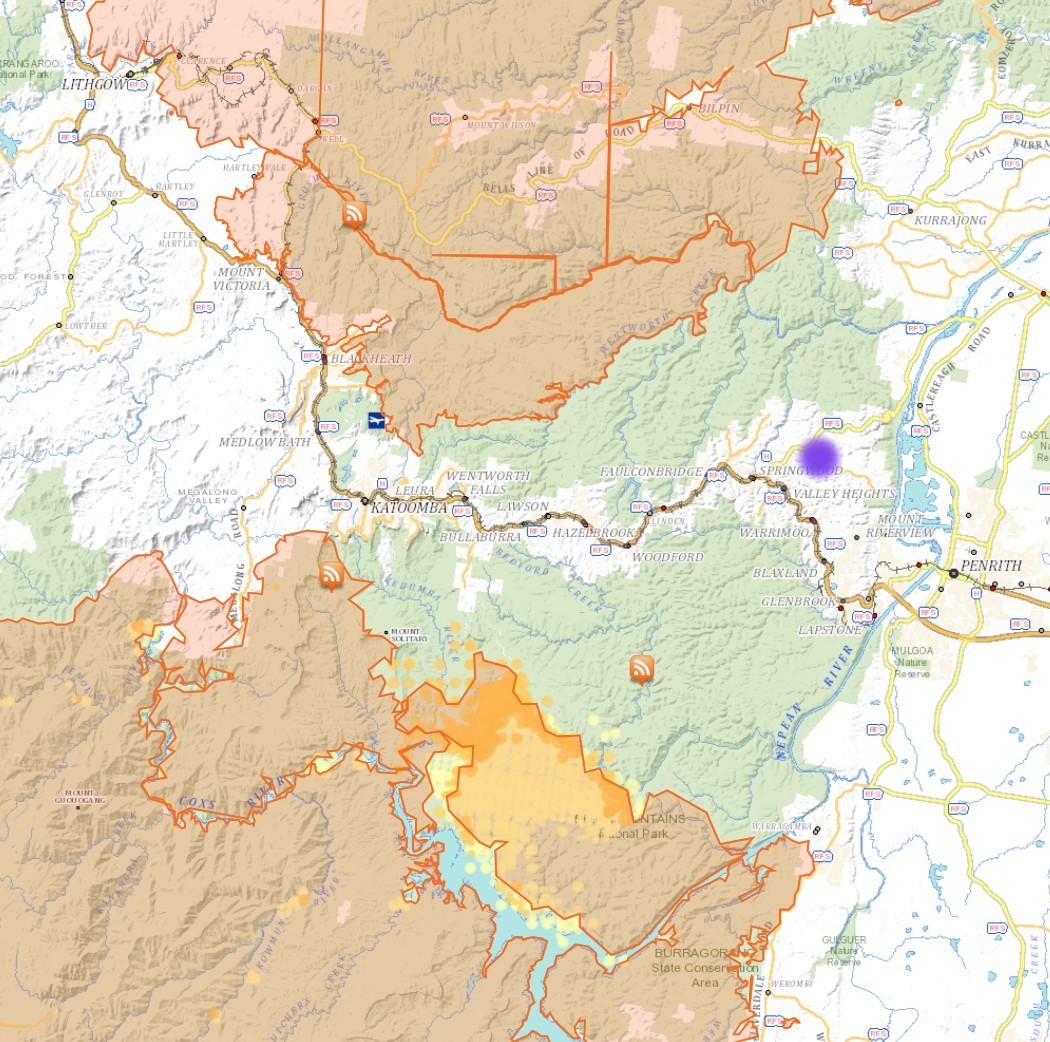
Then we see that these big forests are all burning at the same time. Here is the extent for southern NSW on the 7 January 2020, green areas are the larger patches of native vegetation and most of them are shaded as a fire scar.

.

The forest patches left unburnt are mostly small or isolated or intermingled with human habitation. The large, wild areas needed by many sensitive species burned, often intensively.

This is an ecological step change.

The pattern of disturbance (fire) is now more widespread, intense and all at the same time.

This will have any number of effects on the ecology of Australia’s southeastern forests. The regeneration will happen as it always does. But the plants were stressed by extended drought before the fires, the burns were mostly intense and so we cannot expect the vegetation to recover to its former state even though many of the trees and shrubs will miraculously resprout with epicormic growth and the seed bank will flourish in the ash beds, if and when it rains.

If the recovery effort for the ecology that will be tasked once the people are back on their feet must accept that what was before is no more. The future forests will be different. For a start, they will need to be resilient to this kind of disturbance on a much more regular basis.

Of course, this sort of fire season will have happened before. Not in the memory of the western settlers perhaps but no doubt the ancestors of the first peoples witnessed something like it. But only rarely. The climate record suggests this type of event is possible. What will be interesting is if it happens again and again. That the ecology has not seen before.

So not so much of a Happy New Year here.

We have experienced a step-change though. One that does not happen very often when the scale of a disturbance to the natural world is so wide and so deep that it changes the ecology.

There is an opportunity in such a change.

We can get rid of old and unhelpful conservation paradigms like our desperate focus on the rare things and look to resilience for the goods and service we need from nature whilst helping it protect itself from its own powers of destruction.

That’s it for now but we’ll come back to our need for dominion again soon.

Hope you have a Happy New Year and all your resolutions hold.

It is not everyday that you can point your phone directly at the sun and get away with it — smoke haze in the Blue Mountains, NSW
December 2019

Please share if you like these posts from Alloporus

Obsessions with endangered species?

Obsessions with endangered species?

Regular readers will know that a long time ago now I wrote a book with Ashley Bland entitled Awkward News for Greenies. It sold a handful of copies but failed to go viral. This could be because we had zero marketing budget or it was a poor book or luck would have it thus. Either way, few read it in 2009 and fewer in the decade since.

Recall this was the time that Al Gore produced ‘An Inconvenient Truth’ and we played on that sentiment in our title. Perhaps it was a poor choice.

Not one of us is fond of being told truths that we don’t want to hear, especially things that we will feel bad about. Indeed humans are expert in avoiding the awkward. This sentiment has taken hold now to the extent that we even elect presidents and prime ministers who are olympian in the skills needed to avoid and deflect awkward truths.

The main argument in Awkward News was that this avoidance behaviour stems from a lack of awareness. We no longer feel or understand the very basis of our existence, now or into the future. Humans in modern societies do not realise that we are here because of nature and the resources it shares with us and we will only stay here in one piece if the natural forces that create clean air, filter water, generate food and moderate climate run at rates to support our burgeoning numbers.

Implicit in this explanation was that environmentalists focus on the wrong things. This is best summarised by what Ursula Heise in her book ‘Imagining extinction’ calls ‘elegies and tragedies for loss of species’. Worry for the fate of cute, furry or feathery species is what we obsess over when we should be most concerned about the ability of nature to keep supplying all those goods and services that keep us alive and well.

When in 2012 I followed up Awkward News with Missing Something, a book that was read by even fewer people, the message was similar.

Humanity has an awareness deficit that science has confirmed and our guts are agonising over. Again the distraction of elegy and tragedy can be overlooked for a pragmatic approach. If we think about our environment and the well-being it delivers, then the evidence we need to convince ourselves of the importance of nature is everywhere we care to look. The truth about nature will speak to us and all will be well.

Well, this nirvana of enlightenment with nature seems less likely by the day.

As we near the end of another decade it feels as though the drift is away from awareness rather than towards it, especially in the formal worlds of bureaucracy and academia. Indeed, drift is a generous adjective.

In the land of policymakers, huge blunders continue along with ostrich behaviours of the sand type. In the ivory towers, a stream of evidence flows on how troubling it all is. Unfortunately, it is easier to generate evidence of loss and degradation than it is to use that evidence to find ways to slow, stop or reverse any undesirable trends. Even a casual glance at the climate change literature confirms this conundrum.

Anyway, here I am, a few years on from my last non-fiction least seller, wondering about the merits of another book on this theme of scaring the horses.

On the downside, should I be spending time on more of the same?

Surely the first two epistles did the job. Anything more is just repetition. And if nobody read the first two, why would a third suddenly shatter the ebook sales records? I am not selling the sure-fire best way to become an overnight squillionaire online.

On the upside, nobody read the first two meaning that very few were scared.

Any messages would be fresh, at least from my peculiar voice, and maybe the passage of time has warmed a few to the general topic of impending doom and how to avoid it. There is also the personal benefit of writing that is cathartic enough for me to feel purged of my personal environmental guilt. That is worth it on its own.

On balance, I have to think that yes I should write it out all over again.

At some point, ideally quite soon, humans will need a realignment with nature that is less about obsessions with the koala and polar bears taking a rest on a tiny iceberg and more about what nature does. If everyone understands that it is the services that nature provides for human well-being that we need to obsess about because the processes matter more than the products.

This message of concern for process over products, especially the rare ones, still needs to be said and heard.

If humanity is to get through its demographic transition without obliterating nature, without creating a future world where even the air is manufactured, then nature and its services must be in our everyday thoughts. We will need to get over our obsession with endangered species with all its misplaced effort into just a handful of nature’s charismatic actors because all that really does is salve a collective conscience.

The neat irony being that the best chance for the koalas, elephants and macaws is if the processes that support them are retained and enhanced. Meaning that a focus on the processes will not always be about exploitation.

It will be a tough gig.

These critters — the endangered species that we truly care about are almost always animals with backbones — are held tight and deep. They represent our guilt even as we continue with wine, dine, waste and flights to Bali.

If you find that waiting for this new work that will only make you feel more guilty and helpless in the face of doom is too much, that you have to know now, then there is always Missing Something to tie you over.

Australia is a tough place to grow food

Australia is a tough place to grow food

Australia really is a tough place to grow food.

It is invariably hot and dry and the soils lack nutrients. Then the next day there is a storm that flattens the spindly crop and floods the roots.

This has always been the case.

Australian soils are old and the continent big enough to make for a truly continental climate. The dry times are long and deep and the storms bring golf ball hail. The soils are low in carbon and many are friable with a tendency to want to fly across the Tasman sea to New Zealand on the strong westerlies.

And then, the climate is changing. There will be less water, more extreme storms, and even hotter temperatures.

It makes sense that the agricultural sector would be concerned. They should be. Many farm businesses will struggle to cope.

One concerned group of producers, Farmers for Climate Action, launched a report Change in the Air that claims ‘Australia’s agricultural production will fall and food insecurity will rise without a climate strategy’. They managed to persuade the federal environment minister, Sussan Ley, to launch the report.

The local media made a big deal that National Party MPs — the minority party in the coalition government — refused to attend on the notion that some still doubt the science of climate change and are not sure if human activity was contributing.

Remember that the right-wingers in the Australian government are making the country the global climate laggard and, yes, it’s now beyond laughable and irreprehensible. We are in the realms of criminal negligence.

Now before you read on, regular readers will know that Alloporus strongly agrees with the premise of a coordinated response to climate across all sectors, especially agriculture, and that part of this response needs policy support.

In other words, Alloporus believes that both the state and federal governments have a key role in both climate mitigation and sustainable food production.

The government part of the coordinated response will begin with an acknowledgement of the problem — the climate is changing — and then some policy options that support climate adaptation, not just emission reduction for that alone is nowhere near enough.

Laughing is not ok. It is time to take serious action.

This makes the next comment unfortunate.

The Change in the Air report is dreadful.

I meant it, it is terrible.

What claims to be a ‘research report’ is, at best, a weak catalogue of already published evidence without meaningful review or summary.

The highlight recommendations are for ‘more research’ and ‘a national strategy on climate change”.

Oh my lordy.

There is no time to stuff around with more research and even if there was we already know more than enough about what to do.

Again, why wait for a national strategy when the government has been bumbling around without one for more than a decade.

Here are the key dot points in the report:

  • Risk minimisation
  • Focus on potential opportunities
  • Strong RD&E
  • Transition to clean energy generation in agriculture
  • Capture and storage of carbon
  • Address climate policy gaps

Only one of these is a tangible solution. The rest are aspirations at best. Indeed this was the real problem with the report, it whinged.

Basically, there were no solutions offered just a plea for the government to fix the problem.

This is not ok.

Right now, at the pointy end of the problem, it is time for solutions.

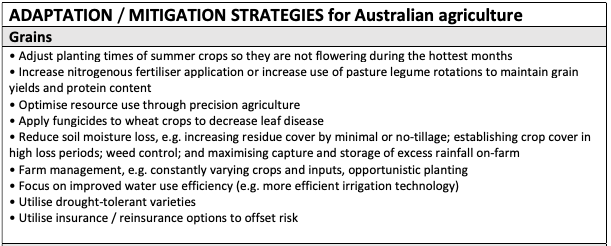
The weird thing is that if you scroll down the report to Appendix 2 on page 64 you will find a lengthy and reasonable list of adaptation and mitigation strategies sourced from the research literature.

Here is the section for grains…

Shame they didn’t lead with this.

Alright, enough moaning.

Most likely the people behind Farmers for Climate Action are well-meaning and believe what they are doing is important. However, we have to consider the possibility that the minister was happy to promote the report because it does what the government wants, namely to kick the issue further down the road by asking for more evidence.

Better would be some simple tractable solutions.

How about an across the board 2% gain in soil carbon in all production soils through production practices that retain vegetation cover, promote deep-rooted perennials and support the addition of organic or inorganic carbon in cropping systems.

This is just one of the many options available.

No more messing about. It is time to get on with it.