Dams

Dams

A decision is made to dam a modest sized river In the foothills near a big coastal city. The city is growing and water security is regularly a hot political topic as the area is prone to drought.

Construction on the dam wall begins in 1948 and on its completion the wall creates a lake with the capacity to hold a little over 2,000 Gigalitres of accessible water.

When the dam was completed the city was home to 1.8 million people. Today there are over 5 million inhabitants and the lake remains the primary source of freshwater for these people and their economic activities.

Downstream of the dam the floodplain has become an important area of agricultural and peri-urban development. The dam protects against flooding and the planners have allowed people to live in previously inundated areas. The dam not only holds a large proportion of the water supply to the city it also protects built and commercial assets from flooding.

When the engineers say that the dam wall could be raised by 14m, what do you think the planners will do?

Naturally, they will allow greater access to land on the floodplain, most likely by releasing some areas for residential development. It is a growing city after all.

In the planning meeting some wag says that it will all be alright because the climate is changing “It will be drier anyway, so no worries”.

This comment goes unchallenged despite the evidence for increased storm frequency and intensity in the region, and the obvious connection between this and major flood events.

Here is a hint with a biblical origin.

Don’t buy a house on a floodplain…. especially downstream of a dam.

Post revisited – Lest we forget

Post revisited – Lest we forget

It is said that old elephants can remember when they were young and the places their parents led them to find water. This memory is triggered in dry times and they lead a new generation to the permanent springs and pools. Makes sense for a long-lived, mobile animal and, indeed, could be a primary benefit of longevity. Evolutionary biologists would add that this also explains why elephant females are the only other mammal we know of where, like humans, older females go through menopause. It helps them live longer.

There are things that humans remember and there are many more that we do not. Our minds are not wired to have all things recorded and catalogued for instant retrieval. They are selective in both what is archived and especially what is remembered and when.

This is true even when the memory is mission critical. How many blokes can instantly recall the birthday of their better halves? It is not how humans do things.

We remember all kinds of things seemingly at random.

No doubt there are triggers for what is recalled so the process has some determinism but there are very few common things that we are all routinely reminded of beyond what it takes to get through life without being arrested.

Then there are the fearsome, nasty and scary things that we block. These rarely make it back into our conscious thoughts unless we are at the therapist.

If we didn’t quite understand something, any memory of it is often vague. Our maths teacher, Mr Dickinson, is remembered for his unfortunate surname and not his explanation of differential calculus.

So even if you read this post from May 2011, you are unlikely to remember it…

Lest we forget

April 25 each year is a public holiday down under and every Australian knows why. It is ANZAC day, a time to remember the brave and courageous soldiers who lost their lives in war. Many thousands attend dawn services across the country come rain or shine.

Australians also know about the Easter and Christmas holidays when many a shrimp finds its way onto a barbie. A fair number also know the religious significance that prompts these days of leisure.

Earth Hour is not a holiday but it is a similar sort of homage, this time to the environment. It began in Australia and is now a global gesture toward restraint in our appetite for energy. There is not a holiday for the environment though. So World Environment Day (5th June) passes without notice; as do the minor events such as World Tree Day (18th September) or World Soils Day (5th December).

There is strong public opinion that the environment is important. Not long after the 2006 release of the documentary movie, The Inconvenient Truth, that went on to make over US$50 million worldwide, action on climate change was palpable. People in Australia took to the streets, “take action,” they said.

Since that time there has been policy paralysis.

Unable to handle lobby group pressure, fearful of what might happen to a carbon intense economy fueled by minerals revenue and coal-fired energy, and an unwillingness to take the real issues to the public, the politicians have achieved nothing.

Initially there was goodwill. Australia signed up to the Kyoto protocol in Bali and there was bi-partisan talk of a market mechanism to price carbon. But the greens said it was not enough and the Carbon Pollution Reduction Scheme was voted down. An odd call that.

The topic was rested.

Then there was failure in Copenhagen, little more in Cancun and deathly quiet over the prospects for Johannesburg. Leverage for the true believers has faded. The vacuum has been filled in part by skeptics, not about the science per se, but about the need to do anything about emissions. And the public seem to have forgotten what all the calls for policy initiatives were about.

We don’t remember that the idea was to become less emission intensive through energy conservation and shifts to alternative energy sources; perhaps even sequester some carbon into the landscape. It has also been convenient to forget that, given the way our economy works, a trading scheme was a handy mechanism to achieve these goals.

We also see to have forgotten that signing up to Kyoto means setting an emission reduction target. As at 2007 emissions were 597 million tCO2e or 77 million tCO2e more than the 5% reduction on 1990 levels. And emissions will, notwithstanding economic slowdowns, rise and grow the actual tonnage of reductions required in the absence of a policy to reverse the trend. Or, of course, Australia could renege on even a modest target.

The noise over a carbon tax is just a smokescreen, a handy way to keep the real policy issues hidden. Perhaps this is because a focused debate, something that talks about what was asked for, would remind us of what we may have forgotten. That a few short years ago most people wanted something done about the challenge of climate change.

Perhaps we should have a climate day, make it a holiday and then we will not forget.

Lest we forget climate day. Well it doesn’t really ring true does it? We can remember and celebrate heroism and sacrifice but not risks to the fabric of our existence.

Alloporus has even slowed on climate related posts and rants. It is not remembered often enough, despite times of deep reflection. Goodness, this year we even forgot to turn the lights out for Earth Hour.

Unfortunately, the earth, its climate and the resources it allows us to consume, is not often in our thoughts. It is slipping away from our culture and we remember less and less of the experiences that it gives us.

In time we will forget about it altogether.

A post revisited — Investment in energy research

A post revisited — Investment in energy research

This post on the remarkable level of investment in energy R&D in the US was written in September 2011. It is not my intent in these retrospectives to play the ‘I told you so’ card but given the egg on the faces of the current and recent Australian governments over energy security, it is pretty hard not to.

Did politicians really think that we have coal, oil and gas and so the job was done?

Emission notwithstanding, did they just sit back and let the end of life for major coal-fired power stations be someone else’ problem?

Well in Australia they did. In America too I suspect. Trump is not pulling the Paris pin because he is a climate sceptic, he’s keeping coal going so that, at least on his watch, the lights stay on across America. Nothing will kill your voter base faster than blackouts attributed to poor planning.

So here is what Alloporus thought in 2011 about energy R&D…


Investment in energy research

In the US Federal research funding into energy is $3 billion. This figure includes investment into oil, coal and gas as well as solar and other alternative energies.

Then there is a further $5 billion invested by the private sector for a total of $8 billion in an industry worth $1 trillion a year; making investment in R&D only 0.8% of revenues.

Apparently $8 billion pays for about 9 days of military involvement in Iraq – pretty scary and perhaps something they might look at when considering reducing budget deficit, but I digress.

The point here is that 0.8% is woeful. Any company that spent less than 1% of revenue on R&D would not last long. Given that energy is so critical to economic performance and given that we have reached peak oil and will eventually run out of coal and gas too, 0.8% seems irresponsible.

And then there is a huge global movement that believes we must tackle climate change by reducing emissions from greenhouse gases.

What should the investment be? In successful economies upwards of 3% of GDP is allocated to R&D, which is roughly $430 billion. This amount must cover many sectors but energy security should be worth at least 5% of the available budget or an order of magnitude more than the current allocation.

We are kidding ourselves if we think that energy security can be achieved when we invest peanuts.


There is money to be made from energy. There always has been. I bet that the first hunter-gatherers who figured out through trial and error how to transport fire with them as they wandered were revered and feared. The thinking and testing that went into creating and catching a spark to start fires was, well, gold to the people who mastered it.

The smart individuals who put a wheel into running water or threw a lump of coal onto the campfire might also have made a relative bob or two.

So it’s not about the returns. It is that it is future money. The power stations cornered the market for a period long enough to scorch the space for new investment. If end of life is 30 or 50 years away there is no market for anything else until then. There is no need to look forward as energy is secure.

This lack of foresight might just be our undoing.

Time for scepticism

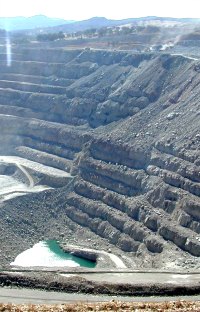
coal mineAt what point did scepticism become a dirty word?

Perhaps it was when political correctness overtook us and we were forced to accept convention or risk ridicule from everyone, including the kids. Maybe it was when we disappeared into the virtual world where the only thing reminding us of reality was stiffness from ‘smartphone neck’. Or maybe it was when the media purposely made sceptic and denial mean the same thing.

Here is quick reminder of the real definition of sceptical… not easily convinced; having doubts or reservations.

What this means is that a sceptic is not convinced by the first thing she hears. She thinks about new information, turning it around to see it from all sides. She seeks other opinion, even counsel. She thinks some more and then makes a decision to believe or not.

The sceptic is not a denier even though she may choose to reject what she is told. She is much smarter than that — she starts with the idea that whatever new information is heard may not be all that it seems.

Recall any scene from your favourite reality TV show. The editors pull together snippets of action to present the most drama and then milk it with liberal use of mood music enhancement. This can make the little craziness in the scene much wilder and entertaining; but if we believed all these capers as the truth we would be foolish indeed.

Now let’s consider how the sceptic would deal with a more difficult example.

Should we believe the Australian government when it says that giving mining companies taxpayer funded offset credits to capture methane at new coal mines is a good tactic to achieve policy targets for emission reduction?

Under any carbon price mechanism the idea is to reduce the carbon intensity of human activities. This means that energy generation, manufacturing, transport and agriculture [the sectors that make up almost all the greenhouse gas emissions] should release less carbon to the atmosphere than in the past. Where the activity can’t be made less intensive, such as a coal-fired power station, emitters can buy credits [or are given allowances] that, in time, make them commercially inefficient and so they are replaced by cleaner technologies.

Methane gas is often associated with coal seams. The whole coal seam gas debate is about extracting this methane as a fuel source. But when the resource in demand is the coal, the methane is either incidental or too expensive to capture. Usually it is released to the atmosphere where it contributes to climate change effects because methane has 23 times the global warming potential of carbon dioxide. Capturing and burning the methane from coal mines would reduce this emission source because methane converts to carbon dioxide when burnt. And carbon dioxide has a net global warming potential of 1.

Burning methane would reduce net emissions from the activity of mining coal.

Except how does this contribute to emission reduction when new coal mines will extract millions of tons of the very stuff that generates greenhouse gases in the first place. No matter that most of the coal is exported and ends on the emissions accounts of another country.

Whatever the rhetoric the taxpayer is actually paying for more emissions not less. In effect it subsidises the development of new coal extraction capacity. This cannot be “a good tactic to achieve policy targets”.

So what should the sceptic do with all this? Be themselves and be sceptical, very sceptical.

This is a ruse by the mining sector to get paid for emitting, the exact opposite of the original policy objectives.

Sounds Crazy #12 | Fossil fuel subsidies

Here’s a thing. Why would you have any international agreement to reduce carbon emissions when governments across the globe are spending 8.5% of tax revenue on fossil fuel subsidies?

Allow yourself to imagine that you come from a nation where the per capita emissions was less than the global average of around 4.5 tCO2e — you could choose any from around 120 different ones.

You would not be too chuffed at any international agreement on emission reduction when you find out that a big chunk of taxpayers money goes to propping up the problem. You could ask this perfectly sensible question: Why not reduce the subsidies? Wouldn’t that make emitting more expensive and be the very market force that complex trading schemes were designed to achieve?

Now you would be told, well yes, but it’s not as simple as that.

Except that it is.

Lost post | big challenges for carbon offsets

This is a lost post that languished as an unpublished draft for over a year. As with most things with any resemblance to climate change policy the comment remains relevant a year later…


The ‘elephant in the bathroom may have farted’ post tells us that the possibility we all knew was there — that market forces can go in both directions — now seems likely for the Australian carbon market.

At the end of the fixed price period in 2015, the carbon price in Australia may well be considerably less than $24. The new estimate is $10 per tCO2e, a shortfall that would deliver a $4 billion budget ouch on forward projections for the government.

Late last year the Australian government decided to remove the collar on the carbon price originally proposed for the 2015-18 period, presumably to allow alignment with the EU carbon market. It also allowes Australian companies to buy up to 50% of their permit requirement from international credits. This means that the domestic carbon price is more likely to track international markets, hence the potential permit price of $10 at the end of the fixed price period in 2015.

Not quite what is supposed to happen if the policy is to work, not least for the nascent offset market.

Here are three big consequences of $10 tCO2e for carbon offsets.

Big consequence #1 — few offset activities are viable at $9/tCO2e

When the permit price is low, then carbon credit prices will be lower still, around 10-15% usually. This makes sense because why go to the trouble of buying an offset credit if it is the same price as a permit? The only time you might is when you have some desire to commit a random act of kindness or to get PR advantage from the co-benefits that offset credits can bring. So usually credits are cheaper than permits.

Reminder of what offset credits are all about — short version is that credits can be generated from activities that abate, reduce emissions or sequester carbon into the landscape [e.g. capturing and burning landfill gas, growing trees on degraded land, managing manure from piggeries] so long as the activity complies with a several important carbon accounting rules

A $9 carbon credit will severely limit the number of offset activities that can be financially viable whilst still complying with all the rules.

In energy, infrastructure, waste and land based carbon projects it will be very hard to cover activity, transaction and opportunity costs of project implementation from a $9 tCO2e return.

Big consequence #2 — revenue from offsets do not go to Treasury

When projected revenue is halved the last thing a government would want is for emitters to buy offset credits instead of permits. Large-scale emitters will act rationally and buy offsets if they are cheaper only this money goes to the offset provider and not treasury. This makes the fiscal hole deeper.

There is also the significant risk that too many offsets could further deflate the price by increasing supply. This was probably the main, but rarely stated, reason for why REDD [reduced emissions from degradation and deforestation] mechanisms that generate credits from protection of tropical forests have not been embraced — too much credit volume further depresses the carbon price.

So we can expect government to be much less enthusiastic about offset credits, at least the complaint kind that can be exchanged for permits. They will, of course, continue to promote and talk up voluntary offset credits, the ones you might buy to offset a flight or a company might purchase in order to be carbon neutral.

It should be no surprise that, despite the fanfare, Australia’s domestic offset scheme called the CFI is taking a very long time to get going.

Big consequence #3 — not enough pain to change behaviour

Remember that the climate change policy that puts a price on carbon was all about reducing greenhouse gas emissions from human activities by making it increasingly more expensive for emitters to carry on emitting under business as usual. Create sufficient pain in the hip pocket and there will be a change in behavior.

Emitters will become more efficient, saving energy themselves, or pass the price on to consumers who will become more frugal. If it the price continues to rise and efficiency gains are exhausted then it pays to make more substantial shifts in behavior, mostly toward alternative energy sources.

At $9 tCO2e for an offset there is not enough pain to make the change.


May 2014 Postscript

See what I mean?  A year on and offsets are still a pipe dream for all but a very few activities such as landfill gas capture that was already there anyway [so much for additionality].

And sometimes glacial pace of progress helps people forget the problem the policy was supposed to address.

Not good enough I say.


Slow, slow, quick, quick | Postscript for the contentious mind

CO2 enrichment Cumberland Plain WoodlandA recent upbeat post on the importance of soil biology ‘slow, slow, quick, quick’ went by without comment.

Except that loyal readers wouldn’t imagine that Alloporus could really let a taxpayer spend of $40 million on infrastructure and operating costs of $1.5 million per year just for the CO2 for one experiment to pass without comment — especially when you look closely at the image to see that the patch of woodland is so small that the enrichment plots and controls will be subject to huge edge effects.

If significant funds are to be spent on a given research topic then there will always be those for and those against its import. On balance we could concede that understanding the effects of climate change on plant growth and ecosystem dynamics will be important. Findings will help lay the foundations for selecting the most effective responses to climate across ecosystems we rely on. We might say research on some of the more acute effects of climate change [temperature, severe weather, seasonal shifts] might yield better bang for buck, as would a focus on adaptation, but for the moment we could concede these points too.

When I visited the CO2 enrichment experiment at the Hawkesbury Institute of the Environment it was a windy day, the air was moving through the ‘cages’ freely and rapidly. We were told that high-tech control systems monitor wind and try to match the delivery of CO2 to maintain consistent enrichment levels. But I could not see it myself.

The experiment is sited in a small, naturally open patch of woodland constrained far more by moisture and temperature extremes than CO2, blitz occasionally by fire and with plant growth potential moderated by old soils. For me it was simply the wrong manipulation, implemented at the wrong scale and at a site too small for what was being tested.

So it’s not actually about the money. What seems unacceptable is the quality of the science.

Sounds crazy #5 | Carbon price forecasts

August 2013 is silly season here in Australia. We have a federal election in just a few weeks time and the inevitable merry-go-round of vacuous media grabs and absence of policy debate is upon us. It is actually rather depressing as the main parties jostle to hog the middle ground to spend money they don’t have whilst no one else can come up with anything better than “vote for me”.

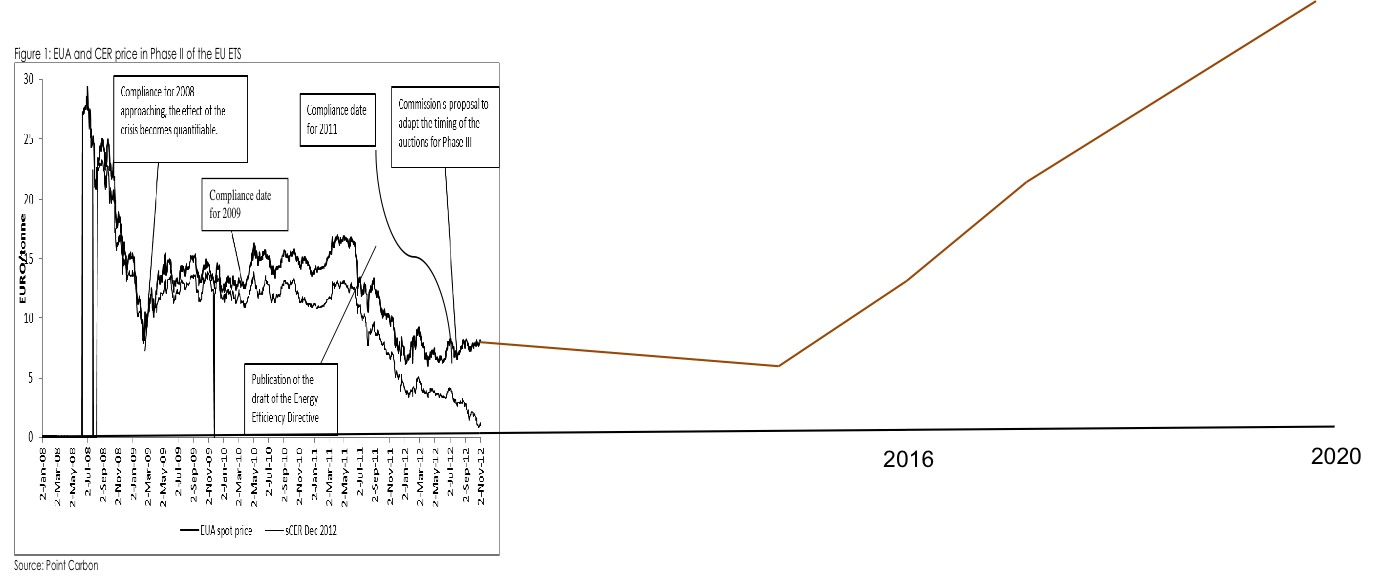
It is also rather absurd. On the rare occasion when media do delve beyond the rhetoric, or for some unknown reason you dig yourself for evidence to help make a voting choice, what emerges are gems like this pre-election outlook from Treasury.  Somehow the economic boffins that work for the ministry have managed to predict that the carbon price that in Australia is currently fixed at $23 will first fall to $6.20 in 2014/15 [fair enough as the start of the flexible price period when the domestic scheme is pegged to the EU market has been brought forward a year] and then rise to $18.90 by 2016/17 reaching $38.0 by 2020.

Now we should remember that this is what is supposed to happen to a carbon price. The whole idea was that to ensure steady emission reduction the carbon market is capped so that supply is squeezed over time causing prices to rise. A rising price on carbon would encourage energy thrift and starts to make clean energy sources economically viable with the net effect of lower emissions. Except that the political will to set, stick to and steadily lower the cap has been conspicuously absent.

Alloporus borrowed a graph of the historical carbon price in the EU published by Point Carbon and appended the Treasury projections.

It looks like this:

CarbonPriceProjections

As regular readers will know Alloporus is no economist, but whilst $20 seems possible, $40 by 2020 is hugely over-optimistic. It would require a significant step change around 2015 to reverse a market that has a t best been steady but mostly fallen. Such a change would need considerable and coordinated global political will to achieve. No single nation would stick their neck out that far [probably why the Australian government linked the domestic scheme to the international market so as to neatly sidestep the pressure to go it alone].

Then consider that by 2020 we will have seen price shocks in oil [and possibly coal too] that, even if temporary, will have the required effect on emission reduction without the need for a separate policy. In other words fluctuations in energy needs in response to inevitable pulses in the global economy will allow the modest emission reduction targets to be met most of the time.

Of course politically it is best if the carbon price is low, but for any cap-and-trade policy to be effective the price needs to rise steadily. Alloporus suspects that the carbon price forecast from Treasury sound like some middle ground plucked from the ether for political expedience.

The craziness here is that a lot of money has been spent and committed to deliver emission reductions — a ‘clean energy future’ as the policy was tagged. Except that the cap-and-trade approach chosen only works if the price of permits [the carbon price] rose steadily over time. And this required that the market was manipulated buy controlling permit and offset credit supply. Now that governments have shied away from that part of the plan, the whole policy falls over and monies spent on free permits for exposed sectors and, in the case of Australia tax threshold adjustments and cash payments to households, turn into welcome handouts that have no impact on emissions at all.

$38.0 by 2020 is what they would like it to be, except wishful thinking cannot make it so. You actually have to implement the policy.

Soil carbon | What we think

I wonder what went through Steve Jobs mind just after the image of the iPad came into it?

Perhaps it was an original idea that formed in a flash of inspiration from the ether — the sort of thing that happens to imaginative types.

Or it could have been a steady accumulation of images, ideas and bits of less elegant technology that came at him from all and sundry that suddenly coalesced into something elegant.

Maybe it arrived as he peered over the shoulder of an Apple designer.

No doubt Wikipedia or the upcoming biopic knows the answer to what the origins were, but we can only speculate as to what he was actually thinking.

It was probably something like…

Hey, I’m really onto something here. Finally a device that everyone will want to have and fits our brand so well our competitors will just have to make copies. And hey, there’s big bucks in it.

You can bet he wasn’t thinking…

Oh boy, I have seen this all before. Crazy how it takes so long to get good ideas to stick, I mean I dreamt this little design up years ago. It will cost so much to develop that I can’t see anyone wanting to buy one from a store or even eBay — that is if the hardware people can even make the thing.

I reckon a big part of the reason Mr Jobs enjoyed so much success is that he didn’t ever think the glass was half empty.

And I don’t mean this in the ‘ra, ra, ra’ kind of can do attitude that Americans are so prone. I get the feeling that his was more a sense of knowing when the idea is right and that it would work.

Recently I attended an ‘Agriculture, Soil Health and Climate Change Forum’

organized jointly by the United States Study Centre, University of Sydney and the DIICCSRT [the Australian federal government department of many acronyms that includes the bureaucrats responsible for implementing climate change policy]. There were 80+ people present who all had more than a passing interest in promoting soil health. Some were just crazy passionate about it… and good on them.

Soil heath is a timely and critical topic. In many ways it is a ‘Jobsesque’ idea being simple, elegant, functional and ultimately something that we cannot live without. A global population that will rattle around 10 billion for at least half a century will go hungry if we stick with the current paradigm of soil as a place to put plant roots and inorganic fertilizer. The biology of soil is what gives its potential to sustain and provide, and whilst we do not fully understand why, managing for soil biology is the agricultural equivalent of an iPad.

So it was depressing [a carefully chosen word] to listen to an apologetic speech outlining how DIICCSRT, who as part of their atmospheric responsibilities also deliver the Carbon Farming Initiative, have failed to get soil carbon management onto its list of CFI offsets.

It wasn’t that there are technical challenges to soil carbon accounting for everyone knows there are. They are as fundamental as decisions to measure or model or even to go with simple activity reporting. They also involve gathering in uncertainty about what agricultural management does to soil carbon stocks [although here I believe we know more than we realize].

It wasn’t even that it has taken so long. We all knew it would.

What was so depressing was that the glass was half empty… and oh so hard to fill

Whatever Steve Jobs thought when the iPad first registered in his mind, you can be sure it was hugely positive.

Luckily the tone of the soils workshop was rescued thanks to a presentation from an overseas guest from the research arm of the US Department of Agriculture. His was a glass ready to be filled. He knew we had a problem with soil and that it was a big one. He knew that it was going to be hard to convince his research staff that they didn’t yet have all the answers and that the solutions would probably come from left field, possibly even from the ‘snake oil’ salesmen. It was going to be about going where we might not be wholly sure of ourselves because that was where the answers would be found.

He didn’t quite say, “boldly go”, but that was what he meant. I was hugely enthused.

It could be argued that we need both of these opposing attitudes to challenges. We need the naysayers to keep out feet on the ground and we need the ‘gung ho’ types so we can keep putting one foot in front of the other.

I think that we don’t yet know how to get the balance right and, in Australia at least, we are stuck. When it comes to environmental policy we have become paralyzed, exquisitely versed in stalling tactics and so fearful of innovation that we fear it like the devil. This is not good and may well be our undoing.

Mr Jobs would have shaken his head.

Farming not fracking

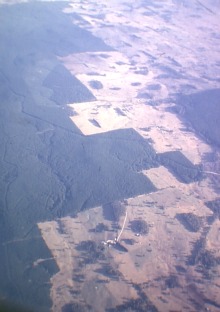
land-clearing-farmingStrolling through the village, as you do on a sunny winter’s Saturday morning, is a real treat.  It is a privilege just to take in the bustle of folk going about their weekend business — buying the paper, greeting a neighbor or settling down for coffee with friends serenaded by a teenager with a guitar and dreams of fame and fortune from his songs. This is why we are so fond of community.

Abruptly my reverie was rudely broken.

“No thank you,” I said to a brusque individual who ambushed me from behind the ‘vote green’ placards that were cluttering the pavement. The pamphlet purveyor was most indignant at my refusal and gave me the death stare. If that had happened in the playground it would have been called bullying.

I strolled on by and observed both the wave of annoyance that passed over me, and the slogan on one of the placards that read ‘ farming not fracking’.

For the uninitiated fracking is the controversial process of getting gas from coal seams by injecting fluid into deep rock layers to fracture them. This releases the pressure that holds onto the gas. Once free the gas can be piped to the surface. It is similar physics that happens when the seal is broken on a soda bottle and bubbles start to rise.

The Greens are on to fracking because it is another nasty resource exploitation process that results in burning of yet more fossil fuels, risks pollution of groundwater or local subsidence, and worst of all, will displace farmers from the land. Not all land, but the land gas companies might buy to exploit the gas reserves beneath the paddocks.

No matter that in greenhouse gas terms natural gas is cleaner than the coal that will be burnt instead to meet growing energy demand, that boreholes have always coexist with farming, and that legislation already prevents anything nasty being used as the lubricant.

As a slogan ‘farming not fracking’ is just silly. It is not even the issue.

Deliver it with a ‘holier than thou’ look on your face and even your supporters will cringe. Everyone else will tell you to take a hike, probably far less politely.

How about this instead?

We don’t like fracking or exploitation of coal seam gas so we have come up with this solution.

The energy that would have come from gas can be generated from alternative sources [solar, wind, wave, geothermal] plus some savings from improved energy efficiency. Both initiatives could be resourced from a small but compulsory ‘no fracking’ investment of say $500 from every household in the country — this one-off payment from everyone  would raise roughly $4 billion.

The return on investment is twofold. Cheap energy in the long run as alternative sources would get over the commercial hump and there will be environmental benefits from avoiding pollution risk. Plus, there would be lower greenhouse gas emissions from the soon to be necessary shift to alternative energy sources again saving money on transition costs.

All this for the annual expenditure to households of one weekly coffee and cake in the village.

The pamphleteer would probably look at me aghast and blurt out, “You mean to ask people to give up their Saturday morning coffee and cake, what are you thinking?”

Then he would spontaneously take up the chant “farming not fracking, farming not fracking…”

And no doubt the young songwriter could weave it all into a lyric.