Paradigm shift

grey kangaroo | NSW“You cannot solve a problem from the paradigm that created it” is a famous Albert Einstein quote.  The great man reminding us not only that lateral thinking is powerful, but that it is easy for us to stay with what we know at the expense of the things that we do not.

At times we appear so stuck in our ways that innovation seems all but impossible. We think in the current paradigm, work in it, live in it, trust it and are horribly uncomfortable when forced to go anywhere else.

Take sheep for example. A godsend if ever there was one — just about perfect wool and lamb cutlet factories. Nations were built on their backs.

In the late 1800’s there were more than 15 million of them in the parched lands of western NSW, outnumbering people by thousands to one.

Now we have talked about sheep before on Alloporus [Last chance to see | Buying up the land] and risk New Zealander and gum boot jokes if we go there again, only it is too good an illustration of what Einstein was on about.

Sheep production has been successful in Australia even when the conditions didn’t really suit them. Herding large numbers of the docile creatures on paddocks was the approach imported from overseas where the same thing had worked for generations.

It was difficult in dry country so, by necessity, the paddocks became quite large and the sheep stations huge. Graziers sweated hard and found a way. Countless sheep were reared, sheared and sold.

So many sheep left the stations over the years that it became apparent that these dry and dusty paddocks were becoming drier, dustier and less able to recover when the rains came. Growing numbers of feral animals, especially rabbits, didn’t help. Over time the rangeland became degraded almost everywhere threatening the viability of farms and bringing any number of unwanted costs from biodiversity loss to muddy waters.

What to do?

Here are some of the ideas that were tried:

  • make the paddocks even bigger
  • make the paddocks smaller
  • try running new sheep varieties
  • spell [rest] the paddocks for a while
  • turn the water points on
  • turn the water points off
  • apply some fertilizer to the paddocks
  • maybe keep the sheep but bring in feed from elsewhere to get them through the droughts

All these ideas and more were tested at some point. What you will notice is that they are all within the sheep-growing paradigm

A few innovators tried rearing goats or harvesting kangaroos. This is better perhaps but is still within the grazing paradigm.

A few very brave souls have suggested there are alternatives to meat and wool production and be paid for the carbon sequestration and/or ecosystem services provided by the land. And there is always ecotourism.

Again this may be better in some circumstances [although ecotourism is rarely the panacea proponents might like it to be] but it is still the economic paradigm.

So is it actually possible to solve the problem if it is so hard to think outside the core paradigm?

Fortunately there are enough ‘out there’ folk to become the early adopters of even quite wacky. The first business suit wearing users of the early mobile phones that were the size of a small suitcase looked most odd until they started doing deals from coffee shops — then everyone wanted one.

So paradigms do change and the grazing one might just be about to.
Sounds crazy #2 | Waiting for the road to dry out

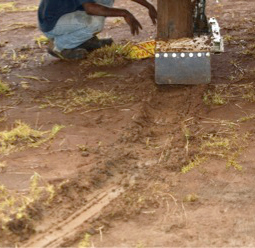
wheel-stuck-in-mudIn the game parks of Africa the roads are often impassable after rain thanks to mud that appears in an instant when water is added to the deep vertisols. Not even a land cruiser can move through the thick, clingy goo. Game drives are suspended until the road dries out.

If vehicles do drive on the wet road before the soil is hard enough, deep ruts form that destroy the road for future use.

After a major flood a similar problem applies to paved roads. Water ponds, seep beneath the tarmac and in places the firm part now sits on a mushy underbelly.

It makes sense to let roads dry out and for potholes and cracks to be repaired before traffic tries again to pass along them.

Only what if transport is the key to a rural economy? The trucks must get moving again and quickly, or else the economy will suffer.

Woe betides a local politician who suggests that the trucks wait a day or two. Political expediency has the trucks moving as soon as the drivers can each the cab to turn on the ignition. They then crunch up and down the roads hugely multiplying the flood damage.

It would be far cheaper to compensate local businesses for a few days lost custom than it will be to repair the roads that have just been given extra damage. Instead we get those trucks moving right away.

Sounds crazy — but it is true.

Sounds crazy #1 | Where to build a house

Paramatta River floodSuppose I build a house on a floodplain.

What can I be sure will happen sooner or later? Yep, there will be a flood.

I could anticipate this inevitability, keep a supply of sandbags handy and build my house on stilts — an ungainly, limiting and potentially expensive option

Or I could insure against the consequences of flooding, cop the damage when the river overflows its banks, but return everything back to normal at home with the help of a payout. All well and good if I can obtain commercial insurance for this particular plot of land that the actuaries know only too well is prone to getting wet.

Or I could build a house on higher ground above the level of the biggest floods. This is obviously the most sensible option

Now suppose that the government gets involved. It decides that it is cheaper to allow people to build in flood prone areas than to move them elsewhere, further away from existing transport and utility infrastructure and from where they are needed for the economy. The jobs happen to be at businesses that also happen to have located themselves on the floodplain.

And then there is the stimulus of spending. The insurance payouts go towards rebuilding and all the new carpets that must be bought and fitted after each flood — all very good for the local economy.

All politicians know how important it is to keep money moving through the system. So government provides a subsidy to the insurance industry so that households can stay on the floodplain.

The result is people do get insurance and, mostly they stay put. It will be painfull when the next flood ravages their Ikea lounge furniture and through the process of claiming the payout but happy enough wielding the Allen key to construct the new lounge suite.

Meantime we have damaged and thrown away perfectly usable materials that we have replaced from never ending environmental resource supplies.

Sounds crazy — but it is true.


TED | Alan Savory

CattleTED lectures are a neat idea. Somehow they have managed to legitimise thinking outside the box and I suspect we don’t fully appreciate how important this is.

Most ideas that stick come from our current paradigms for anything really new must be pretty special to succeed in a society dominated by commerce and naturally conservative mind-set. So ‘good on ya’  TED.

About a decade ago I met Alan Savory on one of his trips to Australia to promote his ideas on holistic management. It was an interesting encounter [for me at least] that took me back to my time in Zimbabwe in the late 1980’s and then to thoughts of what it must have been like to both wander through the bush and the corridors of parliament in the time leading up to Zimbabwean independence in 1980 as Alan Savory had done.

He claims in his book that it was a combination of his science training, days on end tracking in the bush, and his time in politics that brought him to understand the importance of intensive, timed grazing by larger herds for the health of our grazing lands. Now he has extended his idea as a solution to two huge global issues: desertification and climate change.

Check out his TED lecture, it starts slowly but is worth persisting to the punch line.

http://on.ted.com/Savory

Something unexpected

Teaspoon of soilHere is an interesting situation, almost unimaginable.

You are approaching your 60th birthday and are about to be surprised by an unexpected inheritance from a wealthy relative that you barely remember.

Many years ago your great Aunt, who was always rather odd, left you some money.

She stipulated that you could only access the balance of the funds when you are 60 years old, 40 years on from when the money was deposited.

The good news is that the initial capital she left was $10 million, a huge sum even if nobody quite knew how she came to be so wealthy. The bad news is that the $10 million capital has lost value to the tune of 1.3% a year.

Bummer. Not only did you have to wait to be rich, but also each year there were 1.3% fewer funds. Still, in a few months time when you reach 60 there will be a bank cheque for $6 million in the post, more than enough for a world cruise or two and a luxurious retirement.

Your younger brother was less fortunate. The dowager only bequeathed $1 million to him under the same rules. He has to wait longer for his funds and gets a much smaller cheque of $593,000.

A tidy sum for sure but not quite enough to fund his retirement.

Your three cousins, who soon found out about the unexpected inheritance, were also hoping for something from this distant relative that they only just realized they had. Sure enough, she did not forget them and deposited $100,000 each for when they reach their 60th birthday. They get $59,250 — certainly better than a kick in the teeth but hardly a pension fund.

On the first of your world cruises you mull over the odd situation of financial capital failing to appreciate.

What if your retirement savings, that before your great slice of luck were your only means of support in old age, were being eroded at 1.3% a year?

Each year the amount you had saved up went down a bit, not much admittedly but it went down. Likely you would seek to reinvest your capital quick smart rather than run the risk of not having enough funds for your retirement. Also likely you would fire your investment analyst and rant at everyone you could, looking for a scapegoat for such a fundamental error.

And what bad news it was for your brother. If he had known about that $1 million all those years ago and invested it wisely he would have more money than you right now.

As you sip a G&T on the sundeck you can’t help thinking it funny what we take for granted.


Another unexpected thing

Soil scientists have estimated that the amount of carbon in agricultural soils in Australia has declined by 51% in the last 40 years — that is 1.3% a year.

Soil carbon is a critical environmental asset that drives plant growth because carbon fuels soil biological activity, promotes soil structure, aids infiltration and moisture retention and supports nutrient exchange. Handy material to have and not something to be squandered.

What is worse is that science has little idea about the initial carbon stocks [the capital]. It might have been the equivalent of $10 million in which case we can keep going for a while.

We might even have time to reinvest by adopting smart agricultural practices and get the capital to appreciate again.

The worry is that we may be as uninformed and as poorly off as your cousins.


Here is the original scientific reference for loss of soil carbon [you can find a copy on Google Scholar]:

Zhongkui Luo, Enli Wang, & Osbert Jianxin Sun (2010) Soil carbon change and its responses to agricultural practices in Australian agro-ecosystems: A review and synthesis. Geoderma 155 (2010) 211–223.


And some more articles on soil carbon

Carbon in Soil – Why Organic Carbon is So Important

Soil – the missing carbon sink

Dangerously quiet

King Parrot, NSWIt has been 23 months since the NSW Labour government left office after more than 16 years in power.

Normally when a left leaning administration is replaced by a right leaning one the inevitable shift in attitude to nature and natural resources would galvanize the environmental movement.

When hard won conservation legislation, planning rules and funding for environmental management are chipped away there might be an objection, some resistance, or at least some verbal argument. Only there has been very little noise.

No great shouts against the inching away from protection — not even allowing shooting in national parks seemed to get a reaction.

Only the nationally significant issue of coal seam gas, particularly how it will be extracted and the possible impact on farmers, seems to have stirred the pot.

Regular readers will know that alloporus is not overtly green — a regular guy who owns a car, takes plane rides, watches a plasma TV and wrote a book called “Awkward news for Greenies” has little moral ground to claim great environmental advocacy. Yet this quiet is eerie — makes you wonder.

Is it the calm before the storm, the tirade that must hit when the environment is no longer considered?

Or is it something else? Perhaps there is no energy left. It could be that the era of loud advocacy has passed. Maybe the malaise of personal entitlement has swept across us all, even the card-carrying activists.

If it has then we have a problem. Whilst screaming from greenies is about as welcome as a crying baby in the quiet carriage of the commuter train, it performs a vital function.

It keeps the b—-ds honest

And when all that goes quiet it is dangerous for us all.

€0.40 per tCO2e | the elephant in the bathroom

Elephant-01I wonder what it would be like if there was an elephant in the bathroom given a  mature female African elephant weighs 2,000+ kg, stands over 2m at the shoulder and will drop 100 kg of dung in a day.

She is here folks, right here in the bathroom, the smallest room in the house. And she is so big that she could not hide even in her Majesties powder room.

€0.40 per tCO2e

There she is, wafting her trunk gently from side to side, chewing quietly on some acacia bark.

€0.40 per tCO2e

Can you see her yet? Did you hear her stomach rumble?

€0.40 per tCO2e

Oh yes, there she is. The market mechanism designed to make alternative energy sources more attractive by making greenhouse gas emissions expensive.

Remember, emissions are permitted but only so many of them and you need to buy a permit for some or all of them. These permits cost you money. You can buy offsets against those permits from energy efficient projects, even from projects that reduce emissions from land management, and these would be cheaper than the permits and so create an opportunity for trade.

Only to achieve the outcome of overall emission reduction the offsets cannot be too cheap, otherwise what is the incentive to change your emission profile? That, after all, is an expensive thing to do.

€0.40 per tCO2e

If you would like to read about how not to see this elephant, for after all an elephant in the bathroom makes taking a shower a challenge, try here

Time to save the global carbon markets

Once in a lifetime

Cyclone_Yasi_QueenslandIf you play sport then one day you will achieve your lifetime personal best.

You will catch a 3 kg bream, swim 400m in 5 minutes, make 122 not out on a green wicket or score 34 goals in the season. Every sporty person has their personal best, the one they talk about modestly to their grandkids and boast about after a few beers with mates.

It is also true that in your lifetime you will witness your hottest, wettest and coldest day, and your biggest storm.

Now that most of us go beyond the three score years and 10, there are upwards of 25,000 days for us to experience extremes.

Hurricane Sandy was devastating, as was Katrina, events that should only occur once in a lifetime and preferably not at all.

Sandy was a confluence of events, each one quite severe but devastating together, yet it happened. And we know that that equally perfect storm has happened before in previous lifetimes and will again in our children’s lifetime.

Even events that skip a generation or two and occur on average every 100 years are possible. The rank amateur can fluke a hole in one and have his day.

Given time Sandy will be followed by Samantha, Sybil and Susan. And she was preceded by literally thousands of equally severe storms in times past witnessed by settlers, indigenous peoples and before them, various species of now extinct megafauna.

The difference was there were no subways to flood, houses on wooden piers to collapse and substations to explode.

If we understood this fully then we would not blame Sandy or her sisters even if climate change means they happen more often that they did before.

We would realize what we have changed. We are present to witness and put flimsy things in the way of the storms.

We happen to be around for that meteorological PB.

After Katrina, and again after Sandy, there was much courageous talk of rebuilding clearing up and starting it over — inspiring stuff from leaders who know how to tap into the spirit humans have that makes them feel good even in hard times.

So the flooding will be drained and cleared up, the millions of dead rats ground up for fertilizer, the house rebuilt in readiness for Samantha and Shona. Although I suspect not built with too much more care than before.

This is what humans do. It is as innate as any cravings for salt and sugar. We will get to work, repeat what we did before and complain that it wasn’t our fault. So be it, it is our endless love affair with risk and opportunity

Some families will witness tragedy and have to mourn the loss of loved ones and of property, but society will shake off Sandy, even use her as a motivator and fiscal stimulus.

And later, remember her as that once in a lifetime storm.

Biodiversity | Google Trends #2

Ever since the heady days of the first Rio Earth Summit in 1992 when we came up with the Convention on Biological Diversity I have had this feeling that we had invented a fad.

For a while though I could push that niggle aside as the new term biodiversity entered our lexicon and the sound bites of politicians.

Books on biodiversity were written for the populace and texts for students. I even got hired to develop an undergraduate course in this new subject. That it was just a logical amalgam of ecology, evolution and conservation biology was no matter — this was a great new hook to catch the awareness and maybe persuade people to do something about what was happening to the natural world under the increasing weight of human numbers.

Not too many politicians talk about it anymore, at least not to the press. There are a few stalwarts, notably in the conservation NGOs, who still hold a candle for it and a residual trickle of public funding goes toward environmental interventions with a biodiversity theme. Mostly though we seem to be back where we started talking about conservation and preservation of endangered species.

So am I correct in this hunch? Have we really forgotten about biodiversity?

Here is what Google Trends has to say about the popularity of the word in searches from 2004 to present relative to the peak search volume that happened in October 2004.

GTBiodiversityJan2013

Well it would appear I was at least partially right.

Peak search volume was at the start of the data run in 2004 to be followed by a steady and consistent decline through the rest of the noughties.

In the current decade we are running at an average of 47% of that 2004 peak.

It is a pity that we don’t know how much search activity the 1992 Rio Earth Summit might have generated [1998 was Google’s first official year]. In fact the steady increase in overall search volume makes that 47% more measly given that todays daily total search volume is more than 7x that of 2004.

Biodiversity may not have disappeared as a search term but it has waned.

As usual Google trends tells us that we can easily put aside any challenging or technical issues in order to enjoy Christmas and New Year celebrations and we are also not too worried about them when school is out for the northern summer.

The Rio+20 Earth Summit came and went without much fanfare last year. It prompted a bit of a spike in searches but not enough to catch up with those 2004 scores. It does not seem that biodiversity got a fillip from Rio+20 as any pickup was short-lived — maybe because they called it the United Nations Conference on Sustainable Development.