
Leadership magic…
Photo by Dan Meyers on Unsplash
I am.
There, like an addict in rehab, I admit that cognitive dissonance has got the better of me and I am looking the other way from a host of societal and environmental ills.
As a career scientist who works with the evidence of climate, food security, and the social reality of nature’s exploitation, I am still in denial. I am no more ready to give up my morning latte or my afternoon stroll across the links than the next over indulged Westerner.
I console myself with this admission.
At least I know that my ecological gumboots are stomping on the world even if there is little that I can do about it. And, of course, there is further balm in knowing that l am not alone but a member of the vast majority.
A pandemic, a climate crisis, the Taliban, and 40 million Americans on foods stamps notwithstanding, here are three randomly selected things from recent news feeds that I let happen…
“Ah,” I hear you say, “but it wasn’t just you. It’s not your fault,” coming to your own as well as my defence.
Well, it was.
I am part of the system that allowed and continues to allow such ineptitude, lies and selfishness to persist.
The only solace is that I can admit it now. The first but the most important step to making things better.
Please share with others who might want to own it.


Photo by Alejandro Cartagena 🇲🇽🏳🌈 on Unsplash
Talking about the ‘man child’.
Sometimes conversations just meander along into some interesting territory. Here is one between myself and my buddy Chris in July 2020 prior to the US election and 6 months into the pandemic.
Good morning, Chris.
How are you doing?
We have to stop meeting like this people begin to talk.
They do already. So until we grow up and become a republic we have to put up with foreigners interfering in our democracy… Seems to be the news this morning.
I get all of this reporting about the Royals and everything, but they are just the law under themselves. Mind you they always have been news, for centuries literally.
They are just celebrities now, aren’t they?
They are now but they never used to be. Not so long ago it was the power struggle, the wrestling around of power. That’s really what gets people off once money is no longer an issue then it’s all about the power.
I mean you can see that with our own Malcolm Turnbull, you know, there was nothing he would gain from being Prime Minister except some feathers in his cap and maybe a place in history. He’s already worth 150 million bucks or something so he doesn’t really need the money. It’s about the glory and the power?
Yeah, and you wonder what people get out of that it obviously drives so many people. I mean, I think power drives people in business more than profit. In my experience, the people in charge of businesses are there more because they like to be in charge than they are to make profit for shareholders.
Hmm… I get the ‘in charge’ thing.
It’s seductive. No question.
I guess power is what’s really there but what’s the power for in your particular case? I can see the difference between, I don’t know, Gandhi and Donald Trump, they both want to influence people. But very different circumstances that got them to be leaders with very different styles. Gandhi was obviously not in it for the glory or maybe was I don’t know. We certainly didn’t gain anything material out of it.
No, but that’s what I think I’m getting at. I think it’s these people like to be respected and you get that in a position of power. Almost by definition you’re respected because empowering at the end of a gun is respect of some sort or another even if I respect you because you could take my life. I don’t respect you for your moral high ground. I respect you because I’m s*** scared of that AK-47 you’re holding.
Yeah.
So power is the thing, isn’t it?
And we talked about that before, the difference between the sort of positional power and personal power and maybe that’s you know, Trump has no personal power but he’s craved it and so he’s got himself positional power.
I think that’s a good summation of him. It’s why the media like calling him a man child because he is.
Hmm.
This is a bit of a diss to children because children can be quite pure and Trump is clearly not pure but he is an emotional child. No question that he hasn’t grown up at all. What he does is all for that sense of power in himself. Not from what the presidency provides. I remember when I stood in front of the White House on a visit to Washington and thinking ‘this is an interesting place, you know, it’s kind of locked away’. You can’t get at it, you know. Inside of that place, it would be easy to maintain a small army of sycophants just you just prop you up. And if you have no sense of what you’re doing for the other 350 million people in the country it doesn’t matter.
Yes and every utterance that army of people coming out to say what he really meant was ‘blah’ to clean up his mess.
Yep. I was thinking about the 20,000 lies. That’s one every 90 minutes of his tenure. It’s kind of phenomenal, isn’t it?
Is it in the Guinness Book of Records?
An untruth every 90 minutes of his tenure ought to be.
But Kaylee will never lie to the press
Except she does it every day.
She mops up his s*** that is just spread everywhere. But yeah, I mean he’s crashing and it’s really interesting to hear Biden talk about making steel for wind generators and jobs in renewable technologies, battery cars, which out of America just seems like just crazy talk, you know.
But in a way, it’s an obvious platform, isn’t it? Because their problem is that they lost last time because Hillary was considered to be just more of the same, right?
Yeah, she was.
Right? So he’s got to be different this time around. Otherwise, they’ll lose again only he’s not because he’s an old white man?
Agreed, he’s just from the same, Central Casting that produced Hillary.
Exactly. And ironically she was probably a better candidate from that mould.
Yeah, she probably was. Certainly, she was more in touch with her sensibilities because Trump is losing his but yeah, it’s interesting that Hillary was more of the same, but the public chose a scenario worse than that.
Yes, it is extraordinary, isn’t it? Populism might have a short life though. COVID-19 is really sorting them out. I mean all of the populist leaders will be found wanting if they try to be in charge of this virus which will just tell them to stuff off.
Yeah, you can just see it because populism requires you to be popular and so you have to say popular stuff like ‘the stock market is rising’ and ‘interest rates are great’, ‘jobs, jobs, jobs’. And, of course, you have to say that freedom is important and all the other things that are popular. The last thing is to tell people to stay home and you have to shut your business.
Ouch, very unpopular.
It obviously isn’t gonna work for the populist style.
Except you only need to be a bit popular. Remember Margaret Thatcher won less than 40% of the vote or whatever it was. A tiny majority that gets you over the line. Just learn the system you’re in.
Hmm and maybe Biden has to talk green new deal and the like because he needs the support of his side of politics who are going there.
Well, he has to lock in his core base too. Democrats have to get out of the house, brave the virus, and go vote. That’s always their problem. Turnout in numbers and they win.
Yeah. Republicans have said it. If everyone votes we don’t win.
That’s right, which is probably why they don’t have compulsory voting.
Yeah, and why they play all sorts of jiggery-pokery with booths and where they are and how many there are and when they’re open and whatever…
Yep. Yep, illegal, illegal.
Well, you need and all that stuff when it’s all about manipulating the vote.
To bring back the man child!
Please like and share or leave a comment.

Photo by Diego González on Unsplash
Imagine a bizarre military coalition between China, India, Russia, United Kingdom, Saudi Arabia, Germany, France, Japan, South Korea, Italy and Australia.
Between them, these countries spent $762 billion on their military during the lockdown year of 2020. This is 38% of the global military spending that was nearly $2 trillion in 2020, a 2.6% increase in real terms on 2019 according to the Stockholm International Peace Research Institute (SIPRI).
Such an unlikely alliance would be a formidable adversary. There is not much firepower left in the world to go up against such a combined military force.
However, there is one potential adversary capable of taking on such an alliance, at least in terms of military spending.
At $778 billion, the United States accounted for 39% of total global military expenditure in 2020.
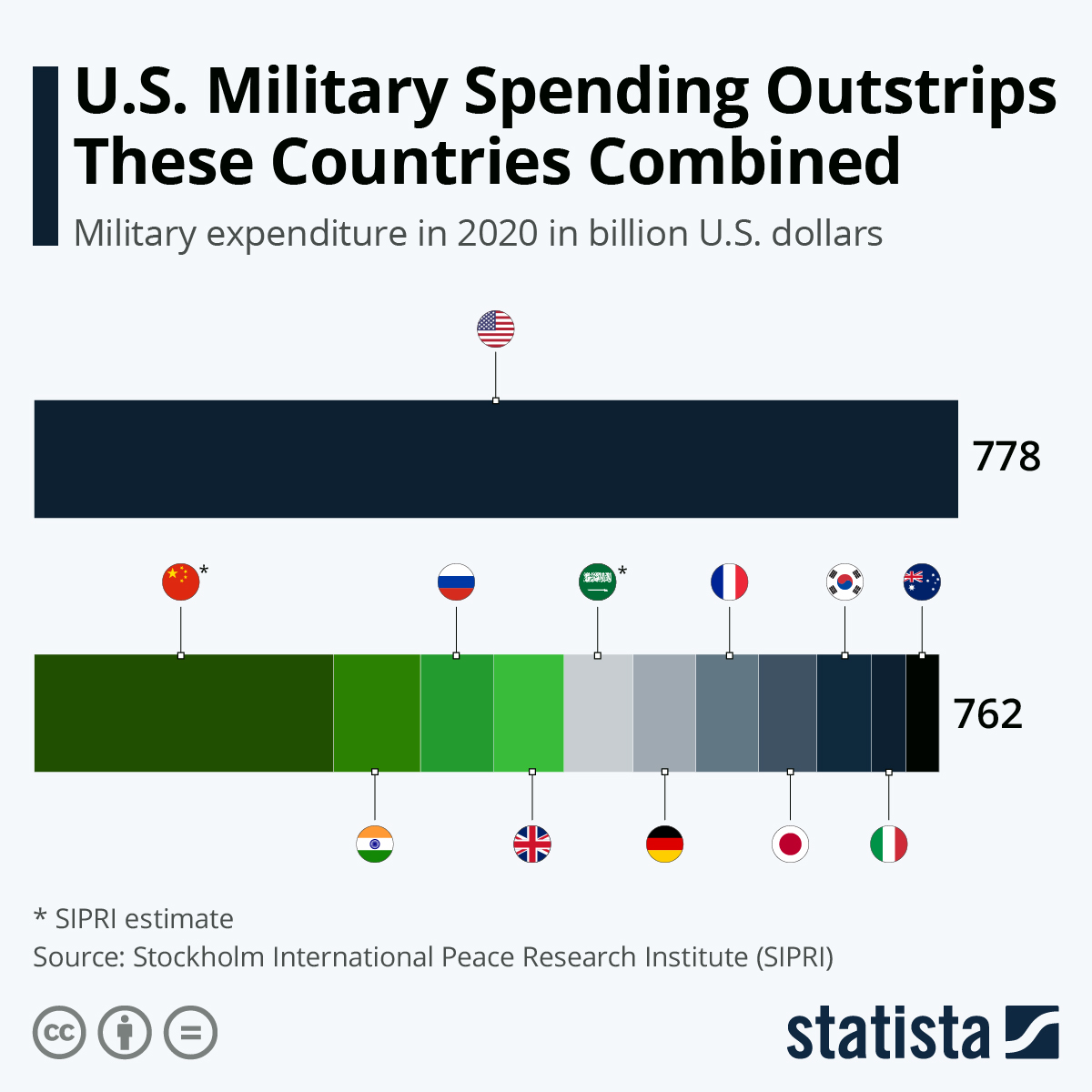
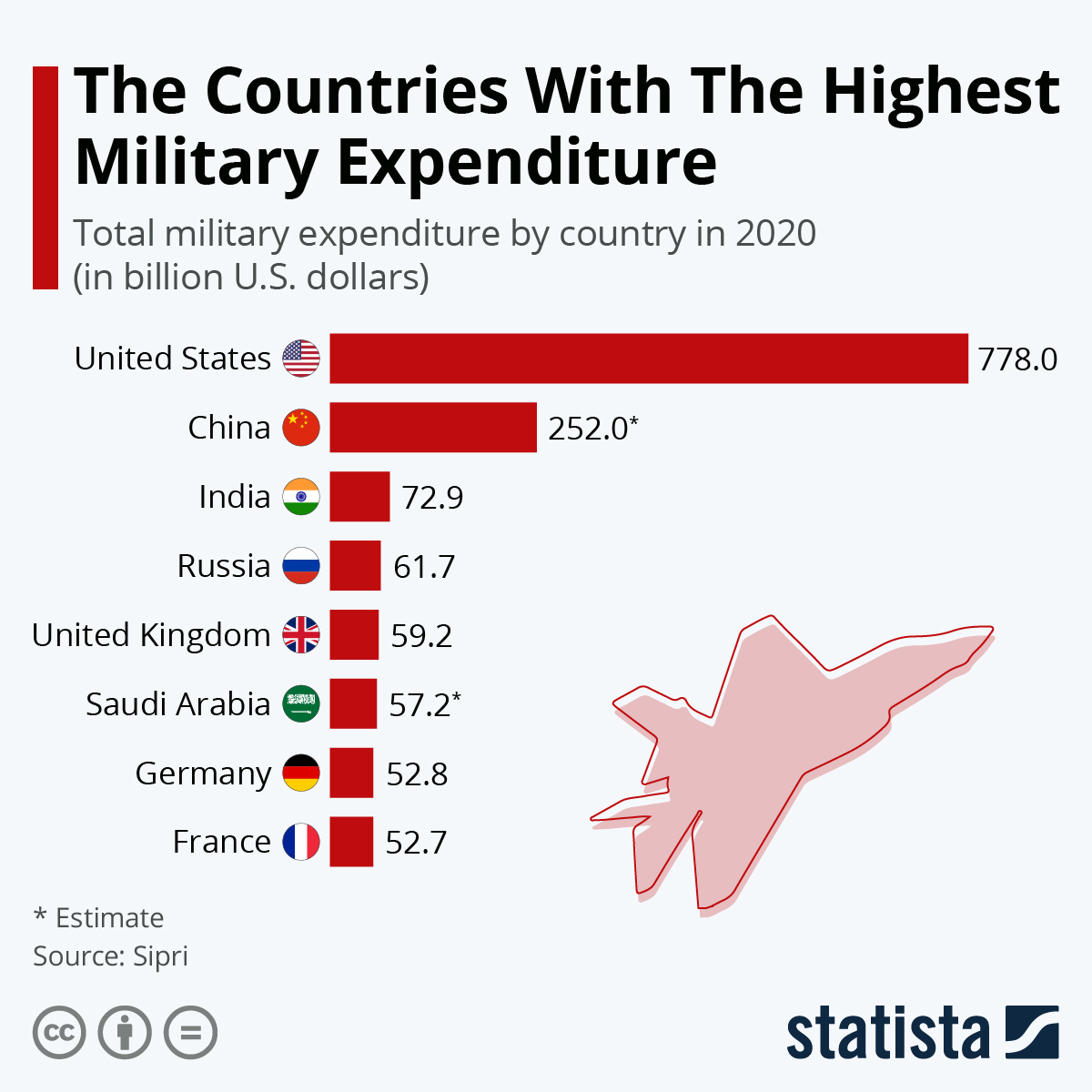
Break down this colossal expenditure by country and the US outspends its nearest rival, China, by three times and spends an order of magnitude more (10.6x) than the next nearest rival, India.
It is hard to see China as the aggressor when these numbers are in the frame. Especially when the disparity between the US and the rest has been going on for decades.
Naturally, the west is grateful for access to such muscle.
There is little doubt military might has been a deterrent, especially when combined into collective defence. For example, NATO, the North Atlantic Treaty Organisation, is an intergovernmental military alliance between 30 European and North American countries to implement the North Atlantic Treaty that was signed on 4 April 1949. But the collective defence NATO countries enjoy is thanks to the US paying for most of the expense.
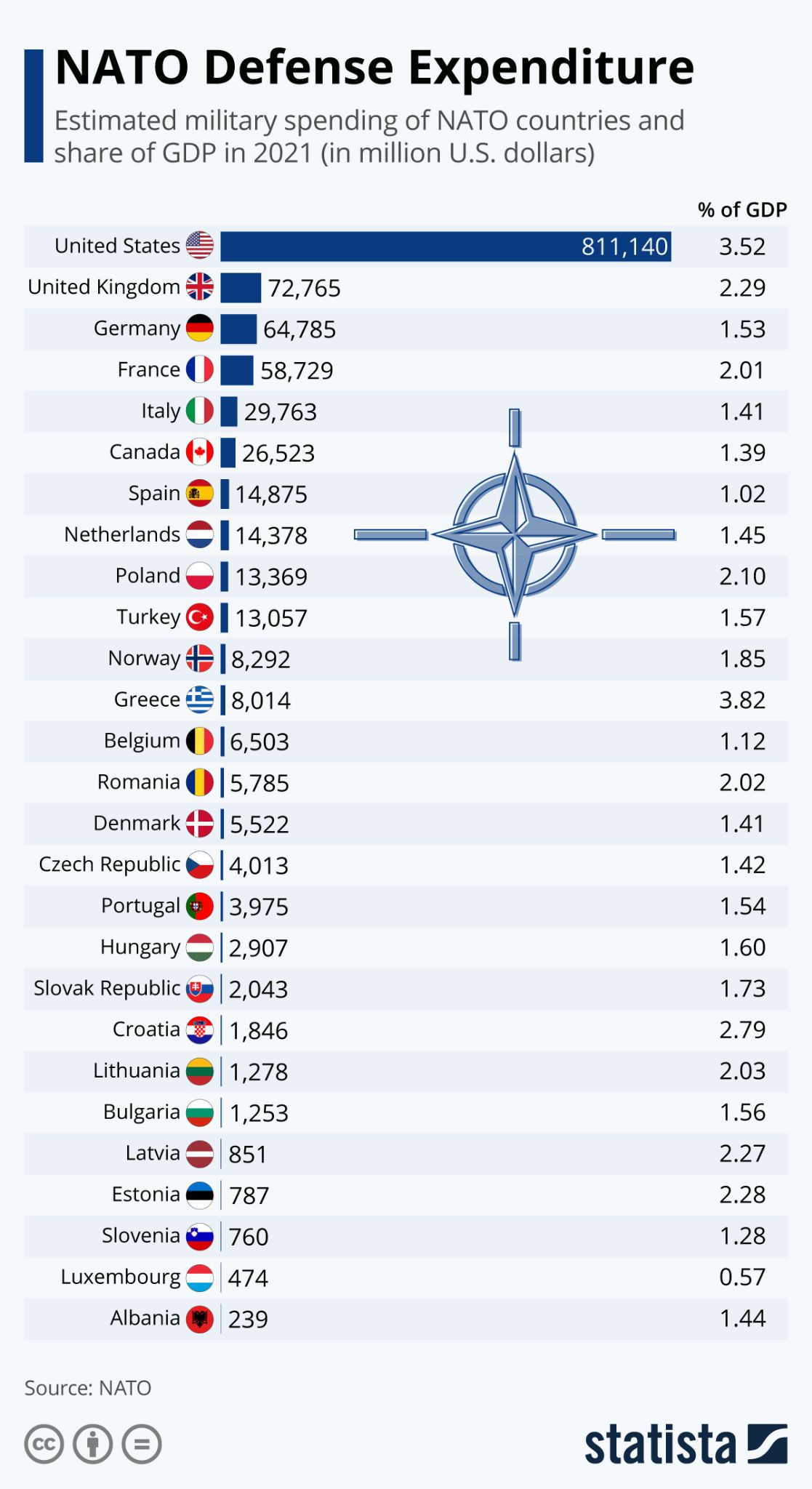
Such generosity is remarkable. If only it was altruism.
Clearly it is hard to put aside advocacy by the military men who are passionate about the need for big boy’s toys deterrent, the wealth creation from such a large military machine, and the influence such apparent generosity buys the US in foreign affairs.
There is no altruism, just some history in being the big cheese combined with social and political advantage from staying ‘strong’.
All this is not confined to the United States.
Australia has a fraction of the population of the US and a puny US1.4 trillion GDP that cannot even touch California (US3 trillion in 2020). Yet the government can spend US$37 billion on French submarines at a cost of US$1,500 for every person in the country.
Everyone is in on it.
Maybe there are better ways of mobilising the fraction of GDP that becomes government spending.
How about a Universal Basic Income?
Recent research shows that an annual payment to all Australians of A$18,500 a year (US$13,500) would cost the taxpayer roughly A$126 billion a year or A$20 billion that the current cost of unemployment benefit and three times the current defence budget.
It would need an unpalatable jump in the overall tax rate from 28% to 34% to pay for it.
But the A$20 billion more than the current payments to the unemployed is just half the military budget.
Maybe it is more about priorities than absolutes.
But as this ramble began with the extreme US military budget, this is the point. Does the world need to spend so much on deterrents and does one country need to overwhelm the rest?
Please share and subscribe. It helps me a lot.
.

Photo by Grant Whitty on Unsplash
The theme of death and taxes we gave an evidence argument in a previous post. This one is about the hip pocket.
As a private citizen in Western democracies, you are certain of two famous things: death and taxes.
Except for those independently wealthy, to survive in the system you have to earn income and that income is taxed. Modestly for low-income earners and at a greater proportion as your remuneration grows.
This ‘work for money that is taxed’ keeps going until the inevitable happens and your body can’t fight entropy anymore.
Would you rather pay $20,000 or $1,000,000 in tax per year?
The weird part of this is that, after some thought, most people would be more than happy to pay a million dollars a year in personal income tax.
Obviously, it would mean that earnings are high enough to spend at least 10 grand a week and still have change. Compared to the low-income individual who plays $20,000 a year in tax, your bum is in the butter.
Similarly, a business paying tax is a good thing.
Corporations have many more ways of avoiding the tax dollar than the individual, but the reality is that net profit after tax, NPAT, where profit is the operative word, is the objective of the business, the reason it exists.
The company will have directors who, should they fail to maximize profit for their shareholders, risk prosecution. That NPAT number, the profit measure should be as high as possible.
A business not declaring a profit is very creative in its accounting or has previously made losses or isn’t a very good business.
Either way, the shareholders are not too happy if profit is not declared because that is their reward, their dividend for risking their own hard-earned to invest in the company.
Once the accounting smoke and mirrors are over, paying little to no tax is not a good thing.
All this preamble comes before any moral argument about whether or not taxes are for the public good.
Remember that tax pays for collective benefits: roads, schools, police, defence plus a whole raft of services and structures that are hard to pay for as individuals, but that benefits everyone.
Tax is an integral part of the modern democratic system. It supports the social structure and a whole chunk of individual well being. Drive out of your front gate and you benefit from the tax dollar as soon as you hit the tarmac.
Without a tax system, we can say goodbye to the current quality of life that we enjoy. Arguably there is a moral obligation through the social contract for all legal entities and individuals to pay their way.
A fair share of tax is designated by the policies and the politics of the day.
And sure there’s no reason to pay more than your fair share according to the rules. As long as the tax system is equitable then everyone at some point in the process will have benefited from the taxes that they’ve paid. There should be a certain pride in paying tax toward the public good.
So to claim that you’ve paid no tax. Or to even hint that such a thing is good does not stack up in any sensible argument.
Paying no taxes as an individual means that you’re either at the very low end of the income scale in need of support or you’ve diddled the books somehow and claimed payments or shifted money around to avoid paying your fair share.
If a company pays no tax then at some point in the process the business has failed to disclose a profit or manipulated the books to sail very close to the wind and, again, avoids a fair share.
There is no doubt that corporations do this. They use all sorts of systems and hire expensive lawyers and accountants to move money around to avoid paying tax and one of the things that society has struggled to do is to reign in that avoidance behaviour.
But when no tax is paid for a very long time then the company is poor at what they do or they’re extremely good at dodging their fair share. Which even if it’s not illegal has certain moral nefariousness.
The graph below can speak for itself.
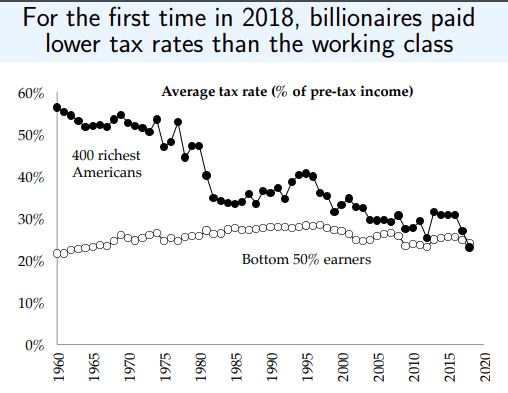
Alloporus would suggest tax is a good thing.
Paying your fair share according to your means should be everyone’s responsibility.

If a political party wins an election with 60% of the popular vote it is a landslide. In almost all democratic systems 60% of votes would deliver enough seats to form a government.
If any individual candidate received 60% of the vote in her electorate she would win the seat in parliament. That seat would be considered ‘safe’ given that there is at least a 20 point margin over the nearest competitor. And likely much more if there were many candidates. A huge margin in anyone’s political language.
Such results are rare.
Politics is won at the margins, not with those kinds of numbers. Democratic elections are often won with less than half the vote going in favour of a single party.
I recall back in 1979 when Margaret Thatcher first came to power and we lived through her initial years of changing things up. The legacy of those changes we’ll leave for another conversation, but I remember when her government was returned for her second term the Tory party received less than 40% of the votes from the people who voted. But in the ‘first past the post’ Westminster system the Tories gained a majority in the Parliament.
Elections for who governs us are marginal a lot of the time.
Donald Trump was elected having lost the popular vote in the 2016 US election, but having more than a hundred more electoral college votes than his rival. Whichever way you look at it, half the people or more did not want the person or the party that was elected.
If politics is just tinkering around the edges and the fundamentals are roughly the same then the result makes little difference. If a party comes in and is unable because of the legal system to dismantle the rules and regulations and is simply providing a little bit of a tweak here and there. Not too much damage is done.
But if we go back to divisive politics. Where electing one party over another is quite a radical change in the way that the world is run. And the way that the country or jurisdiction is run then those margins make a big difference.
It means that nearly half or over half in some instances of the people will not be happy with those in power.

Photo by Timo Volz on Unsplash
All this should encourage political awareness.
If you want your party and the principles that they support to win elections, then it’s time to get out and about and make them happen, engage in the political process and perhaps that will be part of the future story.
But what it also means is that whoever loses, there is still a large number of people who support the losing side and don’t agree with the way that the politics is run.
So the convergence of ideas is an important stability factor for societies. If we are to be stable over the long run when we need to have a convergence of ideas and an ability to ensure that everybody benefits from those ideas.
Back to Thatcher again, and you can argue that she changed things up at a time when a change was required. She took advantage of the opportunity to bring to an end the period when socialist reform had run its course.
A new idea was needed to energise the economy.
We’re in the same situation again. The legacy of that neoliberal idea that began in the 1980s is now old and tired. And whilst it’s created wealth it’s also created disparity. The super-wealthy have appreciated the bulk of the gain and the trickle-down effect runs out of steam before the poorest benefit.
We are close to the wealth disparity present at the time of the early socialist revolutions when the people were much poorer than the elite.

Floodwaters of the Okavango River soaking into the sand — Photo by Alloporus
The pandemic presents an opportunity.
We already have governments doing u-turns on fiscal deficits, locking down whole communities, and fast-tracking vaccines that used to take years to deploy.
That suggests that radical options should be very much on the table. Some of the sacred cows we’ve been sold are not as holy as imagined.
If money can be spent to shore up livelihoods in a crisis, why not all the time? A universal basic income perhaps?
The opportunity is to reflect on the future. What it could, might or is likely to be like. Where humans have the advantage over all other creatures is that we can not only gaze into the future but we can do things to shape that future.
We could inject another paradigm into global politics and global economic structures. And given the juggernauts coming down the road, such a shift is critical.
The pandemic has already shown us that we can change paradigms and still survive.
And recall that winning big is not always necessary.
Change can happen at the margins.
Please browse around for a while on Alloporus | ideas for healthy thinking there are over 400 posts to choose from
Hero image of Thatcher’s Rock Green, Ilsham Marine Drive, Torquay, UK by Jack French on Unsplash

Hero image by Zlaťáky.cz on Unsplash
It has been 30 years since the 1987 stock market crash that pulled the carpet from under any number of brash high-fliers of the day. Many analysts have compared the precursors of that momentous day to the current conditions in overvalued stock and real estate markets around the world.
The main point seems to be that money is no longer real.
It has been a long time since gold, the hard precious metal, was held in reserve to match with the currency issued. Today 90% of the world’s cash is electronic and unconstrained by the need for a gold standard so central banks print the stuff by the trillions. They did this to save the system after the 2008 financial crisis and have just kept going ever since, with no obvious slowdown.
The global debt load is now three times greater than it was at the turn of the century and grows by staggering sums each year.
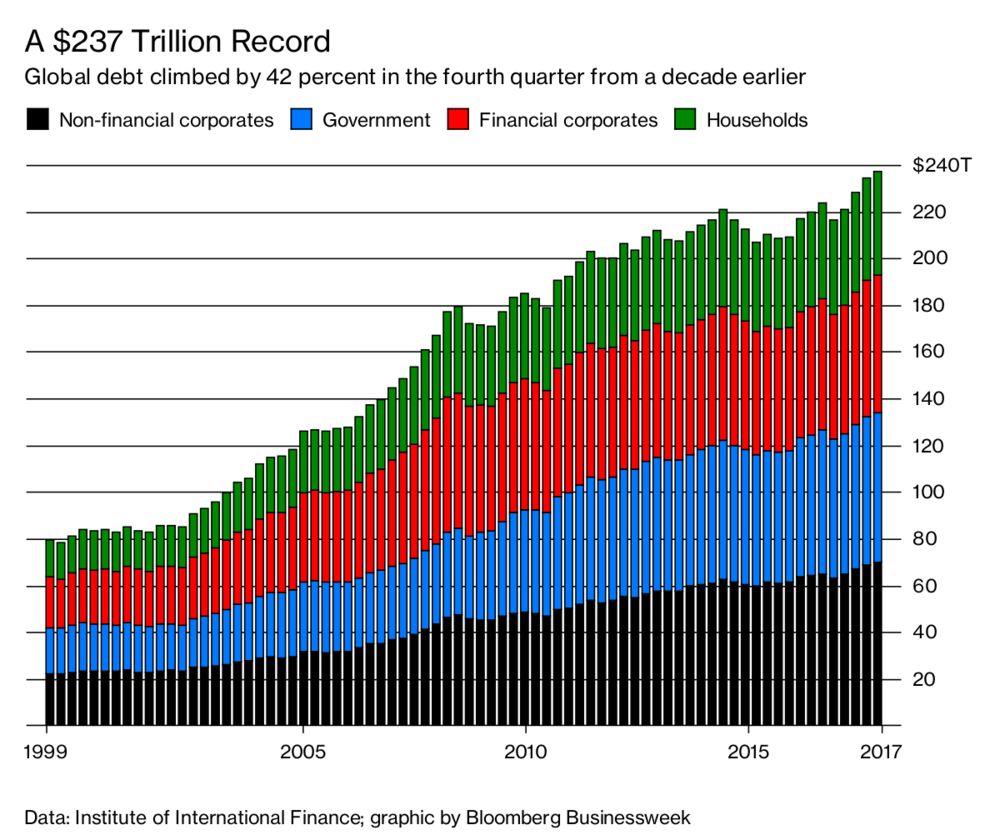
Source: Bloomberg
Governments, companies and households raised $24 trillion in 2020 to offset the pandemic’s economic toll, bringing the global debt total to an all-time high of $281 trillion by the end of 2020, or more than 355% of global GDP, according to the Institute of International Finance.
Here are the gross national debt numbers for the US over a longer time period showing recovery from the impact of WW2 and then some political decisions by both Republican and Democrat presidents since the 1980’s.
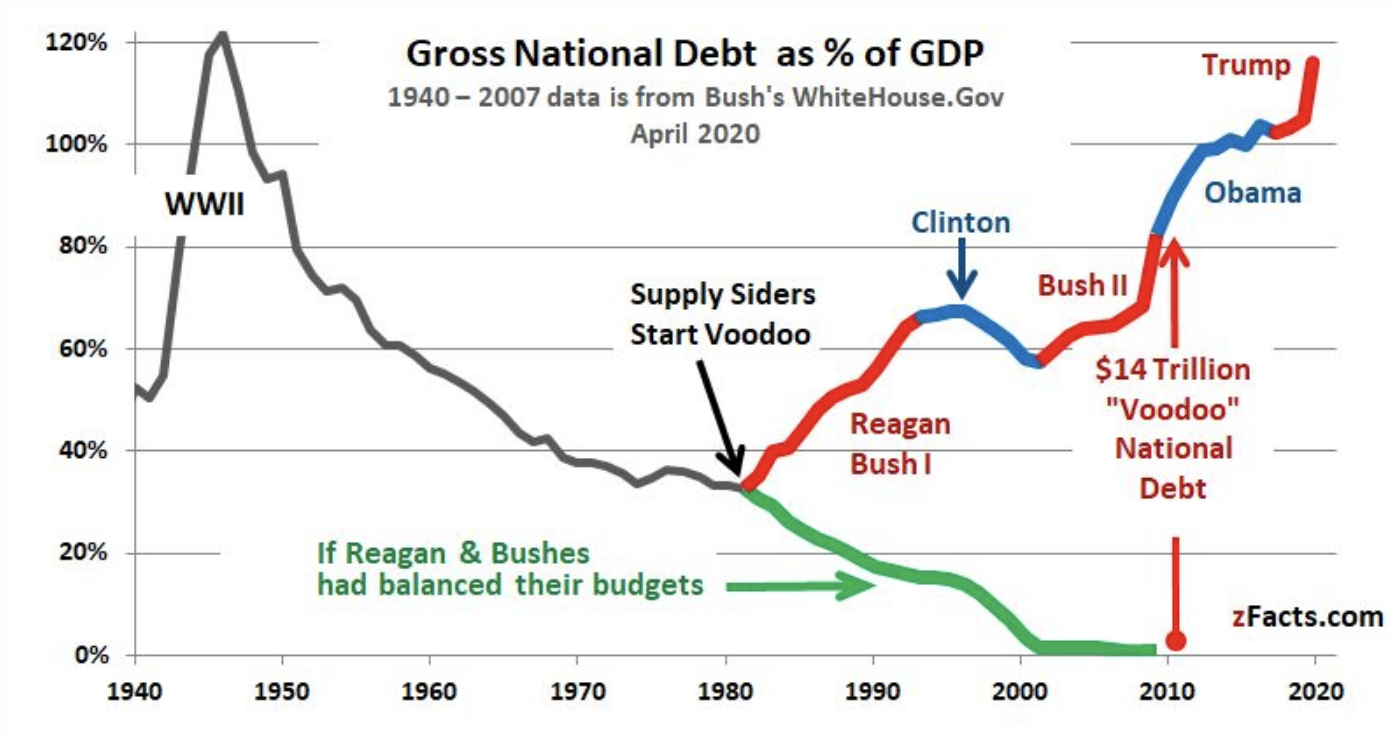
Now here is the thing.
Most of this cash has been used for speculation to give us booming stock markets, crazy house prices and, arguably, Donald Trump.
Convention says that markets will correct, bubbles will burst, and the politics will burn.
Or will they?
If money is only loosely tied to material things (resources, products or services) and governments can print it at will then any correction is bailed out by more ‘printing’. Whatever it takes to ensure the economic system survives.
Why not go all out?
Print more and more. Give citizens a basic income and do away with welfare for the unemployed. And while at it spend some more money to encourage decentralisation of people away from the big cities by subsidies to services in rural areas.
After all, many of us just learnt to work from home. So home could be anywhere, maybe even somewhere with a kind rural outlook.
Here is my question…
If governments can mortgage the future to save economies from financial and pandemic crises why can’t they do it to stimulate an economic transition?
Alloporus
Comment below if you feel the urge and please share with your online folks

A while ago the Deputy Premier of New South Wales, Australia, John Barilaro played brinkmanship with the government. He threatened to move his National Party members to the crossbench. These are the MPs who give the government a majority in the lower house, a coalition that gives Mr Barilaro the Deputy Premiership and his party a number of ministries in return for bringing 13 votes to the table to give the government a slim lower house majority of two seats.
This ‘majority making’ brings with it extraordinary bargaining power.
The National Party decided or perhaps Mr Barallaro decided, to leverage that power and threaten to remove his MPs from voting in favour of government policy. So, they’re in government and proposing to abstain from voting.
Needless to say the Liberal party leader and Premier who has 35 sitting members leveraged her power and told them to sit down and shut up.
The outcome was that Mr Barilaro backed down at the eleventh hour blowing any political credibility he had. He then chose to take a month of stress leave. His actions suggest that was a sensible choice.
What extraordinary issue brought this power play on?
Turns out that koalas were the issue. And principally the unproven ‘fact’ that koalas would go extinct in the next 50 years.

The legislation amended on the back of this non-fact, a State Environment Planning Policy known as the koala SEPP, was amended to extend the habitat that is protected for this species by listing more tree species that cannot be cleared.
Landholders must demonstrate through expert analysis that trees are not habitat for koalas and there are no koalas present in the last 18 years.
Here we have a peculiar situation.
The original facts of the matter do not exist. At the present moment in time, we do not know how many koalas there are in Australia. We do not know how many there are in New South Wales and we do not know the trend in those koala numbers.
We do know that populations fluctuate dramatically in a species that is widely distributed, is prone to certain environmental and human drivers of change, has a slow reproduction rate and is likely to be vulnerable in certain places.
We also know that koalas are often present in disturbed landscapes because the younger eucalypt trees are preferred food and we also know that when we look hard enough with the right techniques (sniffer dogs work really well), we find koalas in places that we previously thought they didn’t exist.
Not knowing how many koalas there are. Not knowing how many are being lost at any one time. Not knowing if populations are stable or simply naturally dynamic are unknowns that form the basis for the legislation.
In other words, there is no evidence that says koalas will go extinct in 50 years.
This makes the legislation itself is at best precautionary and at worst unnecessary. It is flawed in either direction. That a government would be put in jeopardy and members would flex their political muscle over such an issue tells us a lot about the current political process.
It tells us that the facts of the matter don’t really matter at all.
What matters is the political process and the benefits, or not, to individual politicians and their careers from having a stoush.
It’s time to put an end to this nonsense.
Let us all begin with the facts. Whatever the evidence is to hand and let that be at the core of any debate.
Sure, you can have your toy throws and throw them out of the cot, have ego-driven rants as part of the political process. We all need some drama and colour in our lives. What we don’t want is for these rants and raves to be based on half-truths, untruths and downright lies. That is not the democratic process.
We need to have politicians who can form governments that are presenting us facts and policy options to deal with those facts. Then we can decide the policies to support that the majority believe will be in the best interest of everyone and the well-being of our grandchildren.
Politicians must have a steady enough hand and a steady enough head that they’re prepared to look at evidence, evaluate and bring it to the table in good faith, then debate the policy options.
To be debating policy on lies and mistruth degrades the democratic process. It undermines public faith in the institution of democracy and it makes all those political players look like complete idiots.
Pleae leave a comment or browse around for more ideas for healthy thinking.

Photo by Green Chameleon on Unsplash
For a long time, I’ve been fascinated by creativity. Not bad for a scientist.
I like writing especially. I’m interested in all forms, non-fiction, fiction, short form, blog posts. I haven’t quite made it to Twitter, but I’ve always been tempted. I even have an alter-ego, Paul Sorol, the chronicler of the Confused Confucius. Paul is a bit slack at the moment because he’s not actually doing very much. But I hope he’ll get his arse in gear to put out some sayings and conversations in the near future.
I like the technology side of writing, especially the websites and apps that make productivity easier and more efficient. I am raving about Notion at the moment with the power of the relational database to manage all the fragments of information. Close behind is Notability that has taken me paperless.
I like the design side but I’m absolutely crap at it. I love thinking that I can produce a logo or color palette. Where in fact I haven’t really got a clue. Luckily there is Canva.
I even use Procreate on the iPad to dabble in a little bit of freeform here and there. Again with no idea how to do it.
And after a one-time career as an academic where I spent a lot of time designing and delivering science courses, I still think I’m half-decent at producing educational material. And now I’m in the process of developing online courses in kajabi for our sustainably FED initiative.
Part of the joy of content creation in the digital age is doing it all yourself. All the technology makes it possible to take writing all the way to the reader on your own.
Only the jack of all trades syndrome applies. There is still a lot to cover even with the help of smart apps. And to stand out key elements must be mastered, in particular the look and feel of your messages, a style niched into your audience, and, critically, knowing your audience.
Fail on these things and no amount of hard work will deliver traction.
All the successful YouTubers and online entrepreneurs have a niche matched to their primary audience even as some topics are more salable than others.
Anyway, this week I had a change of heart and instead of wanting to do all of those things myself, I realised something I should have realized a very long time ago. No one person can be across everything.
So I offloaded platform and website development for the courses to my colleagues and we shared visions of who the audience is going to be. It left me with the content development and carriage of the design and delivery of the message. Still a lot to do but it eases the pressure and reduces the number of steep learning curves.
My usual motivational tools, like the daily word tally, also took a step aside.
Content development is very different to content creation.
The raw material of creativity is relatively easy to vomit out onto the page or into the microphone. What’s more difficult is to then go back to that material and edit it down to focus on message and craft.
Offloading some responsibility has created more space for the big challenge of editing and a good job too for this fine-tuning is easily the hardest part. How the old school writers with their quills, fountain pens and typewriters managed the editing I have no idea. They must have been awesome at first drafts or had the mental bandwidth of an owl.
In the end content creation is graft. No shortcuts, no technology fixes, and no outsourcing. It’s about being with the words and trusting that the right ones come along.
If anyone is interested in the full process for this blog and the upcoming sustainably FED eLearning initiative, let me know.
 Alloporus