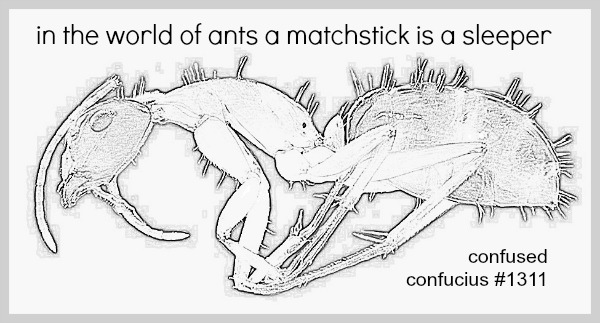
More odd sayings viewed at confused confucius
 Most of us gain more satisfaction than we realize from progress.
We are programmed to solve riddles and explore new things that give us the feeling of moving forward. In modern suburbia it may be that crime shows on TV are enough to satisfy our problem solving need and the confines of a cruise ship once a year does enough for our sense of adventure. Yet there is some expression of the betterment gene in us all. We really like progress.
Our need for progress has morphed over the generations. Not so long ago it was a struggle for equality. We fought against oppression, prejudice and the denial of opportunity, and, for the most part, have made things better.
These issues still linger of course, but all around the world societies mostly do not burn witches at the stake, deny education, a fair wage or the vote. Each generation has seen improvement in these fundamentals compared to times past. So much so that we seem to have lost collective interest in them.
Instead of core benefits, progress of late has been taken over by commerce. We measure ourselves by our access to an almost endless choice of goods and services that we seek to acquire. From the luxury yachts that spend 99% of their time tied up at a mooring, to a kitchen renovation, or even the necessity of five varieties of breakfast cereal in the pantry. Betterment is now all about stuff.
And it is what it is — inevitable really. For when there is no need for struggle people still find a way to do it. Intuitively we know that betterment requires work and sacrifice.
When all our basic needs arrive on a plate instead of channeling our struggle energy into achieving higher things we have settled on ways to get more stuff. This is a pity and perhaps the start of our undoing.
Betterment should really be about our higher selves — our efforts channeled toward awareness, balance and a sense of peace. Stuff would be part of this but not the all consuming driver and measure of how well we are doing.
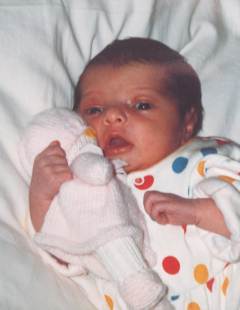 Every hour of every day there are enough babies born to ensure that the global human population grows by 8,000 souls. In a week there are newborns enough to use up half a million disposable diapers a day. Human instinct to make more is a strong as ever. The net result is that we are not short of people.
Now lets switch the focus to one country, a developed one.
Around 22.6 million people call Australia home. Many of these people were born elsewhere or are the children of immigrants. Indeed Australia has a diverse populace and is justly proud of its multicultural tolerance. Most inner city primary schools can claim 20 or more first languages among their students, the result of a liberal immigration policy that has seen more than 7 million people arrive from all around the world since 1945.
Current immigration is around 180,000 per year. This rate ensures that the population grows and labour is available for economic activity.
Devotees of the economic growth gods would say this population growth is essential because people buy goods and services. It is hard to keep the economy moving when everyone has a house full of white goods. A growing population maintains demand for houses and fridges.
But if it is people that you want then there are many more around the world itching for a visa to enter Australia, many more than are granted permission. Some of them can’t wait and try to access the back door.
Most Australians see themselves as egalitarian, believing that people are people, apologizing for past intolerance of indigenous peoples, accepting of modern differences and building a society from people of many cultural backgrounds. And given a history of immigration and multiculturalism would accept the logic of immigration at rates sufficient to support economic growth
But here is the crazy thing. Government policy since 2002 has been to pay Australians to have babies.
It’s called the baby bonus and gives parents $5,000 per eligible child paid in 13 fortnightly instalments.
Why encourage, at significant cost to the taxpayer, more babies when we have so many already?
I wonder what you think the real reason is?
 “You cannot solve a problem from the paradigm that created it” is a famous Albert Einstein quote. The great man reminding us not only that lateral thinking is powerful, but that it is easy for us to stay with what we know at the expense of the things that we do not.
At times we appear so stuck in our ways that innovation seems all but impossible. We think in the current paradigm, work in it, live in it, trust it and are horribly uncomfortable when forced to go anywhere else.
Take sheep for example. A godsend if ever there was one — just about perfect wool and lamb cutlet factories. Nations were built on their backs.
In the late 1800’s there were more than 15 million of them in the parched lands of western NSW, outnumbering people by thousands to one.
Now we have talked about sheep before on Alloporus [Last chance to see | Buying up the land] and risk New Zealander and gum boot jokes if we go there again, only it is too good an illustration of what Einstein was on about.
Sheep production has been successful in Australia even when the conditions didn’t really suit them. Herding large numbers of the docile creatures on paddocks was the approach imported from overseas where the same thing had worked for generations.
It was difficult in dry country so, by necessity, the paddocks became quite large and the sheep stations huge. Graziers sweated hard and found a way. Countless sheep were reared, sheared and sold.
So many sheep left the stations over the years that it became apparent that these dry and dusty paddocks were becoming drier, dustier and less able to recover when the rains came. Growing numbers of feral animals, especially rabbits, didn’t help. Over time the rangeland became degraded almost everywhere threatening the viability of farms and bringing any number of unwanted costs from biodiversity loss to muddy waters.
Here are some of the ideas that were tried:
All these ideas and more were tested at some point. What you will notice is that they are all within the sheep-growing paradigm
A few innovators tried rearing goats or harvesting kangaroos. This is better perhaps but is still within the grazing paradigm.
A few very brave souls have suggested there are alternatives to meat and wool production and be paid for the carbon sequestration and/or ecosystem services provided by the land. And there is always ecotourism.
Again this may be better in some circumstances [although ecotourism is rarely the panacea proponents might like it to be] but it is still the economic paradigm.
So is it actually possible to solve the problem if it is so hard to think outside the core paradigm?
Fortunately there are enough ‘out there’ folk to become the early adopters of even quite wacky. The first business suit wearing users of the early mobile phones that were the size of a small suitcase looked most odd until they started doing deals from coffee shops — then everyone wanted one.
So paradigms do change and the grazing one might just be about to.
 Bruce, a good friend of mine in the time before the espresso when coffee trickled through a filter into a Pyrex jug, said as he poured the cremora free liquid into my mug, “There is no such thing as a new idea. They are all recycled.”
We were discussing evolutionary biology at the time. Probably some nuance of the idea free distribution as applied to Oystercatchers or maybe the reasons for the bizarre ornamentation of millipede genitalia, I don’t remember exactly. As young academics in the biology department at the University of Botswana, it was a normal enough conversation now long forgotten.
But I have always remembered that phrase, “no such thing as a new idea”. It was burned instantly onto my core because it hurt.
My ego could not accept such a crazy concept. It still can’t. I believed then and now that ideas come from the endless bounty of the ether. All you have to do is open a portal and they flow faster than filter coffee.
What happens next is where Bruce was coming from, for the ideas may well be recycled many times but the ego adopts them and presents them to the world as its own unique and original thought.
Now suppose that we put 40 sizable egos into a room for a day and get them to think about a problem. They are all technical experts who know a fair bit about the topic. We call this a workshop and it’s portals away.
Open the floor for discussion and soon there is a flood of ideas. By coffee time everyone is ankle-deep in them. Only all of these ideas conform to Bruce’s definition, none of them are new.
As each ego finds out something new it presents it back to the group as a great idea. And it is, except that other egos have already had that idea and moved on.
In the group though these old ideas keep coming and etiquette requires that these ideas are heard. So people listen politely but impatiently while they think up more ideas of their own. Ideas appear, bounce around and die, all the time taking up space that solutions should occupy.
Keep this up for a day and you can go insane.
Welcome to ‘groupthink’, the politically correct and increasingly popular way to tackle complex problem — put a bunch of “experts” in a room and let them regurgitate old ideas.
It is easy to see how groupthink has come about. We all tend to believe that no one person can have all the answers. There is simply too much information these days for one brain to be across it all, let alone have the skills and bandwidth to synthesize, analyze and interpret what it means.
A gathering of many brains each familiar with the topic should solve this problem performing a kind of risk management. Collectively this intellectual capacity should better cover all the bases.
The problem is those egos that refuse to accept that their ideas are old. What actually happens in workshops is reinvention of the wheel many times over as each participant gets up to speed and the groupthink gets mired in what amounts to getting up to speed. Progress becomes difficult.
When it gets bad things go backwards. Genuinely new ideas fail to make it at all.
Perhaps we should rethink the workshop.

This image was taken in the buffer zone around a longwall coal mine. The kink in the crack is a result of subsidence.
More sayings, maxims and random quotes on Confused Confucius
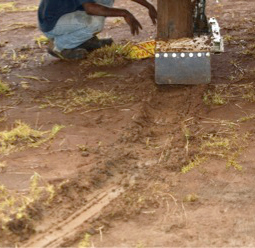 In the game parks of Africa the roads are often impassable after rain thanks to mud that appears in an instant when water is added to the deep vertisols. Not even a land cruiser can move through the thick, clingy goo. Game drives are suspended until the road dries out.
If vehicles do drive on the wet road before the soil is hard enough, deep ruts form that destroy the road for future use.
After a major flood a similar problem applies to paved roads. Water ponds, seep beneath the tarmac and in places the firm part now sits on a mushy underbelly.
It makes sense to let roads dry out and for potholes and cracks to be repaired before traffic tries again to pass along them.
Only what if transport is the key to a rural economy? The trucks must get moving again and quickly, or else the economy will suffer.
Woe betides a local politician who suggests that the trucks wait a day or two. Political expediency has the trucks moving as soon as the drivers can each the cab to turn on the ignition. They then crunch up and down the roads hugely multiplying the flood damage.
It would be far cheaper to compensate local businesses for a few days lost custom than it will be to repair the roads that have just been given extra damage. Instead we get those trucks moving right away.
Sounds crazy — but it is true.
At what point are we accountable for what we know?
Consider the recent tsunami in Japan. Anyone in one of those coastal towns who knew that the wave was coming would have warned whoever they could. And many did. There are stories of great heroism by fire servicemen, emergency workers and ordinary citizens staying in danger themselves as they encouraged people to reach higher ground.
Anyone who had the opportunity to raise the alarm but failed to use it would feel guilty for the rest of their lives.
Earthquakes and tsunami happen in Japan. This inevitability forces planners to carefully consider where buildings must go in relation to this known risk. Engineers must also put their expertise into building construction sufficient to withstand shocks from shifting ground and walls of water.
Should these precautions for a foreseen event follow similar rules to those when danger is real and present? Applying a planning rule or choosing a structural material does not require heroism, but there might be a similar sense of responsibility around the decisions made in these professions.
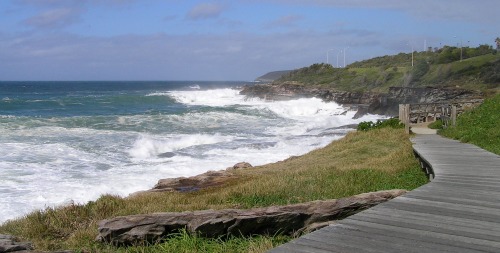
Prime real estate in coastal towns is where there is an ocean view.
Planners who zone the coastal fringe as green space or tsunami protection zones would not be popular. Developers would soon find an alternative to an engineer who insists on the super safe construction options for these are almost always expensive.
In the political and economic realities of a modern world, developers will leverage many a weight onto hapless planners for the profit is in those plots with an ocean view. Perhaps these decision makers need courage too, only for, them, it will be much harder than in the adrenaline-fueled heat of an emergency.
What about courage for decisions on climate change? We now know that there will be changes to the intensity, frequency and timing of weather events – the altered likelihood of extremes and long-term shifts in the averages. We can foresee these climate change effects even though it is not a real and present danger just yet.
It is, however, time to plan for sea level rise, extreme weather, drought, heat waves and shifts in seasonality that are the likely effects with significance for livelihoods.
At the moment we are dodging this accountability.
It would be sensible to put climate change scenarios into strategic and local planning tools and have planners understand why climate change effects should be considered in their planning horizon.
Building design already has the smarts for energy efficiency, structural integrity and resistance to extremes. All the engineers need to do is favour these options and set their skills and experience to figuring out even better solutions. The planners can support them with compliance requirements that assist against the pull of market forces that will always favour the cheaper alternatives.
There is a difference in these examples of required courage and personal responsibility. Decisions made in the face of danger are instinctual. When danger is at some unknown point in the future, we have time to think. We rely less on instinct and more on reasoning and allow ourselves some latitude. We may respond to the pressure of compromise. No need to worry, it’s not happening now.
Without immediacy there is no adrenaline required, we can relax into the comfort of busy work and allow the process of decision making to take over. Soon it is the meetings, hearings, forms to be filled and documents to be filed that allow us to forget that there was actually an important, responsible choice to be made.
When buried in the process it is easy to forget that there might be some responsibility to make the call and some accountability for it.
 Suppose I build a house on a floodplain.
What can I be sure will happen sooner or later? Yep, there will be a flood.
I could anticipate this inevitability, keep a supply of sandbags handy and build my house on stilts — an ungainly, limiting and potentially expensive option
Or I could insure against the consequences of flooding, cop the damage when the river overflows its banks, but return everything back to normal at home with the help of a payout. All well and good if I can obtain commercial insurance for this particular plot of land that the actuaries know only too well is prone to getting wet.
Or I could build a house on higher ground above the level of the biggest floods. This is obviously the most sensible option
Now suppose that the government gets involved. It decides that it is cheaper to allow people to build in flood prone areas than to move them elsewhere, further away from existing transport and utility infrastructure and from where they are needed for the economy. The jobs happen to be at businesses that also happen to have located themselves on the floodplain.
And then there is the stimulus of spending. The insurance payouts go towards rebuilding and all the new carpets that must be bought and fitted after each flood — all very good for the local economy.
All politicians know how important it is to keep money moving through the system. So government provides a subsidy to the insurance industry so that households can stay on the floodplain.
The result is people do get insurance and, mostly they stay put. It will be painfull when the next flood ravages their Ikea lounge furniture and through the process of claiming the payout but happy enough wielding the Allen key to construct the new lounge suite.
Meantime we have damaged and thrown away perfectly usable materials that we have replaced from never ending environmental resource supplies.
Sounds crazy — but it is true.
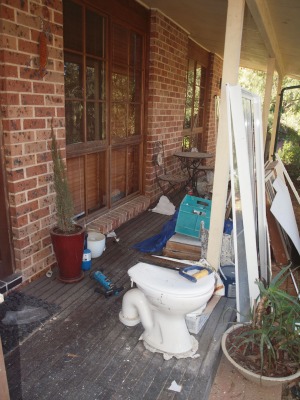
Our house is a shambles.
The dishwasher and the fridge are in the living room, the spare room looks like a bathroom warehouse, the front porch has turned into a building site and the lounges look horribly cute in their drop sheets.
Yep. We are in the middle of renovations, just a small upgrade to the kitchen and bathroom. It seemed so modest a task and yet the disruption has left me asking, “why, oh why did we do it?”
The answer my beloved wife — who has done a fabulous job in designing and managing our little project including sourcing all the materials [go eBay] — is tantalizingly simple. No pain, no gain.
It is impossible to get a new bathroom and a kitchen upgrade in your house without copping major inconvenience and dust in the nostrils. It has to get worse before it gets better. Sound logic you might say.
But I suspect that this is not how we really think.
I reckon it is human nature to prefer “all gain, no pain”.
This is certainly what drives business. Profit is best arrived at with minimum fuss. Any cost that can be deferred, or better still, sent somewhere else, will be. The simpler the business system the less that can go wrong and so long as the company has enough competitive advantage in the marketplace, simple is good.
If there has to be pain then, reluctantly, businesses insure against its effects. Even though the logic of insurance is to cop the pain initially but be pain out to sooth its effects.
Now that I start to look for it, I cannot seem to find instances of business voluntarily accepting the ‘no pain, no gain’ maxim.
Perhaps this is the flaw in modern day commerce. Decoupled as we now are from a physical cap on monetary wealth [currencies are no longer tagged to gold bullion] business is free to find unlimited profit — and profit is best had without pain.
Parents of today’s teenagers will probably tell me that this phenomenon is not restricted to business. It is spreading through the youth faster than a tweet.
I will need some time for healthy thinking on this topic to develop but worth sharing I hope.
Meantime I can’t wait for the builders to finish.
As always, any comments gratefully received.
 Alloporus