Millipedes in Zimbabwe

Millipedes in Zimbabwe

Peer-reviewed paper series

Dangerfield, J. M., & Telford, S. R. (1991). Seasonal activity patterns of julid millipedes in Zimbabwe. Journal of Tropical Ecology, 7(2), 281-285.


This is a cute little paper, one of the first to come out of a brief but very fruitful collaboration with my colleague and friend, the late Steven Telford.

It reads like it was squeezed out of the smallest amount of data possible, then imbued with youthful enthusiasm and naivety. Which is exactly what happened.

Steve and I worked together in the Department of Biological Sciences at the University of Zimbabwe in the late 1980’s. It was a time of transition from old colonial times to a more modern independence for the country and long before the University conferred a doctorate for being the president’s wife. Apparently, use of the ‘Dr’ moniker lends gravitas even without completing the research or writing a thesis.

Back then there were still a few old timey academics wandering the halls musing on the number and size of parasites you could find in an elephant carcass or the physiology of crocodiles that leaves them in a near death oxygen debt after a charge to catch prey. We had access to these singular minds and to their eccentricities but not the rocking chair in the corner office that was always reserved for lunchtime siestas.

Steve was a fine zoologist who knew a great deal about the mating behaviours of frogs, particularly the painted reed frog, Hyperolius marmoratus, and he was very popular with the students who liked his teaching style and his up to date eccentricities. Many an hour was spent shuffling cards on a makeshift table under a marula tree having first taught the honours class how to play.

For a long time, we had just said hello or had an occasional brief exchange in the tearoom. Then one day Steve invited me to help on a field trip he was planning for his third-year zoology students to the Zambezi Valley. I think I said ‘thank you, happy to help’ but in hindsight, I should have rained gratitude from the heavens.

We stayed at the Rukomichi Research Station and messed around with some field work of various types and I had my first real elephant encounter. Steve was after some ecological insights and techniques so we taught sampling specifics (the how to do it) and some of the statistical logic (how many samples do you need to make an inference) for dung beetle numbers.

Moving nearer to the Zambezi, the students marveled at, and Steve commented on, the zoology of the prolific wildlife in Mana Pools where the warden’s office was flanked by rhino skulls. And everyone played cards.

It was idyllic.

Inevitably there was science talk. What, why and how questions about everything from the impenetrability of jesse bush to the mating system of impala — territorial males holding harems in case you were wondering. And then millipedes because I had already clocked them as a fascinating option for a soil ecologist to work on given they were prolific, huge, diverse and, most importantly, barely studied. The fact that their mating habits were readily observable did it for Steve.

We conjured up any number of hypotheses about their ecology and evolutionary biology and started to test many of them in the lab and on many a field excursion. Foraging activity was one of the behaviours we observed and this paper came from the first data we collected.

It was obvious that these animals were seasonal, holding out deep in the soil during the dry season and emerging after the first or sometimes the second major rain event in October. They walked around on the surface after rain stopping to eat and mate. Then as the soil dried they sheltered in shallow burrows or under the wooden blocks we scattered through the miombo woodland and degraded habitats in our study area.

The seasonal pattern of abundance was refined in later work but this first graphic was pretty close.

Screen Shot 2017-06-22 at 9.14.21 pm.png

Probably the most interesting number from this work was 30.6%, our estimate of the proportion of annual leaf litter fall consumed by millipedes.

How did we get from a graph of activity to food eaten? Activity plus density multiplied by the amount of food eaten per animal compared against the annual litterfall. It takes a lot of information to get to even a vaguely useful number. It was easy enough to publish observations it takes much more to make them helpful.

I continued to watch these animals walk around after rain for nearly a decade. Several more papers followed that we might get to later, but this one was the start of something that only happens occasionally. A professional relationship that was truly synergistic and produced far more than it should.

Millipede_Activity.jpg

Steve passed away in Mozambique a few years after I moved to Australia. We had stayed good friends but lost contact and I was unable to find out any of the circumstances. It is a regret and a sadness. Part of the reason for revisiting some of our work is to remember him.

Message of hope

Message of hope

There is a book that contains a message of hope. It says that if you live your life a certain way then good things will come to you. All that you have to do is believe in the message.

Many people have read this book and gained faith. They live their lives according to the message and they are happy. Good things happen to them and their happiness is contagious.

In the usual nature of things every now and again a person reads the book and finds a different message. They understand the way to live but they cannot find happiness. They do not see why everyone is not living this certain way and it begins to upset them greatly. Soon their dislike for all other ways of living turns them sour. Now they hate everyone not like them, sometimes even those who are living according to the message and are happy.

Hate is a powerful emotion that is hard to shake. It festers as prejudice and explodes as anger. Occasionally such hateful people are so angry they resort to violence to calm their senses and their faith justifies any action as just.

Time passes and people all over the world read the book with its well-written message of hope. Millions of readers adopt the certain way but there are a few who misunderstand and let hate develop and take root. As the message spreads about one third of all inhabitants at any one time are living this message of hope.

Now suppose that when the book was written there were only 100 million people around to read it and perhaps only a few hundred individuals who misinterpreted the message and became convinced that all non-believers deserved to die. These troubled souls were spread far and wide; they did not speak to each other and felt isolated and alone.

Today there are 7,520,642,839 people in the world. There are tens of thousands of misreads when readership is in the billions. More than enough people to talk amongst themselves and get organized.

They decide to convert everyone to their interpretation of the message. For them purity is important and there can be no other interpretation than the one they have. Of course very few people listen because the certain way has made them happy and there is no room in it for hatred.

The misreaders become more and more agitated. They plan actions that will make everyone listen and they embark on a crusade, a trek to the place where the message began to make people listen, with force if necessary. As they gather to demonstrate they clash with police. Many are injured and some killed from both sides of the readership. It is not long before the violence has escalated into a all out war that the misreaders have no hope of winning being small in number and lacking resources compared to the majority.

The misreader leaders are captured and put on trial where the majority convicts them of crimes against humanity. It is messy and levels of happiness decline.

In a substantive way the book and its message are depleted. The book is still read and the message of hope heralded but every now and again a misread still happens. The accumulated history of misreads have asked a question that some among the faithfull find disturbing. It takes only a little while for a new generation of misunderstanding to emerge and organize around a hatred for the certain way and a cycle is born.

Game theory explains it and a human tragedy is created by it.

And just to trick your brain out of its innate prejudice, remember that the book is the bible.

An example to us all

An example to us all

A youngster, Teagan, is on the train heading into Sydney central station on a warmer than average Sunday afternoon. She is bored and winding up her siblings in every way possible. After a lengthy game of kicking the seat, she encourages them all to sing rap songs.

Now the sister is probably about seven. She knows the words are rude or at least not what she is supposed to sing, but Teagan eggs her on anyway. Soon a few choice expletives and sexism are delivered in a Californian drawl.

Their father, who smelled like he had had a few for lunch, turned around from a couple of seats further down the carriage.

“Watch your bloody mouth,” he said, in a half apology to himself.

It’s a classic of course and it followed any number of hollow threats to put an end to the unruly behaviours of seat kicking, risky trapping of the small feet in the moving backrest, and random exploration of all adjacent carriages.

This man had no control over his children. And they did not respect him or any of the other adults in the carriage. He had no authority over their actions and they were playing him like a fiddle knowing just when to push and when to pull back to avoid the inevitable rapid escalation that would happen behind closed doors. Out in public where society sets rules against any physicality, he was impotent.
Teagan is one annoying child. But my guess is that there are many more like her. Kids who are lost for want of structure and, dare I say discipline, to focus their young and agile minds onto matters that excite and engage them whilst teaching respect and a sense of self-reliance. In short, giving them the skills to take personal responsibility.

Now I know that you agree with this. And I also know that you think it sounds pompous and old-fashioned. It repeats the laments of parents from all previous generations and sends us on the road to “Victorian Dad” made famous in the irreverent Fizz comic book of the 1980’s. Such conservatism is not what the modern world needs or wants.

Perhaps. We are certainly far more liberal than at any time in history. We allow ourselves and our offspring so much behavioural latitude that personal boundaries are blurred or lost. For a child, this is a huge problem.

It is easy to blame Teagan’s father for his inattention and failure to control his brood. But it is also easy to see why he can’t.

Teagan meantime is learning a suite of skills in manipulation, emotional control and timing that will stand her in good stead in the future. Unfortunately, that particular skill set finds its easiest expression in ignoble practices.

She could, however, do exceptionally well in politics.

Upsize

Upsize

There are thousands of books on positivity. Every week new ones emerge that squeeze every last nuance out of get up and go. Amazon lists 261 titles under positivity and over 220,000 in the ‘Mind, Body, Spirit’ category. The concept must sell.

One of the common themes is to think big. Upsize your ambition as well as your fries and truly exceptional things can happen. Your thinking, the ideas you can conjure and your cholesterol levels can all expand if you upsize enough.

It is tempting.

I had great plans for a past venture of mine, Biotrack Australia, that monitored environmental performance for a fee. There were visions of expansion from a few local government, research, and mining company contracts to global dominance. Fuelled by much hard work with some great staff, the technology improved along with the business. We even set up a branch in Botswana (long story).

I began to imagine a neon sign atop a high-rise in North Sydney beaming out the company logo across the iconic harbour.

Then the cash ran out.

Instead of expansion to the world, Biotrack downsized. It turns out that the fees did not match the level of interest potential clients had in finding out just how well their environment was performing. And you can see why. Unless a company has to report its externalities they have no need to measure them. Knowledge has to make a material difference to the bottom line and even then decision makers need to feel the immediate benefit of investing in it.

So Biotrack spent what we had left on an all out search for clients who would make money from knowing their environmental performance and, well, failed to find any. Soon after the technology and IP were sold for a modest amount.

No neon this time.

The post mortem was brief. We decided that we’d experienced an all too familiar problem for commercial start-ups where some success prompted growth in advance of the cashflow to support it. In short, we were undercapitalised. Our resources did not match the grand vision.

This was a satisfactory explanation at the time. One that did not undermine the positive grand vision.

And given that nobody has ever won the lottery without a ticket, we felt we had given it a fair go but just didn’t have the necessary luck.

A decade on and I’m reflecting again on this notion of positivity. I suspect that in our line of business — the one that is trying to provide information and knowledge of environmental performance for a fee now taken up by Alloporus Environmental — no amount of positivity is enough. It is not the same as, say, a golf tournament where there are 50 people with enough skill to win it, and one winner on the day. Rarely is the winner the one who didn’t think they could.

No, I now believe that we are in a game without a winner. And in such a situation not even a shelf full of positivity is enough.

I am convinced that knowledge is neither required or desired, especially when it comes to the environment.

As an environmental knowledge provider you can think as big as you like, imagine the neon signs, and read all the books, but it will make no difference for there is no tournament there to be won and no amount of upsizing can create one.

Post revisited – Lest we forget

Post revisited – Lest we forget

It is said that old elephants can remember when they were young and the places their parents led them to find water. This memory is triggered in dry times and they lead a new generation to the permanent springs and pools. Makes sense for a long-lived, mobile animal and, indeed, could be a primary benefit of longevity. Evolutionary biologists would add that this also explains why elephant females are the only other mammal we know of where, like humans, older females go through menopause. It helps them live longer.

There are things that humans remember and there are many more that we do not. Our minds are not wired to have all things recorded and catalogued for instant retrieval. They are selective in both what is archived and especially what is remembered and when.

This is true even when the memory is mission critical. How many blokes can instantly recall the birthday of their better halves? It is not how humans do things.

We remember all kinds of things seemingly at random.

No doubt there are triggers for what is recalled so the process has some determinism but there are very few common things that we are all routinely reminded of beyond what it takes to get through life without being arrested.

Then there are the fearsome, nasty and scary things that we block. These rarely make it back into our conscious thoughts unless we are at the therapist.

If we didn’t quite understand something, any memory of it is often vague. Our maths teacher, Mr Dickinson, is remembered for his unfortunate surname and not his explanation of differential calculus.

So even if you read this post from May 2011, you are unlikely to remember it…

Lest we forget

April 25 each year is a public holiday down under and every Australian knows why. It is ANZAC day, a time to remember the brave and courageous soldiers who lost their lives in war. Many thousands attend dawn services across the country come rain or shine.

Australians also know about the Easter and Christmas holidays when many a shrimp finds its way onto a barbie. A fair number also know the religious significance that prompts these days of leisure.

Earth Hour is not a holiday but it is a similar sort of homage, this time to the environment. It began in Australia and is now a global gesture toward restraint in our appetite for energy. There is not a holiday for the environment though. So World Environment Day (5th June) passes without notice; as do the minor events such as World Tree Day (18th September) or World Soils Day (5th December).

There is strong public opinion that the environment is important. Not long after the 2006 release of the documentary movie, The Inconvenient Truth, that went on to make over US$50 million worldwide, action on climate change was palpable. People in Australia took to the streets, “take action,” they said.

Since that time there has been policy paralysis.

Unable to handle lobby group pressure, fearful of what might happen to a carbon intense economy fueled by minerals revenue and coal-fired energy, and an unwillingness to take the real issues to the public, the politicians have achieved nothing.

Initially there was goodwill. Australia signed up to the Kyoto protocol in Bali and there was bi-partisan talk of a market mechanism to price carbon. But the greens said it was not enough and the Carbon Pollution Reduction Scheme was voted down. An odd call that.

The topic was rested.

Then there was failure in Copenhagen, little more in Cancun and deathly quiet over the prospects for Johannesburg. Leverage for the true believers has faded. The vacuum has been filled in part by skeptics, not about the science per se, but about the need to do anything about emissions. And the public seem to have forgotten what all the calls for policy initiatives were about.

We don’t remember that the idea was to become less emission intensive through energy conservation and shifts to alternative energy sources; perhaps even sequester some carbon into the landscape. It has also been convenient to forget that, given the way our economy works, a trading scheme was a handy mechanism to achieve these goals.

We also see to have forgotten that signing up to Kyoto means setting an emission reduction target. As at 2007 emissions were 597 million tCO2e or 77 million tCO2e more than the 5% reduction on 1990 levels. And emissions will, notwithstanding economic slowdowns, rise and grow the actual tonnage of reductions required in the absence of a policy to reverse the trend. Or, of course, Australia could renege on even a modest target.

The noise over a carbon tax is just a smokescreen, a handy way to keep the real policy issues hidden. Perhaps this is because a focused debate, something that talks about what was asked for, would remind us of what we may have forgotten. That a few short years ago most people wanted something done about the challenge of climate change.

Perhaps we should have a climate day, make it a holiday and then we will not forget.

Lest we forget climate day. Well it doesn’t really ring true does it? We can remember and celebrate heroism and sacrifice but not risks to the fabric of our existence.

Alloporus has even slowed on climate related posts and rants. It is not remembered often enough, despite times of deep reflection. Goodness, this year we even forgot to turn the lights out for Earth Hour.

Unfortunately, the earth, its climate and the resources it allows us to consume, is not often in our thoughts. It is slipping away from our culture and we remember less and less of the experiences that it gives us.

In time we will forget about it altogether.

Sex in millipedes

Sex in millipedes

Peer-reviewed publications series #1

Suppose for some reason you want to know who is in control, the male or the female? Now this is a pretty deep psychological question that is at the heart of countless novels, TV dramas, and the routines of feminist comediennes.

It is central to evolutionary biology theory too. Do females choose mates and so have some control over the genes they pass on to their offspring? Eggs are generally more energetically expensive than sperm so females should be picky and males more profligate.

The male problem is making sure that one of your billions is the one. This explains pair bonds and the so-called ‘sneaky rutting’ so prevalent in birds, and in humans too it seems. Being the one also explains why males compete so emphatically with other males. An essential evolutionary strategy is to beat your rivals to it. Genes for ‘hang back and wait your turn’ rarely persist.

Enter a millipede species from southern Africa, Alloporus uncinatus, in the taxonomic Family Spirostreptidae. This animal is essentially a prehensile tube designed to burrow into soil and glean what can be had from dead vegetation. This simple design is truly ancient. Millipedes have ancestors in the Carboniferous — some 300 million years ago when oxygen levels in the atmosphere were higher and nothing else was big enough to eat them — that were over 2m long and 50cm wide. Truly pythonesque.

Yet the simplicity of this body plan, reduced to more modest proportions in modern species like A. uncinatus, hides some heady complexity. It seems that eons of millipede evolution created very specific sexual practices and accoutrements.

We are talking, multiple partners, rape, the occasional homosexual mistake, sperm competition, mate guarding, and elaborate genitalia. Not bad for a bug shaped like a bendy air hose.

So to the research.

When there is competition between males for females, one way for a male to increase his chance of fertilizing eggs is to hold on to the female for as long as possible and stand guard to prevent other males from doing the deed. An eerily familiar notion.

In millipedes, males do not fight amongst themselves to protect females, but they copulate for a long time, an hour and a half on average, coiling tightly around the female making it very difficult for any other males to try it on. Extend copulation for a long time and it would prevent other males gaining access to the female.

Screen Shot 2017-06-12 at 3.09.08 pm.png

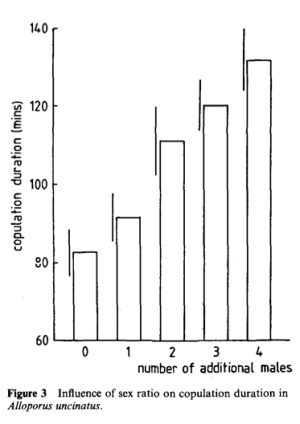
Formally this is called the ‘copulatory-guarding hypothesis’ that predicts that if copulation duration is adaptive then copulations should last longer when the intensity of competition between males is high. Evidence for copulatory guarding has been recorded in some beetles, water striders, and stink bugs.

What we did was test the hypothesis with A. uncinatus by introducing additional males to the close confines of a pair already in the midst of the act.

If the hypothesis was true then copulation duration should increase as more males are added. You don’t need a PhD in statistics to confirm what happened, this graph should do it for you.

In this millipede species at least, males guard females from other males just as theory predicts.

All lives are equal

All lives are equal

All lives are equal

A few years ago Bill Gates persuaded Warren Buffet to contribute to the Gates Foundation and so create the biggest single pile of philanthropic cash in history. This was quite something. Currently, an asset base of over $37 billion is available generating cash to spend on things that Bill, and presumably Melinda and Warren, think are important for the public good.

This is spending greater than the annual GDP of over 100 countries on the UN list. No small matter. And it is a spend that would otherwise not happen because governments or other donors claim they don’t have the cash.

So what did Bill choose? What activities were seen as the highest priority among the many thousands of options?

Even a cursory scan of projects the Gates Foundation supports tells the story. Bill, Melinda and Warren spent money on people. Mostly on activities that improved the lives of poorer people by making them healthier, giving them opportunity and education. All are noble things.

And as a friend of mine once reminded me when I was lamenting the crazy rate of human population growth, you cannot blame the kids for being born. You have to help them.

And so there is a moral imperative to do something for the 4 billion or so people who live on $2 a day or less, have little or no health care, struggle to feed, clothe and educate their children, often with very little hope for anything better.

The philanthropic spend has to be on people.

Governments blinded by GDP growth should take note.

But this is not the point of this post.

Humans have taken over the world. And in it, they have created a highly inequitable and competitive system that by definition generates haves and have-nots. In this place a philanthropic focus on people is understandable. There is always suffering and a powerful need to relieve it.

There is enough suffering to soak up the Gates billions a thousand times over. It is an unpleasant but inevitable consequence of the human condition, a symptom of a much deeper problem.

We are more making creatures.

Our biology drives us harder than we think. Those of us born as ‘haves’ do not notice this very often because with wealth, more making is curtailed somewhat. A couple of kids is usually enough when income is more than $100 a day.

Instead, we channel more making into having more. We gather goods, comforts and money with extraordinary voracity even as we claim moderation and make a charitable donation.

I wrestle with my own complicity in this every day because it is a hard one to shift when there are so many opportunities for things to get better… for me. In a blink and a modest interest-free monthly payment a perfectly functional television and TiVo becomes a 55-inch smart screen and Netflix.

And unbeknownst to us, the more making instinct is soothed. Somehow I feel a little better. Certainly, I feel better enough not to worry about the billions of people the Gates Foundation wants to help because ‘all lives are equal’.

Except it is hard to see equality. Turns out that I will use far more resources than most by good fortune at birth. Most others will use a lot less, again by birth as much as anything. And yet all the people in the world would use more than they do given half a chance.

So despite obvious inequalities of wealth and opportunity, all lives share equal intent. We all want to be more.

Post revisited — the missing link

Post revisited — the missing link

It used to be said that only death and taxes were certain. All else was a maybe. It seems Australians can now add ‘confused climate policy’ to the list of certainties. Since this post first appeared in August 2011 very little has changed. You could even argue that some of the uncertainty has leaked to other jurisdictions and tweets from the POTUS.

And the message is still missing.

The missing link

Some years ago I wrote an essay entitled ‘What if it’s not emissions’. I was not in denial or even sceptical about climate change, more concerned that we had become fixated with emission reduction as the solution to climate change. So convinced had we become that it was a given that if emissions came down, we would have fixed that awkward problem and all will be well with the world.

My real issue was that we risked putting all our eggs into the emission reduction basket.

After more years of political inaction than seems decent, the Australian government has just released a clean energy future policy on climate change. And, guess what? We still have the same fixation. The proposal is all about emission reduction, initially through a tax on pollution followed by a cap and trade system to make emitting greenhouse gas so expensive that no rational business could afford such behaviour.

It might be about emissions, but the policy formulation sees only a modest reduction target – 5% below 2000 emission levels by 2020. This means in 2020 Australia is pledging to emit 509 million tCO2e in greenhouse gases or 56 million less than it did in 2009.

Only by 2020, even with the proposed intricate emissions reduction policy fully functional, emissions of 679 million tCO2e are predicted.

Actual emissions will increase because the Australian population will grow in numbers at roughly 890 people per day, the economy will grow and so will affluence. Economic growth will require energy to follow the historical trend of a doubling in consumption every 30 years. And although the policy does talk about energy efficiency and alternative sources, the required capacity increase will inevitably be met by traditional means.

Emissions growth will leave a shortfall in the target of 170 million tCO2e or 30% of current emissions. So it would seem that the emissions reduction basket has few eggs.

This again begs the question ‘What if it’s not emissions?

Let us accept what the science tells us and agree that it is emissions that are a significant driver of the current climate warming. What the policy shows is that, rather like American debt ceiling, we cannot quite admit the severity of the problem. And, more importantly, we lack the courage to tackle the problem head on. It is just too hard and too scary.

And this would actually be ok if we hadn’t missed the critical issue in all this.

We have stopped talking about how 7 billion people are going to sustain growth in affluence on a warming planet. We have forgotten about adaptation. Forgotten that we will need to use water wisely, deliver sustainable production on farms, and manage our landscapes when the temperatures change, rains forget to fall, seasonality shifts, severe weather events become more frequent and the sea levels rise.

Less than $1 billion of the $25 billion revenue generated from the carbon tax will go incentive land management through carbon offset projects. They will mostly be Kyoto compliant activities such as permanent tree plantings and flaring methane – just as the international agreement to proceed with a second commitment period of the Kyoto protocol teeters.

There will be money for biodiversity initiatives. Good stuff, but just more of what we have already been doing.

What happened to incentives to revegetate the landscape and put carbon back into the soil? The critical activities that will help us manage that scarce water, produce reliable quantities of food and help save what is left of nature. Missing, presumed dead.

Seems like we should ask again, ‘What if it’s not emissions?

Hidden in deep in the 2017 budget papers from the Australian government is an apparent cut to funding for the National Climate Change Adaptation Centre. This centre is one of the few places in Australia with a focus on adaptation, the thing we have to do if emission reduction fails. Something like Plan B that, given the precariousness of Plan A, should be getting a boost not a cut.

Only this is where we are at just three years out from 2020. Devoid of policy, pushing rubbery emission targets out to the distant future, and cutting funding for Plan B.

For the sake of the grandkids, let’s pray that it is not emissions.

What happens if democracy dies

What happens if democracy dies

Suppose the system used in 123 countries that billions of people have come to understand and take for granted fails, initially by electing muppets into office, and then collapsing altogether under the weight of distrust and disillusion.

Many scholars and the very clever writers on the excellent 5th season of Orange is the New Black, have pondered this situation. What happens could be a toss up between a joyous reinvention of commerce and exchange, with unwritten rules of human decency holding everything together, or more brutal exchange systems where the stronger grab from the weaker in a nasty cascade.

Academics play it out more sedately as game theory involving hawks and doves and conclude, mostly, that some sort of balance will emerge, an equilibrium of sorts, but a fragile one that easily gets out of whack. Drama writers just make the goings on in the fictional Litchfield prison ever more bizarre and ever more believable.

Whatever the conjecture, all agree that should democracy fail it will be replaced by something. And there are those who are scared of what comes next and others more confident. But here is a thought. What if democracy has already failed? And failed miserably.

What if it’s not democracy — the process that gives the majority what they want from an array of limited options — that holds everything together but something else.

Perhaps it is the process of exchange where human behaviour is moderated by mutual benefits, initially between individuals and then scaled up. And so long as exchange for mutual benefit is possible, all is well.

This idea also explains brutal exchange. Taking what I need by force is always an easy option in an exchange system but without mutual benefit it cannot persist forever. Human history is all about how brutal exchange eventually breaks down exponentially; think slave trade, apartheid, black integration. The excesses fall away readily whilst the residual lingers for a long time.

What we see as elections to public office makes very little difference to fundamental exchange. The passing of laws and regulation may restrict some transactions and even try to prevent others but not much can stop a deal when there are people willing to take it.

It turns out that a huge amount of what politicians actually do is ensure that exchange is easy, especially with other jurisdictions, and they try their utmost to do nothing to disturb the fragile economy.

So, in fact, if democracy dies, maybe not much happens at all but brutal exchange.

Post revisited – Can we have sustainability?

Post revisited – Can we have sustainability?

There is a problem with sustainability.

It is only possible if the resource base can cope with a human population growing at 8,000 per hour and support the 7.5 billion already here as they climb the hierarchy of needs. Resources must either be vast enough to not show symptoms of depletion or renew at rates greater than use.

This is clearly a very big ask.

Any one action might, on its own be sustainable — always take a reusable mug to the coffee shop — but this does not mean that the supply of beans, milk or the power to run the espresso machine is sustainable.

This post from 2011 explains more…

Can we have sustainability?

Sydney at four million inhabitants is a moderate sized city by modern standards. It is a similar size to Phoenix, half the size of Chennai, and a suburb compared to the 34 million inhabitants of Tokyo.

But Sydney is plenty big enough to have transport problems. The arterial roads that feed into the harbor side CBD are mostly modern freeways, with tunnels and six lane bridges, but they just cannot handle peak flow. Smart commuters travel on the train.

One bonus of train travel is that on the days when you forget your iPod you get to hear people chat. A young couple sat ahead of me on one such day and discussed water.

“No we can’t.”

“Why not?” said the husband.

“Those things just spray you with drips that don’t even get your hair wet. I need to get my hair

wet.”

“What about the water crisis?”

“What about it?”

“Here, the dams at 39.2%”

It was true; there in the black and white of the morning paper ‘Dam levels at a record low’.

Sydney relies on water storage in a major dam, Warragamba, and the rain sometimes forgets to fall in its catchment in the Blue Mountains some 80km inland from the coast. The significant drought that began in 2006 and broke three years later forced water restrictions on all domestic use. To augment supply and reassure consumers there was drawdown of groundwater together with pumping from catchments further afield. And then, just to be absolutely sure, a desalination plant was commissioned and constructed.

The husband pressed his point.

“If only half the residents of Sydney took a shower this morning that’s two million showers,” he said.

“Ah, you want me to sit next to someone who hasn’t showered. Gross.”

“No, if they all showered for a minute less than usual they would save ten litres a minute, that’s 20 million litres saved.”

He said 20 million as though it was a large number and it certainly sounds impressive. The water from a minute of 2 million showers is 20 megalitres, enough to fill 30 Olympic sized swimming pools, provide 2 million toilet flushes or irrigate several hectares of winter wheat.

“I don’t care if it saves the planet I need a real shower.”

“It would help,” the young man said with hope in his voice.

It is easy to imagine a similar discussion over all sorts of conservation actions that can be done around the home. Recycling kitchen waste for example. All it requires is a sealable tub on the kitchen bench.

“But it smells and clutters up the place, get rid of it. And I hate those ants.”

Yet even in an average household it is easy to generate 10 litres of apple cores, vegetable peels and melon skins every week. Then if everyone in the street did it, say thirty homes, then we might see many tons of green stuff that the garbage men would not have to truck, saving fuel and space in the landfill for the garbage we cannot recycle.

There is a 60 litre black plastic bin in my garden that receives all the kitchen scraps. Every now and then there is a layer of brown leaves added and a bucket of water from the washing machine rinse cycle. All those apple cores and potato peelings decompose readily so that the bin is never full, even in winter. The magic of entropy facilitated by the military style operation conducted by decomposer organisms keeps the breakdown ahead of the household ability to generate waste. In spring the material under the bin is carbon rich compost ready to start off the vegetable patch.

If every second household in Sydney did this then, over a few years, millions of tons in greenhouse gas emissions would be avoided just by not having to shift the waste into landfill. There would be issues around nitrogen runoff into remnant vegetation patches from gardens now replete with green manure, but it is food for thought.

These sustainability actions are all good but surely we can do better. It would be great to do more than change the light bulbs, install a low-flow showerhead, manage the compost to help build up the carbon in the stony garden soil, recycle the gray water, install solar panels, grow vegetables and any number of household behaviours for sustainability.

Perhaps we could become self-sufficient.

The reality is that there is little prospect of genuine self-sufficiency for most of us. Even with half a hectare of yard and the compost going great guns, most of the vegetables I grow end up feeding the wildlife. There is greenery but not enough to provide for the family. The household members are also used to vigorous hot showers, power on demand, perfect fruit and veggies, the air conditioner in summer and the fireplace lit when it gets chilly.

No longer do we sit in front of smoky coal grates in high backed chairs with wings to keep the draft off our necks. We are acclimated to an even twenty something degrees wherever and whenever we happen to be. This level of comfort has sensitized us to the point where we really feel deviations from our comfort level, not that a few degrees colder or hotter would have any affect at all on our chance of survival.

We have climbed the hierarchy of needs yet, in our minds, we sit as though we are still at the base level where deviations from what feels safe have the power to upset us.

Does this mean that westerners are desensitized to the problems we have in the environment? Not totally. The media runs stories of environmental challenges and energy saving bulbs are sold in supermarkets. There are energy use ratings on white goods and grants to install water saving devices or solar heating systems.

In Sydney, the Inconvenient Truth made it onto the most watched movie list for a few weeks despite being shown only in selected cinemas; school kids prepare assignments that help them learn about water, land and wildlife challenges; market surveys put the environment high on the list of issues that decide elections hot on the heels of taxes, education, health and the military. Yet whatever we say people still want their needs met. This is their priority.

What we must accept is that our living environment has changed. For better or worse we are sensitized human beings. Most of us really would struggle to survive in the wild and this puts very different parameters on sustainability. Now we must sustain conditions in narrow comfort bands, supply only certain food types and ensure a high level of creature comforts.

The exchange on the train said it all. Not in the words, but the incredulity in the woman’s voice and the despairing logic of her husband.

“Ah, you want me to sit next to someone who hasn’t showered. Gross.”

The numbers are vast. The resource base has to be equally huge or unfailingly renewable if sustainability has even a remote chance.

Only this post suggests that provisioning is not even the real problem.

Our heads are just not in it.