Post revisited – The hip pocket

Post revisited – The hip pocket

At election time jobs, health, education, and security are always at the top of the issues list. They shuffle and compete for airtime but rarely does any other matter oust these four horsemen. In western democracies, where well-being through the delivery of these basics needs correlates with what’s in your hip pocket, the only other major issue is the economy.

None of this is a surprise.

This post from 2010 tried to be optimistic about how the youth might bust the logical assumption that people are programmed only to take care of their well-being and that of their loved ones to, maybe, embrace issues beyond self…


The hip pocket

A young colleague recently claimed that her generation has great concern about environmental ills. She thought that her y-generation all have deep feelings about the woes of our world. They want something done about it, especially climate change. She claimed that late alphabeters are angry at any government that promises action on climate change but then renege as the Australian government has just done.

“Are you sure,” I said, ‘won’t they vote with their hip pockets?”

“No they have all they need,” she said, “I mean we all have food and shelter and with those needs met we want to do the right thing.”

I believed her, at least the intent part. And I am sure it is how she feels herself having moved her own career path away from high finance into an environmental company. Unfortunately I don’t think that we have the freedom from basic needs that our apparent wealth implies.

It may be that most westerners are well fed, sleep in a bed, have a wardrobe, watch TV and take the occasional holiday. And it seems that all primary needs are covered (yes, it is true the TV is now a basic need according to the UK social services) and, therefore, higher values should mature. We should think about values beyond the basic, including care for the environment.

But this wealth, that supplies all the basics and more, has not given us emotional freedom. We are not free to think of higher things because we are still struggling to keep our wealth coming. We are locked into long hours of work to pay for large mortgages, excess food and more clothes than we could ever wear. And as we are at work we have to pay for someone else to look after the kids, and someone to do the washing, to mow the lawn and so it goes. In the end we have to keep the kids at home until they are middle aged to help us pay for it all.

And what if we just stopped? If we gave it all up in order to be enlightened, then the monetary flows so essential for our economies would stop as well. Our material world would collapse in a heap. And, well, it just can’t happen. Back to work we go, stressed to the max, a hand checking on the hip pocket.

Let us hope that I am just a cynic, a product of a different generation, and that the youngsters really do have a sense of higher value – although anyone who has seen a Lady Gaga music video may have to search hard for higher value. Let us hope and believe that these youngsters will vote on their beliefs and give with their voice to help change the way we think. Let us hope that they won’t vote with their hip pockets.


Gen-Y has had a while to vote with their heads, hearts, and feet. Arguably they have not. Although they have tried and are probably more aware than they would admit, the evidence and the anecdote suggests that the tug of the hip is stronger than ever. The cost of living is brutal, the cost of having fun likewise. Don’t even ask about servicing a mortgage.

Arguably they have not. Although they have tried and are probably more aware than they would admit, the evidence and the anecdote suggests that the tug of the hip is stronger than ever. The cost of living is brutal, the cost of having fun likewise. Don’t even ask about servicing a mortgage.

Great-grandparents of these Gen-Ys had a very different hip pocket story. They did it tough too. Recession, depression, low wages, hard and long yards. Their pockets rarely had anything in them as most of the money went from hand to mouth. Yet they toiled and they built. They improved things.

No doubt the current and future generations will do the same. They will, like their wily old ancestors, build something.

Unfortunately, their motivation will again be the tug from the hip pocket.

Are scientists ready?

Are scientists ready?

The peer-reviewed publications series of posts based on my personal reminiscences from my time as an academic has triggered a number of thoughts and emotions. One is the dubious relevance of the work to anything beyond a young academics career path.

Research is intellectual fun and throughout the time I was a researcher, and at intervals later, along with the endorphins I thought that I had helped add another straw onto the haystack of human knowledge. This banal thinking readily justified the most esoteric of studies, including the sex life of millipedes. And there is some logic here, for should the haystack become large enough then any number of problems are crushed under the sheer volume of evidence. At least that is what we used to tell ourselves.

There are people who have rumbled this ruse including Dr Bhaskar Vira of the University of Cambridge who summed it up as “time for university leaders to double down on the interdisciplinary, solution-oriented work that this complex, problem-filled world needs”.

Questions should be asked about the relevance of university research and there should be suggestions made for change. Bluntly, get real or stop wasting taxpayers money.

And why wouldn’t this happen? Surely this is a given and is not a question that should even be asked. After all, academics are smart folk. They ought to know what is needed and how to make the best use of their considerable intellectual bandwidth. But Dr Vira’s argument is that Universities are not structured to allow this to happen and I have to agree.

It was one of the reasons I left the academic system that always felt too lethargic to be part of the real world. There was currency in research output but no requirement for any of it to be relevant and in my discipline of ecology many a long nose was peered down at anything applied to a real-world problem.

No doubt there are pockets of innovation and nimble responses here and there but collectively the system is not delivering on most of the wicked problems. And all that esoteric research on millipedes didn’t either.

Dr Vira asks for interdisciplinary, solution orientated work. Getting people to cooperate outside their specific area of expertise — read ‘comfort zone’ — and to look for solutions through applied research is asking more than most can give. It takes great courage and self-confidence to walk into a room of specialists from another discipline and ask them to work with you. Not many people can do it.

The narcissists, bullies, and fools can, but they are not the source of effective collaboration.

Humans fake cooperation when it is a requirement for a paycheck, so industry and commerce can build teams of sorts, but even when the incentive is clear, businesses need small armies of project managers and change consultants to make sure output happens.

So, can academics work together to save the world from its woes?

Unfortunately, my friends, not in a million years.

Post revisited – Serious change should be controversial

Post revisited – Serious change should be controversial

This little missive from October 2011 laments the loss of meaningful argument over important issues…


Serious change should be controversial

Back in 1979 when I still needed a hairbrush, I wandered the campus of the University of East Anglia as a sporty nerd. I was the type of student who spent far too long in the library but covered up this flaw with an addiction to team sports and the associated drinking games.

At the time I barely noticed that some of my peers were far trendier. They took to barricading themselves in the University registry – the main administration building that housed the office of the Vice–Chancellor and senior management staff – for days at a time. They would drape sheets out of the windows with slogans denouncing whatever oppression they were feeling. Each time the occupation was for a political, and no doubt, worthy cause that usually involved solidarity (a big word back then).

The longest occupation lasted a week. It was in solidarity with mine workers who were on the receiving end of a crusade by Prime Minister Margaret Thatcher to break the power of trade unions. Both Thatcher and those trendy students were railing for or against a serious change.

Thatcher won of course and sent the country into a market-driven phase that arguably brought some prosperity but also eroded much of the traditional political divide and eventually gave the UK ‘New Labour’.

Even nerds got caught up in some of the radicalism of the day, albeit safely. Many of us boycotted Barclays bank because they happened to have a subsidiary of the same name in South Africa. We didn’t realize that undermining banks was probably not all that helpful to the struggle against apartheid but it was a statement we could make on the way to the library. I had my account with the Midland.

Spectacles may be rose-tinted when remembering such heady days, but it does seem that naive as we undoubtedly were, the issues of the time stoked ire and action. Politics was controversial as societies across the world brought about change.

Serious change should be controversial.

It was a big deal to break down union power that itself had come about in a struggle to correct past wrongs in exploiting the workforce; the same kind of wrongs that were fought against in the apartheid struggle.

Today there are still hard and controversial choices to be made, especially about the environment, climate, and resource use, but we seem to have lost the ire and action that sets up an issue as controversial.

At best we get posturing and egoist rhetoric with an occasional ‘straw man’ to give the appearance of real debate. In short, we have an argument for the sake of it. Nobody seems to occupy the registry anymore.

As the Harvard philosopher Michael J Sandel puts it:

“When everyone – Democrats, Republicans, corporations, and consumers – claim to embrace your cause, you should suspect that you have not really defined the problem, or framed it as a real political question.”

We seem to get this all the time in the age of the soundbite. No one seems to define the problem.

Rosy or not we need some true controversy back. Real dissent forces us to argue our position from first principles. We must not just react against the alternative view but think it through and become convincing, drawing on as much logic as we can muster.

Do this often enough and we shake hands with our core truths and get to know the problem.

The result will be some argument, perhaps even a demonstration or two, but also some political innovation. There will be thoughts that are outside the narrow middle ground into which the bulk of the west has converged.

A little controversy might help us to find real solutions to the challenge of keeping 7 billion people happy without destroying nature or each other.


Nothing has changed since this post appeared — apart from the fact that we are now more numerous by about 500 million, that’s the population of the US plus Indonesia who are 3rd and 4th on the list of most populous countries. Political debate is still vacuous and the problem remains woefully undefined. Radicalism has been purloined by a handful of evil people.

Here is a thought as to why.

What if you can’t touch the problem? You know what it is — the unwanted side effects of market-driven economics that, by and large, gives you what you do want — but any attempt to define or even mention the truths of wealth concentration, resource use inefficiencies, debt burdens, bailouts, and plain old corruption; let alone frame their politics. These things risk upset that you cannot control. The economic system is untouchable. Breathe on it and it might fall over or cause chaos.

Instead, modern politicians argue amongst themselves about themselves.

In the absence of anything more meaningful, ordinary people become trolls or commit road rage with little idea of where their frustrations originate.

So we don’t need old-school radicals to occupy University registry buildings and we certainly don’t need religious radicals blowing them up, what we need is to ask and debate some of these type of questions…

  • What would happen if markets were regulated to make them more efficient?
  • Can you regulate without destroying the essence of opportunity?
  • What if there was a cap on profit margins?
  • Would the world end if taxes increased or levies were raised to pay for public services?
  • Is the market really that fragile? And if it is, what the hell do we do to buck it up?
  • Can our unprecedented ability to capture and access information help?

So you see the political frame can be constructed. If a grumpy old blogger can come up with a start, surely the massive bandwidth of human intellect can go on with it.

WHO, WTF

WHO, WTF

I lived in Zimbabwe for two years in the late 1980’s. The country was beautiful, functional and a little of the euphoria of independence was in the air. Only there was also a kind of malaise beginning like a cloud bank rolling in to eventually block out the sun.

People knew that something wasn’t quite right. There was unrest in Matabeleland, not a huge amount of produce in the shops beyond the basics, and a vibrant black market in currency and consumer goods. Locals without external funds had a long wait to buy a new car.

Thirty years have passed and a lot has happened. Unrest, droughts, food shortages, AIDS, hyperinflation that led to the dropping of the Zimbabwean dollar as official currency, involvement in regional war, degrading infrastructure, unemployment and poverty. Today estimates are that over 70% of Zimbabweans now live in chronic poverty

Throughout this time Robert Mugabe has presided over this increasing chaos at the expense of his people, initially as Prime Minister and as President since 1987, using his not inconsiderable political talent for the sole purpose of staying in power. He is 93 years old.

Mugabe is a classic example of African leaders who were first heroes in the struggles for independence, then became despots and autocrats who you challenge at your peril. He has done enough personal damage to have several honorary degrees revoked (Universities really don’t do this), sanctions on his international travel, and calls for him to stand trial for crimes against humanity. Nelson Mandela once referred to Mugabe as ‘a politician who despises the very people who put him in power’.

He is a terrible individual on so many levels, a product of his times that were dictatorial and elitist on both sides of the battle but also an evil individual. His country has collapsed into poverty on his watch with not even a glimmer of recovery on the horizon.

Enter the World Health Organisation.

This week they decided to make Robert Mugabe a ‘goodwill ambassador’.

Words fail me.

The good people of Zimbabwe deserve so much more.

Post revisited – washing machines

Post revisited – washing machines

What does 2 billion look like?

2,000,000,000

A two followed by many zeros. It’s big.

This number of standard sized washing machines would fill over 8 million 40 ft shipping containers, roughly equivalent to the total capacity of the global fleet of container ships.

And before the next generation of youngsters get over their binge drinking obsession, there will be 2 billion dishwashers on earth saving teenagers from Cincinnati to Conakry the indignity of doing the washing up.

Quite the improvement considering that running water only entered the majority of homes after the industrial revolution.

Here is what Alloporus said about washing machines in June 2011…


Washing machines

The number of people with the economic ability to purchase a dishwasher will double to more than 2 billion in the next 30-40 years.

Far more will rise above what Swedish statistician Professor Hans Rosling calls the ‘washing line’; an income of US$40 per day, the threshold necessary to own and run a washing machine.

On the one hand this is a worry.

Energy is needed to manufacture and power all these devices as is a water supply to allow them to function. Policy efforts on climate change notwithstanding, the cheapest power still comes from fossil fuels. It is why China is building coal-fired power stations even as they diversify into alternative fuels because they will need the energy to run all the new white goods.

On the other hand, sales of consumer goods will drive economic growth.

This is good news for those who require GDP growth, the enshrined dogma of political success. Nothing will prevent families from buying a washing machine if they can afford it, nor indeed, airplane tickets, dishwashers and cars as their wealth allows.

Couple this inevitable growth in buying power with ever more people and the growth paradigm has never looked better.

Hans Rosling has a very clever way of explaining the population and economic growth combination using Ikea boxes

It is the economic transition that is integral to the population one.

Without economic growth it is harder to see population growth slowing and eventually contracting. Children must consistently outlive their parents for this to happen and that means needs must be met and standards of living must rise.

It seems that we have not fully embraced this reality.

No amount of environmental concern, moral imperative to preserve resources or even fear of environmental collapse is likely to trump the imperative to improve things for our families.

For this is an expression of self-preservation that is hard wired?


There is a reason that Rosling’s Ikea box video has appeared several times on this blog.

It is the best and most accessible explanation of what will happen to the human population of this planet under business as usual. It is also the most likely outcome baring collapse.

But that number, 2,000,000,000 remains hard to fathom.

When the number refers to washing machines an armada like no other is needed to move them to a point of sale. There is such a global fleet and it is ploughing the waves right now heavily laden.

Innocence of youth

Innocence of youth

YouTube has thousands of videos of kids being cute. Not quite as many as there are of cute cats but a lot.

Many of the kids videos are so endearing because the little darlings are cooperating, making reasoned arguments, listening to each other and showing compassion. They are being their unsullied selves even with chocolate ice cream all over their face.

This purity not only generates clicks, it shows us truths. Gentle yet powerful reminders of the way things should be done if we want a safer, more humane world.

Elizabeth Broers, a head teacher at a primary school in the UK, knows this better than most and wrote about how her 11 year olds could give wise counsel to politicians. The most provocative being ‘be honest’.

Youngsters can smell a fraud from 50 yards and then call it out, often with some cruelty — yes, they have that too. And this is clearly the trait most lacking in our pollies.

And this is clearly the trait most lacking in our pollies.

It is trite to suggest that we elect a few adolescents to parliament because they would drown in a tsunami of cynical narcissism that would knock them flat as soon as they walk through the door. No, we need to let them spend their youth learning how to mask the smell of the dishonest otherwise they will have a difficult life. We can’t send them to the parliamentary penitentiary, that would be too cruel.

So what about if we get our politicians to grow down.

Send them to spend a few working days a year in a primary school. Not for the photo op but for the experience, in the playground at little lunch, in the classroom, and even in the 4×4 on the way home.

Let them see what a kid sees for a few days a year, as though they were a kid.

If it made them even a smidgen more empathic it would be a start.

Interesting take on sustainability

Interesting take on sustainability

Our problems go far deeper. We are going to need a rapid and fundamental shift in our values, habits, behaviours, and outlooks.

Marc Hudson

This is a UK academic talking about the empty rhetoric on “sustainability” and reminding us that we’ve known about the problem of using up resources faster than they can be replenished for at least a century, longer if you agree with what was written about the ancient Greeks.

We are no more sustainable than an eBay shopper with a credit card.

As Lilly Allen wrote, “we are weapons of massive consumption” and its not our fault.

We can spruik stewardship of natural resources, modern simplicity, even organic foods but the reality is we are consumers. It is what we do. Not even a circular economy can fix this core trait that is glued to our limbic system with aruldite.

We might need a fundamental shift but no amount of sustainability rhetoric can change the reality that the human condition is to progress, individually and collectively. We all benefit from this for despite global and local problems — and there are many — on average, conditions for the majority are far better today than they have ever been.

So I would argue that sustainability, together with its architects, advocates, and acolytes, are just our conscience talking. Well, whispering actually from the deeper recesses of our reptilian brain stem.

Sustainability, resilience, adaptability and other offerings more at home in the 1960’s are words we know we should hear and act upon but we just cannot make the fundamental shift.

My contention is that we are just not wired for the change that is needed.

Now, if you’ll excuse me, I need to make a sneaky last second bid on one of my watched items.

A post revisited — BMAD

A post revisited — BMAD

Humans are fickle creatures. Yet, as David Hume, the Scottish philosopher, figured out over 250 years ago, we are driven by our passions far more than reason. It can take an unearthly level of persuasion to alter a passionately held view even if there is irrefutable evidence. And many a time the view prevails.

This story about conservation in the face of scientific evidence makes the same point…


It is often said that the end cannot justify the means. This adage comes for the logic that an immoral act is an immoral act irrespective of when it occurs or for what reason.

The other day I witnessed an argument that left me thinking how this is adage is rarely applied.

The discussion began over a conservation problem that is becoming widespread in the eucalyptus forests of eastern Australia. Mature canopy trees are dying from infestations of sap sucking insects that proliferate to reach huge numbers sufficient to defoliate the tree. This explosion of insects and damage to leaves happens where a bird species, the bell miner, is abundant.

Rather than eat the insects, bell miners eat the sugary lurps that the scale insects use to protect themselves – it is a little like harvesting, for the insects regrow the lurp that covers them and the birds come round again.

Bell miners are aggressive birds and chase away other species. This lowers the predation rate on the insects that, over time, means more insects. The insects feed on the leaves that eventually succumb. When the trees lose too many leaves they die back. The process has been given an acronym BMAD; bell miner associated dieback.

Bell miners do well in disturbed forests because they like the dense undergrowth that comes when a forest is altered by fire, logging or other human interference.

Once established the best way to slow the spread of BMAD is active management involving the removal of shrubs. This means suppression through mechanical means, sometimes fire or, more usually, the application of herbicides.

These are drastic interventions of the kind that the conservation movement opposes with religious fervor. Only BMAD is far worse. So even among the ardent conservationists it has been accepted that intervention to remove shrubs is necessary. It is acceptable to manage with interventions of herbicide a habitat that was disturbed.

All good so far. The argument came of over the next issue.

Someone made the comment that ecologically endangered communities could be managed for improvement.

‘No, no, no you cannot do that’ was the indignant cry. ‘You cannot mess with an EEC, you just can’t.’

It was seen as a morally abhorrent suggestion. If something is designated as endangered it is suddenly untouchable.

But why not actively manage? Is it not exactly the same as the intervention proposed to tackle BMAD. In that thorny issue the end justified the means. But the same means cannot be applied to an EEC.

So in the real everyday world we have selective morality.


Let’s just rephrase this outcome.

A Threatened Ecological Community is determined as such by a Scientific Committee that sits in a room in a city and decides a given vegetation type is rare enough and its integrity and longevity threatened enough to meet a set of listing criteria. The committee members review evidence and decide if there is sufficient threat to place the vegetation on a list of habitat types at risk of extinction.

This appraisal confers some protection where the habitat type exists in the landscape. More critically it confers that protected status in the mind of the conservation manager who could contemplate active management for lurp control but not in a habitat that the evidence said was threatened with extinction. That had to be left to be as it is, even if the habitat was degrading and on it’s way out.

No amount of evidence could shift this view. Ironic given the process of listing is supposed to be science based and objective.

Selective morality is not exclusive to environmentalists but they are very good at it. In a way they have to be because there are few options in a world built and driven by profit. They are forced into leaving alone habitat that will degrade in the absence of active management because management is associated with negative outcomes.

Their passion for protection drives them far harder than any amount of reason.

David Hume’s ghost cannot resist a chuckle

Political argument

Political argument

It’s a Saturday lunchtime and I am at home minding my own business when a 60 something couple wearing matching purple polo shirts saunter up to my front door. One of them knocks.

“Hello, we are from the Coalition for Marriage”, the man said as he thrust a pamphlet towards me as though it were a weapon.

“G’day,” I said, “what can I do for you?”

“We are worried about civil liberties,” he said.

“Really,” I said, “And why would that be?”

“This legislation will open the door to a vast erosion of civil liberties, just like it has in 24 other countries. It’s all in the brochure.”

“Really,” I said again.

Now I should point out that Australia is in the throes of a postal vote on the question: Should the law be changed to allow same-sex couples to marry?

Yes, I know we are way behind the times. It is possible that down under is still in the era of big hair and shoulder pads or, at best, still partying in the millennium. Our political dithering has become laughable with same-sex marriage just one of any number of issues where neither major party are able to find a consistent policy. The go-to solution being to punt decisions down the road for another day or at least until all the excuses for dithering are exhausted.

Still unable to find their consciences on equality, some bright spark in Canberra thought a ripper solution would be to have a postal vote on the issue, a plebiscite costing $122 million. The dictionary says that a plebiscite is the direct vote of all the members of an electorate on an important public question such as a change in the constitution. Few will doubt that same-sex marriage is an important issue but all it requires is some common sense, it is not a constitutional crisis.

It is obvious to anyone with an ounce of sense in their noggin why we are having a voluntary postal vote in a country where voting in elections is compulsory and most under 25 would not even know where to post a letter on a topic that should be dealt with in the parliament like all the other issues of the day. It’s the only way the minority ‘no’ has any chance of winning.

But I digress.

Gathering my senses I stepped out onto my front porch and looking the gent in the eye I said, “Can you explain how this matter alters my civil liberties? If two folk want to get married, what could that possibly do to affect me or you?”

“It has happened in 24 countries?”

“What has happened?”

“It’s in the brochure.”

“Forget the brochure”, I said, “Can you explain to me how, if a gay couple across the street gets married, that has any effect at all on you or on me?”

“This will mean, well not this but later legislation will erode our civil liberties.”

“How so?”

“It’s happened in 24 countries, it is in the brochure.”

“Forget the brochure. You are here at my home, you tell me what your argument is?”

“There will be later legislation that erodes our liberty.”

“Again, how does a couple across the street getting married affect your liberty or mine?”

“It will be later laws..” my visitor’s voice tailed off because even if he had read his brochure he could not articulate an argument for his position. His wife, at least I assume it was his wife, just smiled and nodded.

“Hold on,” I said, “the sum of your concerns is that maybe some future legislation may come in to erode civil liberties so you want me to vote no on this current issue?”

“Yes,” he said.

“And that’s all you have?”

“Yes.”

“Well, thanks for dropping by”, I said, “both my wife and I voted yes.”

“That’s great,” the wife said, “so glad that you voted.”

The couple left and I reflected on this unusual interaction rather more than I thought I would. Not on the topic of marriage equality for all discrimination should be weeded out from our social systems, bit by bit if necessary. Arcane rules that prevent another person the same liberties to love and marry that I enjoy should be removed and pass into history. Yes is the only morally just answer to the plebiscite question.

What got me was the debate or lack of it.

Here was a topic that two ordinary folk felt strongly enough about to give up their Saturday morning and go door knocking. Yet when pressed for some logic or rationale for their viewpoint they had none. Well, they thought that they did, but imagining some future disaster fails any pub test that I know about.

It also showed that these folk knew little about the political process. The deals in the corridor, the politics over policy, the influencing over persuasion, the burying of the real issues, and the downright bastardry of it all. This seemed lost on them. They came across as naive and I believed that they were.

Foot soldiers are not generals. They supply the delivery grunt at the bidding of the strategists and given this role, I should give them some slack. Perhaps I was expecting too much.

It’s just that we debate so little that when such an opportunity presents itself there is a degree of excitement at the chance. Perhaps I was too excited. Perhaps I let my love of a good argument get the better of me.

Whatever the emotions in the encounter the real reflection was the lack of political argument. There is plenty of polarised opinion but very little to explain why. We are struggling to articulate a position on issues of all kinds. Not able to understand where they come from or any logic that might underpin them, our opinions just appear like blind faith.

So I am very grateful to the Coalition for Marriage. They taught me an important lesson. If you have a strong opinion, make sure you know where it came from and why you have it.

You might need to justify it someday.

Cubitermes sankurensis

Cubitermes sankurensis

Peer reviewed paper series

Dangerfield, J. M. (1990). The distribution and abundance of Cubitermes sankurensis (Wassmann) (Isoptera; Termitidae) within a Miombo woodland site in Zimbabwe. African Journal of Ecology, 28(1), 15–20.


Early in 1987 all efforts to finish my doctoral thesis seemed fruitless. The data were in and the structure agreed with an array of supervisors delivering comments and instructions all taken on board. I recall that the first few chapters were written and re-written any number of times before they were deemed satisfactory. The process was rigorous and arduous as each chapter was given painful birth. I was over it.

A choice was needed to fight or flee the adversity. Such moments happen to everyone at points in their lives. I don’t recall the exact day but the decision happened to cease prevarication, lose the perfectionism excuses, and push the thing over the line. It worked. Within a couple of months my thesis was submitted for approval and for the first time I realised what can be done when the brain actually pays true attention to a task.

Much later I also found out that you couldn’t force this focus. It comes on its own when it’s good and ready. Uncannily, but only if you let it, focus arrives in plenty of time to meet deadlines.

The problem with the burst of energy on my thesis was that I finished it. Now it was time to find something to do with all the education.

NHM South Kensington

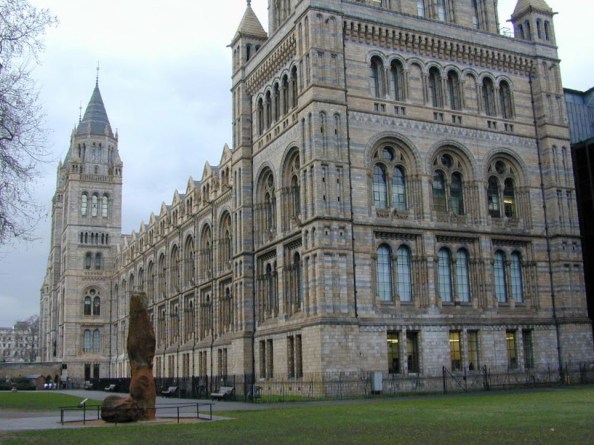
The Natural History Museum in South Kensington is a true wonder. It has some startling public galleries with homages to the Victorians who established and built its edifices and its reputation. You can feel very small standing beneath the blue whale skeleton and minuscule in front of the marble statue of Charles Darwin.

What the public don’t see and very few visitors will know is that the building also houses biological specimens from every corner of the globe. These vast collections are all immaculately curated and stored in thousands of drawers and jars in rooms that smell of naphthalene. This wealth of biodiversity is the raw material for systematics, the branch of biology that deals with classification and nomenclature.

Among these many specimens are termites.

For a week in the late summer of that thesis year my eyes were glued to a microscope trying to find the teeth on the left mandible of major soldiers. Thanks to an uncanny alignment of the stars my immediate future was to be as a postdoctoral researcher at the University of Zimbabwe, the opportunity of a lifetime. And what else could a soil ecologist study in Africa than termites. They have, after all, eaten the continents architectural heritage and ruined any number of crops.

So here in the corridors that the public don’t see, I was doing my homework, cramming for a taxonomy test like no other and, thankfully, meeting some taxonomists who would be a huge help when it mattered.

My focus was the fungus growing species, the Macrotermes, whose soldiers have mandibles big enough to be sutures on wounds and whose workers build mounds literally the size of a house. So it was inevitable that the first research was on the soil feeding species Cubitermes sankurensis that was not on my homework list and builds soccer ball sized homes.

‘The distribution and abundance of Cubitermes sankurensis (Wassmann) (Isoptera; Termitidae) within a Miombo woodland site in Zimbabwe’ is not the most erudite contribution to ecological science ever made. In fact, it is a huge surprise that it was published at all.

A few mounds were mapped and the number of termites estimated by correlating mound dimension with the number of termites counted in soil cores taken from a sample of mounds. Around 1,000 termites per square meter, the numbers said but what this actually meant it was hard to say. There was no evidence at all really.

It is hard to know how many peer-reviewed papers are like this one. Nothing obviously wrong and yet little, if any, knowledge gained.

There were plenty more termite mounds to measure and later work produced more useful information than no obvious pattern between vegetation structure and the distribution of termite mounds.


By the way, for those sharp-eyed naturalists the header image is, of course, not Cubitermes but a species of Odontotermes, a fungus growing genus, that needs the wide vents to keep the fungus garden moist.