This post is a little petty, a bit of a whinge, and yet necessary.
There should be some advantages to high office. Typically the benefit is not stellar remuneration. For example, the Prime Minister of Australia earns A$550,000. Whilst this amount is considerably more than the average punter, the top ten CEOs in Australia all earnt over A$10 million in 2019.
If you want to make millions don’t try for the top political jobs. You won’t starve but you won’t be buying a yacht anytime soon. You will need to borrow one from your business mates.
The head of the Reserve Bank of Australia, technically a bureaucrat given that the government pays his salary, Dr Philip Lowe earned just over A$1 million in 2019 and was responsible for managing a $182 billion balance sheet. The highest-paid pure bureaucrat was the Department of Foreign Affairs and Trade secretary with a total remuneration of $936,442.
Alright, so the more significant monies go to the private sector and the help.
Now I am not sure this is even remotely sensible for two reasons.
The first is that how are the best people for the job going to apply if they can get an order of magnitude better money elsewhere. Politicians are underpaid. Never thought you would hear that one. Only the current crop is overpaid for their capabilities but if we are to attract the best to do the toughest jobs, we need some pay parity to make the remuneration for messing about in parliament worthwhile.
The second reason is that CEO salaries are way too high. The way to achieve parity is to get a grip on the private sector’s excesses. Sure a reward for responsibility is necessary and they also want to compete for the best minds but really, $10 million. That is just taking the piss.
But wait, I have missed something.
There are perks to high office.
Here is one taken up with extraordinary enthusiasm by the recent POTUS.
Meantime the CEOs are circling their wagons.
The biggest Australian telco, Telstra CEO decided to blame the kids. Back in 2019 he was quoted as saying “Young kids are earning $5m playing Fortnite but when a business executive devotes a huge portion of their life … that it’s somehow morally wrong they get rewarded for it.”
Wait a minute.
A youngster with millions of online followers who love everything their hero does can earn a hefty sum. This is a simple supply-demand function that the CEO should understand. Just that same way that top-level professional soccer players with massive followings for themselves and their clubs can command crazy salaries, the CEO can get one too.
Perhaps not.
The point is the balance has gone. High public office should be rewarded by more than a medal for service and the CEOs should be paid on performance, not by their mates on the board.
Australian billionaire, Solomon Lew, pocketed $24.25m in dividends after his retail empire, Premier Investments, received almost $70m in wage subsidies during the coronavirus crisis.
What bullshit is this.
If 50% richer during a global crisis that put workers into lockdown in their homes doesn’t raise your hackles, then paying out big dividends to shareholders with one hand whilst holding out the other for a subsidy surely will.
It makes the abuses of power by Trump look benign.
I’m on a roll and my words per day have been through the roof.
As a writer such bouts of productivity are to be cherished because they dry up as fast as they flood, the block kicks in, and suddenly you’ve got nothing to say.
My problem is that this particular spurt of enthusiasm has lasted the best part of a year. There is a lot of material that needs to be tidied up.
The writing gig is a long process. Only the first part, maybe 20%, is origination. The inspiration strikes and the first splurge of vomit makes a splatter on the page. The next phase is to tidy up the mess.
Making sense of the first draft takes numerous waves of editing and rejigging in order to shape a narrative that is, at least in the writer’s mind, comprehensible.
After that, the process involves third parties engaged with structural and copy editing, as well as preparation of material into the various format to share with the world.
The process of writing is a mechanical one, way more drudge than inspiration and creativity.
My current quandary is, do I stop writing and begin the real work?
Whilst I’m on a roll this seems like a mistake. I must keep going whilst the muse is dancing away in front of me. Only, where will the time come from to clean up the mess?
I really don’t know what to do.
The process of science
Science is the same.
As a student, I was always told that science is 5% inspiration and 95% perspiration. A quote pilloried from elsewhere no doubt but no less true for lack of originality.
The process of science goes something like this.
An idea worth testing springs to mind, typically on a topic that you find fascinating. Maybe you spot a gap in knowledge that an experiment or a set of observations can fill.
That moment of clarity will set in train several months worth of hard work pulling together the evidence through experiment or observation. More often than not the procedures need development and fine-tuning, it can take a week to calibrate a measurement. Once the set up is done the data collection begins and last as long as the test requires. A while if the subject is the gestation period of an elephant. Then comes the collation, analysis and interpretation of the data into evidence. This in itself can take months with the prospect that the hypotheses will need clarification and another experiment or two completed before the evidence is clear. All this must then be condensed into a short communication that peers will tear apart before an editor maybe gives the green light to publication.
All up, an equally long and laborious process as writing. More a slog than an inspiration.
Few research scientists have the luxury of hanging about in the fun of speculation and hypothesis generation. In science, there is no substitute for the effort needed to generate evidence. There is no evidence without the hard yards in the laboratory or the field.
Even if you are the theorist who looks to the mathematics of it all, there is drudgery in the proof.
Evidence takes hard work.
Now for an apparent non sequitur
The process of sustainability
The conundrum of ideas versus hard work applies to a whole range of our sustainability problems.
We know that ideas are inspirational and they can come together in a flash. They are fun and full of promise and there are lots of sustainability ideas around. Google delivers 290 million results for the search term ‘sustainability ideas’.
The conversion of ideas into practical solutions is the hard part. Actions that are actually going to make a difference to human use of natural resources on the ground and at scale. Most of this is just a lot of hard work.
Check any list of ideas for sustainability like these
They are all fantastic options. Societies everywhere should be onto them and thousands of others like them.
All these ideas have one thing in common. They take effort to implement.
The wondrous inspirations need hard work to achieve their desired outcomes.
Sometimes there is more work required all the time, sometimes just in the transition, but the core message is that sustainability is not an easy task. It’s particularly difficult against the current technological advances that generate cheaper unsustainable products and services.
Being sustainable is not really about the sustainability concept itself, it’s more about the fact that society exists in this process of inspiration and hard work.
We can’t just make a call on the inspiration. There’s a lot of hard work involved in making sustainability solutions stick.
Worth remembering when the next idea to save the planet comes along.
The reason I could get a laugh was that I said what most people wouldn’t. What humoured them was the fact that their repressed thoughts could come out of someone else’s mouth.
Presumably, this is one of the rules of comedy.
I used to be able to read the room and figure out what the tension was, the issue or politically correct motivation that was dominating the conversation.
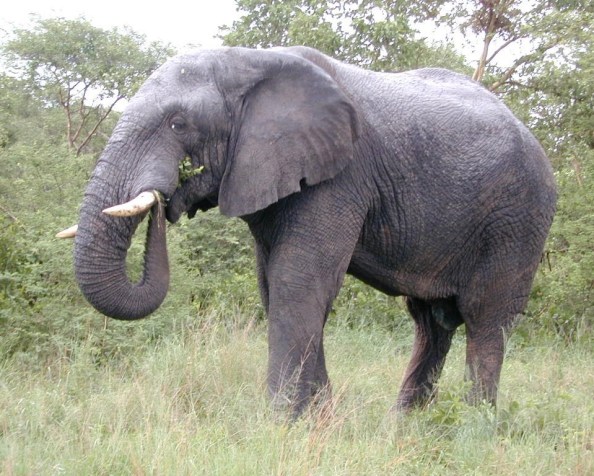
Once cornered I would point to the elephant or perhaps the pile of steaming dung on the floor and make a few deprecating remarks about how silly it was to be so worried about a fictitious beast that could not possibly be on the 63rd floor of a city office block.
Nervous hilarity usually ensued.
Not so much these days. Maybe the pungency of the dung doesn’t translate on virtual meetings.
I still make my wife laugh, thank goodness.
What a pleasure that is and a true test of a good relationship. I can be myself around her, say crazy things, be a bit wackadoodle and she loves it. Thankfully she is still invested.
For a while now I have struggled along in a very toxic workplace where mediocrity is considered poor form because it might show people up. Everyone is operating way below their capacity thanks to an atmosphere of fear delivering insecurity, all promulgated by the leadership. A nasty situation.
It has sapped my energy and made my normal humour redundant.
Trying to lighten the mood and bring people some levity in their being is vital because most work meetings are not that important after all. Not to say that good governance and its efficient delivery is not important. It is vital to our society. Poor delivery of law and regulation is actually cancer on democracy that will eventually bring it down.
Only without some levity, all sense of proportion is lost.
Nobody knows what really matters or when to be serious or when to make decisions or that it really does not require an hour to decide if we use Zoom or Microsoft Teams.
Stress is an extraordinary phenomenon. We are all struggling to cope with a pandemic and ‘that year’ where in Australia, we had drought, heat, wildfire, flood, a pandemic, and runs on toilet rolls.
It’s a challenging time to stay light.
Back in my days in southern Africa, the Zimbabweans always used to say about any grumpy individual that he had a “sense of humour failure”.
I fear a terminal case of that presently.
So I’ve been trying to figure out how to regain my sense of humour.
Meditation helps, of course, as does exercise. And yoga would too only seem to have lost the urge for that. So deep has the malaise become the only thing that seems to keep me sane is writing. It helps to put into words some of these difficult and challenging feelings.
There are days when the lightness returns and some humour is possible. I hope that those days will become more frequent as I come to terms with a difficult situation.
So keep your pecker up young man, your chin somewhere towards the sky. And hopefully, that sense of humour and lightness about the world will come back, even in these challenging times.
See, even if you just talk to yourself it can help.
Don’t forget there is always a little giggle to be had from the aphorisms of the The Confused One
When I was a kid, I was a Leeds United supporter. They were top of the league at the time, had the best players, the best team, and I loved their funky logo, very 1970’s.
I painted it on my school satchel.
This was a risky thing to do given that I went to school in North London, a spit and a shove from White Hart Lane, the home of Tottenham Hotspur, the team most of my school mates supported. And, of course, Tottenham is up the road from Highbury, the home of Arsenal FC and the enemy in one of the biggest local rivalries in soccer.
In fact, it was a huge shock when my son who was born in Zimbabwe and raised in Australia turned out to be an Arsenal supporter. What was he thinking?
My excuse for not ‘go you Spurs’ was that I had no sense of association with the area having just arrived from two years in the north of England and then prior to that as a young kid in South London. No affinity for North London at all really and so I aligned myself to the club that was doing the best at the time, the one at the top of the league.
I’ve noticed that throughout my life I’ve always latched on to the team or the player who was the best at the time. I admired that ability to become the world’s best or recognized as one of the best players of a particular game.
These days when I must decide between England or Australia during the Ashes tests, baracking for the best is a problem. As a cricket buff it’s kind of fascinating to want the home country to win or the best team to win which invariably in recent years at least has been Australia. Often I will cop out and follow the players who I think are the best out of those two teams, again most often Australian.
My focus is on high quality wherever I see it and not just barrack for those people but to follow them and to recognize them for their skill and artistry.
When somebody stands out from the pack because they’re genuinely good then I recognize that straight away and become a fan. Interesting to understand why that’s the case, why I’m going for the best team at the time.
Leeds United of course has been in the doldrums for decades. After relegation from the first division they struggled in the championship only this year to return to the Premier League. I have no idea who plays for the many more. I know they have a dynamic manager who’s given them a new way of playing and their current success. And I wish them well and I hope that they do well but I don’t follow them in the same way as I did as a kid.
Looking back a big part of this risk taking – wearing a Leeds United scarf to Stamford Bridge in the late 1970’s was reckless – was me going against convention. I wasn’t following in footsteps or the tribe. At least not of tribalism that has to do with why people support their local teams through thick and thin. For me, it’s about a search for excellence and an insecurity in my own ability.
I want to manage my own sense of inadequacy by looking up to people with talent, recognising high quality and becoming a fan of not necessarily the individual or the team, but the qualities that they represent.
That way, I always have something to live up to.
I find this motivation useful in just about everything that I do. Even when I tried woodworking, which I’m dreadful at, and put together tools and the skills to try to have a go at it. I went to the great training ground of YouTube and found incredible individuals who were able to not just demonstrate skill in construction with wood, from the basics through to some complicated solutions, but we’re good at explaining it. They made woodworking accessible and the skills learnable through humour or an ability to take a process and break it down into its constituent parts. After many an hour across multiple channels looking at the woodwork material I now have a reasonable idea of how to do it, at least not to make a complete hash of it, and hopefully keep myself safe.
My problem, as regulars will know from the sort of post on Alloporus, there’s always a challenge in there somewhere. The challenge of seeking excellence is this.
I have lost the ability to find excellence in the workplace.
Many of you will know that I work in the environmental sciences. My role as an ecologist is to try and understand how the natural world works in order to better apply policy and practice.
At the moment the application is to agricultural production systems and balancing agricultural production with other values that we gain from the environment.
I have struggled over the last decade or so to maintain that sense of who should I barrack for? Who can I see that is demonstrating excellence in this process. Who is really across there portfolio and understands the processes and what’s happening.
To be honest with you, I don’t have those people anymore.
As a young academic I found such individuals easily. They were the senior professors and the prolific academic writers who were able to talk with true depth of understanding. Whenever they said something I would think, ‘I didn’t get that, you know, I need to learn more from what this person is saying’ and off I would go to the library. Maybe I put those people on a pedestal a little, but they were extremely helpful in guiding me forward.
One of the reasons that top academics achieve success is because they’re knowledgeable. They read a lot. They spend hours and hours and hours reading up on their discipline and unpacking the information. It’s not about smarts, more about absorbing and putting content into context. And individuals good at this were never short of an answer or a pearl of wisdom. So I tried to be like them. I tried to gather as much information as I could and I think that, over the years, I’ve been reasonably good at that.
Perhaps my weakness is that I am interested in so many different things. I have more breadth than depth. That is not so good if you want to be an academic but perhaps not so bad a thing if you’re trying to be an environmentalist or to create genuine sustainability outcomes.
Breadth distances you from the main players. A shortage of these well read people in the latter part of my career is perhaps understandable. Those individuals I admired have either retired or have passed away. The youngsters coming through are out of my reach now that I’m no longer in the academic world.
In the applied work I now find myself closer to the operations of the environment on the ground. The quality of knowledge is different. People know about their local circumstances. They know about the local situations they’re dealing with and are not lacking in knowledge. But they’re mostly ignorant of the sort of theoretical and structural underpinnings of their subject.
I have local knowledge too from the many years spent trudging around in the field collecting data. But it wasn’t their fields, Mostly it was fields on other continents. And it creates a gap in the sense that they don’t believe that I understand what they’re talking about because I don’t know their local circumstances.
And they don’t know what I’m talking about because they lack that knowledge of the theory and applying the theory to the practice.
I feel at a bit of a loss to be honest, desperate for the workplace equivalent of the best player and the best teams. I can’t find them, nobody available to latch onto and regain a sense of motivation and something to work towards.
Unless of course, they don’t exist. And so we arrive at the nub of it.
Maybe we don’t have these people that understand the bigger picture. At least in the way that I’ve been trying to understand it for the last decade with breadth rather than depth.
We’ve seen that Donald Trump was a bumbling politician, had no idea what he was doing, and had no idea of how to win an election. He fluked the first one on the back of heavy popularism and failed miserably to repeat the exercise.
It’s easy to convince ourselves that the US election result in 2020 was a great win for common sense. For the sensible majority to pat themselves on the back for coming back from the brink of disaster.
Except that, number one, Trump was elected the first time around.
Number two, he still won more votes in the election the second time around than any other President has won bar Biden. Seventy million people plus thought he was still a good idea. Even after four years of total nonsense and chaos.
And it would be very wrong indeed for Democrats to simply assume that it’s all back to business as usual. Bask in the joys of a net majority in the population and win on the back of that whilst hoping that the status quo will return.
Heads up, there is no question that popularism will come back.
The right will continue to develop more competent candidates for future presidential elections. It has happened already in other countries around the world: India, Brazil. Russia, Turkey already have competent politicians who fit what you might loosely call Trumpism. A would-be strong populist stance, only they are much better at it than the Donald.
This problem is that division is not going away just because Trump was removed — well, at the time of writing he still hasn’t actually gone, but we’ll assume that justice will be done and eventually the oval office will be vacated. The reason Trumpism won’t go away is because of what it represents. It’s actually all about resources and access to the wealth that those resources create. For with wealth comes power.
The human instinct is to grab and obtain power, maintain it, and grow it. A reflex that has given us success as a species and will never go away.
Breaking down this approach that is so innate in our biology, if we hadn’t grabbed resources and concentrated them in organised units, then we would not be here having this conversation using this technology. To simply remove that approach is not only difficult biologically, but it’s also near impossible psychologically. Hence the failure of communism, evening things out is simply not how humanity works.
Humans are designed to be competitive and to want winners and losers in the system. Politics is about giving a safe place for those winning and losing wars to be fought and for outcomes to be given at least a little empathy and equity. The reality is that in recent times the wars are being won by the right, by people with a lack of empathy and a very strong sense of that wealth creation gene that leads to power — those of us alive in the UK during the decade of Margaret Thatcher experienced something similar.
So don’t be surprised at all if much more competent Trumps appear. They won’t be orange, they won’t tweet all day, and they won’t play golf when it’s time to make a decision.
They will be as hard and as politically savvy as anything we’ve ever seen. And they will push their agendas as forcefully as any other political party that you could imagine. The only way to win against such candidates is to galvanise the majority who we hope, and I say hope because I’m not convinced of this, are fair-minded and empathic to others. Then for everyone to become aware that wealth is not the be-all and end-all and that there is a moral responsibility to look after the less fortunate.
Ironically, most modern societies actually do this rather well.
In many countries, there is a solid and functioning education system, law enforcement, healthcare of sorts, and realistic infrastructure. Many of these services are provided by the taxpayer so they are paid for before households have discretionary funds. These systems provide opportunity and support people.
Obviously, it is not perfect. There are many who are not supported well enough and do not have sufficient opportunity. The thinking is that these were the Trump base, the disadvantaged and the stagnant, those who lost faith that there was an opportunity.
Maybe so but there are 70+ million of them in the US alone. It’s hard to believe that they nearly made a majority, that is ‘most people’.
It means that the things said and done by governments, even the centrist ones, have failed to maintain the well-being of everyone whilst still allowing the system to continue to progress in technology and wealth. What was working ‘rather well’ isn’t anymore.
Centrists beware. Trump was a was not an aberration. He was lucky and he took advantage of an opportunity. But there will be people who will follow him that have a better grasp of the politics and better grasp of the policy in order to push that right-wing agenda of more rewards for the winners and more pain for the losers.
They are unlikely to appease those who lack opportunity but that does not seem to matter. In the time it takes for their popularity to wain a great deal will change.
Are we ready enough to cope?
Thanks for reading these posts, it really helps to know that they might tweak some healthy thinking
Jill is so excited. She has invited the whole family and her besties around on a sunny sunday afternoon for tea.
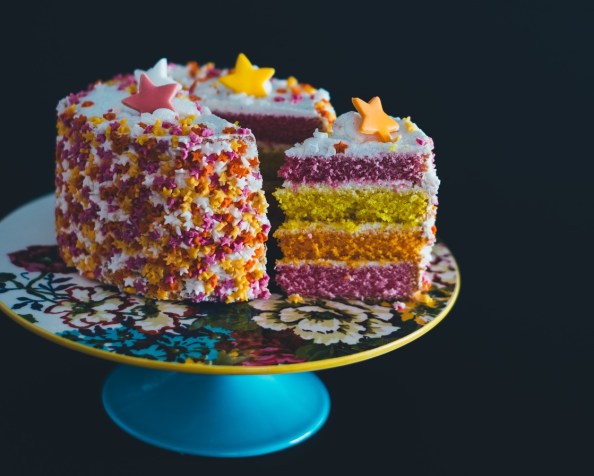
On the table is a beautiful cream cake.
Her husband Joe joins his heavily pregnant wife at the table along with their son Billy and he announces that it is time to cut the cake. The gender of the unborn baby revealed to the expectant audience.
What will it be?
The excitement builds, will Billy have a brother to beat up or a sister who will run rings around him before breakfast?
In the mother’s belly, the baby is wondering what all the fuss is about and wishing that its mother would stop stressing and go lie down.
The mother and father hold the knife together just like they did all those years ago and plunge the blade into the cake.
Squeaks of delight from all the single ladies while the mothers clip their little Johnnies around the ear for pigging out on the sausage rolls.
A second cut. It is the moment of truth.
The slice emerges from the creamy camouflage to reveal… beige.
It’s a gender-neutral baby.
OMGs all around, what is going on?
Shock and blank stares and a few chuckles from the early adopters.
Joe rotates the cake and quickly cuts another slice, maybe the reveal is sector-specific. He lifts the next slice and the crowd gasps. It is still beige.
This baby has no gender. It is destined to live life on the outer rim of society never fully accepted by any social group.
At this point Joe’s mother-in-law steps in.
She snatches the knife and begins to hack away at the cake as if her hand will obviously find the blue or the pink bit.
But no. There is no colour.
It is either the wrong cake or the baker forgot to add the food colour. The gender of Billy’s bro or sis is still a mystery.
What happens next says everything about the human condition.
Everyone could all have a laugh and do it all again next week with a coloured cake or…
Jill shouts at her husband, bursts into tears and runs up the stairs bawling with embarrassment. She had spent weeks preparing for this only to have a disaster in front of all of her friends. Her anxiety spikes and suddenly the sky is falling in.
The mother-in-law clubs the husband with the phone as though it is all his fault, then calls the cake shop to give them hell as the worst cake shop in the history of the patisserie, only much less politely.
Joe escapes to the barbecue in the garden where a couple of his mates have stashed the cold beers while the guests are left to mill around and come to their own conclusions.
If I tell you that this scene is played out on a YouTube video, then of course we find that funny. We’ll lol with hilarity that the family goes off at an honest mistake and starts to blame those idiots from the cake shop before they realise it’s their own emotions that are triggered.
The scene is entertaining and it gets millions of views.
What concerns me is that the family reacted that way in the first place. Put that situation in front of all the families in the world and half the time you would get the same result with the family suing the cake shop for damages. The other families would have a good laugh about it for years.
Too many of us have lost the ability to put events into context and how seriously to take them.
The year 2020 is one that everyone will remember and most people would like to forget.
Here are some of what happened to us in the year.
Drought and fire
Our year of 2020 began towards the end of one of the deepest droughts on record in our region. The bush was bone dry. Not satisfied with a deep drought, to the north and the south of us were two huge bushfires with fronts hundreds of kilometers long. The Gospers Mountain fire to our north burnt through an area more than three times the size of Greater London. By the end of the fire season approximately 18,600,000 hectares (46,000,000 acres) of rural land had burned across Australia with the loss of 33 lives including six firefighters, and causing over $100 billion of damage.
The closest the Gospers firefront came to our home was 10km so we got lucky but the smoke was with us every day and along with the tension and our belongings packed up ready to evacuate. Weeks crept along like months. We were locked down in the house with all the doors and windows, shut and the air purifier going full blast.
There is something acute about living under the constant threat of evacuation and genuine danger. Remember we had fire in our back yard in 2013 so we knew what was possible. The stress hormones are produced naturally and you begin to get this level of constant vigilance that drains everything. All our precious goods, packed and ready to load into the car are still stacked in our spare room a year later. We seem unable to bring ourselves to put most of them back to where they normally live.
Along with the fires and the smoke was the heat. The hottest day, January 4th, was 45.1 C with several days over 40 C all through the summer.
Rains
Eventually though the fires subsided as the rains came. And in typical Australian fashion, the drought was broken with massive flooding. We had 214.6mm on the 10th February that flooded everything in the basement but we didn’t care. At least it finally put the fires out. Such relief that finally the fires were not only under control from the extraordinary efforts of the firefighters, but that nature chipped in and a little bit more of normality returned. That it took a deluge was just what we expected.
Relieved now that we were heading towards autumn and winter and out of the fire season when of course, we were locked down again. This time the pandemic, a deeper and wider impact than the fires had been and it meant that most people forgot the summer disasters. No matter that for the first time in recorded history a fire season had impacted not just the rural properties, but also many of the coastal properties and indeed delivered smoke and tension to most of the east coast towns and cities.
COVID Pandemic
We’ve all got our COVID stories.
In our case we were very fortunate, no infections and no need to get tested… yet. The ‘work from home’ directive suited us anyway because we do most of our work from home. And, luckily for the extended family, it was really not much different to normal, save for the mask wearing, no hugging, and shortages of toilet rolls.
The uncertainty early on was debilitating. I recall a particular week when at the start of the week golf was fine, everyone could play, on Tuesday nobody could play and on Thursday you could play with restrictions on how you could go about it. First world problems for sure. Overall we got off lightly.
People worked hard to find the best solutions even when nobody knew what was happening. I think that collectively folk coped with it pretty well. At least in the first lockdown the Australian public seemed to be quite comfortable with restrictions that no government would under normal circumstances even hint at doing let alone actually implement. Essentially a house arrest for the entire population, but we did it and, for the most part, people kept to the rules.
In this household we are in the vulnerable category for the virus so we adopted the mask wearing like everyone in Europe was doing. Not so many Australians were keen on the masks idea and so we got some very weird looks in the supermarkets. People didn’t really get it was to protect them more than the wearer; a civic duty rather than a personal duty.
Crises affect people’s understanding of where things are and what things need to be done for the collective benefit. It also creates a disruption to conventional wisdom. This is a huge opportunity given how entrenched and stale some institutions have become. We will have to wait and see if the crisis brings progressive innovations, especially among our political leaders. Many have gathered considerable political capital with their strong responses to the crisis. There is little point in mentioning the leaders who made a complete hash of it.
Closer to home
Once we started getting used to public health restrictions my year continued with a challenging work environment where what science can offer generates antagonism towards the messengers.
I also stopped doing yoga, put weight on, became very stressed at various points in the year, and so, all in all, it’s been one to forget this 2020.
I was able to continue to write and have produced more material than I can cope with on the editing front. So silver lining perhaps.
We also hired some delightful Chinese guys to lay spotted gum flooring throughout the house replacing a carpet that had done a sterling job but was now tired and ready for retirement… just like me.
The new floor is awesome. Timber really is a wondrous resource.
What about 2021?
The interesting part though is what 2021 will look like. Will it be more of the same with natural disasters, health challenges, and shortages of toilet rolls. Already in the north of the state heavy storms have produced beach erosion and local COVID lockdowns are back.
Obviously normal is not what it was but is now a constant state of flux. Changes happening everywhere. Our focus now is to understand change for economic, environmental and social disruption will be part of our stories for 2021 as the pandemic will continue to play out before a new normality is established. Hopefully we will be wise enough to create population immunity through vaccines or exposure with the least disadvantage to the poor. And by population we’re talking about a global population of over eight billion souls. Maybe some of the political capital could be spent in an egalitarian direction for once.
So we can expect 2021 to be challenging. Best to prepare for difference rather than stability and return to what was normal because it’s not just the virus. We haven’t even touched on the crises that are about to hit us. Here are a few…
concentration of wealth
peak soil nutrients
global food production
water use and abuse
waste
climate change adaptation
These are Alloporus’s favorites, but there are a host of issues that are already huge for the planet is in a state of flux, we really have to get our heads around that reality.
On the bright side
It is best to start the year on a bright note, which of course everybody wants to do as they set their resolutions and get themselves geared up for a fresh start.
There is much to be optimistic about, not least the opportunity created by change. Where one thing falls away there’s a chance for another solution that is better, more efficient, more resilient and dare we say, more sustainable to take its place.
The motto of my alma mater is ‘do different’ and change is a wonderful time to be different, optimistic even.
In 2021 let’s ‘do different’ and try alternatives, embrace change as an opportunity, rather than lamenting the loss of what went before.
I hope you survived 2020 relatively unscathed. We all feel differently now than we did at the start of last year. But let’s hope that we can embrace change and look at opportunity. And engage amongst ourselves to build a fantastic 2021.
Thank you for reading the ‘Alloporus healthy thinking’ blog in 2020. I hope you will stick with me for 2021.
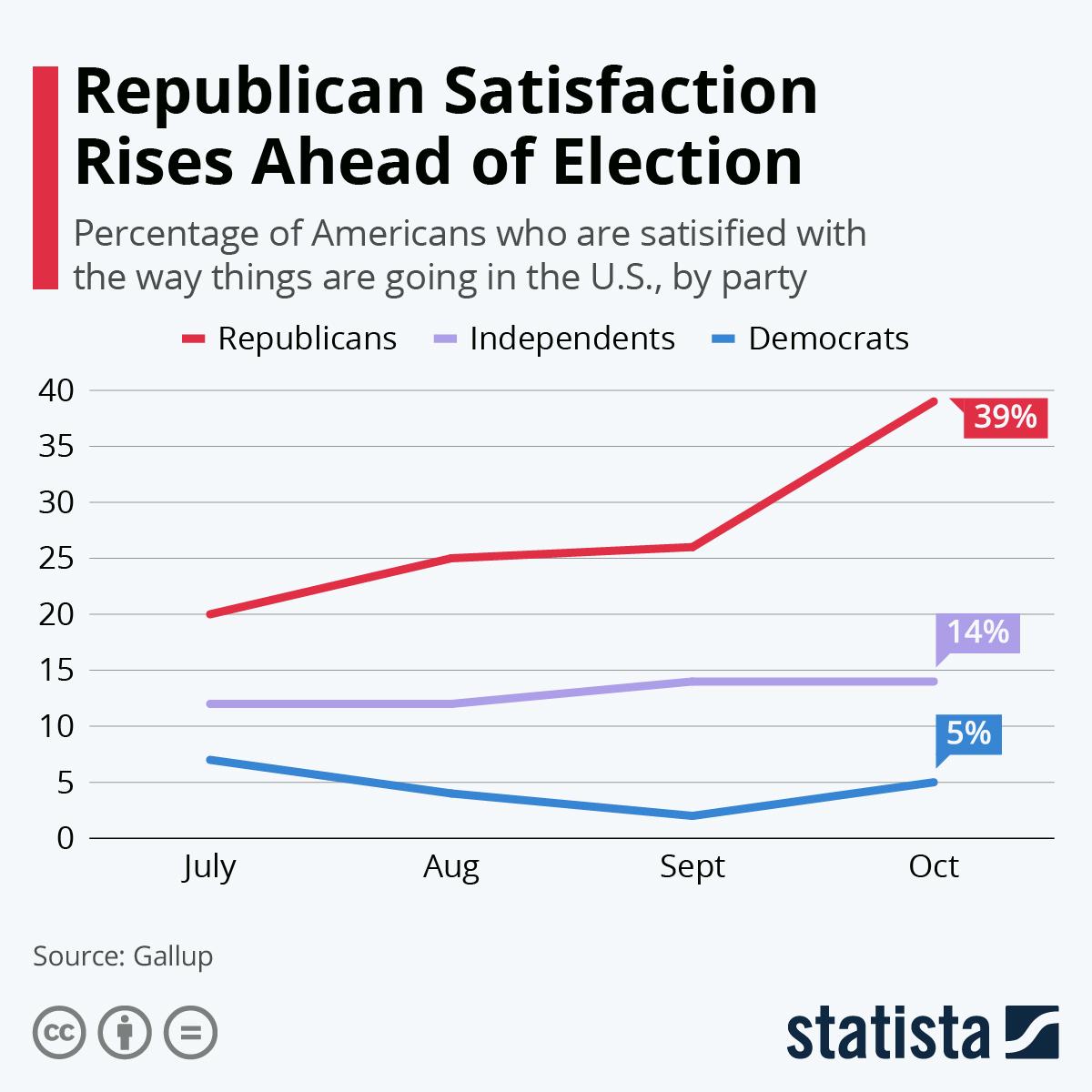
According to a Gallup poll, the proportion of Americans who identify as Republicans and are satisfied with the way things are going in the US reached 39% in October 2020 up from 20% in July. This compares to the October number for Democrats of only 5%.
On what planet does 40% of a particular section of a community agree that the way things are going are satisfactory when the US is in such an incredible mess?
There is the COVID problem with world-leading infection and death rates, the racism problem, the sexism and misogyny, the general incompetence of Trump… What more is there?
Well, there is gun control, climate change including some of the worse bush fires on record, domestic violence, trade tariffs, unemployment, incarceration rates, national debt, and the long, long list of western ills that we don’t seem able to fix.
It doesn’t make any sense as to why 2 in 5 Republicans think that everything is going well. What would it take for them to say that it’s not going well?
More to the point what has happened between July and October to double the satisfaction rate? That 20% increase is bizarre. It could be that the polling technique was flawed or maybe the sample size is small or biased. But it’s hard to imagine that during the course of a major pandemic with substantial hits to the economy and personal freedoms through lockdowns along with job losses and massive debt, that everything is satisfactory. What kind of craziness brings out such a statement in people is really hard to figure out.
Should we take notice of polling? Well, most politicians would argue no. But the stark thing here is that only 5% of respondents identifying themselves as Democrats were satisfied with the way things are going. So Democrats are panicked or at least concerned while Republicans think it’s fine.
This is the growing separation of political view in the US which is interesting after decades of convergence onto centrist type policies on most of the issues that matter. A division in the political stance at least gives people something to adhere to and to be against.
Here is…
another astonishing statistic
Recall what QAnon actually is
At its heart, QAnon is a wide-ranging, unfounded conspiracy theory that says that President Trump is waging a secret war against elite Satan-worshipping paedophiles in government, business and the media.
QAnon believers have speculated that this fight will lead to a day of reckoning where prominent people such as former presidential candidate Hillary Clinton will be arrested and executed.
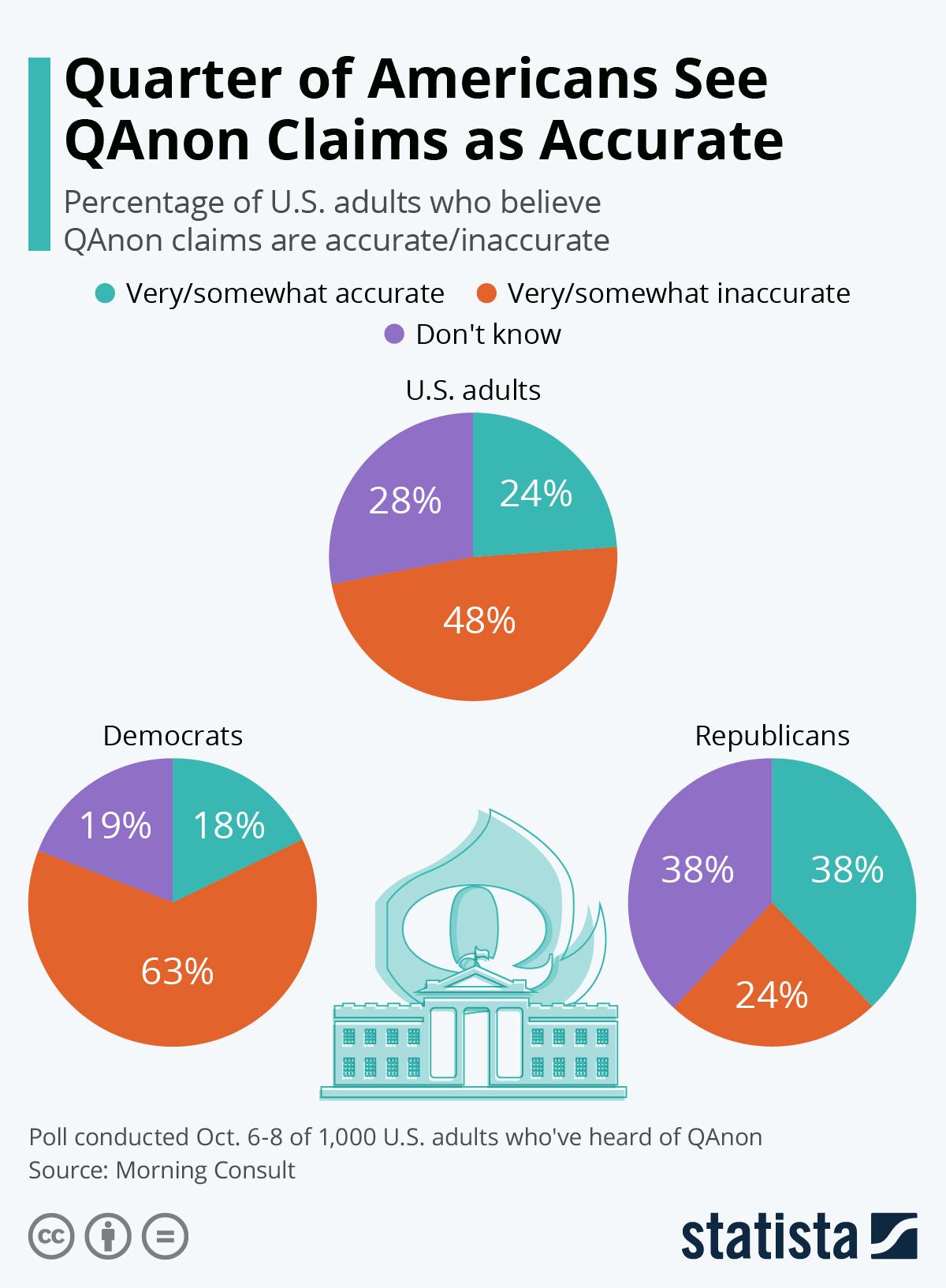
So 2 in 5 Republicans believe in conspiracy theory and nearly 1 in 5 Democrats do too. This is just as alarming. What goes through a person’s mind to allow these two statistics to appear? What were they thinking?
The answer is that they don’t.
There is a dearth of critical thinking on all sides. Instead, it is easier to think fast in the Daniel Kahneman sense, and not force any detailed analysis or appraisal of the evidence, not even a quick reality check.
People can then exist in a kind of bubble that comfortably fits their current world view and only engage with material that supports it. Confirmation evidence is easy to determine because it feels good. Evidence or views that feel off or a bit uncomfortable is just those nasty GOPs or lefties depending on the colour of your own bubble. These views can be just shouted down or, where necessary, trolled. Heck, if that doesn’t work there is always a demonstration.
Ask any of the 40% if they have thought carefully about what they say they agree with and they will confirm that they have, very carefully. This is the elegance of a bubble. It wafts a gentle lullaby over you to make believe that thinking has happened… by someone else. No need for me to do any heavy lifting, if the POTUS tweeted it, it must be true.
And so here we are at the end of 2020. A frantic and genuinely eventful year. When we need to be thinking about what amazing opportunities the circuit breaker of a global pandemic can give us, 24% of Americans think QAnon claims are accurate.
I don’t know whether it’s COVID or Trump or time of life or stressful work conditions or all of the above but I’ve been having the weirdest dreams lately.
For a long time, I would have only one dream. The theme was that I had a lot of luggage and a plane to catch. The problem was getting to the airport with all that baggage and getting it on the plane without outrageous excess charges.
Only in the dream I rarely made it to the airport. First-year psychology students could figure out the meaning of that one.
Last night I had a different, rather disturbing dream.
I was in a written exam, something I haven’t done for four decades and the subject, English. The questions on the exam paper were difficult to find and impossible to put into the correct sequence.
It was the weirdest experience as the questions were on different kinds of paper and the words were hard to read. What the questions were actually asking seemed obscure.
I tried and I tried and I tried and in the end, failed to complete the examination.
Me, the ultimate nerd, failing to complete an academic task. It felt like the most incredulous thing ever. After some time deciding whether or not I did actually complete the exam or if I did enough to pass the test, maybe I could reset the examination later on, maybe the next year… After all of that trying to recover from disaster, it was clear that I had failed the examination and would have to deal with it.
Part of the psychology around all this would be that in the real world I have been pushing myself to do more writing and thinking, maybe, I should go back to my educational roots.
The obvious explanation is such a change is frightening. There is something about receiving a comfortable salary that influences your way of being even if you don’t enjoy the work that you’re paid to do.
But it got me thinking about our general state of mind.
Especially how easy it is for people to become unsettled. And there’s no doubt that the COVID crisis is extremely unsettling. Anyone with an eye to global politics or with even a passing interest in American politics has just gone through a terrible and settling period and it’s still going.
Anyone who cares or concerns themselves with equality and egalitarianism is easily in strife because of the continuing racism, misogyny and concentration of wealth that we talk about often.
Given all these stresses on top of the many immediate ones that are part of daily life, there is no doubt that mental health is new cancer. It will affect everybody when they least expect. And, if we were smart at all, then we would be building capacity to help people through such times.
We are helping each other a little. If you go on social media feeds and let the algorithm do its work, having chosen a few inspiring quotes and videos, you can see there are a lot of people engaged with positive messages and this is very powerful. Such grassroots, bottom-up approaches are essential. Empowering the positive messages, maybe with a share or two, is an easy way to help.
Then there is the harder work to make sure that politics can catch up. Maybe something like what Margaret Thatcher did in the first episode of the latest season of the Crown. When she was hounded by the old school, stupid white men, she got rid of them all, replacing them with young white men. So she got halfway there, at least.
Sidenote though, the Johnson cabinet is young, inexperienced and widely considered to be totally incompetent.
Thatcher’s motivations were not pure but that ‘getting rid of the old school’ is something that is imperative in our political systems. We need young imaginative ideas. And it’s time to get those. They’re there, all we have to do is empower them.
But back to my slumbers. Bad dreams are part of life and they send subliminal messages.
Throughout my career, I’ve tried many different obscure paths, and the odd blind alley, only to end up in a very traditional workplace. So in a way, I’m challenging my own response to being innovative and to support the changes that we have to make. Dreams have the uncanny knack of pointing it out with a poke around in the dark corners in the closet of life.
Obviously, to learn is the key.
And in this instance, I think the dream is giving me the courage to pursue this return to education. And to try and pass on some of my experience to the next generations so that they can forge their own paths with a little more confidence.
And obviously to ban all forms of academic examination as they really don’t help.
Thanks for getting this far, a share would be fantastic.
We love the maybe, could be, might possibly be, and the equivocal. This comes about from our training, for we are sceptics.
The idea is that nothing should be taken on face value. There must be evidence in order to understand whether or not there is sufficient information to make a decision. And if a decision is not possible, then to form an opinion one way or the other. Only most scientists are afraid to state opinions in any strong sense when they are wearing their mortarboards. Usually, they will hedge in case they’re wrong. Along with the scepticism, there are the egoic responses of not wanting to get anything wrong at any time. Just normal human behaviour.
The problem with all this is that it gives scepticism a bad name.
It’s as though sceptics are always humming and aahing and never coming up with an answer. But this is not the true meaning of scepticism.
What it really means is to be questioning, review the facts, and run with what the evidence suggests.
This does not mean splinters in the butt from the fence or outright denial. As long as key questions are asked and enough evidence is available to reliably answer them, it’s okay for a sceptic to give that yes or no answer.
The everyday sceptic
Most people in everyday life find evidence gathering disconcerting. It is much easier to just give the yes and no answer without evidence and call it an opinion if questioned about the facts. Our politicians have taken to this with glee.
This puts scientists in a very difficult position in society.
Less and less evidence is in play. Plus the science that generates evidence is delivered by people who are letting their scepticism run away with them, making any advice they give feel as equivocal as the delivery. When we need them to stand up and be forceful, the pressure forces more wallflower behaviour.
Interestingly in the health story, particularly with the current COVID-19 crisis, everyone has been happy to listen to the white-coated ones and governments have taken that advice and run with it. It’s as though they’ve resorted to the science and even though those scientists can be sceptical and never truly sure of themselves or their predictions.
Luckily for the health officials, epidemiology theory is reasonably tight and well understood. The fundamentals are accepted around the world by most of the experts. So the patterns of infection and what to do about them are both well known and quite likely to happen, but even then they can’t make predictions about whether or not infection rates will change in a particular way on particular days or particular weeks.
So they still remain somewhat ‘maybe, could be’ about their statements.
The politicians on the other hand are more than happy to let the decisions on the hard calls on matters of public health be made by scientists standing next to them on the podium. Particularly because it needs to be there to justify some of the actions that otherwise people would not accept.
Being locked down, essentially under a form of house arrest, is a hugely draconian measure. And no politician would be able to get away with that in modern democracies without the strongest justification.
So we have this enigma going on where specific evidence is used and accepted and the politicians in particular leverage it to their advantage. And then we also have the majority of science, which is not considered or adhered to and, typically, ignored.
Ecological scepticism
Ecologists are in a particularly difficult position.
These are the scientists who try to understand nature and how nature works. They have trouble with their experiments as we’ve previously noted. The evidence that they gather is often equivocal itself thanks to weak inference so that hedging and being unsure about the specifics become the norm.
Only we need the ecological scientists to stand up now.
Issues left behind because of that scepticism and nervousness are critical to our survival. We can’t sit on the fence when it comes to soils, to food production, to the ecology that drives that connection, and the diets that we are consuming. It’s time to deliver serious calls about these things. Equivalent if you like to people in lockdown. The level of impact that ecological science needs to have is as strong as that.







 Alloporus