Quantitative

Quantitative

For me ‘ah ha’ moments fall into one of two types. There are the ‘oh why didn’t I think of that before’ kind of ah ha’s that tickle the brain when they happen but often fade into the nether regions of forgetfulness soon after.

Then there are the real ‘ah ha’s’, the kind that are arresting, stick around, and may even shift my perception of the world.

Recently I experienced one of the latter, a real doozy.

In a meeting with colleagues who, between them, had over a 100 years of environmental experience I realised that none of them understood numbers. They did not think quantitatively.

It worth taking a moment to absorb this observation. Eight experienced professionals who most would describe as technical experts, all with a tertiary education and many years of practice with problem solving in land management, native vegetation and agriculture, were not thinking numerically.

Few of them would admit to this of course. They’ll pour over spreadsheets, examine graphs and even contemplate statistics alongside the best of their ilk, but deep down they are not thinking numbers.

Instead they shift words and documents around. They think in the language of processes and procedures not likelihood, rates, and difference.

As many a post on this blog attests, my brain handles proportions and probabilities.

However, I am not especially mathematical, and often lament a lack of fluency in that language. But limited math literacy does not stop me thinking numbers. I’ll see a proportion and instantly ask “proportion of what, a thousand or a million?” In my head 20% of 10 is not the same as 20% of 1,000,000 when it’s, let’s say, greenhouse gas emissions. There is materially in the latter number even though the proportions are the same. It seems impossible not to do this numerical reality checking when faced with the variability in space and time of the matters environmental people are interested in.

But there it was, plain as a binomial distribution. My colleagues were not quants. When they relaxed into an innate thinking state, they did not see the world quantitatively.

Now before the trolls get too upset, this ‘ah ha’ is not about belittling or downgrading all the feeling thoughts, the creative thinker or even the normative types. All problems are best tackled with a variety of thought processes and the best answers do not always come from understanding a likelihood. What got me was that the quantitative type was not in the very building you would expect to find it.

For a scientist, researcher and one time lecturer in biostatistics this is a hard one to fathom. The question still bouncing around like a subatomic particle is why? There is no obvious reason, other than the peculiar quirks of chance, that none of these people were quantitative.

Only they were not and soon the consequences started to come up. Any talk of likelihood, rates, and difference would not be fully understood without explanations and time to digest what the numbers mean.

It would not be possible to just present a graphic and assume that everyone would understand any obvious pattern, let alone the nuance.

In short, my colleagues were not going to have an easy handle on inference.

This is a huge deal. If the people who are closest to the facts as they play out in the real world do not get the numbers, the same people who support decisions around sustainability and the trade-offs with natural resource use… Well, there is a good chance we are in muppetville all over again.

Ah ha.

Where to invest

Where to invest

$50 billion is the current projected cost to replace the Australian submarine fleet.

$60 billion is roughly 5% of Australia’s GDP

$96 billion is what 9.3 million Australian households spend on the modern equivalent of bread and water, somewhere near 15% of their weekly budget. This is a pretty standard proportional spend in mature economies. Somewhere between 7 and 15% of household budgets go to food. The French at the higher end, the British the lower.

Big numbers then.

$226 billion is an order of magnitude larger. It represents the size of the labelled green bond market in 2016.

$895 billion is the size of the climate-aligned blond universe. This amount includes investments that are designed to support climate adaptation or have an impact on emissions but are not quite up for a green label.

$1,000 billion is the projected size of the climate aligned bond market in 2020, just three years hence, investments that are needed to help all countries meet their Paris climate commitments for emission reduction.

$90,000 billion is the current size of the global bond market.

The interesting question is where to put all this money.

It makes sense to put a hefty chunk of it into actions that improve environmental performance or, alternatively, new submarines.

Empathy

Empathy

Suppose you are a die hard Manchester United fan. You have been in this manic state since you first kicked a ball around the living room in your diapers. It’s baffling why Manchester United is the club that captured your undying soccer loyalty given there are numerous top grade clubs within spitting distance of your childhood home, however, you cannot question it for the feeling resides somewhere deep and unexplainable.

Along with this love of the Red Devils comes a dislike, some might even say hatred, for the club that plays at a ground just 6 km distant and wears sky blue. Your ire rises higher at any mention of jokers from other towns, Liverpool especially.

Now this rivalry with the opposition is no doubt part of the deep and unexplainable. It has something to do with the limbic requirement to compete and win.

Along with this genetic programming, nurture has imbibed you with the essence of local culture, defined your broader allegiance, and provided you with an accent. Who can even understand what those scousers are saying?

I’m sure you are with me so far, at least in principle.

You may not be a soccer tragic or reside in north-west England, but I guarantee there is something you are passionate about to your core. A tumult in your soul that has no apparent explanation.

Importantly, such passion is never truly extinguished. Sure it wanes, but come finals day or a beer around the barbecue, and the old passion reignites like a bushfire in a breeze.

Like it or not, admit it or not, tribal affiliation makes you feel good.

This is because the tribe has two highly desirable traits. First the tribe covets your loyalty, cares for it and protects it to your benefit. This becomes a delicious positive loop. The more you feel wanted the stronger the tribe and the stronger the tribe the more loyalty you relinquish.

The second highly desirable trait is that there are always other tribes.

So just as your loyalty is rewarded with warm feelings of belonging and place, so the tribe tests its mettle and your allegiance with rivalries.

And herein lies the ancient human condition as recognisable 3 million years ago as it is at Old Trafford on a Saturday. We love a good stoush.

In our modern, supposedly enlightened times, it is no longer necessary to attack Liverpool FC supporters, leave them for dead, capture their womenfolk, steal their pigs and eat all the yams in their grain store. It is sufficient to chant abuse from the stand and laugh when their striker scuffs his shot wide. But rivalry is crucial to the tribe. It feeds the loyalty process and without it the warm feelings are much harder to maintain.

Crucially this necessity for rivalry builds more than aggressive contempt. It is not admissible to speak these other thoughts because they are easily misinterpreted, but at some level you have respect for those scouser scum. They are, after all, tribalists like you. They are misguided in their choice of allegiance, deranged even, and yet without another tribe of near equal size and passion what would be the benefit in winning any encounters. Crushing minnows ultimately depletes loyalty.

Thankfully there they are on the terraces, giving back as good as they get, and always rendering that god awful song about walking. Curiously they are wearing the same clothes as you. They are as overweight and unfit as you, and, hey, isn’t that Bob from accounting?

In short, you empathise with the opposition support because you need them and because you recognise their image in the mirror.

The same thing applies to all other tribal rivalries that humans have invented. In the violent conflicts any empathy has wilted or died invoking a chicken and egg explanation. But in many others the empathy is still there and may even be the reason there is restraint.

One of these intense rivalries is over the environment.

Not the grab for land, water and oil that is at the core of many, perhaps all, wars but the rivalry that exists even in stable nations with well defined and uncontested territories.

On one side there are various tribes with members willing to hug trees or stare down bulldozers to protect the lesser spotted owlet even as the greater spotted owlet numbers increase to previously unknown heights.

In opposition are tribes with members in hi-vis vests or business suits who have never even seen an owlet.

This rivalry is ostensibly about the consequences of resource use. More strictly, who should get the benefit from exploiting natural resources or wear the opportunity costs of parsimony.

The consequences of resource use are real enough, far more so than the winning or not of 3 points towards the title race and a few months worth of bragging rights. Any human exploitation of natural resources alters the flows of energy and nutrients through the environment either directly – log a forest and habitat is changed or last altogether – or indirectly – burn coral and the climate changes.

Green tribes hate this outcome.

Brown tribes hate this outcome too mainly because it fuels green tribes out to stop them. Usually those with a development focus feel so strongly about the need for resource use to fuel the economic engine that they don’t even notice the consequences for future resource use let alone any undesirable externalities.

The trouble is that the green tribes have to get their hemp and their biofuels from somewhere in the environment. Every human leaves a footprint in the sand.

Equally the brown tribe members know that even though ‘a tree converted to dollars invested in the stock market’ is a well trodden road to wealth, on this road there are potholes, oncoming traffic and, heaven forbid, fuel shortages. Heavy boots do some real damage.

The kernel of empathy exists in these contradictions.

It comes through admitting that even the off grid, eco-home, tiny house still has a footprint and that with over 15 billion human feet on the planet, the tiny house option cannot be for everyone. It also comes from the notion held among some resource users that maintaining a resource for the long haul can be a better economic outcome given the resource is still there to be used.

Many also know that the environment always offers renewable solutions.

Then we have the option of incentivising resource use actions that limit the undesirable outcomes using the language of the economic tribe to change behaviour. We pay resource users to be careful. A weird compromise position that partly neutralises the conflict.

Here, then, is the thought.

When you next find yourself in a tribal situation, and this will probably be sooner than you think, look for the empathy. Try to find that connection with the rival that you know makes them just like you.

Should this situation have something to do with the environment and the empathy feel just can’t be seen, look harder, for empathy is there hiding behind the entrenched positions.

Energy prices

Energy prices

In the mid-1990’s energy prices in Australia were some of the lowest in the OECD.

I distinctly remember the politicians of the day boasting about how good this was for industry and business and I have to say I bought the argument. Utilities that people have to have should be affordable. The marketing men can persuade me that a Mercedes is so much better than a Hyundai and well worth the price tag because it is a discretionary spend on my part, but water, power and waste removal I must have or we are back in the dark ages.

Twenty years later, the current government has announced a new energy policy that they claim will save the average family $100 a year on their energy bill. This new policy is supposedly a response to the problem that domestic energy prices have risen by 67% in the last decade, and with supply shortages forecast regularly, the medium term economics suggest this annual rate of increase will persist. Energy costs in Australia are now at the top end of the OECD ranks.

Oops.

Australia is also going to struggle to meet emission reduction targets it promised in Paris in part because this cost pressure from energy has become an excuse not to focus on renewables and to continue with power generation with a heavy emission profile.

Oops again.

Lots of rant and rave opportunities here, classic Muppetville. The one I want to unpack is that cost saving, $100 a year for the average family.

Median annual income in Australia is around $81,000 and has been increasing steadily at around 3.5% more than doubling since 1990’s when energy was cheap.

An income of roughly $220 per day is right up there with the highest in the world. Savings on the energy bill proposed by the government is 27c per day, not even the price of a coffee and cookie in a month.

The average household energy bill, on the other hand, is around $4.20 per day and currently increasing at close to 7% or roughly 29c per day.

Phew, that’s a relief. The government policy is going to save the average household most of the money they would have to spend to on the price rises. Superb.

Should average annual income continue to rise at 3.5% the 29c cost saving on energy is further compensated by an additional $7.70 per day in extra income.

This explains why economic growth is so important to governments. Despite inevitable difficulty around the margins, on average it puts money in voters pockets.

It also makes that first ‘oops’ identified earlier a huge blunder.

Energy is literally the engine of economies so to let its costs spiral and allow the security of supply to lapse is stupid however you spin it.

Dams

Dams

A decision is made to dam a modest sized river In the foothills near a big coastal city. The city is growing and water security is regularly a hot political topic as the area is prone to drought.

Construction on the dam wall begins in 1948 and on its completion the wall creates a lake with the capacity to hold a little over 2,000 Gigalitres of accessible water.

When the dam was completed the city was home to 1.8 million people. Today there are over 5 million inhabitants and the lake remains the primary source of freshwater for these people and their economic activities.

Downstream of the dam the floodplain has become an important area of agricultural and peri-urban development. The dam protects against flooding and the planners have allowed people to live in previously inundated areas. The dam not only holds a large proportion of the water supply to the city it also protects built and commercial assets from flooding.

When the engineers say that the dam wall could be raised by 14m, what do you think the planners will do?

Naturally, they will allow greater access to land on the floodplain, most likely by releasing some areas for residential development. It is a growing city after all.

In the planning meeting some wag says that it will all be alright because the climate is changing “It will be drier anyway, so no worries”.

This comment goes unchallenged despite the evidence for increased storm frequency and intensity in the region, and the obvious connection between this and major flood events.

Here is a hint with a biblical origin.

Don’t buy a house on a floodplain…. especially downstream of a dam.

New species

New species

It is a hugely exciting day today for against all odds and logic, completely out of the blue, and to my total surprise, given that I am not even a taxonomist, I have discovered a new species of ape… me.

I have a slightly bigger head than average, a wider girth, less hair, and some vaguely different genetics to my closest relatives. This, apparently, is more than enough to establish a new species.

So I am now declaring myself Homo spuriensis.

Of course, I am instantly critically endangered, as there is only one of me known to science. A specimen that is well past breeding age. This rarity status is both a challenge and a badge of honour. Being critically endangered means that some specimens of another species, Homo sapiens, will do their utmost to protect me. They will set up reserves and recovery plans and lament the loss of my previous habitat that they appropriated. This will make me famous but do very little to prolong my own existence or that of my unique genome.

All the other species sharing the planet, including the vast majority of the aforementioned H sapiens, will not give a rats. They will carry on minding their own business of gathering resources to promote their own genes. Nature will not even notice this new addition to the biodiversity lexicon.

It is possible that a few species of bacteria, virus, parasite or symbiont will take a liking to me but, again, this is not personal. They would have done this before my nomenclatural change.

The tragic prognosis is that Homo spuriensis will be extinct within a generation. Another sad, lamentable piece of evidence that spaceship earth is doomed.

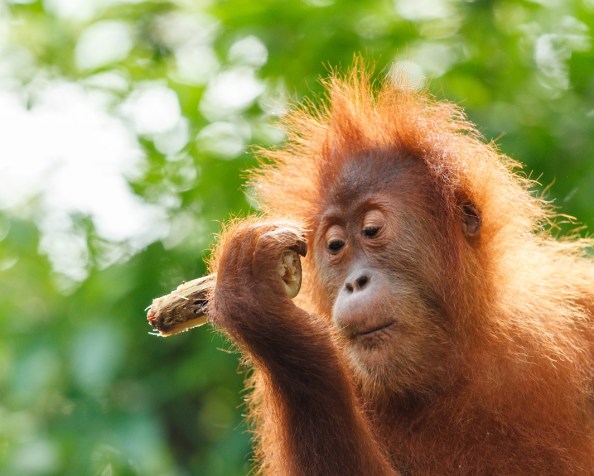
I am sorry to bring you this initially exciting but ultimately depressing news but luckily there is another new species of ape just discovered in Sumatra.

Keep it real everyone.

Ideas that persist

Ideas that persist

Nor, considered aright, does it seem any argument in favor of the gradual extinction of the Sperm Whale, for example, that in former years (the latter part of the last century, say) these Leviathans, in small pods, were encountered much oftener than at present, and, in consequence, the voyages were not so prolonged, and were also much more remunerative. Because, as has been elsewhere noticed, those whales, influenced by some views to safety, now swim the seas in immense caravans, so that to a large degree the scattered solitaries, yokes, and pods, and schools of other days are now aggregated into vast but widely separated, unfrequent armies. That is all. And equally fallacious seems the conceit, that because the so-called whale-bone whales no longer haunt many grounds in former years abounding with them, hence that species also is declining. For they are only being driven from promontory to cape; and if one coast is no longer enlivened with their jets, then, be sure, some other and remoter strand has been very recently startled by the unfamiliar spectacle.”

Herman Melville, Moby Dick

This quote is from a fictional account published in 1851. I get that.

Except that I can’t help feeling that this passage reflects how Melville thought about this issue. He had been to sea of course, as a merchantman and on a whaling voyage, so he had first-hand experience with months of time to talk and explore what other mariners knew about the sea and its fish. Somewhat cutely, whales were fish back then.

Melville chose to ignore the evidence as many a purveyor of fiction is want to do, and refashion it. He used spin in a novel.

Or did he?

The ideas that actions of hunting could deplete such animals on unfathomably large oceans defied logic to the Victorian generation. It just could not be possible. The evidence of obvious depletion, reduced distribution, lower contact rates and changed behaviours, just did not fit the worldview.

In ‘Awkward News’ there is a passage reflecting a similar thought in the minds of early settlers to Australia. Here so vast an expanse of country lay before the first, second, third and even subsequent generations of rural folk that no amount of vegetation clearing could ever deplete it.

It is a though there is something in our DNA that programs us to ignore the possibility that resources could ever be in short supply. We seem to have to believe that resources are infinite.

This helps us in two ways.

A belief in every renewable resource buffers us from the fear of lack. This is a powerful base fear, for starvation is a slow and emotionally painful death.

It also allows us moral latitude for actions that deplete resources, especially pertinent in the case of whaling that was a brutal culling of wild sentient creatures for commercial gain. If the belief is that taking a few whales does little or nothing to their long-term survival as a species it mollifies the obvious brutality of killing individual animals slowly with harpoons and lances.

Same idea with bulldozers and chains. Removal of native vegetation is justified because there is plenty more of it across the horizon.

Jump forward 160 years and the demand for natural resources has increased beyond what could have been imagined in the 1800’s. We don’t need whale oil anymore and, for the most part, whales are back in the stomping grounds of their ancestors if not quite in the same numbers as before.

We do need land though. Water too. And space to live and recreate in. The world has shrunk perceptibly with technology able to whisk us over the ocean at speeds and distances that the old whalers would have defiled as some evil magic.

Yet that DNA is still expressed.

Many of us continue to believe that resources are either infinite or if, for some bizarre reason, a resource is used up, our technological ingenuity will conjure up a replacement that is better and more profitable.

Whatever we do those base fears of lack are still there. They persist and our emotional response remains to ignore them or refuse to believe that their realities will ever be realised.

It should be a sobering thought. Only our response is to thrust our heads in the metaphorical sand and hope that that nagging feeling will go away.

When we look up again all is well because, for sure, “some other and remoter strand has been very recently startled by the unfamiliar spectacle”.

Optimism

Optimism

I see the glass as half empty far more often than I would like.

It’s the cynic in me that does this, a nimble imp that jumps around incessantly to skilfully sneak up and strike when I’m not looking.

And I am not alone.

Many of us are pestered by negativity fed incessantly by the imp and his allies in the mainstream media with their constant peddling of bad news as something we just have to know. It is enough to depress the most ardent of us.

The psychology is simple enough. We are shown bleak accounts of impending and real doom to make us feel hopeless and in this stupefied state we don’t need to try to fix anything, we can just keep on consuming our way to distant happiness.

The imp just loves it.

He gets to play silly buggers with us and there it is, a glass half empty.

Diogo Verissimo, a conservation scientist and social marketer, believes that to make the environment a mainstream concern, conservation discussions should focus less on difficulties and much more on positives. He’d like us to see the full half of the glass.

In April 2017 the Smithsonian Institute organised the Earth Optimism Summit to shift the global conservation movement’s focus away from problems and toward solutions. Verissiomo’s own Lost and Found project tells the stories of 13 species once thought extinct but now rediscovered by intrepid and dedicated humans.

The hope is that the good news with the help of storytelling will generate a “more positive vision for the Earth’s future”.

It is hard to be optimistic though. The numbers of people and their needs are scary and our psychology held deep in our reptilian brainstem is not in our favour. Too many posts on this blog have explored this dilemma.

Population clocks

Post revisited – Washing machines

Post revisited – Can we have sustainability?

The biggest global challenges revisited

It seems unlikely that some good news stories will create much more than a temporary salve.

Now I believe we are on the path that Thomas Malthus warned of back in 1798 when he talked intelligently about per capita production and mankind using the abundance of resources for population growth rather than for maintaining a high standard of living.

Sure we slow down population growth rates when affluence is high, counter to the Malthusian trap, but we are doing it after our absolute numbers have reached 7.5 billion. A full order of magnitude more than the 700 million alive when Malthus wrote his famous essay.

These billions are resource hungry and increasingly disconnected from the natural world.

In fact, if I hadn’t been lucky (and resource hungry) enough to visit over 20 countries in my lifetime I’m not even sure I would believe that 7.5 billion people was even possible. But it is here, a miracle that Malthus would have imputed to the almighty.

What the imp knows is that despite the occasional good news story, Malthus was actually right. He got the numbers a bit askew, an understandable error given the knowledge of his day, but the theory is sound.

Resources will become limiting and the consequences will not be pretty or good.

The glass half full may be the view we need but it is a hard one to see.

Overshoot day

Overshoot day

Overshoot day is the day in the year when human activities have used up the amount of the Earth’s natural resources that can be renewed within one year.

Ideally this is sometime in very late December or better still, January, February or later in the in the subsequent year. Overshoot day celebrated then would mean we are either in balance or slightly ahead using less resources than are renewed each year. This was pretty much true up to the late 1960’s.

In 2017 overshoot day was 2nd August.

This leaves another 151 days left in the year to keep everyone going on resources not renewed within the year. We are using up credit, reserves of resources that sit in the renewable pool.

There is more bad news if you are Australian. Our Aussie lifestyle chews up more resources than most. If everyone lived like us then overshoot day arrives on 12th March, almost half a year earlier.

Put another way, if everyone lived the Aussie lifestyle, we would need 5.2 Earths worth of renewable natural resources per year. And if we all had the British stiff upper lip or Italian suits, then it would be 3.0 Earths.

This is a serious problem folks. I mean it. We are overextended taking up at least a third more than is renewed. It is like having a salary of $100 a week and spending $130 a week. It is only sustainable for as long as your savings or credit card allows.

Aussies should be ashamed that they are the most profligate being ahead even of the Americans (5.0 Earth’s in their case); not that finger pointing helps. All the wealthy people in the world are collectively living on credit. We are borrowing from the pool of reserves without an ability to pay back in. The risk in this transaction is not secured against any collateral other than the technology mantra.

In natural resources terms, buy now, pay later, becomes use now, worry about shortages later. And it could become use now, deal with collapse later.

If laboratory rats run out of food they get hungry, then they fight each other, and then they eat each other.

It is ugly.

Our system of credit, supply chains, and technology applied to renewable resources will buffer us for a while. It is why we don’t feel shortages or, indeed, hunger for those of us living on $100 plus a day (a little under $50,000 a year before tax).

It is also why we buffered this system after the GFC even though we knew it was built on sand and so much of the extra credit promised ended up in just a few pockets. We should pay much more attention to all this. But I digress, here is the key message.

Overshoot day is the most important day of the year. If we are smart, less greedy and less fearful we could even make it a biannual celebration.

So when you are pondering your New Year’s resolutions and reflecting on another year lodged into history, with full stomachs and the lingering indigestion of Christmas cheer, spare a thought for the day in 2018 when we overshoot our renewable resources for another year.

Eating your pet

Eating your pet

A while ago I was on the road in rural NSW looking at the conservation value of native vegetation patches. A fascinating tale of dual consent, blinkered minds and koalas. These stories will come later for I have another I must tell first.

On my travels, I chatted with a government vegetation officer who is also a farmer. For many years Dave has legally hunted on his property to remove feral animals and reduce the number of kangaroos and wallabies that eat his crops. This is standard practice in the Australian bush and a necessary function.

Although all native animals are protected under NSW law the balance between kangaroo numbers and the interests of landholders means there are commercial licenses to supply meat and skin products and non-commercial licenses for the purpose of damage mitigation and public safety. The commercial harvest is regulated through a quota and every step in the kangaroo supply chain is licensed and monitored. Around 1,800 professional roo shooters ply their trade across Australia.

So when David shoots animals on his land it is all above board. What he does with the meat was what we chatted about.

He makes biltong, a better kind of jerky if you will. And by all accounts it is delicious. I am a big fan of biltong from my time in southern Africa so we had a fascinating yarn about his techniques, recipes, the best animals, and the best cuts. Loin from smaller wallabies, dried in a dehydrator with a good hit of chilli, in case you were wondering.

africa-1238491_640

Excited on my return I began to tell my wife about this kangaroo biltong when she yelled ‘yuk’ and demanded that I stop.

“You can’t eat a pet,” she screamed.

Now I should explain that we have a swamp wallaby that visits our backyard during wet periods, usually with her joey in tow or pouch. Wallabies have a certain cuteness but are as wild as a ferret and definitely not pets. They are responsible for the loss of many an edible garden plant.

I should also say that my wife is by no means a nature lover. Movies, shopping and a good yarn with her friends are more her thing. She is also a keen carnivore who has been known to berate vegans for not feeding animal products to their kids. But clearly, she connected with this emblem of the nation.

Somehow she has acquired a visceral response to eating it.

I was taken aback. My biltong story remained untold and my own curiosity over why we have not made more of this protein source for sale to eager Asian markets was not aired. I had to be quiet misreading badly the depth of feeling for wild animals that I saw as a resource, David too presumably.

So you can’t eat your pet, even if it is not actually your pet.

This is a more severe dampener on a market for kangaroo meat than I had imagined. Pragmatologists beware, we have a long way to go.