A silent voice

A silent voice

Photo by Jason Rosewell on Unsplash

It was my turn to cook dinner the other day, chicken biryani made with thigh meat, coriander, and a healthy teaspoon of Kashmiri chilli.

Whilst waiting for the chicken to defrost, I decided to progress my step count and march up and down the hallway. Indoor exercise looks odd but is necessary in a La Nina year when it seems to rain 24/7 here in Sydney.

Rather than just march, I fired up Spotify and chose a few tunes to make it easier to move. This track came up first.

https://open.spotify.com/embed/track/1Cj2vqUwlJVG27gJrun92y

I always put this version in my ‘best ever’ top 20  — the performance is sublime, and the song, written by Paul Simon when he was just 21 years old, is a work of genius.

And the people bowed and prayed

To the neon god they made

And the sign flashed out its warning

In the words that it was forming

Then the sign said, “The words of the prophets are written on the subway walls

In tenement halls”

And whispered in the sound of silence

This lyric tells us we have made trouble that we dare not speak. It is as powerful today as it was in 1963 and ably supported by Disturbed, I am spontaneously singing at the top of my voice as I march up and down the living room.

The delivery builds until the prophets scream their words… only I can’t. 

My vocal cords are starved. My core pushes hard at the air in my lungs only for the words on the walls to stick in my throat. 

I am silent.

I keep walking up and down in shock until the next relatively obscure track with delightful African rhythms makes everything okay again.

https://open.spotify.com/embed/track/1symqHZD5IP3wJtEIx1cws

The chicken is ready to simmer with the basmati, and it all comes together into a delicious dish. My wife came home, and we chatted over our dinner as though nothing had happened.

The impact of my strangled voice took a while to register. 

Not until the following day did I realise that my closed throat had been that way for years, maybe even my whole life. I can’t sing from my core. My best is to mumble a few ideas through closed lips. 

Just thinking this reality shocked me again.

Then I realised where it all came from. 

I was brought up in a religious household scared of alternative world views. My parents couldn’t listen to anything other than the bible and the church. 

As a lad, just as an adult, I was curious. I had a lot of questions that needed answers. Why must I go to the church three times every Sunday? Do I have to wear this uniform? Why do I have to pray? What is God anyway?

But if I spoke it was, in Paul Simon’s words, to ‘people hearing without listening’ and so after a while, I shut up and said nothing.

I didn’t know that this clamming up would last my whole life.

It took music for me to realise.

The irony is that my career has seen me become an educator, advisor, author, and blogger. This combination of activities is all about voice. I have had plenty of things to say, or so it seems.

My constricted throat screamed at me because even with the tools and the opportunity, I was silent.

This is a big deal for me.

Now that I know my voice is strangled, I can rescue it.
Money from air

Money from air

The world is weird right now. 

Here in Sydney, we exited COVID lockdown thanks to a sudden spurt in vaccinations and a decision to live with the virus after 18 months, thinking it could be kept out. 

Lockdown is hard for folk used to freedoms. Everyone is over it, and yet the exit vibe felt more cautious than euphoric while fronting to the GP for a double jab.

Then we lost our state premier, Gladys, forced to resign because the ICAC had to investigate her involvement in dodgy deals by a disgraced Liberal MP, her secret boyfriend at the time. That is a shame because she was one of the few pollies holding it together. The federal government ministers, and especially the PM, are just racing to cover their arses.

Now La Nina has dumped weather on us for weeks. We try to be upbeat and say that the cold and wet is better than wildfire. It is, but even that sounds hollow.

Meanwhile, in Australia…

The 2021-22 Budget committed an additional $41 billion in direct economic support, bringing total support since the beginning of the pandemic to $291 billion as of May 2021.

The Treasury, Australian Government

Such large numbers are hard to fathom, so for comparison government revenue was  $472.4 billion in 2020-21 (24.3 per cent of GDP) and in 2021–22, Government revenue is forecast to be at its lowest level as a share of the economy since 2011–12. Submarines notwithstanding, they are hard up for cash.

COVID economic support has cost the government nearly one year’s revenue. 

This is way above the initial fiscal commitment and goes onto the books as debt.

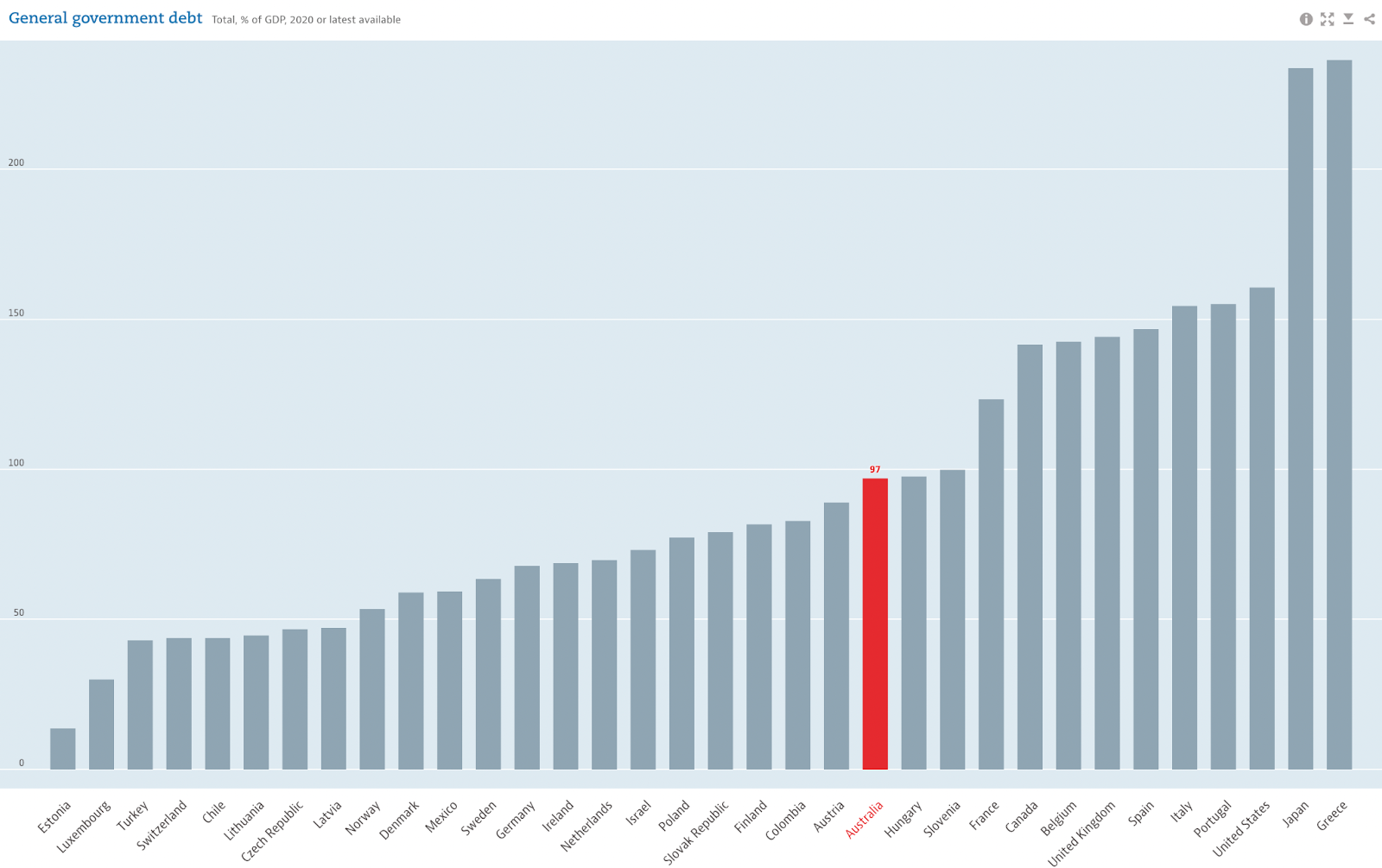
Here is a graph of the government debt loads for OECD countries in 2020, essentially the pre-COVID numbers from the OECD website

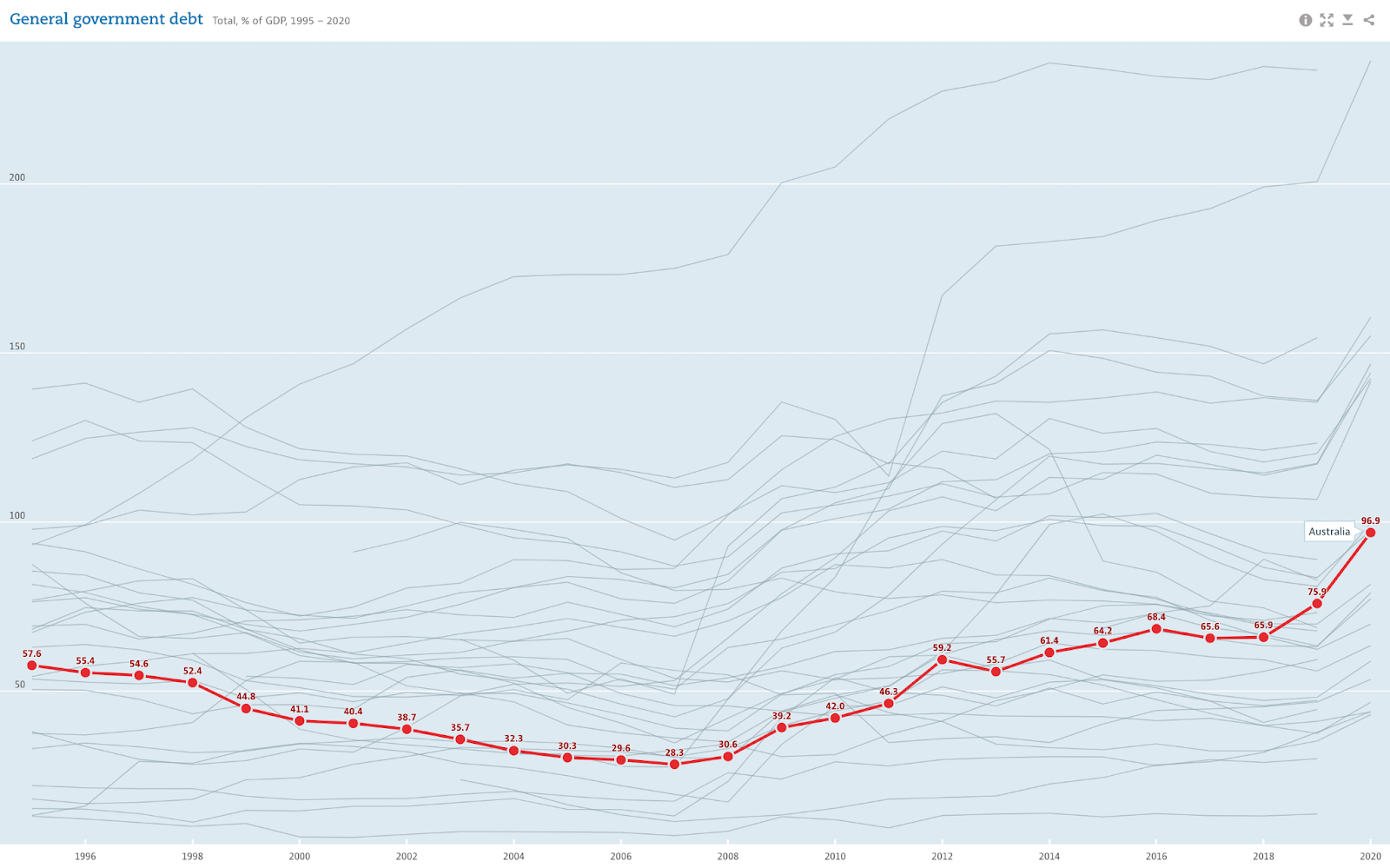
Australia is a mid-ranking OECD country for debt relative to GDP. However, the debt load rising steadily since 2007, has spiked with this extra expenditure. 

Alloporus has already mentioned that the global debt load has climbed to nearly $240 trillion, a number so big that it cannot fit on the screen of a standard calculator. Australia has made its modest contribution.

Gran always lived by thrift, a frugal approach that ensured there was no debt. Before people had access to credit there was no option but to live within means. 

Then the economists told us that 

the two primary causes of hyperinflation are (1) an increase in money supply not supported by economic growth, which increases inflation, and (2) a demand-pull inflation, in which demand outstrips supply. These two causes are clearly linked since both overload the demand side of the supply/demand equation.

Investopedia

Not being an economist my naive observation is that borrowing money or printing it to maintain the economy during a crisis that kicks economic growth in the nuts, fits primary cause number one.

But not to worry because…

“In the U.S., the central bank does not pay debt with the money it creates. Rather, it lends money at its targeted interest rate and the private sector employs that capital more productively. The money created is paid back, which is a crucial reason this monetary policy doesn’t produce hyperinflation.”

Economist Asher Rogovy

Truly, the world is weird right now. 

Progress is possible if we are patient

Progress is possible if we are patient

Photo by Ameer Basheer on Unsplash

Back in 2010, Australia was about to legislate a carbon price. Not the ‘great big tax’ that haunted the Gillard government but its predecessor, the Climate Pollution Reduction Scheme (CPRS), an attempt at emission control when the political climate still had a whiff of progress about it.

The CPRS, a cap-and-trade emissions trading scheme for anthropogenic greenhouse gases proposed by the Rudd government as part of its climate change policy, was voted down by the Greens. Under Bob Brown’s leadership, they decided it was too little, the targets were too weak. The perfect getting in the way of the good.

Instead of a start, there was no price on carbon and an open the door to the naysayers who ambled their way through for a good laugh and some appalling behaviour.

What followed was a decade of inaction, political assassinations of prime ministers, and the mess we are in now with the current PM not wanting to go to COP because he is held ransom by a bunch of clowns who think a $250 billion public purse to prop up coal mining is an idea. I could go on.

In the end, he went and tried to make climate change about submarines.

Progress is a process. 

I know progress can be slow when there are values at stake. It takes time to test the water, convince the recalcitrants and avoid failure from unforeseen consequences. 

And in politics, most important, do not scare the horses. 

The reality that the Greens missed so badly back in 2010 is that some good is possible along the slow path to the perfect. 

For example, when 136 countries sign up to a minimum corporate tax of 15% we should all applaud and pat the negotiators on the back. And yes, even if one of them is the forever on the nose Mr Cormann.

The agreement means that countries would legislate a global minimum corporate tax rate of at least 15 per cent for companies with annual revenues over 750 billion euros ($1.2 trillion), the big end of town. Then, if these big players have earnings that go untaxed or lightly taxed in one of the world’s tax havens, their home country would impose a top-up tax that would bring the rate to 15 per cent.

No more squirrelling away revenues from IP and other intangibles in the Cayman Islands without paying up.

This is a tiny step toward a more even distribution of wealth creation through governments legislating some trickle down to slow the charge to wealth inequality that grips the world. Recall that would be the trickle of wealth that the neoliberals claim is an inevitable consequence of successful economic growth.  

Sure 20%, even 40%, would be better and more realistic. But 15% is a start.

Some developing countries and advocacy groups say the 15% is too low and leaves far too much tax revenue on the table. And although the global minimum would capture some $205 billion in new revenue for governments, most of it would go to rich countries where many of the big multinationals are headquartered.

This is a similar argument the Greens spouted when they couldn’t let the big emitters get away with it under the CPRS. They wanted justice right away. 

Too far too soon.

The point here is that progress needs time and increments. It can do leaps, but the circumstances must be just right for rapid advances to stick. Waiting around for those opportunities is a luxury that humanity lost when it found fossil fuels. 

Stick at the process

The option to wait for the leap that can only happen when the stars align and the wind is blowing away the smell is no longer risky, it is suicidal.

We have to stick at the process of incremental change. It is painful to support such a puny percentage as 15% but it’s way better than waiting for donut economics to appear and change the whole game.

What the Greens did in 2010 was irresponsible, even for them. What the leaders have done since is on a par.

But a carbon price back in 2010 would have seen a small but effective change in the emission trajectory and a far greater chance of reaching any targets that the world would have us set now.

Humanity is not at war with nature

Humanity is not at war with nature

“Humanity is waging war on nature. This is suicidal. Nature always strikes back – and it is already doing so with growing force and fury. Biodiversity is collapsing. One million species are at risk of extinction. Ecosystems are disappearing before our eyes … Human activities are at the root of our descent toward chaos. But that means human action can help to solve it.”

António Guterres, UN General Secretary

During World War 2 at least 70 million people perished, economies collapsed and infrastructure was devastated. Military and civilian fatalities numbered over 50 million, with at least another 20 million deaths from war-related disease and famine. 

Food supplies were disrupted everywhere with rationing common. It was not until the early 1950s that most commodities came ‘off the ration’ and in the UK it took nearly a decade after the end of the war before food rationing ended. 

WW2 was a global disaster.

At the end of the War in 1945 with the horrors still fresh, representatives of 50 countries gathered at the United Nations Conference on International Organization in San Francisco, California. After two months of discussion and negotiation, they signed the a charter to create a new international organization, the United Nations, designed to prevent another world war.

In 1945 the deprivation and chaos were raw, everyone had experienced it for themselves. No surprise that the UN Charter in Chapter 1 describes the purposes of the United Nations in Article 1 as 

To maintain international peace and security, and to that end: to take effective collective measures for the prevention and removal of threats to the peace… 

Article 1, UN Charter

In the 75 years since the charter was signed, a cold war flared then ended with the collapse of soviet communism, simmering regional conflicts dragged on especially in the middle east and the Horn of Africa, and acts of terrorism have devastated communities but, so far, humanity has avoided WW3.

Indeed as Steven Pinker argues in his book Better Angels of Our Nature, humankind has become progressively less violent, over millennia and decades. The evidence for declines in conflict is compelling if controversial.

So why the language of waging war, force, fury and descent into chaos from Mr  Guterres, the main man at the UN overseeing the maintenance of peace and security?

Presumably, he thinks scare tactics are needed. Make the reality sound like a war to wake people up to the enormity of the challenge.

The truth is alarming enough. 

Unbridled exploitation of nature by 8 billion people has changed the planet eroding the essentials of nature that humanity relies on for 23 trillion kilocalories a day in food, not to mention clean water and fresh air. 

Biodiversity is in decline everywhere, especially in the soil where it is most vital for the production of all that food. 

In the Amazon, we are back to 81,000 ha of rainforest clearing every day or 40 football fields per minute.

Suicide perhaps but not WW3.

Destruction of nature is not a war 

War is defined as…

an intense armed conflict between states, governments, societies, or paramilitary groups such as mercenaries, insurgents, and militias. It is generally characterized by extreme violence, aggression, destruction, and mortality, using regular or irregular military forces.

In other words, a lethal conflict between the incompatible.

The Secretary-General, a career politician with an education in physics, says that “nature always strikes back – and it is already doing so with growing force and fury

Nature does not fight back because Gaia has no ability to recognise humanity from any of the other drastic climate and global changes that have reorganised nature in the evolutionary past. 

Recall there have been 5 other mass extinction events and a host of smaller ones that removed a huge proportion of lifeforms alive at the time. The physical and resource space created just allowed for more evolution. Nature filled the gaps with new lifeforms. All that is needed to generate diversity is disturbance, error and natural selection. 

Nature does not fight us. She has no disagreement worthy of lethal conflict. 

As far as nature is concerned the actions of expansive humanity with the knack of resource use is no different to any previous extinction event. 

Lifeforms are lost because conditions change and, after some time, new ones take their place.

Humanity is not at war with nature, we are just in the business of exploiting all the resources on offer with no thought for what that means for the future of those resources and the processes that generate them.

More like suicide than war

At the end of WW2 in Europe as the Russian army closed in on the Reich Chancellery in Berlin, Adolf Hitler, still deluded but defeated, shot himself. 

It was a cowardly response to avoid responsibility for actions that devastated a continent. 

Any history of the war struggles to describe this ending. The Third Reich was defeated but the main perpetrator slipped away from justice even before the world knew the full extent of his crimes.

Destruction of nature is not a war. 

It is suicide — the taking of our own life — and it smells like that airless Führerbunker in April 1945.

The man in the middle

The man in the middle

Photo by L.W. on Unsplash

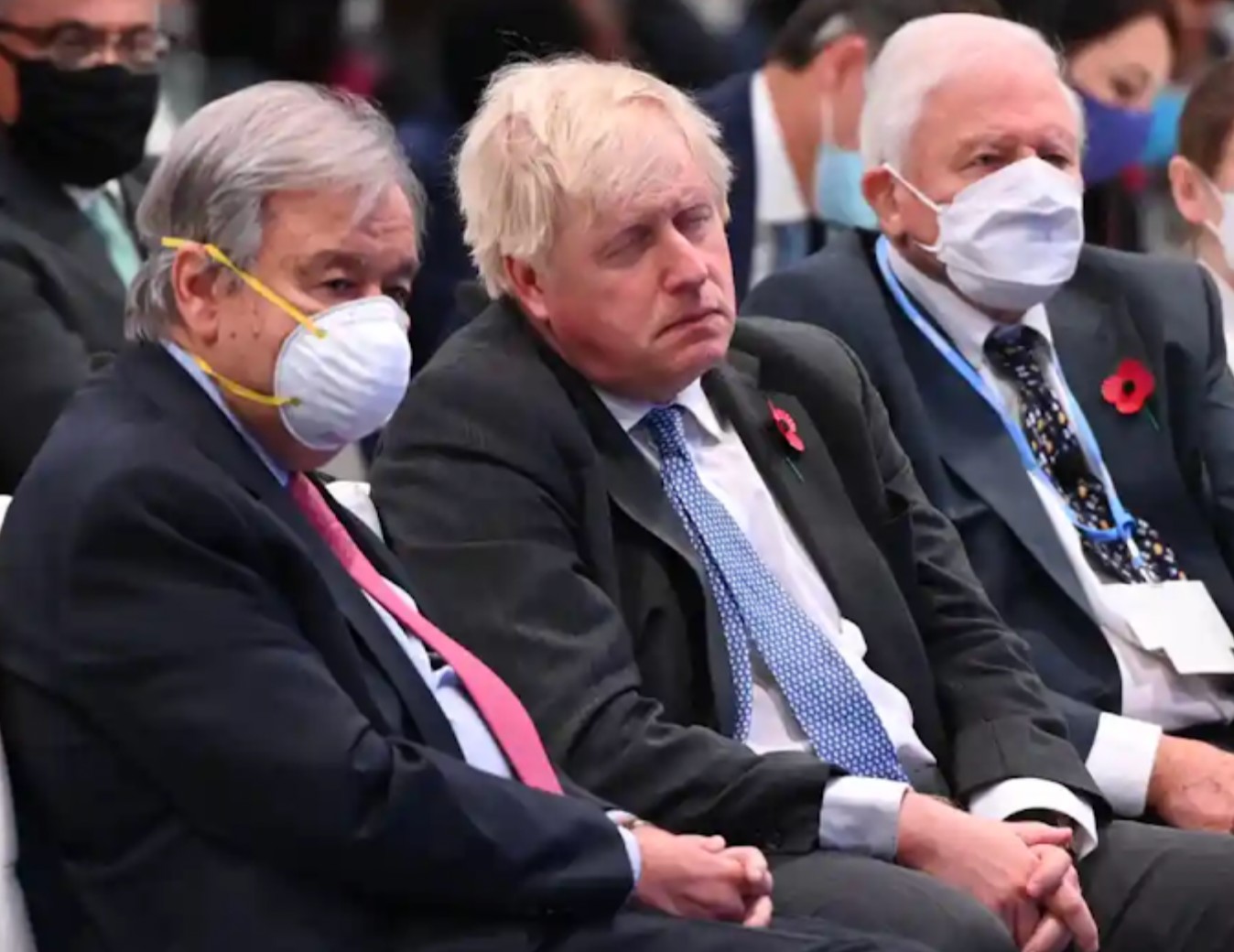
A picture is worth a thousand words. 

As this one is worth a million of them, I will risk copyright infringement because it’s too good not to share with you.

A brilliant photograph by Jeff J Mitchell/Getty Images appears in an online article in The Guardian.

On the left of the unmasked man in somnolent posture is António Manuel de Oliveira Guterres, a career politician, former Prime Minister of Portugal and the Secretary-General of the United Nations — a 71-year-old white man in relaxed but attentive mode.

On the right of the reclining dude is Sir David Attenborough, the internationally renowned broadcaster, naturalist and author who is 95 years young. 

Sir David has been busy his entire life and has remained prolific and added activism to his resume in his retirement years. Finally able to speak his mind as one of the very few people on the planet old and travelled enough to see the change in the planet’s biodiversity with his own still sharp eyes. He is also wise enough to interpret what he has seen for what it represents — a massive impact from human beings on the rest of the planet. 

The gentleman in the middle is understandably a little tired. 

He had to jet down from Glasgow to London to attend a dinner at The Garrick Club in the West End. This gentleman’s club, a simple euphemism for men only, was founded in 1831 and currently has a seven-year waiting list of new candidates. Gentlemen prospects must be proposed by an existing member and elected in a secret ballot, the original assurance of the committee being “that it would be better that ten unobjectionable men should be excluded than one terrible bore should be admitted”.

Our napping chap had to fly down to the club for a reunion of Daily Telegraph journalists. Naturally, there would be revelry and a complete absence of boredom in an exhilarating dinner date.  Such a foray would knock any big-hearted galoop about a bit.

However, duty is a demanding mistress. 

This opportunity for a kip is at the 26th Conference of the Parties to the United Nations Framework Convention on Climate Change. It came just after one’s cabinet colleague delivered a budget promoting air travel by reducing taxes on domestic passenger flights. Jetting about shows leadership by example.

The colleague, Mr Sunak, may or may not be in line for club membership given he has something about him that may have come from his Punjabi Hindu parents. On the plus side has an obscenely wealthy spouse. This conundrum will mean assurances of the committee come after more than one round of Graham’s 1972 single harvest port. 

Duty and revelry are ready reasons to excuse dozing off.

The absent mask, not so much.

How many words would capture the thoughts running through the REM sleep of the man in the middle? 

The picture suggests something like this:

I am a pig in shit, and I don’t give a fuck about anything else that is going on. I’m just enjoying the adulation and how everyone laughed at my jokes.

Why the baby boomers had it good

Why the baby boomers had it good

Photo by Esther Ann on Unsplash

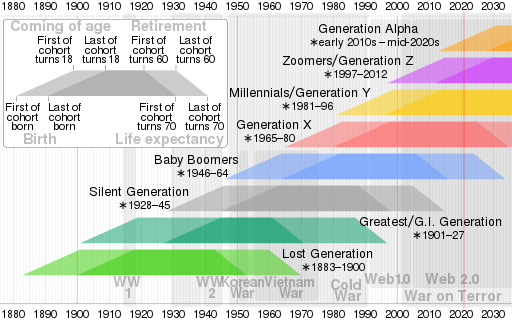
I was born in 1961 as one of the last Baby Boomers, the demographic cohort that came about from a spurt of fertility following WW2. 

The world of the 1960s was very different to today. 

There were far fewer people for starters, technology had not reached everyone, there was no internet, no streaming, and a long-distance phone call cost over $1 a minute. There was also no Covid.

My grandma bathed her children in a tin tub in front of a coal fire. I always had access to instant hot water. 

My father bought his first car, a third hand Austin A40 the size of a peanut when he was in his 40’s. I am lucky enough to buy a new car with a turbocharged engine and big enough for five adults.

Image source: Morse Classics

Personal computers, mobile phones, the internet, global travel, gastronomic delights, and Netflix have arrived in the lifetime of the Baby Boomers. So many things have changed over the last 60 years that my infant self would never have imagined my future. 

I have experienced so much that I need to pinch myself to be sure it all happened.

Cmglee, CC BY-SA 4.0 via Wikimedia Commons

The Alpha generation 

What of the babies born today, the Alpha generation? What will they experience in their lifetimes?

If the Boomers went from landlines to Facetime, maybe the Alphas can expect holograms, space travel for the masses, and bionic body parts. They could also have to pinch their virtual selves.

Only they will have more to do than the Boomers.

We know that their generation must solve many problems made from the successes of the previous generations. They will be faced with issues of food security, water security, wealth discrepancies, refugees, and any number of technology transitions, especially with energy. 

Oh yes, and Covid or its derivatives. 

They will also be impacted by changes to the climate.

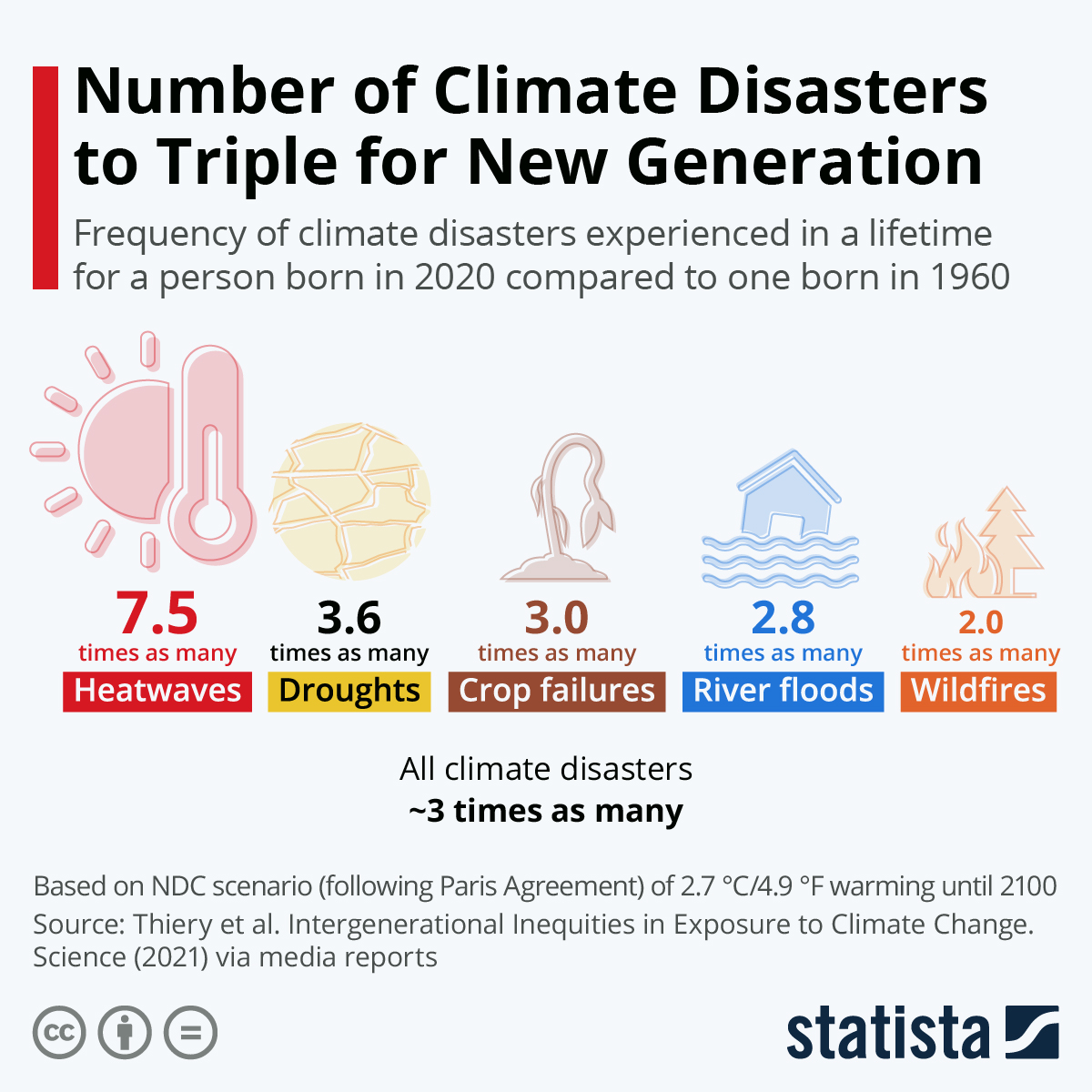
Here are some of the numbers based on a warming scenario should we meet the Paris agreement targets and see a global average of 2.7℃ of extra heat

This is a lot of extra disasters.

The WHO describes heatwaves as the most dangerous of natural hazards. From 1998-2017, more than 166 000 people died due to heatwaves, including more than 70 000 who died during the 2003 heatwave in Europe.

The Alpha generation can expect over 600,000 heatwave related deaths every decade.

A golden age

The Boomers parents and grandparents did it tough too — nobody goes through a global war unscathed.

So I am lucky to be born a Boomer and forever grateful.

However, my generation has done a lousy job of preparing for the future. We have not curtailed population or consumption but promoted both. Nature has buckled under our excesses, and the natural resources we leave for the Alphas are either depleted or dangerous to use.

The Baby Boomers had it good because we were born at just the right time, the golden age of technology and wealth. We tapped the sun’s ancient energy for a cheap fix and a costly legacy.

It will take a lot to make a platinum age from what we will leave behind.


Feel free to browse the Alloporus back catalogue for more ideas and random thoughts.

Money makes money for a few

Money makes money for a few

Photo by Daniel Barnes on Unsplash

How does wealth concentrate? 

Alloporus has discussed whether or not it’s fair to give a 10% pay rise to every employee in a business

It sounds dutiful and egalitarian, and it also suggests the company must be doing well to make such an intelligent investment in its workforce. 

Breaking the numbers down, it is clear that 10% to the lowest-paid workers in the company and even those on the average salary in the company results in far fewer extra dollars in the paycheck received by the CEO; let’s call him Jerry, for his 10%. 

The average worker gets, say, $200 extra a fortnight after tax. On his $750k a year, Jerry is looking at an additional $1,700 despite his heavier instalment to the tax office.

Justifications abound because the CEO is the boss and must make the decisions and wear the risk. He is worth the extra pay and has considerably more buying power in raw dollars from his 10% pay rise. 

Jerry is an intelligent fellow — not a given — so he chose to put the money from his pay into a unit trust, nothing too fancy, just a rainy day option. He did this each month.

The shop floor worker, Tom, was in debt, and he decided to put the extra money into credit card repayments to bring his balance down. His kids wanted presents for Christmas, which took care of December’s extra pay. His eldest daughter was about to go to college, and Tom wanted to send her off with a small sum to get her through the first semester away from home and used January’s extra pay. 

Tom consumed the extra money, and Jerry put it away in a modest investment. 

After ten years, Jerry’s investment of $3,600 each month was worth $577,971, of which $132,328 was the result of compound interest at 5%. 

He decided to cash out his units and made a hefty downpayment on a property south of Brisbane that he immediately rented to increase his net returns to 7.5% and convert his principle into a more stable asset class.  The property doubled in value over the next decade, giving Jerry another $1.5 million property in his portfolio. 

Now, you could say that Tom could have done the same thing and matured his salary increase by investing it. His $433 per month in the same unit trust would be worth $67,950 after a decade, including $15,500 of interest.

Making an investment choice might have been a clever play. Tom may have saved just enough through the investment to offer his daughter a deposit on a flat or maybe pay for her wedding that came ten years down the road. 

But his material wealth would never reach the same levels as Jerry in his working lifetime. 

As they say, money makes money. 

But the point here is that wealth also concentrates. 

The company has one CEO and a handful of executives with salaries large enough to easily invest their 10% but lots of workers, many struggling to make ends meet. The opportunity to make real money falls to a few.

Of course, the owners were happy too. The major shareholder in the business, Mr Hannah, also enjoyed a 5% share dividend each year. His 2.5 million shares were worth $5 million when the first instalment arrived, a handy $125,000.

Similar dividends were paid annually for a decade, with the money moved into various assets that yielded 5% interest. That initial $125,000 plus the annual instalments grew to $1.8 million in a decade, $400,000 of that in interest. Naturally, the shares rose on a buoyant market to be worth $10 million. 

The owner’s wealth accumulated too.

Then there are the super owners. Here is one chosen at random. In June 2021, Bloomberg Billionaires Index listed Dieter Schwarz, a german businessman who built his fortune owning supermarket chains, as the 61st richest person globally with an estimated net worth of US$27.3 billion. 

Should Mr Schwarz earn 5% interest on his assets, he receives $3.7 million a day before tax.

It is hard to figure out how to spend that kind of money. 

Of course, most of the time, these people do not. They invest it after paying clever accountants to minimise their tax. Then, on occasion, they give some of it away.

Dieter Schwarz.  $13,500,000,000
Mr Hannah. $1,800,000
Jerry. $578,000
Tom. $67,000
Annual returns after ten years on a 10% pay rise or 5% dividend compared to the cumulative returns from Mr Schwarz’ existing assets

The pattern is clear —  capitalism creates wealth that concentrates into a few individuals or entities. Over time this opens a wide gap between those who have and those who do not.

None of this is new nor much of a revelation. Accumulation and concentration are how capitalism works. The reason for revisiting the basics is that there is a lot at stake should this pattern continue.

Poverty and excess make each other very uncomfortable, and history tells us that resolving such disparity is ugly for everyone.

Better not to let it get out of hand.


Thank you for supporting Alloporus with your time. Please pass on the ideas to your peeps.

Trump lost but have the democrats won?

Trump lost but have the democrats won?

Photo by Ehimetalor Akhere Unuabona on Unsplash

Trump lost.

He will contest and whine, but for now, the American people are more concerned about their democracy than his tantrums. 

This is an encouraging sign. 

The country pulled itself back from the brink and gained some time to reflect. It’s what happens next that matters.

People may remember a frustrated President Obama, particularly in his second term of office. A recalcitrant and regressive Republican majority in the senate scuppered most of his key initiatives. 

President Biden is familiar with that scenario, viewing from the Veeps chair throughout that painful process. Republican’s majority in the senate has gone, but they have not gone away, nor has their mischief. 

A debate must happen within the democratic party. 

They united to get rid of Trump, fair enough. But a firm, adult conversation must happen between the old school and the new youngsters who have a very different take. 

Alexandria Ocasio-Cortez, serving as the U.S. Representative for New York’s 14th congressional district since 2019, for example, is asking the party to look very closely at how it got itself in the mess that resulted in Trump in the first place.

It is time for an alternative. 

The old school must realise that moving to the centre is no longer the answer. At least not the established centre that pampers to donors and the corporate world. 

If that happens again, it matters very little really which colour is in power because each offers the private sector the same easy ride. 

A centrist policy that bails everybody out using debt which simply funnels itself into a tiny number of people with stock options is not the future; it can’t be. 

Now is the time for dramatic rethinking and risk-taking. 

The Biden presidency won’t be able to do that. There have been enough old white men in the oval office for us to know how that goes. Admittedly this one has a woman of colour as vice president. But still, too much of the old school lingers. 

Back in the election, the progressive left had an old candidate too, considered way too risky at the time. The gamble to dump Saunders and go with the convention only just paid off. And it was a high-risk game to play in the first place. 

What must happen now is that the youngsters must come through. Their energy, positivity, and passion must fuel a progressive cause focusing on the well-being of people and the planet. They will usher in a different economic model because the last one is not working. 

The problem that faces them is scary. The planet cannot support three cars per household, and by 2030 just sourcing food for 11 billion people will be hard enough. 

Recall the late, great Hans Rosling’s explanation of the demographic transition

He said that the 2 billion poorest aspire to a pair of shoes, another 3 billion to a bicycle, 2 billion more to a car and a billion or so in the rich countries who, pre-COVID, aspired to fly to a remote destination on holidays. 

Progression means an economic approach that meets those aspirations, noting that a bicycle is not enough and, perhaps, three cars is not possible. 

If you want to ‘reimagine the shape of progress’ as Kate Raworth puts it check out her TEDx talk on Doughnut economics.

Thankfully Trump lost and the Democrats under Biden will calm the waters somewhat. 

Relative peace will buy time for the new generation of ideas to thrive. Only then will they have won.


Thanks for reading this blog post. There are plenty more to read and share.