One million people

One million people

Consider a city of roughly 1 million people, Adelaide, Australia for example — Calgary, Canada; Bonn, Germany; Tuscon Arizona; or Bristol in the UK would do equally well.

Adelaide has two Australian Football League teams, a pro soccer team, two professional basketball teams, three Universities, a cathedral, numerous hospitals, many shopping malls, around 440 schools, an International airport, and a zoo.

There are over 400 suburbs arranged around a CBD that has high-rise office blocks that provide a common destination for a metropolitan public transport system that includes a fleet of over 1,000 buses.

There are doctors, dentists, lawyers, Artisans and actors; and enough skilled tradesmen to build or engineer almost anything.

In short, Adelaide is a self-contained community surrounded by enough farmland to feed everyone.

If it were possible to gather all the people who live in Adelaide into one, standing room only location it would be quite a spectacle. It is hard to imagine what it would look like.

There would people as far as the eye could see. Lay them down head to toe and the line would stretch 1,800 km — 400 km further than a road trip from Adelaide to Sydney.

Stand them in single file and the line would be 30 km long, similar to the queue at the post office.

Now having conjured the image of so many people in your mind’s eye put them all onto commercial aircraft.

Because 1 million is roughly the number of human beings who are, at any one time, airborne in commercial airliners making vapor trails around the globe.

This is both staggering and scary at the same time.

It is enough just to illustrate the scale of the challenge to provide life support to all the people we have made and still retain some environmental integrity.


First posted on LinkedIn

Warrior

Warriors beachThe desert bakes the feet of the brave warrior even in the shade of the acacia. A waft of thick air brings a strange scent, somehow fresh and made of vibrant colour. Our warrior turns toward the smell and an urge comes to stride out. Instinct draws feet forward ever faster as clean air banishes the torpor of heat. So powerful is this cleansing that he runs towards the breeze. As beads become rivulets down his temples he reaches the edge of a cliff and is amazed at what he sees, an azure vista full of promise and opportunity. Fatally he stops to think. The view is too much. It calls and repels in equal measure, pregnant with the opportunity of pastures new and yet is far away. His breath hurts and his legs stiffen in fear of further exertion. He thinks again and returns to the safety of the scalded earth.

Jobless

workerIn the modern world people need jobs. Employment gives us a source of income so that we can pay bills, make a home and bring up kids. We take this as both fact and inevitable, for most of us will be short a lottery win or, lamentably, independent means

It was not always like this.

For our recent ancestors [all of those humans who lived before the invention of agriculture some 10,000 years ago] it was enough to find food, water and shelter on the back of your own effort.

People hunted and gathered with their time as they sourced from nature what was needed. They lived in groups to share out the workload, spread the risk of bringing up the kids, and protect the best gathering patches, but in the end they ate what they found.

No doubt there were roles within these groups but no jobs.

We assume that the employer worker story — the perennial struggle between capital and labor — began much later and in the scheme of things very recently. Paid work probably began in earnest around the time agriculture which would mean that 190,000 years had past where anatomically modern humans had existed without a salary.

Today everyone in the western [and increasingly the eastern] world has the notion of a job and we assume that most covet one. People know the difference between employer and employee even if they may not fully understand the mobilization of capital. Except that half the people alive today find their ‘jobs’ in subsistence agriculture where all their time is taken up growing food for themselves and their family.

In many ways half the world’s people are closer to the joblessness of our ancestors, tending and gathering from their kitchen gardens, paddies and maize fields. The other half could not imagine life was possible without work. How else would the rent get paid?


Idea for healthy thinking

Do you think it is possible in mature economies to return to such joblessness or roles without jobs?

I wonder?

It is hard to imagine that we could give up our competitive natures. Money and our desire to compete for ever more of it satisfies that need without resorting to its obvious alternative of beating each other up.

After all those hunter-gatherers did more than hunt wildlife with their spears and arrows.

Goanna


goanna

I can’t get this image out of my head.

A road in the outback and a young aboriginal kid in western clothes bashes the long grass on the verge with a big stick. He is trying, along with his mates, to flush a goanna all under the watchful eye of an elder. The hunted creature remains hidden and may or may not have avoided the blows.

The elder has his own stick, a baseball bat in metallic blue. After a fruitless search he calls time and the hunting party climb back into a late model land cruiser station wagon.

The sound bite captured by the media crew before the elder drives away is that this country is sacred to his people and should not be exploited for shale gas.

I know it is unholy to drawn attention to the truth of this scene. An ancient culture lost but still pretending to exist whilst embracing with both arms the trappings of a new one. I am afraid that even with a few baseball batted visits to the bush those youngsters will not have a feel for country. They will know mobile phones, internet porn, Call of Duty and soggy chips.

This is sad. The generations of indigenous kids that went before had a wholesome life that was connected to the earth. The kids that climbed into the air-conditioned land cruiser will live longer than their ancestors but maybe not with the same wellbeing.

It’s just that whilst fracking probably will contaminate groundwater, clutter the landscape with drilling rigs and mess up all the local roads with traffic, resource use is a requirement for a western lifestyle. We cannot fly, drive and cavort around with technology trappings by chasing goannas. We have to exploit natural capital and subsidize our own energies from external sources. And that is a truth.

Of course it would be nice to do this with the least externalities and with care to restore any damage that is done. But let us at least acknowledge the truth that we cannot make mobile phones with a goanna.

Nor can everyone who owns a car go out and hit one with a stick.

Sounds crazy #7 | Hidden hazards in the backyard

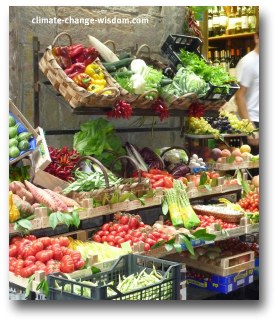
produce-01This ‘sounds crazy’ is an absolute ripper.

This bottom column headline and grab appeared on the front page of the weekend Sydney Morning Herald this week…

Hidden hazards in the backyard — Families are unwittingly exposing their children to the risk of sickness and even brain damage from lead hidden in backyard soil and paint… 

Fair enough. No doubt there is many an older inner city property that has not been renovated since the time lead was in most paint stock and some of that old stuff is peeling away and ending up in garden soil across the suburb.

Any city dweller knows that cities are not exactly pristine. The air is heavy with particulates from brake dust to builders waste and on a rainy day it washes all over your shoes. It comes with the territory.

The grab continued…

Lead experts fear the trend towards home vegetable patches and community and verge vegetable gardens is also putting children at risk.   

So at a time when all our electronic conveniences have deprived our youth of knowing anything about life giving soil, we must put the fear of god into those with the umph and initiative to get back to sharing produce they have tended.

Thousands of generations of good folk grew vegetables in their backyards. They planted, watered and cared for their crops and then fed their families wholesome fresh food. The extra they exchanged with their neighbors or sold at a local market helping to create the very essence of community that is so central to our wellbeing.

And they did this even when cars were spitting out lead, when the pipes were made of lead and when DDT was the pesticide of choice.

Did those dangers stop them? Not at all, they prospered and went ahead to multiply by the millions. So much so that today we need to double global food production in the next 30 years just to keep up with demand and will need every square foot of productive space we can find.

All I can say is shame on those ‘experts’, university academics with a career to build, and shame on the media for printing such fear mongering [and this time you can’t even blame Rupert].

For heavens sake, growing veggies in the backyard is a good news story.

I just wish the possums would stop eating mine.

Soil productivity | maxing it out

dung-maize-fieldHumans are extraordinary competitive creatures. We have found myriad more or less peaceful ways to challenge ourselves from sports to corporate takeovers. We even harass each other for parking spots at the shopping mall.

And everyone does it, even nerdy types. They will play ‘Warhammer’ or go for best online score on their ‘Words with friends’ app. My own nerd gene forces me to log my golf score into a spreadsheet after every round for a record of my personal best, all in the knowledge that because I avoid the club competitions, the only person I can beat is myself.

This requirement to compete means we are not programmed for moderation. We like the best, fastest, strongest, and would be those if we could.

A World Bank project in Kenyan used this instinct to help subsistence farmers grow more food on their tiny 1 ha plots. If a farmer adopted more sustainable land management practices he would receive a payment for the additional carbon his actions sequester into the soil. More importantly his yields of maize, yams and beans increase.

The instinctive requirement to outgrow your neighbor helped enormously in getting the project started and with uptake. No small feat considering a rural community of some 60,000 needed to change some life-long habits in order to receive money from air!

I learned about this interesting example [one of the few successful land-based carbon projects activities that are not about growing trees] at an ‘Agriculture, Soil Health and Climate Change’ Forum held in Sydney recently.

Whilst the mood in the room was congratulatory toward the guest presenter who had made the long journey from Washington, there was a question for the presenter from a vastly experienced CSIRO agronomist with firsthand knowledge of the project area.  He wanted to know why, even though productivity improved, the maize yields were just one third of the potential for the district. Did the farmers not have access to inorganic fertilizer? “No they didn’t” was the predictable answer.

But what struck me was the intent behind the question. It was though the ‘increase yield by a little and enough to encourage the farmers’ was not right. If the potential yield is three times that, we should try to max it out.

Why stop at just a small yield gain when there was all that potential left in the ground?

No matter that the question was posed politely. There was no doubt it was a criticism. The project was underselling that soil potential — surely the farmers would be better off with three times the yield rather than modest gains off a low base.

Well no they wouldn’t.

Even if the soil productivity potential was much higher than realized, it was only possible with more intensive farming at significant financial cost.  Taking on a growing reliance on inputs, farmers would risk the debt spiral that afflicts so many of their cousins in the West [including Australia]. And, needless to say, subsistence meant there were no resources to purchase inputs anyway.

Whilst moving to a high input system might increase yield, it would also put pressure to adopt other profitable options such as economies of scale. Surely it would be better to merge those 1 ha plots into much larger units that could accommodate mechanization.

You see the point. Our CSIRO friend had a paradigm in his head based on what he knew would work best from his viewpoint — and that involves commerce, commerce that feeds on competition.

Maxing it out might increase yield but it would put great strain on both the human and the physical system. It seems unlikely that those 60,000 people in the project area could reallocate the 40,000 ha without most of them having to suppress their innate competitive instinct. In other words we would be asking most of them give up their options to participate in the competitive paradigm that spawned the solution we have suggested. Bizzare.

When it comes to feeding the global population both locally and that commercial scale, we will need to suppress the competitive gene and think more pragmatically. Maxing it out is just brinkmanship. We need to come up with far more equitable and environmentally benign solutions.

A modest incentive to adopt sustainable practices buys time for us to figure it out.


Paradigm shift

grey kangaroo | NSW“You cannot solve a problem from the paradigm that created it” is a famous Albert Einstein quote.  The great man reminding us not only that lateral thinking is powerful, but that it is easy for us to stay with what we know at the expense of the things that we do not.

At times we appear so stuck in our ways that innovation seems all but impossible. We think in the current paradigm, work in it, live in it, trust it and are horribly uncomfortable when forced to go anywhere else.

Take sheep for example. A godsend if ever there was one — just about perfect wool and lamb cutlet factories. Nations were built on their backs.

In the late 1800’s there were more than 15 million of them in the parched lands of western NSW, outnumbering people by thousands to one.

Now we have talked about sheep before on Alloporus [Last chance to see | Buying up the land] and risk New Zealander and gum boot jokes if we go there again, only it is too good an illustration of what Einstein was on about.

Sheep production has been successful in Australia even when the conditions didn’t really suit them. Herding large numbers of the docile creatures on paddocks was the approach imported from overseas where the same thing had worked for generations.

It was difficult in dry country so, by necessity, the paddocks became quite large and the sheep stations huge. Graziers sweated hard and found a way. Countless sheep were reared, sheared and sold.

So many sheep left the stations over the years that it became apparent that these dry and dusty paddocks were becoming drier, dustier and less able to recover when the rains came. Growing numbers of feral animals, especially rabbits, didn’t help. Over time the rangeland became degraded almost everywhere threatening the viability of farms and bringing any number of unwanted costs from biodiversity loss to muddy waters.

What to do?

Here are some of the ideas that were tried:

  • make the paddocks even bigger
  • make the paddocks smaller
  • try running new sheep varieties
  • spell [rest] the paddocks for a while
  • turn the water points on
  • turn the water points off
  • apply some fertilizer to the paddocks
  • maybe keep the sheep but bring in feed from elsewhere to get them through the droughts

All these ideas and more were tested at some point. What you will notice is that they are all within the sheep-growing paradigm

A few innovators tried rearing goats or harvesting kangaroos. This is better perhaps but is still within the grazing paradigm.

A few very brave souls have suggested there are alternatives to meat and wool production and be paid for the carbon sequestration and/or ecosystem services provided by the land. And there is always ecotourism.

Again this may be better in some circumstances [although ecotourism is rarely the panacea proponents might like it to be] but it is still the economic paradigm.

So is it actually possible to solve the problem if it is so hard to think outside the core paradigm?

Fortunately there are enough ‘out there’ folk to become the early adopters of even quite wacky. The first business suit wearing users of the early mobile phones that were the size of a small suitcase looked most odd until they started doing deals from coffee shops — then everyone wanted one.

So paradigms do change and the grazing one might just be about to.

Something unexpected

Teaspoon of soilHere is an interesting situation, almost unimaginable.

You are approaching your 60th birthday and are about to be surprised by an unexpected inheritance from a wealthy relative that you barely remember.

Many years ago your great Aunt, who was always rather odd, left you some money.

She stipulated that you could only access the balance of the funds when you are 60 years old, 40 years on from when the money was deposited.

The good news is that the initial capital she left was $10 million, a huge sum even if nobody quite knew how she came to be so wealthy. The bad news is that the $10 million capital has lost value to the tune of 1.3% a year.

Bummer. Not only did you have to wait to be rich, but also each year there were 1.3% fewer funds. Still, in a few months time when you reach 60 there will be a bank cheque for $6 million in the post, more than enough for a world cruise or two and a luxurious retirement.

Your younger brother was less fortunate. The dowager only bequeathed $1 million to him under the same rules. He has to wait longer for his funds and gets a much smaller cheque of $593,000.

A tidy sum for sure but not quite enough to fund his retirement.

Your three cousins, who soon found out about the unexpected inheritance, were also hoping for something from this distant relative that they only just realized they had. Sure enough, she did not forget them and deposited $100,000 each for when they reach their 60th birthday. They get $59,250 — certainly better than a kick in the teeth but hardly a pension fund.

On the first of your world cruises you mull over the odd situation of financial capital failing to appreciate.

What if your retirement savings, that before your great slice of luck were your only means of support in old age, were being eroded at 1.3% a year?

Each year the amount you had saved up went down a bit, not much admittedly but it went down. Likely you would seek to reinvest your capital quick smart rather than run the risk of not having enough funds for your retirement. Also likely you would fire your investment analyst and rant at everyone you could, looking for a scapegoat for such a fundamental error.

And what bad news it was for your brother. If he had known about that $1 million all those years ago and invested it wisely he would have more money than you right now.

As you sip a G&T on the sundeck you can’t help thinking it funny what we take for granted.


Another unexpected thing

Soil scientists have estimated that the amount of carbon in agricultural soils in Australia has declined by 51% in the last 40 years — that is 1.3% a year.

Soil carbon is a critical environmental asset that drives plant growth because carbon fuels soil biological activity, promotes soil structure, aids infiltration and moisture retention and supports nutrient exchange. Handy material to have and not something to be squandered.

What is worse is that science has little idea about the initial carbon stocks [the capital]. It might have been the equivalent of $10 million in which case we can keep going for a while.

We might even have time to reinvest by adopting smart agricultural practices and get the capital to appreciate again.

The worry is that we may be as uninformed and as poorly off as your cousins.


Here is the original scientific reference for loss of soil carbon [you can find a copy on Google Scholar]:

Zhongkui Luo, Enli Wang, & Osbert Jianxin Sun (2010) Soil carbon change and its responses to agricultural practices in Australian agro-ecosystems: A review and synthesis. Geoderma 155 (2010) 211–223.


And some more articles on soil carbon

Carbon in Soil – Why Organic Carbon is So Important

Soil – the missing carbon sink

How many mobiles do we need?

It is reasonably well known that despite widespread poverty and reliance on subsistence agriculture, growth in the uptake and use of mobile phones in Africa is the fastest in the world.

The opportunity to bypass the clunky fixed line option that you must wait months to have connected by going mobile has been too good to miss. Pay as you go options with tiny recharge amounts to cope with the cost just made it even easier.

All over the world and in just a few decades every man and his dog has acquired a mobile phone.

A recent techcrunch.com report has aggregated the consequences of this inevitable trend.

The headline figure is that the number of mobile-connected devices will exceed the number of people on earth by the end of 2012. And well worth a headline. Quite staggering really that we already have enough mobile devices to go around everyone.

More telling was the prediction that by 2016, there will be 1.4 mobile devices per capita. That year, there will be over 10 billion mobile-connected devices, including machine-to-machine (M2M) modules.

Pause a moment on the notion that having sufficient mobile enabled devices in circulation for one each, even though there are 7 billion of us, is not enough.

One device obviously does not cut it.

What this means is that once we have one, most likely we will get one, two, maybe several more.

Staying in touch has always meant a lot to us and, whatever way we look at it, we are a social species.  It looks like that instinct to stay on touch or to feel that we are able to connect is very important indeed – important enough to part with the funds to hire or buy multiple devices.

It may not be too late to invest in telecoms shares.

New eBook – Environmental Issues for Real

Not satisfied with haranguing readers of this blog with environmental woes, I have branched out into the dynamic new world of ebook publishing.

Thanks to the amazing people at Smashwords my latest collection of essays on the environmental issues of the day is now available to download in all the usual formats.

Give it a whirl and maybe leave a review on the site. It would be great to hear what you think.