The elephant in the bathroom may have farted

elephant02Well it would seem that somebody close to the policy makers might have noticed the elephant in the bathroom.

This week an article in the Financial Review talked of a carbon tax budget hole that could be $4 billion deep thanks to a carbon price that might not continue to rise after the fixed price period after all.

Blind Freddie can’t help but chuckle and the elephant’s stomach rumbles with contentment.

It seems that there has been some new modeling of the carbon price beyond the fixed price period on behalf of Australia’s Climate Change Authority. The numbers suggest a “fall from July 2015 to $10.72 a tonne”.

This should be no surprise given the current European market prices are hovering around $5 tCO2e — this difference from $23 per tCO2e and rising to the reality of current market price is the elephant standing quietly next to the bassinette.

Now if you are a government that has been struggling to get the balance sheet back in the black because it was one of the core things you promised to do, then $4 billion less revenue is a problem. Especially given that the carbon price policy was hugely unpopular in the first place and will continue to give you trouble in an election year.

If it was just a revenue shortfall [$10 instead of $23+ per tCO2e] that probably wouldn’t be too bad. Only the revenue is already either spent or committed, mainly to ease the pain for exposed industries and for consumers, making a market price dip in 2015 a double whammy.

Awkward for the Australian government but stayers among carbon traders in Europe are not too worried. The say it is just what markets do, they will show price volatility around long-term trends. And just now the price is low. Later it will rise again, not least because this is a regulated market designed specifically to manipulate credit supply to raise the price and reduce demand. Like all markets, success comes from the long play.

Then there is another thing that the elephant symbolizes.

Remember that the carbon price is for a permit to emit and fewer permits purchased mean fewer carbon emissions. This was the policy objective: to reduce emissions of greenhouse gases by making it more expensive to emit than the alternatives.

And as President Obama brings action on climate change to the State of the Union address, it will be hard to ditch the policy now. So here are a couple of options given we can see the elephant.

Ostrich option | Bury the report or, if the electorate cotton on, spin it like a fury.

After all 2015 is a long way off. There is plenty of time for anything to happen, perhaps even something positive. Remind yourself of the positivity of the ballsy carbon traders and wait. In the meantime, do whatever is possible to make the whole thing go away.

Be a honey badger | take hold of the policy, believe in it and shake it hard.

The idea of a carbon price was that it should deliver behavior change and make Australia less carbon intensive.  So embrace that and with the tenacity of a honey badger stick with it. Allow an aggressive permit allocation limit, ease the coupling to the EU carbon market by changing the proportion of credits emitters can source from overseas and explain why to consumers. There is no reason that the domestic market cannot have a higher carbon price than elsewhere other than the fear of ceding competitive advantage.

In short, show leadership.

Now there is a thing.

Dangerously quiet

King Parrot, NSWIt has been 23 months since the NSW Labour government left office after more than 16 years in power.

Normally when a left leaning administration is replaced by a right leaning one the inevitable shift in attitude to nature and natural resources would galvanize the environmental movement.

When hard won conservation legislation, planning rules and funding for environmental management are chipped away there might be an objection, some resistance, or at least some verbal argument. Only there has been very little noise.

No great shouts against the inching away from protection — not even allowing shooting in national parks seemed to get a reaction.

Only the nationally significant issue of coal seam gas, particularly how it will be extracted and the possible impact on farmers, seems to have stirred the pot.

Regular readers will know that alloporus is not overtly green — a regular guy who owns a car, takes plane rides, watches a plasma TV and wrote a book called “Awkward news for Greenies” has little moral ground to claim great environmental advocacy. Yet this quiet is eerie — makes you wonder.

Is it the calm before the storm, the tirade that must hit when the environment is no longer considered?

Or is it something else? Perhaps there is no energy left. It could be that the era of loud advocacy has passed. Maybe the malaise of personal entitlement has swept across us all, even the card-carrying activists.

If it has then we have a problem. Whilst screaming from greenies is about as welcome as a crying baby in the quiet carriage of the commuter train, it performs a vital function.

It keeps the b—-ds honest

And when all that goes quiet it is dangerous for us all.

€0.40 per tCO2e | the elephant in the bathroom

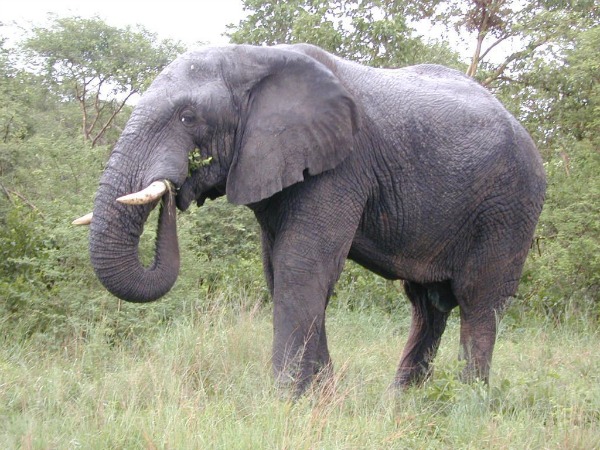
Elephant-01I wonder what it would be like if there was an elephant in the bathroom given a  mature female African elephant weighs 2,000+ kg, stands over 2m at the shoulder and will drop 100 kg of dung in a day.

She is here folks, right here in the bathroom, the smallest room in the house. And she is so big that she could not hide even in her Majesties powder room.

€0.40 per tCO2e

There she is, wafting her trunk gently from side to side, chewing quietly on some acacia bark.

€0.40 per tCO2e

Can you see her yet? Did you hear her stomach rumble?

€0.40 per tCO2e

Oh yes, there she is. The market mechanism designed to make alternative energy sources more attractive by making greenhouse gas emissions expensive.

Remember, emissions are permitted but only so many of them and you need to buy a permit for some or all of them. These permits cost you money. You can buy offsets against those permits from energy efficient projects, even from projects that reduce emissions from land management, and these would be cheaper than the permits and so create an opportunity for trade.

Only to achieve the outcome of overall emission reduction the offsets cannot be too cheap, otherwise what is the incentive to change your emission profile? That, after all, is an expensive thing to do.

€0.40 per tCO2e

If you would like to read about how not to see this elephant, for after all an elephant in the bathroom makes taking a shower a challenge, try here

Time to save the global carbon markets

Obama wins

President Obama is returned to office, quite comfortably in the end; only he looked anything but comfortable.

The oratory in the Presidents victory speech was familiar, right down to the repetition of phrases and anecdotes that have worked well for him many times before. Only they seemed out of place and at odds with his countenance. That slim youthfulness wears the strains of office and endless campaigning easily, but there was no joy in him. It felt like the passion had gone, drained away by four years of political reality.

Obama couldn’t arouse the faithful with a “let’s finish what we started” message because not much has started and what was finished [Obamacare] turned out not to be as popular as it should have been. Best he could do through the first term was to hose down fires with no surety that they would go out [jobs, deficit, war].

You could see it all  in his speech. All the issues that he really wanted to speak about truthfully but couldn’t mention replaced with things he had to say but only half believed.

Nothing about reigning in the banks and the profit driven end of town.

Nothing about deficit being debt and that debt can readily become living beyond your means.

Nothing about how war might start out as an economic stimulus but over time is crippling to both treasury and psyche.

Nothing to say about the idea that incomes may not always need to rise for voters to be happy.

Obama did say thank you because he is a polite man and was clearly grateful for avoiding failure. He didn’t manage to inspire hope and didn’t look like he was invigorated to start anew. And this is a pity because the only way to tackle those unmentionables is head on making sure to bring the people with you.

There is still a chance because hope never dies, even if in Obama it seems to have been drained and jaded by the magnitude of the task.

Leadership really is a tough gig in a modern world of individual entitlement.

Chance

Back in the day one of the first things I used to teach in my undergraduate biostatistics classes was that correlation is not causation.

For example, there may be a pattern between sun spot activity and the number of storks nesting in northern Europe, but you cannot conclude that sunspots cause nesting success. If it were that easy to assign a cause to all the patterns we see then a whole bunch of professions from currency speculation to climate change science would be unnecessary.

In my classes I used the presence of correlation to introduce the two main theme of my course: the concept of chance and the importance of the scientific method in helping us know when it is reasonably safe to ignore it.

Chance, and its measure probability, is a concept more intuited than taught. It was always fun to see the lights go on for a student who got it. More often though the pain of understanding likelihood was forsaken and students reverted to the age old standby of wrote learning.

All this recollection came about after I listened to a radio host who was recounting figures showing a significant spike in poker machine revenue in May and June 2012 (up 10 and 7%) across Australia. And in the same breath he reminded listeners that this coincided with cash payments to households from Federal government as compensation for cost of living rises from its introduction of a carbon price.

Now, of course, the radio host was smart. He didn’t imply or even hint that there was a causal relationship between the arrival of free cash and an increase in gambling revenue; but merely placing the two pieces of information together was enough.

My own emotions leapt to confirm gross inefficiency and lack of foresight in the government policy frame. Obviously people spent the money gambling.

Back in the classroom I would have berated my students for making the connection that I made. And really there is no evidence that a one-off cash payment to pensioners and low-income households ended up in slot machines, or even that some of it did.

Except that 10% of monthly poker machine revenue is roughly $100 million. This is a tidy sum and $500 more than usual in each and every poker machine.

Given that roughly 600,000 Australians play pokers machines weekly, that $100 million will be around $167 each.

The cash payments for families were $100 per child and for pensioners $250.

Chance is a fine thing.

Policies on the scrap heap

alloporus has been a place where the topic of leadership has popped up consistently.

It is after all an intrinsically fascinating topic [leaders not heroes] but mostly it gets a mention because of the leadership vacuum in the political life of Australia [Wot, no politics | Leadership is tricky | Labour leaders].

An insightful article in the News Review section of the Sydney Morning Herald by Miriam Lyons, executive director of the Centre for Policy Development based in Sydney, showed what a lack of leadership could mean. Her idea, presented in a neat analogy with fantasy football, was that there have been many policies proposed by politicians that would be laughed at by their parties if presented to the current parliament.

The best one for me was Andrew Peacock who, as shadow environment minister, went to the 1990 election proposing a 20% cut in GHG emissions. The Liberals didn’t win. When they did, in 1996 under John Howard, there followed a decade of keeping well away from emission targets and ignoring the Kyoto protocol completely. Today such a target would be preposterous.

Lyons point was that policies are fickle things, easily left behind when the mood of the day makes them unpalatable. And that many a good idea languishes even when international moves are in favour.

In Australia the trend for rejection seems to have become so severe that there are few policy ideas left standing.

Except that policy is core business for politicians. We entrust our elected members to discuss, debate and land at the right balance between our personal freedom and the necessary efficiencies from the collective. And we allow them a small army of staffers to figure out and implement all the rules, regulations and incentives that chosen policy requires.

So why, when I read the list of policy options now considered laughable, do I cry?

I despair because all of those policies once proposed by parties from all persuasions but now on the scrap heap contain a kernel of leadership. Each one of them was just a little bit out there, sufficiently different to be on the edge. Their proponents needed to be bold and took a risk in putting them up because there was a chance that the policy would be unpopular.

And this is partly why they were cast aside, for on the edge can also be on the nose. It is easy then to retreat into the entrenched assumption that the public will bite you if you present unpopular policy.

But is this true?

Like Lyons, I don’t think so. Unpopular policy can easily become popular if it works. That is if it delivers balance on the public and private interest. But it needs to be told and sold, and that takes courage or, dare we say it, leadership.

Astonishing

ImageImagine a Manchester United supporter on a commuter train to work. He sits next to a random person and, for once, starts a conversation. Turns out that the fellow passenger is a Manchester City supporter.

Outside the emotional pressure cooker of match day the exchange is civil.

Even though United are on a poor run of form and are trailing in the league, neither fan gives an inch. They spend a competitive half an hour talking up the virtues of everything from the merits of their best players to the quality of the meat pies at the grounds.

This is what we do when we declare our support… we support, talk up, cheer our team however lowly or troubled it may be at the time.

Maybe I am naive but I thought that a similar responsibility befell senior politicians when it came to talking about their jurisdiction.

So I nearly fell of my chair yesterday when on the radio was a recording of the Australian Prime Minister Julia Gillard complaining about transit times and departure congestion at Sydney airport. Every business traveller will tell you stories of long delays, she said.

What! Can you ever imagine a United supporter saying that Sir Alex is a bit slack, “came in late for work yesterday he did”? Or hear the City fan suggest that Balotelli should be dropped from the squad. Never, not in a million years.

The back story to the Gillard harangue was that the G20 leaders summit in 2014 was to be held in Brisbane and not Sydney, a choice made by the government for either political gain (the preferred media spin) or because the Sydney Convention Centre was scheduled for refurbishment and unavailable (a practical explanation not favourable to spin). Or maybe they just wanted to spread it around.

Whatever the real reason, the Prime Minister chose to claim airport inefficiency as her sound bite for why it was Brisbane over Sydney.

What a crazy call. Whatever your political motivation you don’t bag out your own team. In fact, I would say that Gillard, who has a loud public voice because of her position, was being irresponsible. She should be talking up Australia in every day in every way. It is in her job description.

If the Australian people ignore such gaffs and her inability to see the consequences of them and re-elect her to office, I reckon she would be one lucky lady.

And as a United supporter, I also hope and pray that she supports City.

Have we lost the plot?

This week Colin Barnett, the premier of Western Australia, was quoted in the Australian from a speech at a business leaders forum in Perth as saying that “We’ve lost the plot as to what we are trying to do here” implying there were other ways to reduce emissions than imposing a carbon tax.

“Why would we have a carbon price of $23 when the only somewhat credible trading market in Europe has a market price of $10?” he said.

This is the sort of thing you might expect a premier from the contrary political code to the Federal government to say. More so when it is the colossal revenues from mining that has been the engine of the WA economy for decades. The last thing a Liberal government wants is to dampen that particular fire.

At the same forum and quoted in the same article, the head of Westfarmers, who own a big chunk of Australia’s retail sector, described the carbon tax as “unnecessarily complex” and that “you have to be a rocket scientist to understand this stuff.”

Oh well, you could say, it’s just a couple of browns in a brown newspaper having a go at what they see as a constraint on the golden goose of capitalism. It’s to be expected.

And that would be a big mistake.

What everyone has forgotten to explain is why such a cost is necessary.

A few years ago we knew it was the “biggest moral issue of our time” at least according to Kevin07. Unless we took action global warming would consume us. And the majority believed that action was necessary.

Then the government prevaricated, forgot whose behviour they needed to change and introduced complex legislation that was more about plugging leaks than achieving a result.

It is emission reduction. Remember?

We thought that if we reduced greenhouse gas emissions then there would be fewer of the molecules that can trap long wavelength back radiation in the atmosphere than under business as usual and, if we managed reasonable reductions, we might slow global warming.

And then there is the real and far more critical reason. In a relatively short time we will run out of oil. If we haven’t at least begun the transition away from our dependence on oil for transport and fertilizers then we risk economic collapse everywhere. This is a huge deal, easily as important to the global economy as spiraling sovereign debt. Emission reduction might seem a bit left field as a means to transition away from oil but it starts the process of introducing and incentivizing alternative fuels and it starts to set the price signal that will come in a hurry when supply cannot meet demand.

Australian politicians must know this. They are well-educated, can interpret a graph and have a day job that puts this sort of issue front and centre.

Only they come up with a clunky policy that they have chosen not to explain to any of the people who really matter.

Maybe they think that because we have seemingly endless coal reserves, and now natural gas too, all will be well.

Or they just cannot bring themselves to explain the details behind the necessary pain of a transition – even though we already know that transitions are painful.

Perhaps they can’t explain something that they do not understand themselves.

Whatever the reason no one in the government has stood up to calmly, and with clarity, tell us why.

Then again, perhaps they really have just “lost the plot.”

Leadership is tricky when it comes to carbon

It is easy to see why political leaders are reluctant to let markets run things. Unconstrained buying and selling usually gets away from itself, careering towards the lowest denominator, the financial bottom line.

Even those of a conservative persuasion who often understand how markets work can be wary of the unfettered force of rapid growth. They know that growth increases the risk of collapse when commodities of the day become scarce as they inevitably do. Unleash these volatile forces at your peril.

So here we are in Australia about to embark on a new market mechanism, the carbon price. From 1 July 2012 the top 500 emitters of greenhouse gases will, at the end of each financial year, have to pay for permits to cover their emissions.

At first the government will sell permits at a fixed price of  $24. Then, after three years, permits will be priced by supply and demand through an auction mechanism. And just to make sure the market doesn’t go haywire the government will control the permit supply and set a price floor and a ceiling for at least three years.

If the price bombs, liable emitters will have pay extra to true up to the floor price.

The carbon price mechanism also offers the option of creating credits from approved emission reduction activities under the Carbon Farming Initiative. Naturally it is not really carbon farming as the bulk of activity will be in landfill gas and tree planting.  The problem here is where the money goes. In simple terms emitters buying credits spend their money in the market but they buy permits from government. Too many credits and the revenues fail to match the commitments government has made to ensure passage of the policy in the first place.

Why all the constraints?

The answer is that this is not really a market mechanism, even though it looks like one. It is actually a policy to reduce “pollution” by using financial cost to change behaviour. The market part is just a way to try and wield the policy instrument with an even hand.

The risk, of course, is that keeping all that market power in check takes away most of the benefit too.

It’s a bit like having a guard dog on a chain. The burglar hears the growls and barks but if he trusts the chain will hold, there is no danger and he can pass into the house to pilfer the silver. Soon enough the owner realizes the risk taken by leaving the dog on a leash.

So what should happen? Well some honesty first. Despite the rhetoric, a carbon price is not about the atmosphere or saving the planet from global warming. It is the first of many steps in the transition of the economy away from dependence on fossil fuels.  A vital step it must be said, although not the only one.

Pricing carbon is a way to foreshadow the economic costs of transition, to get us used to the pain before it really starts to hurt, let’s say when oil is $200 a barrel. It also gets the transition started earlier than it might if it were left to unfettered market forces. Ironically, it also protects some of the assets that create the emissions by giving them a longer life. It is a choice of leadership that sees its role as smoothing the inevitable bumps in the economic road.

Obviously reducing emissions is also a smart hedge on the global warming issue.

Now we know what the whole business is about, maybe we can let the mechanism run.

Bob Brown retires

What is the right thing to say when 67 year old who worked as a doctor for over a decade and devoted another 35 years of his life trying to keep us all environmentally honest with the last 15 of those as a beleaguered minority voice in Federal parliament?

“Thank you,” would seem appropriate.

Or maybe “Thanks Bob, enjoy your retirement. We’ll miss you” if you feel a little more familiar.

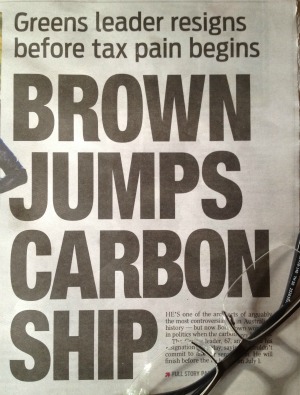
Headlinein Daily Telegraph on Bob Browns retirement

But no. Instead we get this crass headline in the Daily Telegraph.

Using the unexpected retirement of long time Greens leader Bob Brown to chirp about a tax that previously his party had blocked twice is just scraping the bottom of a very dirty barrel.

Your paper may sit as a political opposite to the Greens but there should be some common decency, a nod toward a worthy opponent however far his views may be from your own.

Imagine the uproar at home and overseas if on the back page of the newspaper  the headline was “Tedulkar quits to avoid touring Australia”, when all that happened was it was his time to retire.

In the past I have been critical of the Greens policies, especially when they blocked the CPRS. And I am not that fond of environmentalism either.

I also suspect that a party that in its essence is against things rather than for them will always be at the margins.

But when its leader and shining light decides to retire after a long and no doubt tiring time giving voice to things we would rather not know about, what we should all say is…

“Thank you Bob, it was an honour, enjoy your retirement.”

——–

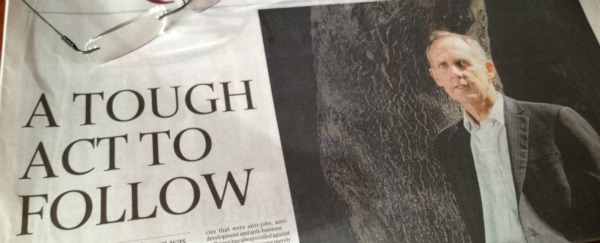
My faith in the rightness of things was partially restored by this headline in the Australian, not noted for their  fondness for tree huggers…

Bob Browne - A tough act to follow

…good on them.