Policies on the scrap heap

alloporus has been a place where the topic of leadership has popped up consistently.

It is after all an intrinsically fascinating topic [leaders not heroes] but mostly it gets a mention because of the leadership vacuum in the political life of Australia [Wot, no politics | Leadership is tricky | Labour leaders].

An insightful article in the News Review section of the Sydney Morning Herald by Miriam Lyons, executive director of the Centre for Policy Development based in Sydney, showed what a lack of leadership could mean. Her idea, presented in a neat analogy with fantasy football, was that there have been many policies proposed by politicians that would be laughed at by their parties if presented to the current parliament.

The best one for me was Andrew Peacock who, as shadow environment minister, went to the 1990 election proposing a 20% cut in GHG emissions. The Liberals didn’t win. When they did, in 1996 under John Howard, there followed a decade of keeping well away from emission targets and ignoring the Kyoto protocol completely. Today such a target would be preposterous.

Lyons point was that policies are fickle things, easily left behind when the mood of the day makes them unpalatable. And that many a good idea languishes even when international moves are in favour.

In Australia the trend for rejection seems to have become so severe that there are few policy ideas left standing.

Except that policy is core business for politicians. We entrust our elected members to discuss, debate and land at the right balance between our personal freedom and the necessary efficiencies from the collective. And we allow them a small army of staffers to figure out and implement all the rules, regulations and incentives that chosen policy requires.

So why, when I read the list of policy options now considered laughable, do I cry?

I despair because all of those policies once proposed by parties from all persuasions but now on the scrap heap contain a kernel of leadership. Each one of them was just a little bit out there, sufficiently different to be on the edge. Their proponents needed to be bold and took a risk in putting them up because there was a chance that the policy would be unpopular.

And this is partly why they were cast aside, for on the edge can also be on the nose. It is easy then to retreat into the entrenched assumption that the public will bite you if you present unpopular policy.

But is this true?

Like Lyons, I don’t think so. Unpopular policy can easily become popular if it works. That is if it delivers balance on the public and private interest. But it needs to be told and sold, and that takes courage or, dare we say it, leadership.
Astonishing

ImageImagine a Manchester United supporter on a commuter train to work. He sits next to a random person and, for once, starts a conversation. Turns out that the fellow passenger is a Manchester City supporter.

Outside the emotional pressure cooker of match day the exchange is civil.

Even though United are on a poor run of form and are trailing in the league, neither fan gives an inch. They spend a competitive half an hour talking up the virtues of everything from the merits of their best players to the quality of the meat pies at the grounds.

This is what we do when we declare our support… we support, talk up, cheer our team however lowly or troubled it may be at the time.

Maybe I am naive but I thought that a similar responsibility befell senior politicians when it came to talking about their jurisdiction.

So I nearly fell of my chair yesterday when on the radio was a recording of the Australian Prime Minister Julia Gillard complaining about transit times and departure congestion at Sydney airport. Every business traveller will tell you stories of long delays, she said.

What! Can you ever imagine a United supporter saying that Sir Alex is a bit slack, “came in late for work yesterday he did”? Or hear the City fan suggest that Balotelli should be dropped from the squad. Never, not in a million years.

The back story to the Gillard harangue was that the G20 leaders summit in 2014 was to be held in Brisbane and not Sydney, a choice made by the government for either political gain (the preferred media spin) or because the Sydney Convention Centre was scheduled for refurbishment and unavailable (a practical explanation not favourable to spin). Or maybe they just wanted to spread it around.

Whatever the real reason, the Prime Minister chose to claim airport inefficiency as her sound bite for why it was Brisbane over Sydney.

What a crazy call. Whatever your political motivation you don’t bag out your own team. In fact, I would say that Gillard, who has a loud public voice because of her position, was being irresponsible. She should be talking up Australia in every day in every way. It is in her job description.

If the Australian people ignore such gaffs and her inability to see the consequences of them and re-elect her to office, I reckon she would be one lucky lady.

And as a United supporter, I also hope and pray that she supports City.

Have we lost the plot?

This week Colin Barnett, the premier of Western Australia, was quoted in the Australian from a speech at a business leaders forum in Perth as saying that “We’ve lost the plot as to what we are trying to do here” implying there were other ways to reduce emissions than imposing a carbon tax.

“Why would we have a carbon price of $23 when the only somewhat credible trading market in Europe has a market price of $10?” he said.

This is the sort of thing you might expect a premier from the contrary political code to the Federal government to say. More so when it is the colossal revenues from mining that has been the engine of the WA economy for decades. The last thing a Liberal government wants is to dampen that particular fire.

At the same forum and quoted in the same article, the head of Westfarmers, who own a big chunk of Australia’s retail sector, described the carbon tax as “unnecessarily complex” and that “you have to be a rocket scientist to understand this stuff.”

Oh well, you could say, it’s just a couple of browns in a brown newspaper having a go at what they see as a constraint on the golden goose of capitalism. It’s to be expected.

And that would be a big mistake.

What everyone has forgotten to explain is why such a cost is necessary.

A few years ago we knew it was the “biggest moral issue of our time” at least according to Kevin07. Unless we took action global warming would consume us. And the majority believed that action was necessary.

Then the government prevaricated, forgot whose behviour they needed to change and introduced complex legislation that was more about plugging leaks than achieving a result.

It is emission reduction. Remember?

We thought that if we reduced greenhouse gas emissions then there would be fewer of the molecules that can trap long wavelength back radiation in the atmosphere than under business as usual and, if we managed reasonable reductions, we might slow global warming.

And then there is the real and far more critical reason. In a relatively short time we will run out of oil. If we haven’t at least begun the transition away from our dependence on oil for transport and fertilizers then we risk economic collapse everywhere. This is a huge deal, easily as important to the global economy as spiraling sovereign debt. Emission reduction might seem a bit left field as a means to transition away from oil but it starts the process of introducing and incentivizing alternative fuels and it starts to set the price signal that will come in a hurry when supply cannot meet demand.

Australian politicians must know this. They are well-educated, can interpret a graph and have a day job that puts this sort of issue front and centre.

Only they come up with a clunky policy that they have chosen not to explain to any of the people who really matter.

Maybe they think that because we have seemingly endless coal reserves, and now natural gas too, all will be well.

Or they just cannot bring themselves to explain the details behind the necessary pain of a transition – even though we already know that transitions are painful.

Perhaps they can’t explain something that they do not understand themselves.

Whatever the reason no one in the government has stood up to calmly, and with clarity, tell us why.

Then again, perhaps they really have just “lost the plot.”

Leadership is tricky when it comes to carbon

It is easy to see why political leaders are reluctant to let markets run things. Unconstrained buying and selling usually gets away from itself, careering towards the lowest denominator, the financial bottom line.

Even those of a conservative persuasion who often understand how markets work can be wary of the unfettered force of rapid growth. They know that growth increases the risk of collapse when commodities of the day become scarce as they inevitably do. Unleash these volatile forces at your peril.

So here we are in Australia about to embark on a new market mechanism, the carbon price. From 1 July 2012 the top 500 emitters of greenhouse gases will, at the end of each financial year, have to pay for permits to cover their emissions.

At first the government will sell permits at a fixed price of  $24. Then, after three years, permits will be priced by supply and demand through an auction mechanism. And just to make sure the market doesn’t go haywire the government will control the permit supply and set a price floor and a ceiling for at least three years.

If the price bombs, liable emitters will have pay extra to true up to the floor price.

The carbon price mechanism also offers the option of creating credits from approved emission reduction activities under the Carbon Farming Initiative. Naturally it is not really carbon farming as the bulk of activity will be in landfill gas and tree planting.  The problem here is where the money goes. In simple terms emitters buying credits spend their money in the market but they buy permits from government. Too many credits and the revenues fail to match the commitments government has made to ensure passage of the policy in the first place.

Why all the constraints?

The answer is that this is not really a market mechanism, even though it looks like one. It is actually a policy to reduce “pollution” by using financial cost to change behaviour. The market part is just a way to try and wield the policy instrument with an even hand.

The risk, of course, is that keeping all that market power in check takes away most of the benefit too.

It’s a bit like having a guard dog on a chain. The burglar hears the growls and barks but if he trusts the chain will hold, there is no danger and he can pass into the house to pilfer the silver. Soon enough the owner realizes the risk taken by leaving the dog on a leash.

So what should happen? Well some honesty first. Despite the rhetoric, a carbon price is not about the atmosphere or saving the planet from global warming. It is the first of many steps in the transition of the economy away from dependence on fossil fuels.  A vital step it must be said, although not the only one.

Pricing carbon is a way to foreshadow the economic costs of transition, to get us used to the pain before it really starts to hurt, let’s say when oil is $200 a barrel. It also gets the transition started earlier than it might if it were left to unfettered market forces. Ironically, it also protects some of the assets that create the emissions by giving them a longer life. It is a choice of leadership that sees its role as smoothing the inevitable bumps in the economic road.

Obviously reducing emissions is also a smart hedge on the global warming issue.

Now we know what the whole business is about, maybe we can let the mechanism run.

Bob Brown retires

What is the right thing to say when 67 year old who worked as a doctor for over a decade and devoted another 35 years of his life trying to keep us all environmentally honest with the last 15 of those as a beleaguered minority voice in Federal parliament?

“Thank you,” would seem appropriate.

Or maybe “Thanks Bob, enjoy your retirement. We’ll miss you” if you feel a little more familiar.

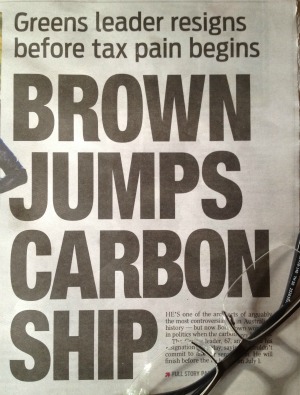
Headlinein Daily Telegraph on Bob Browns retirement

But no. Instead we get this crass headline in the Daily Telegraph.

Using the unexpected retirement of long time Greens leader Bob Brown to chirp about a tax that previously his party had blocked twice is just scraping the bottom of a very dirty barrel.

Your paper may sit as a political opposite to the Greens but there should be some common decency, a nod toward a worthy opponent however far his views may be from your own.

Imagine the uproar at home and overseas if on the back page of the newspaper  the headline was “Tedulkar quits to avoid touring Australia”, when all that happened was it was his time to retire.

In the past I have been critical of the Greens policies, especially when they blocked the CPRS. And I am not that fond of environmentalism either.

I also suspect that a party that in its essence is against things rather than for them will always be at the margins.

But when its leader and shining light decides to retire after a long and no doubt tiring time giving voice to things we would rather not know about, what we should all say is…

“Thank you Bob, it was an honour, enjoy your retirement.”

——–

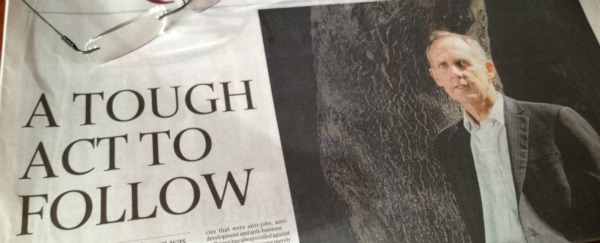
My faith in the rightness of things was partially restored by this headline in the Australian, not noted for their  fondness for tree huggers…

Bob Browne - A tough act to follow

…good on them.

Wot, no politics

It was a momentous day in 1990 when the Australian government decided to permit the broadcast of proceedings in the Australian parliament on free-to-air television.

Since then it has been possible for the electorate to see first hand what elected members get up to in their day jobs.

We can all follow the procedure, the tradition, the ceremony, the banter, the heckling, the bad behaviour, the nodding off after lunch, and the politics.

It is the last bit that interests me.

Tune in to question time and you will see the government field questions on where it stands on the issues of the day. The opposition will poke and prod to unearth the truth, the philosophy that underpins the position. This they will then undermine and deride to make their alternative position seem so much more sensible.

In return the government will fire back proclaiming the logic of their stance and how the alternatives will surely fail.

In short, there will be debate.

And debate will help us all understand the options and form our own opinion. Those of us not able or foolish enough to take in question time live will be able to get a potted summary in the weekend editorials or a sound bite on the news, maybe even head to the blogosphere to see what everyone else thinks.

So what happens when, back in the chamber, you are so afraid of your philosophical position you bury it so far back in your mind that after a while you easily forget what it is.

You now have nothing to defend. No philosophical foundation on which to argue the issue; no weapons or ammunition for a verbal fight and no empathy, compassion or understanding if enlightenment is your gig. You have nothing.

And there is no debate.

Tune in to question time today and what you will witness is a slanging match over nothing more than personality and procedure.

It is simply too painful to watch.

Labour leaders

At this time of confusion over political leaders in Australia that highlights a frightening vacuum in leadership, I though I might point back to a post from last year entitled Don’t argue the mechanism, set the target.

It hints at why the Australian Labour Party finds itself in such a mess today and at why, when the Liberals return, they will show themselves to be equally disheveled.

What will it take for real opinion to spark real debate to result in real policy?

Answers on a postcard to….


Leaders not heroes

Leadership is hard to define, not easy to learn and is, perhaps, only gifted.

True leaders inspire us and we trust them. We listen to what they say and we accept what they decide. This is because leaders do and say things that make us feel good about ourselves. And what they do we believe in, often without need of explanation or a spelling out of logic.

Heroes are a little different. They motivate us because they are admirable. They do what we would like to do. We can imagine ourselves slaying the dragon and winning the adoration of the damsel or, if you prefer, as a heroine beating up the patriarchy to create equality and emancipation. Our heroes actually do these things. Heroism generally requires conflict.

In our modern ritualized world, our heroes do our fighting for us or they act bravely in the face of danger. Leaders can do these heroic things for they too have courage. Only they do them without having to fight.

Leaders show the way forward as not only the logical but the truthful path. They do this instinctively; picking their way with ease through the complexity of options to choose those that really make sense. They can slay the dragon if needs must, only they will more likely convince it to live happily on the top of the mountain.
They also have vision. A clear notion of what the future looks like that is not an idealized utopia but achievable and likely futures. And leaders are not afraid to explain the future to followers and skeptics alike. The dragon will live on the mountain and will not visit the valley unless invited.

And there is one more critical element that sets leaders apart from both heroes and mere mortals: they can combine fearless vision with timing. They know instinctively how to act and when to act to achieve the desired outcome. Heroes are presented with their opportunity and instinctively move to the front of the cowering throng sword in hand. Leaders anticipate the dragon’s arrival and go outside the village to engage the foe on neutral ground.
It takes courage, smarts and conviction to be a leader. It also needs a certain lightness of hand (and word) dispensed with ease and grace. And wisdom helps, preferably born of experience, or where time has yet to allow for this, then from instinct.

There have always been leaders who have most of these things and these people have become important in our societies. You could probably name your own favorite. And if we did a survey of favorites, the majority of the many leaders that people would chose to name as inspirational come from the past. Many favorites will be historical, a few will be modern, but hardly any will be in public office. Bar the notable exception of a few charismatic entrepreneurs, our current leaders do little to inspire us. This is especially true in politics.

And then there is one final, and perhaps the most critical, quality of leaders, one that seems to be missing from all modern political leaders. That is the ability to realize that leadership is not about them, even though they must be strong, stand out and even be heroic. Leadership is actually about the outcome, the means proposed to get there and the timing of the actions. So true leaders must have humility. The quality of knowing that it is just a channel that they present to the people who look to them.

People follow what they intuitively know to be right. All they need is for it to be presented. Sometimes we are conned. A few infamous historical leaders have taken their people down horror roads through force of rhetoric and oratory but have all fallen when the truth came out. When it became clear they lacked humility they were ousted. It sometimes took a great effort but they did not survive any more than the pathways they proposed.

So in the end leadership cannot be about being heroic because actually we lead ourselves. All that leaders really do is show us the way. Outcomes happen as each one of us as individuals take responsibility.

Mental musings on leadership might help a little. The real issue is what the future holds and who will lead us to it.

In our children’s lifetimes we will reach 9 billion souls, oil will be $200 a barrel making alternative energy an economic imperative, agricultural soils will show the symptoms of overuse and we will have to wrestle with the consequences of land, water and food shortages. These things will happen with or without climate change and we will want wise heads to lead us through the challenges with confidence and surety.

Can we expect this from our political elite? Yes we can. Indeed we should demand it.

We should ask for courage, smarts, timing and, most of all, humility.

Thinking

Do we think enough or too much? It’s an interesting question with chalk or cheese answers depending on where you try to find them.

According to Parnell McGuiness writing in the Sydney Morning Herald we are not thinking enough because our breakneck media cycle and the domination of the lobbyist has eroded true thoughtfulness on the big issues. Immediacy and a need to be right have reduced the extent to which we really explore a challenge and so we have become stuck in a narrow range of options. Discussion has been reduced to argument and no one seems able or confident enough to subject their view to serious interrogation.

I must say I have to agree. Our serious media reports more on style than substance from our leaders, although to be fair, this is because there is so little substance to discuss. The intellect is there. It cannot be that so many highly educated individuals cannot figure things out or engage in the necessary debate on issues that are difficult to resolve. Yet it is hard to find that debate. Instead we are given the extremes of opinion without the logic flow that led the proponents to their definite conclusion.

McGuiness suggests a return to true open-ended questions such as ‘What is happiness?’ As opposed to the already constrained “Can we be happy in a capitalist society?” Implying that we have become too constrained in our thinking for thinking to be effective. She has a point. And her solution is that we create more fertile thinking places and get to it.

Then there are the new age types who tell us that we think too much. We live in a mental fog created by our thinking brain that makes it very hard to see the truth. Constant brain chatter has made us fearful of the future and a slave to all our past psychological damage. If we could only stop all that noise and intuit then we would know instinctively what must be done.

This spiritual solution, that is hardly new having been around in various guises for millennia, is to take up meditation, yoga and gentle walks in the countryside or any activity that will help our chatterbox brains take a breather. In short, think less.

So are we not thinking enough or are we thinking too much?

Well there is definitely too much chatter going on in our heads. We are far too easily distracted by the inane, argumentative and opinionated. And what is it with the thousands of TV dramas in which there is either murder, infidelity, corruption or, preferably, all three. Our minds are so stimulated that it is no surprise they are manic.

So yes, we think too much. And we could all do with some quiet and quieting time.

Only then we need to re-engage our thinking minds with the wisdom we will find in those quiet moments. We need our brains to help make intuition real because reality requires practical solutions. And they need some thought.

So maybe we each need a week of Vipassana meditation followed by a workshop at the nearest think tank. I wonder what kind of solution that would produce.

M

You can find the original essay on open-ended thinking by Parnel McGuiness in the latest issue of Binge Thinking

The Greens need a new name

This picture is of a white rhinoceros, Ceratotherium simum.

The species nearly became extinct in the 1980’s but was saved by a concerted and dedicated effort of translocation, breeding, reintroduction and protection.

When you are next to one of these creatures you know that a world without Ceratotherium simum would be a lesser place.

Saving both the iconic and the less well-known but equally important species that make up biodiversity will require more heroic action and a fundamental shift in perception. We will all need to understand that there are consequences of resource use by 7 billion humans and that if we want to keep rhinos, even as semi-wild species, then we must pay attention to those consequences.

We will all need to be green.

And this will happen. When it does we won’t think of recycling, energy efficiency, consuming only what we need, rambling in wild places because they will all be completely normal. Green will not be some funky fringe activity, it will be the solid mainstream.

There will not be green, only normal.

As Hot, Flat and Crowded author Thomas L Friedman says

“(The) sign that we are succeeding will be when the term ‘green’ blessedly disappears. (Because) when green is the standard, not an option, you’ll know that we’re having a green revolution and not just a green party.”   

In anticipation of this critical event the Australian Greens might consider a name change. How about ‘The Progress Party’? Or maybe, ‘The New Whigs’?

No doubt there are far better suggestions.

Only the point is serious. There is an opportunity right now for new political leadership, for a party to emerge that understands that green and brown will be replaced by another colour; purple perhaps

A colour that can meld all the conservation and preservation ethos of green with the production and wealth creation necessity of brown to create a colour that represents an economic system that supports for now and the long term.

It is a shame that word purple has too many syllables to be marketable, for it is the colour of wisdom.