That’s Africa

Okavango Africa.jpgLast Wednesday night I tuned in to the ABC News24 coverage of the memorial service for Nelson Mandela expecting somber reverence or perhaps the kind of party that only Africans can do.

I should have known it would be something else.

The start was delayed by the requirement for every dignitary to make his or her own special entrance aided by typically inept African organizing but, conveniently, heavy rain could take the blame.

And nobody seemed to mind.

Filling in the airtime was anther matter. The ABC wheeled in a former activist who had struggled against the apartheid regime and then escaped [long before Mandela was released] to become an Australian citizen.

Unfortunately he was sadly bitter. His deep hurt and anger had travelled with him and he still had it in spades. His comments ran as though the oppressors were still oppressing and Nelson Mandela had not existed.  This attitude of hatred and recrimination was exactly what Mandela knew he had to diffuse. The miracle was that through courage and compassion he did it for a nation, but sadly not for this exile.

Quickly we abandoned the ABC and its disrespectful commentator and streamed the coverage.

You had to laugh out loud at the antics.

There were the random guys in the foyer as the dignitaries arrived. These are the traditional ‘hangers around’ that are everywhere in Africa, who obviously had nothing to do but hang around. Presumably they had security clearance… presumably.

There was an extraordinary performance by a gospel cum rap singer trying desperately to energise the crowd to God by being energetic himself. As his antics became more and more exuberant another random guy assigned to hold an umbrella over the singer was finding it more and more difficult to complete his assigned task. He was stoic and hugely comical as he did his best.

Then there was the huge amusement of Ban Ki Moon claiming the applause of another African dignitary as the latter ascended the stage to be embarrassingly ignored by the UN Secretary General.

President Obama showed how to calm the restless crowd with an impassioned speech that closed in on the truth of what Mandela gave us. Cleverly he still managed a sly dig at the current crop of African leaders who cannot hold a candle anywhere near the father of the nation. Only he spoilt it later by helping the Danish PM take a selfie — and we thought only Kevin Rudd did that.

And there were the boos for President Jacob Zuma. Not, as I thought at the time, because there was politics even at the memorial service for one of the world’s greatest, but because he had not made the day a public holiday. Fair enough, he deserves a slap for that.

Then we ran out of steam and let the remaining hours of the ceremony go.

The bit we watched was classic Africa, full of cheer, cheek and irreverence layered over famously sloppy organization. It rained and was obviously cold, went on for hours, and still the people danced to celebrate a great life.

I reckon Madiba was watching all the antics as proud as punch with his famous smile lighting up the heavens.

Failure

Springwood golf clubHow do you know when it is you who has failed or when the system has failed? Is it possible to tell the difference or even what failure is at all?

Everyday life is enough to trigger such anguished questions in all of us. Should we ‘man up’ and take responsibility or go the way of the mountaintop and realize that nothing is ever fired directly at us?

Recently a series of events made my own thoughts about failure acute.

First I enjoyed a delightful [if somewhat rainy] charity golf day to raise money for bushfire victims. The local community rallied as it has done consistently since 193 homes were lost in a fire that an ecologist friend of mine described as a huge blowtorch.

Sponsors showered golfers with freebies and the golfers duly purchased vast numbers of raffle tickets and made generous bids in the auction when the golfing was done. The clubhouse was packed with people and there was a palpable sense of unity in a shared cause… and that isn’t so common in these distracted days.

Out on the course it was a team game [the scramble format for those in the know] and we were doing ok. We had an ideal handicap mix and the will to win that seems to gush out of every golfers pores no matter their [in]ability.

Coming to the last two holes we knew we had a bit of chance but really needed a couple of birdies. Drive, 6 iron, putt gave us one. Then, a 9 iron to two feet. That was two and enough for a credible 4th place. We were quietly chuffed with that.

Not a failure at all and, for me, sticking that 9 iron when it [kind of] mattered made me quite proud of myself. Such moments make the memories of an amateur sporting life.

I’ll pass over the conversation a few days later with a social media marketing guy who politely said I would never make any money from my books along with the ongoing anguish that is every consultants daily grind — clients who, bless their cotton socks, don’t really want the help you are offering — and cut to the chase.

The system of information gathering on how the environment works in the state of NSW is, abruptly, surplus to requirements, along with the conceptual framework that supports environmental decision-making.

The new[ish] state government have thrown out statewide natural resource management targets and cut the guts out of the human capital and budgets that previously gathered data on the health of the environment. A brutal dismantling that stinks of the political polemic.

Why would anyone do this? Knowledge is power and always has been. The environment is and always has been the foundation of our success, not to mention the source of what keeps each and everyone of us alive. So why stop trying to understand it by scrimping on the measly current spend on collecting the data?

Perhaps it is a sinister plot, a backlash against all those closet greenies in the previous government who had run the show [somewhat corruptly as it turns out] for more than a decade. Or, more worryingly, a belief that natural capital is inexhaustible and that humans were invented to mobiise it into wealth, fast cars and tea parties.

Whatever the reason the news hit me as a monumental personal failure. Clearly I had nothing to do with the decision or any influence over it either way and yet I took it personally.

Even as I fought the illogical feelings with personal pep talks and a viewing of Despicable Me 2, anguish was taking hold. It has since solidified into a funk that if I don’t shake it loose will sit for a long time in the pit of my stomach.

Of course there is some justification for my malaise.

Since the early 1990’s I have been variously teaching, researching, advising, criticizing, developing and talking up environmental monitoring — I even switched out of academia into the risky world of entrepreneurship to build an environmental monitoring company that for a time helped accumulate data and understanding.

Wearing my consultant’s hat I have prepared countless reviews of strategy and provided policy advice on MER that has consistently talked it up and tried to explain the value proposition. Recently I even came up with some new approaches to data analyses that will add more value to the raw numbers.

And it feels like it was all for nothing.

Only worse, it also feels like I should have done more to make it obvious, even to blind Freddie, that monitoring the environment was worth it for everyone.

As I write there is still a lead weight in my midriff that I am sure will take some shifting…

But this too shall pass.

Time will lighten the load and another golf game will see a white ball fly and land somewhere near the flag.

I hope.

Leadership still sucks

Leaning_Tower_PisaThe 100th post on alloporus was posted 8 months ago. That mini-review managed to reduce most of the previous content down to a couple of words “leadership sucks”.

And if you live in Australia then you would probably agree without reservation, whatever your political persuasion. We have an imploding Federal government with an opposition that just has to sit and watch it happen, whilst at state level there is a steady unpicking of legislation to turn the world brown.

Australia is even losing the plot in sport where in one code it is fine to punch the opponent in the biggest game of the season and in another a punch that missed is described as ‘despicable’

Ah, leadership, wherefore art thou.

As though in some kind of zombie state most folk seem to be ignoring it all. Perhaps it might go away. Just keep on selling the coal to the Chinese and we can carry on being rudderless [no pun intended].

Public lethargy is everywhere, spread as a thin veneer over stronger feelings of fear and woe, suggesting that leadership still sucks.

Only in the 100th post I also made a commitment to be more positive. Well that was a promise easily made and hard to keep.

It would seem that 5 decades of exposure to the human condition has allowed negativity to seep right through to my core. No matter the sunny disposition, gratefulness, the knowledge of blessings, and awareness of the privilege I enjoy — most of the latest alloporus blog posts are still glass half empty.

Not even the clever work of Plummer showing that despite our growing numbers the grand scheme of things is getting better has made me feel chipper.

It could be that I am wired to get upset and then depressed at all the craziness. I mean do we really need to know the sex of Kim Kardashian’s baby when we don’t know where most of our food comes from?

Less depressing would be the idea that this preoccupation with the inane and a requirement for drama is hard wired in us all and, more importantly, was necessary for our success.

There is obvious survival value in being obsessed with the immediate and the mundane for out on the savanna there were mundane things that could eat you or make you sick. Any hunter-gatherer who sent her mind gazing too far into the future went hungry or lost her child to an opportunistic leopard.

The addiction to stress is less easy to justify away unless we see it as a by-product of a requirement for drama. Argument does bring us awake, sets our adrenaline to work and makes us ready to fight or flee. In other words, drama was probably a basic requirement for successful savanna life.

Modernity provides us with every opportunity to latch onto drama and be in that alert state; only we have very little real need for it. Now drama is of our own making. These days we don’t find ourselves risking a drink from the crocodile infested rivers but we still like the feeling such risk brings.

I guess what all this justification talk becomes is a soothing of sorts. I do feel better posting rants when I accept that drama, argument and disagreement are a natural part of me, part of us all. The ego has to be thanked for getting us this far

What is still challenging is how to shift through to the positives. Not the ‘ra, ra, ra, yes we can’ positivity that is just another way of priming the body to act. I mean the real positives that come from truth.

For the moment these are harder to write about.

Must see post really makes you think


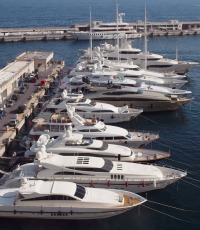
Yatchs_MonacoSo now that you have had a squizz and a chuckle at the excellent satire of Brad Plummer in the Washington Post [here is the link again if you missed his must see post], what should we make of a world where some of the big metrics of quality of life and lifestyle are trending in the right direction?

Yes it is true that there is still poverty, disease, crime, environmental degradation, precarious economies and the prospect of global changes out of our control, but the reality is that, even with so many of us, the majority are in pretty good shape. And those lucky enough to live in the developed world really do live like kings compared to the kings of just a few generations ago.

Not even all the King Georges in the House of Hanover who were having a ball before and after 1800 had electricity, TV or a mobile phones. All four of them would have had to get a lackey to heat their bathwater and another to send out the pigeons when messaging for a booty call.

What the numbers that Brad Plummer collated tell us is that there is a transition in most things. We start off slowly, get things moving to the point that they are a problem, and then turn them around so as to fix the problem. Next to no heart disease in the 1900’s, peaks at 40% of deaths in America during the 60’s and 70’s and now declining proportionately [probably because we got pretty good at human plumbing].

Humans are actually very good at this sequence.

Explore, innovate and exploit while we can get away with it, then put checks on all that exploitation and start to [slowly] clean up the mess. It is as inevitable as the earth orbiting the sun with a slight wobble in the tilt of its axis.

It means that ‘it will get worse before it gets better’ is often true and that we like it that way. Perhaps we even need it to be so.

We seem to need the worse to be upon us before we do anything about it. This is, of course, a great risk at a time of 7 billion human souls all striving and many getting a better life. Because it assumes that whatever the ‘worse’ is we can fix it — one day we will wake up to that fact that emission reduction is trendy policy but will not solve the climate challenge, but I digress.

The key message though is the psychology that makes Plummer’s post satire. We universally fail to see that what we really have is actually, for the most part and for most people, pretty good and getting better. Instead we prefer to be told that the sky is falling down.

Maybe there is a way to work through this necessary ‘doom saying’ faster. We could shunt along through it and get quickly to the other side where the solutions are found.

So all we need is a little rescheduling on TV — after Today Tonight, just before the inane sitcom starts, we get a ten minute Ted talk on some really neat idea that will solve a global challenge.

Easy and a bit like when the Magic Roundabout was on before the news to make sure that the kids were still around to get a glimpse of the headlines showing death, destruction and the political chaos of the day.

No pain, no gain

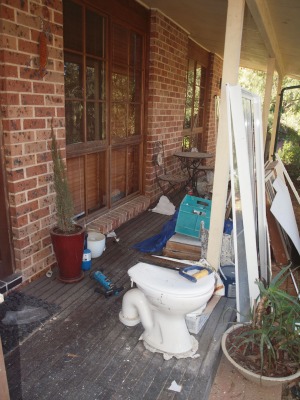
Porch-becomes-building-site

Our house is a shambles.

The dishwasher and the fridge are in the living room, the spare room looks like a bathroom warehouse, the front porch has turned into a building site and the lounges look horribly cute in their drop sheets.

Yep. We are in the middle of renovations, just a small upgrade to the kitchen and bathroom. It seemed so modest a task and yet the disruption has left me asking, “why, oh why did we do it?”

The answer my beloved wife — who has done a fabulous job in designing and managing our little project including sourcing all the materials [go eBay] — is tantalizingly simple.  No pain, no gain.

It is impossible to get a new bathroom and a kitchen upgrade in your house without copping major inconvenience and dust in the nostrils. It has to get worse before it gets better. Sound logic you might say.

But I suspect that this is not how we really think.

I reckon it is human nature to prefer “all gain, no pain”.

This is certainly what drives business. Profit is best arrived at with minimum fuss. Any cost that can be deferred, or better still, sent somewhere else, will be. The simpler the business system the less that can go wrong and so long as the company has enough competitive advantage in the marketplace, simple is good.

If there has to be pain then, reluctantly, businesses insure against its effects. Even though the logic of insurance is to cop the pain initially but be pain out to sooth its effects.

Now that I start to look for it, I cannot seem to find instances of business voluntarily accepting the ‘no pain, no gain’ maxim.

Perhaps this is the flaw in modern day commerce. Decoupled as we now are from a physical cap on monetary wealth [currencies are no longer tagged to gold bullion] business is free to find unlimited profit — and profit is best had without pain.

Parents of today’s teenagers will probably tell me that this phenomenon is not restricted to business. It is spreading through the youth faster than a tweet.

I will need some time for healthy thinking on this topic to develop but worth sharing I hope.

Meantime I can’t wait for the builders to finish.

As always, any comments gratefully received.


The heart of the matter

This article was written back in 2010 and was published online on The Climate Spectator. Nearly three years on it still makes fascinating reading as the rhetoric ramps up ahead of the federal election.

rocky shore NSWRecently the NSW Natural Resources Commissioner, Dr John Williams, hosted a workshop in Canberra on resilience thinking that was attended by a platoon of scientists, agency staffers and consultants, all concerned about the environment.

In his opening remarks, the Commissioner urged the participants to consider a simple enough question: What matters most?

A ripple went around the room as things that matter jostled for space in everyone’s head. No doubt thoughts of happiness, love, friendship, the mortgage and a few thoughts we don’t usually admit to arrived, and it was clear that there was not just one thought. The one thing that mattered did not appear instantly to everyone.

Caught as we are in the policy vacuum on climate change, with backflips and peculiar ideological positions to frustrate us, it might be useful to ask the same question of the climate change debate: What matters most?

Those representing heavy emitters will cry that exposure, unnecessary liability and uncertainty matter. Few of us like threats to business as usual. However, some exposed businesses have used climate change as an opportunity. We have all been offered the option to offset a flight or visit a carbon neutral office, where the most important thing is to be seen to be doing something good. Catastrophe can make for great PR, and so matters most, but for very different reasons.

Unless you install roofing insulation, climate change is of little consequence to small business. There is not much beyond the upward creep in the quarterly energy bill to keep your attention away from more pressing issues of cashflow, customers and the late arrival of a key staffer.

A couple of years ago, the general public in Australia thought climate change itself mattered most. They even elected a new government with a Prime Minister who claimed it was “the biggest moral challenge of our time”. Today polling suggests the majority see climate change as just another opportunity for politicians to renege on a promise. And a third of them think we should not pay a cent to fix it.

Climate scientists, at least those gathered under the banner of the IPCC, reached a consensus that greenhouse gas emissions matter most. Concentrations of gases that absorb reflected radiation, the atmospheric blanket that makes life as we understand it possible, were the key regulators of climate. Human activity was upsetting the delicate balance of greenhouse gas composition and we needed to stop that or risk catastrophic warming.

Emissions matter most because they lead to warming that puts more energy into the cyclical systems of atmosphere and ocean, changing the pattern of circulation, making it wetter, drier, and perhaps more stormy on an increasingly voluminous ocean. In short, having some very specific local climate effects.

The diplomats at the UNFCCC thought this mattered too, but not as much as the necessary diplomacy. So they negotiated at length to agree that net emission reductions matter, but that we need to negotiate some more to agree on the reduction targets and how to achieve them. Clearly, among the policy makers, it is debate that matters most.

Ask residents on the beach front at Byron Bay the question and it’s all about saving their homes from storms. They may not even know that warming will raise sea levels and may make some storm surges more acute, for it has always mattered that the ocean was only a wave away from your beachfront retreat. Save a thought for the 200 million citizens of Bangladesh on the Ganges delta who don’t even know that sea level rise matters most to them.

Irrigators along the Murray River in NSW who, despite having a legal license to extract water, have not seen any reach them for a long time, have another answer. What matters most to them is the real prospect of losing their livelihood altogether.

Clearly, there are as many things that matter most about climate change as if we had asked the question without the qualifier. Climate change is a threat and an opportunity, a challenge and a risk. For some it is real, but for most of us it is not the most important thought in our heads. So perhaps what matters most is not climate change at all.

Perhaps we have missed the real risk, the real challenge that we face, and the hint of what that is comes from all these specific concerns. What matters most is that we have the capacity to adapt and transform to a changing world.

It is critical that we give ourselves the flexibility to make our food production more efficient, ensure our environments will deliver all the services we take for granted and that our economic and social structures remain viable as they transition.

It also matters that we act on that capacity now, for the world is changing rapidly. The shifting climate just makes some of the inevitable the changes more acute and immediate. None of this should be a surprise, given that there are now close to seven billion souls trying to fix what matters most to them.

———

Here in April 2013 I am not sure if the timelessness of the sentiment in this article is what matters most.

Perhaps we should get our arses in gear.

The last loaf of bread

Consider the situation if this delicious crusty loaf was the only one on the planet.

More than that, it is the very last loaf of bread there will ever be.

After thousands of years of grinding grains into flour, adding yeast, a little salt and some water, kneading the mixture and applying some heat, the making of bread has stopped. And this loaf is now the last of its kind.

What would you do?

What should you do?

A while ago I wrote a story about Joe who was prescient enough to realize that he had this very conundrum.

You can download Joe’s story from the free downloads page of my Climate-change-wisdom site.

If you like it, why not download my ebook Stories for a change to read some more adventures and anecdotes that will tweak your environmental imagination.

You can get a copy in your preferred ebook format at Smashwords for less than the price of a cup of coffee.

Greek debt again

I came across this interesting visual presentation on the size of the Greek national debt… maybe staggering is a better adjective.

Recall that the talented presenter was dwarfed by half a trillion dollars. Now let’s go across the pond to the US.

The US national debt is roughly $15,717,900,000,000

That is $15.7 trillion if my conversion is correct – a tad more than Greece and a huge $50,000 for every US citizen.

In principle the US has a better capacity to repay creditors given the debt is 107% of GDP compared to 143% for Greece, but I just can’t get my head around the absolute number. And even though I lay no claim to an understanding of economics I am sure that owing more than you earn is not a good place to be.

You can see why climate change action is neither here nor there when the world has chosen to walk along this kind of fiscal knife edge.

The new gold

You would never call an actuary sexy. Number logic people just don’t have the suave of a James Bond or the sass of a Marilyn. They are just too precise. Absorbed by detail and loving that a + b = c, especially when b is the reciprocal of the square root of f, they just lack that playful oomph.

That said being a good number cruncher was never a bad career. Thanks to the acute need for their skills, especially from insurance companies treading the tightrope of premiums over risk, data people have always been well paid and in reasonable demand. Over the years it has been quite tricky to get a place on an actuarial degree.

Now, however, sexy is in for the statisticians too, because the mad men need them. Or more strictly, there is a new breed of advertiser who have taken the mix of imagery and psychology invented to persuade us all to buy things to a whole new level. Now it is possible to predict as well as persuade.

Thanks to the already huge and rapid accumulating databanks on our online profiles, our offline purchases and even where we are throughout the day (yep, that handy little app in your smartphone does more than tell you where you are and how long it takes to walk three blocks), it is now possible to track behaviours and from that predict what might happen next, or better still intervene with an irresistible offer.

The mad men who want to place that person specific ad on the right device at the right time need the data crunchers to do the sums.

Here is a simple example. Your Facebook profile says that you like the delectable British soul singer Sade (mine does) and your mobile pings a GPS signal that you are in Sydney. Instantly the ticketing website you use puts two and two together and sends you an email with Sade tour dates. Not only that but her Sydney concert listing is flashing with a special offer of 10% off the usual ticket price. Outcome obvious, you have an outstanding night out and can’t wait for her next tour.

Here is another example. Your credit card purchases at the casino hotel, activity at the gaming tables and even what goes out of the mini-bar in your room are monitored in real time. What you buy, win, and loose on your casino weekend break are matched to a predictive model based on thousands of previous punters that tells the hotel staff the optimum time to offer you a free meal voucher or a discounted show ticket for the next evening. That optimum being the point being just before your instinct tells you to cut your losses and check out.

This is just the start of the thousands of uses that analysis of data can support. Take a moment and you will think of plenty yourself.

Usefulness readily translates into products and services that become a new gold, the nuggets that come from data mining. The vast datasets on what people do, where they do it and when trawled, filtered, analysed and modeled to predict what, where and when they will do next. All so that businesses can deliver a timely intervention.

The talk is of a multi-billion dollar industry built around analysis, interpretation, and prediction, followed by delivery of highly targeted suggestion. It is a whole new field for anyone unfazed by terabytes of data and permutation algorithms…. and who are also unfazed by where the money comes from.

I wonder how many of the new gold diggers will dare to ask.

Population clocks

In an idle moment just before Christmas I gave in to my obsession with population growth and checked a few of the world population clocks.

These are neat web enabled algorithms that calculate and display an estimate of the number of people in the world. They tick or scroll along in real time as they make a virtual count of the births and deaths of people around the planet.

At 10.30am Sydney time on the 21 December 2011 a sample of them read

  • 6,880,986,220 on Poodwaddle
  • 6,933,668,504 on Metapath
  • 6,940,632,100 on Tranquileye
  • 6,982,567,212 on US Census Bureau
  • 7,010,439,251 on Worldometers

Clearly the algorithms and the underlying data sources produce some variability in the numbers.

Chances are that the true number is somewhere between 6,906,205,940 and 6,993,111,375 which is the 95% confidence interval for this sample of five estimates.

This confidence interval is 87 million roughly the population of Italy and Poland combined suggesting to the cynic that these clocks are not that precise.

Moving forward 101 days to 1 April 2012 and at 9.30 in the morning Sydney time the population clocks said

  • 6,854,561,707 on Poodwaddle up  26,424,513
  • 6,953,660,825 on Metapath up 19,992,321
  • 6,962,506,474 on Tranquileye up 21,874,374
  • 7,004,421,653 on US Census Bureau up 21,854,441
  • 7,031,948,549 on Worldometers up 21,509,298

This is an average increase of 22,330,989 new people in the world in just 101 days.

That is 221,098 per day or, if you prefer, 9,212 per hour.

I use to say it was 8,000 an hour, maybe I should now say 9,000 although what is another 1,000 between friends?

And yes, there is some uncertainty. It may be only 7,000 per hour. Or it may be the upper end of 11,000. Either way it is a sizable village every hour and a small city each and every day.  Scary.

Read more in my Hubpage article, What do population clocks tell us?