New eBook – Environmental Issues for Real

Not satisfied with haranguing readers of this blog with environmental woes, I have branched out into the dynamic new world of ebook publishing.

Thanks to the amazing people at Smashwords my latest collection of essays on the environmental issues of the day is now available to download in all the usual formats.

Give it a whirl and maybe leave a review on the site. It would be great to hear what you think.

Gardens

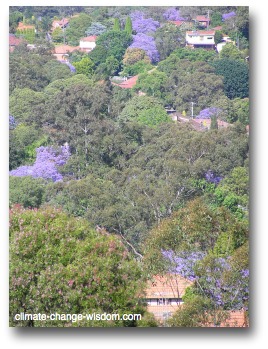
A garden is a place that humans create from nature.

We carve out a parcel of land around our dwelling, add some landscaping and select plants to display nature’s beauty and bounty. This orderliness of things is pleasing to us. We feel in control as though our effort has tamed the wilderness.

The cleared patch puts some space between our homes, allows us to potter around outside without bumping into the dangers that trigger our fight and flight response and even provides fresh lettuce for a salad.

The first gardens were probably about clearing the vegetation around the hut so that we would not step on an unseen snake and the water would drain away more easily.

Most of us have or would like a small garden, our own small patch of tamed tranquility. We also enjoy visits to grander spaces that surround opulent homes for a garden is also a statement. It says something about the owner.

These spaces are so important to us that when we allow half the land area in the suburbs of many of our cities to be gardens. This makes our cities bigger, city infrastructure more expensive, and our commutes longer.

So why is it that with all these good reasons and commitment to have a garden we actually don’t spend that much time in them?

Obviously during the week we are at work and our kids are at school so we cannot be in two places at once. Then there is homework, the newspaper or TV, and dinner to prepare. At weekends we have shopping and sports and, well, a whole bunch of things to do.

There is some gardening of course; only this is mostly to keep the garden looking good.

And then you can’t be in the garden in the rain.

Take away all the effort in upkeep and we hardly spend any time in the garden at all. Only the kids use it and for them it is an attractive space until they get to high school when other things tweak their interest or the space is just too small for real soccer.

There must be another reason for our love affair.

It could be because all we need is to see evidence of our personal control over nature. A garden is a space close to us that we (or perhaps the landscaper) have tamed and bent to our will if you like. It is a safe buffer between the real world and us.

And yes, we like that space to be beautiful. We like to select and display selections from nature that we especially like or on occasion might even want to eat. Most of all we want it to look good simply because looking at it is what we will do most.

Perhaps it is OK that we do this, that we create this visual buffer. Especially if when we get a spare moment and its not raining we wander around the garden or just sit in it, maybe even on the grass. Maybe we are now so removed from nature that it really is too much for us to be exposed directly to its real tooth and claw and that our modifications of nature are a necessary half way house.

My guess is that these days, gardens get looked at only occasionally and entered for their own sake very rarely. When I travel on the train to the city, a journey of 60km each way, I can count on one hand the times I have seen people in their gardens.

So maybe gardens are actually about that neighbour thing.

Perhaps they are there to demonstrate how wealthy we are. It explains why when we look to buy a house, the size and shape of the garden around it is so important to our purchasing decision.

It would be better if we actually spent more time in our gardens, just because we can.


Environmental issues for real – Environmentalism

We should find news footage of men and women in orange jump suits slashing with scythes at genetically modified crops disturbing.

And what was our response when the taxpayer foots the bill to “rescue” activists who board whaling vessels?

I was always told that the end cannot justify the means. Clearly it is not that simple.

Read my latest Ezine@rticle to see why environmentalism might be an environmental issue.

Easy or not

Meercat taking it easyIn his book ‘Hot, flat and crowded’ Thomas L. Friedman rails against the glorification of easy. His main complaint is that anything we do to support ourselves in an increasingly hot and crowded world is not going to be easy. And those who say there is an easy way are just kidding themselves.

Humans are notoriously hard to motivate without some form of reward. Most of what we need to do to keep producing natural resources and accommodate climate change when there are so many of us will require some sacrifice. The only reward will be the hope that we have done the right thing. Saying it will be easy is at best naive and at worst irresponsible.

To illustrate his point Friedman quotes Michael Maniates of Allegheny College.

Maniates makes the following assertions about what we ask of ourselves and one another:

  • we should look for easy, cost-effective things to do in our private lives as consumers because
  • if we all do them the cumulative effect will be a safe planet, because
  • by nature, we aren’t terribly interested in doing anything that isn’t private, individualistic, cost-effective and, above all, easy.

I reckon Maniates is on the money.

In default mode we are lazy. We would rather not sacrifice but if we have to then please can we do it from the couch. Please do not ask us to actively sacrifice.

Friedman’s frustration is understandable because it was this lazy default mode that has seen us consume with abandon and take ourselves to the edge of the resource use precipice.

In his book ‘Thinking, fast and slow’ Daniel Kahneman even has an explanation for why lazy is the default.

Cognitive research seems to be telling us that we think in a couple of different ways. We intuit most things. This action is easy and fast and works well for the bulk of our everyday decisions.

Only our intuition is not very good at complex thought, especially where we need to analyse for or calculate a result. For this we have to engage the thinking brain. The only problem is that this type of thinking takes work – real physical work apparently – and we find it difficult.

Our environmental challenges are very new and not in the default program. Our intuition has evolved for us to know that food, water and shelter are either here now, or just around the corner. We are not used to thinking about where these things are going to come from; yet we are forced more and more to think analytically about the basics. Indeed we have to think twice: first to tell us that we have a problem and second to figure out some solutions.

Friedman suggests it is irresponsible to say that our environmental challenges are easy to solve when, in fact, they are hard. Potentially more challenging than the problems themselves is that we prefer to solve things in our default mode. We prefer to intuit answers because it is a lot easier that way. Thinking is just too hard.

Take a moment to recall your experiences in the workplace or at home. Ask yourself what proportion of your time and that of your colleagues and family members is spent in default mode

Yep, we prefer not to have to think hard. No surprise that we glorify easy.

Only there is a reason why talking up easy is so common. My guess is that any call to think hard about anything will fall on deaf ears.

Leaders not heroes

Leadership is hard to define, not easy to learn and is, perhaps, only gifted.

True leaders inspire us and we trust them. We listen to what they say and we accept what they decide. This is because leaders do and say things that make us feel good about ourselves. And what they do we believe in, often without need of explanation or a spelling out of logic.

Heroes are a little different. They motivate us because they are admirable. They do what we would like to do. We can imagine ourselves slaying the dragon and winning the adoration of the damsel or, if you prefer, as a heroine beating up the patriarchy to create equality and emancipation. Our heroes actually do these things. Heroism generally requires conflict.

In our modern ritualized world, our heroes do our fighting for us or they act bravely in the face of danger. Leaders can do these heroic things for they too have courage. Only they do them without having to fight.

Leaders show the way forward as not only the logical but the truthful path. They do this instinctively; picking their way with ease through the complexity of options to choose those that really make sense. They can slay the dragon if needs must, only they will more likely convince it to live happily on the top of the mountain.
They also have vision. A clear notion of what the future looks like that is not an idealized utopia but achievable and likely futures. And leaders are not afraid to explain the future to followers and skeptics alike. The dragon will live on the mountain and will not visit the valley unless invited.

And there is one more critical element that sets leaders apart from both heroes and mere mortals: they can combine fearless vision with timing. They know instinctively how to act and when to act to achieve the desired outcome. Heroes are presented with their opportunity and instinctively move to the front of the cowering throng sword in hand. Leaders anticipate the dragon’s arrival and go outside the village to engage the foe on neutral ground.
It takes courage, smarts and conviction to be a leader. It also needs a certain lightness of hand (and word) dispensed with ease and grace. And wisdom helps, preferably born of experience, or where time has yet to allow for this, then from instinct.

There have always been leaders who have most of these things and these people have become important in our societies. You could probably name your own favorite. And if we did a survey of favorites, the majority of the many leaders that people would chose to name as inspirational come from the past. Many favorites will be historical, a few will be modern, but hardly any will be in public office. Bar the notable exception of a few charismatic entrepreneurs, our current leaders do little to inspire us. This is especially true in politics.

And then there is one final, and perhaps the most critical, quality of leaders, one that seems to be missing from all modern political leaders. That is the ability to realize that leadership is not about them, even though they must be strong, stand out and even be heroic. Leadership is actually about the outcome, the means proposed to get there and the timing of the actions. So true leaders must have humility. The quality of knowing that it is just a channel that they present to the people who look to them.

People follow what they intuitively know to be right. All they need is for it to be presented. Sometimes we are conned. A few infamous historical leaders have taken their people down horror roads through force of rhetoric and oratory but have all fallen when the truth came out. When it became clear they lacked humility they were ousted. It sometimes took a great effort but they did not survive any more than the pathways they proposed.

So in the end leadership cannot be about being heroic because actually we lead ourselves. All that leaders really do is show us the way. Outcomes happen as each one of us as individuals take responsibility.

Mental musings on leadership might help a little. The real issue is what the future holds and who will lead us to it.

In our children’s lifetimes we will reach 9 billion souls, oil will be $200 a barrel making alternative energy an economic imperative, agricultural soils will show the symptoms of overuse and we will have to wrestle with the consequences of land, water and food shortages. These things will happen with or without climate change and we will want wise heads to lead us through the challenges with confidence and surety.

Can we expect this from our political elite? Yes we can. Indeed we should demand it.

We should ask for courage, smarts, timing and, most of all, humility.
Truth

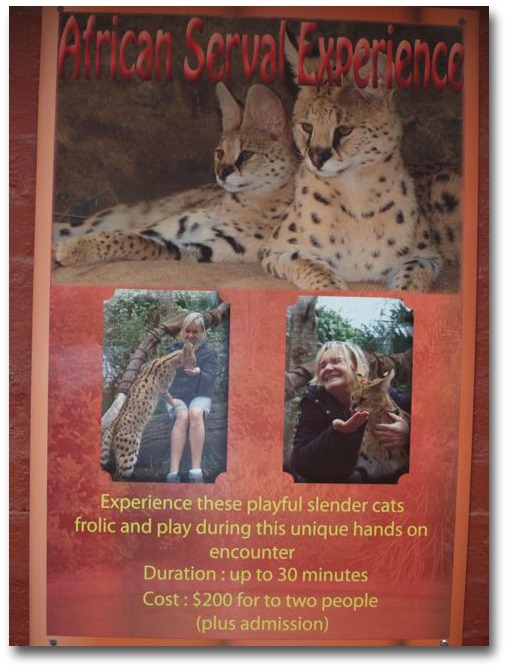
I took this photo on a recent visit to Mogo Zoo on the south coast of NSW.

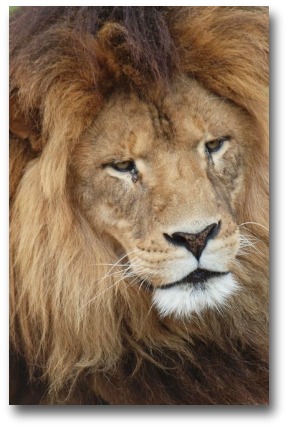
Although small, the zoo is a neat and well-run establishment that boasts, among a number of interesting exhibits, a pride of white lions bred from individuals with a rare mutation that occurs on occasion in and around the Kruger National Park in South Africa.

Clearly the photo is not of a lion but an advertisement for a zoo experience. For $200 you can spend some time petting a serval (Leptailurus serval), an equally magnificent African cat similar, if somewhat larger and with longer legs, than the domestic variety. Servals are relatively common and widespread in sub-Saharan Africa and specialize in pouncing on rodents in the long grass of the savannas.

And here I have to admit to a huge contradiction in my head, for I have had the privilege of seeing serval in the wild. When in their element they are just as magnificent as any of their bigger cousins.

It was easy to conjure from memory the image of the cat in the grass lit by the orange glow of the sunrise, standing alert with an indescribable sense of belonging.

So my gut response to the advert was that no amount of enclosure landscaping or attention to the visitor experience could come close to the truth of seeing these animals where they should be.

Then I saw the look on the visitors face.

I realized that you do not need to go to Africa to find the truth.

Funny that.