Protecting Mother Nature

“We must protect mother nature from our worst excesses” is the headline of an article in the Enquirer section of The Weekend Australian this week.

The tagline “We can raise our living standards without destroying the natural world” introduces an opinion piece about growing human numbers and our deepening psychological motivation to keep up with the Joneses. Two things that are leaving us with stress and putting strain on the environment. And yet the ”wonderland of nature” is still there to us inspire the spirit. Natural glories abound that should garner our respect and “a determination to protect Mother Earth from our worst excesses.”

All good stuff you would think.

There are posts a plenty on this blog and by many thousands of other bloggers saying pretty much the same thing. Hey, it is even the main tenet of my latest book Missing Something.

_

Missing Something | get your print on demand copy from Amazon or download a paperless version Missing Something Kindle Edition.

_

So why mention this piece from the sunday paper? Well, the curious thing is that the article is attributed to Craig Emerson, the federal Minister for Trade and Competitiveness in the struggling Labour government.

Now if the juxtaposition of topic and source doesn’t make you smile, then it is worth remembering that the newspaper is as brown as it gets [being owned by News Limited is a bit of a give away] and is always sticking the knife into anything with a green hue.

Clearly the editor was having a laugh and providing a great gotcha opportunity to catch the hapless minister sometime later in the election year.

It is shameful that the sordid media cycle and political agendas do this to such important ideas. We do need to be more mindful of nature, more concerned about our exploitation of natural resources, and even to take time out to feel the wonder for ourselves.

What the Minister did, apart from being suckered, was miss the opportunity. It is not enough to say that there are now very many of us putting the environment under pressure, we have to confess to our dysfunctional desire to exploit and find the emotional fortitude to think before we act.

Maybe my lesson was to enjoy the chuckle I had at reading a green rant from a trade minister and leave it at that.

NEW BOOK | NEW BOOK | NEW BOOK | NEW BOOK | NEW BOOK | NEW BOOK | NEW BOOK

It is true, I do have a new book that is all about how we perceive natural resources and those wonders of nature.

Check out a description here or better still order a print-on-demand copy of Missing Something from Amazon or download the Amazon Kindle edition of Missing Something right now.

Something unexpected

Teaspoon of soilHere is an interesting situation, almost unimaginable.

You are approaching your 60th birthday and are about to be surprised by an unexpected inheritance from a wealthy relative that you barely remember.

Many years ago your great Aunt, who was always rather odd, left you some money.

She stipulated that you could only access the balance of the funds when you are 60 years old, 40 years on from when the money was deposited.

The good news is that the initial capital she left was $10 million, a huge sum even if nobody quite knew how she came to be so wealthy. The bad news is that the $10 million capital has lost value to the tune of 1.3% a year.

Bummer. Not only did you have to wait to be rich, but also each year there were 1.3% fewer funds. Still, in a few months time when you reach 60 there will be a bank cheque for $6 million in the post, more than enough for a world cruise or two and a luxurious retirement.

Your younger brother was less fortunate. The dowager only bequeathed $1 million to him under the same rules. He has to wait longer for his funds and gets a much smaller cheque of $593,000.

A tidy sum for sure but not quite enough to fund his retirement.

Your three cousins, who soon found out about the unexpected inheritance, were also hoping for something from this distant relative that they only just realized they had. Sure enough, she did not forget them and deposited $100,000 each for when they reach their 60th birthday. They get $59,250 — certainly better than a kick in the teeth but hardly a pension fund.

On the first of your world cruises you mull over the odd situation of financial capital failing to appreciate.

What if your retirement savings, that before your great slice of luck were your only means of support in old age, were being eroded at 1.3% a year?

Each year the amount you had saved up went down a bit, not much admittedly but it went down. Likely you would seek to reinvest your capital quick smart rather than run the risk of not having enough funds for your retirement. Also likely you would fire your investment analyst and rant at everyone you could, looking for a scapegoat for such a fundamental error.

And what bad news it was for your brother. If he had known about that $1 million all those years ago and invested it wisely he would have more money than you right now.

As you sip a G&T on the sundeck you can’t help thinking it funny what we take for granted.


Another unexpected thing

Soil scientists have estimated that the amount of carbon in agricultural soils in Australia has declined by 51% in the last 40 years — that is 1.3% a year.

Soil carbon is a critical environmental asset that drives plant growth because carbon fuels soil biological activity, promotes soil structure, aids infiltration and moisture retention and supports nutrient exchange. Handy material to have and not something to be squandered.

What is worse is that science has little idea about the initial carbon stocks [the capital]. It might have been the equivalent of $10 million in which case we can keep going for a while.

We might even have time to reinvest by adopting smart agricultural practices and get the capital to appreciate again.

The worry is that we may be as uninformed and as poorly off as your cousins.


Here is the original scientific reference for loss of soil carbon [you can find a copy on Google Scholar]:

Zhongkui Luo, Enli Wang, & Osbert Jianxin Sun (2010) Soil carbon change and its responses to agricultural practices in Australian agro-ecosystems: A review and synthesis. Geoderma 155 (2010) 211–223.


And some more articles on soil carbon

Carbon in Soil – Why Organic Carbon is So Important

Soil – the missing carbon sink

Confused Confucius questions | #1 In the beginning

confused confucius questionsSocial media is a great tool to explore the wonders of human nature.

As billions of smartphones, pads and tablets beep or jingle to alert the world to a new message so each owner in a reflex action picks up and responds. It is now so natural to comment, post and message that nobody even thinks about it.

What has amazed me is how liberated our online talk is, far more so than if we were chatting in the pub or over the cooler in the office. We have no qualms at all about saying what we think online, and usually it is the first thing that comes into our heads.

This growing fondness for telling the ether our deepest thoughts and feelings creates a whole new opportunity for cheeky folk like myself to prod and provoke a reaction.

As an experiment in testing this ability of people to bare their souls via a digital device, I started asking some random questions on the online articles platform HubPages where there is an alloporus profile with a few articles.

Rather than the usual “How to” and “What is” type questions, I settled for the “Why do we” type under the tag

Confucius confusions | Do you have any answers to this modern question that would have baffled the wisest sages of old?

The first observation was that this particular online community seems to view questions and then write answers more than they read articles. I received more views of questions in a week that I have for my articles in 6 months. Not surprising though considering the audience is primarily would be writers who like to voice their opinion.

The next thing that struck me was the topics that get people excited. So far the most viewed questions are

Why is elegance so rare?

Why are business suits dark?

The more tax you pay the more money you earn, so why are we obsessed with paying less tax?

Why do we take so many photographs?

These ‘random’ questions with no real bearing on anything seem to fire people up. Many write short essays to get their message across. And maybe this is a good thing. Since it is now far too expensive to go and have a chat in the pub every night, maybe we can get into discussion online.

Not all questions get people going and alloporus will monitor the questions that drift away into the ether without a spark as closely as the ones that get noticed.

So far most questions were asked under the category ‘Religion and Philosophy’ so as to suggest they were thoughtful rather than deliberately controversial. The interesting thing though was how passionate people can be over these random questions. What seems to happen is that answering allows feelings to flow.

So far any overtly environmental questions seem to get only a fraction of the views of the esoteric conundrums and only an occasional answer. This is bad news for this wannabe best-selling author who writes about the travails of the dance between humans and the environment. Clearly the topic is not often on our minds.

More to come on this exploration of human awareness.

When 24% is really 0.8%

According to the 2010 World Public Opinion Poll, the average American thinks the US spends 27% of the federal budget on foreign aid.

The actual figure is close to 1%. Even with the fickle nature of survey data this is a huge discrepancy, unbelievable really.

Does the average person on the sidewalks of US towns and cities really think that the US government gives a quarter of its money away in foreign aid? One dollar in four, leaving three to pay for everything else at home. Surely not.

Perhaps the perception is there because the US is by far the biggest single contributor to overseas development aid.

In 2010, the OECD reported the US spent $30 billion on aid, more than half as much again as the next most generous country, the UK ($14 billion), and 23% of the global total.

As a percentage of gross national income that $30 billion is just 0.21% and well below the average country effort (0.4%). It is also half a percentage point below the UN target of 0.7%. As it happens only five countries meet the UN target (Norway, Luxemburg, Sweden, Denmark and Netherlands).  The US would need to up the ante to $100 billion to catch up with the Scandinavians.

So the reality is that most countries give away less than half a cent in the dollar of national income to assist other countries develop. And the cynic would chirp that even this tiny percentage is not entirely altruistic as often the money is spent on goods manufactured at home plus some of the recipient countries will become trading partners in the fullness of time.

$30 billion was 0.8c in the dollar of the $3.6 trillion US federal budget of 2010.

Why the huge discrepancy? I must say I am at a loss. It could be because the average person has little notion of just how big the US budget is and so easily thinks that the donor part must be substantial. Or maybe people just don’t realize the huge cost of services at home.

Then again, we all tend to think that we are more generous than we actually are.

Whatever the reason, the numbers suggest there is huge difference between what people think is happening and reality.

The last loaf of bread

Consider the situation if this delicious crusty loaf was the only one on the planet.

More than that, it is the very last loaf of bread there will ever be.

After thousands of years of grinding grains into flour, adding yeast, a little salt and some water, kneading the mixture and applying some heat, the making of bread has stopped. And this loaf is now the last of its kind.

What would you do?

What should you do?

A while ago I wrote a story about Joe who was prescient enough to realize that he had this very conundrum.

You can download Joe’s story from the free downloads page of my Climate-change-wisdom site.

If you like it, why not download my ebook Stories for a change to read some more adventures and anecdotes that will tweak your environmental imagination.

You can get a copy in your preferred ebook format at Smashwords for less than the price of a cup of coffee.

Because we can

Neil Armstrong, the first man to put a space boot and plant a flag on the moon passed away a couple of weeks ago. Many around the world gave a mental nod in remembrance and respect, and rightly so.

Notable for not cashing in on his deserved fame, Armstrong was a modest man who achieved great things. When you realize that the team that put him on the moon did it on less computer grunt than you have in your smartphone, getting to the moon and back was a display of remarkable courage and ingenuity.

One of the media eulogies to Armstrong played part of a speech by President Kennedy made around the time of the space program. There was great passion and determination in the President’s voice that said we will go to the moon. And we will go there simply because we can. Nothing about technology advancement, commercial spinoffs or even the political capital that such an undertaking would generate. It was just a big, audacious goal.

Of course there was political mileage to be had in a time of cold war competition with the Soviets. It was also a time when the nascent power of the capitalist system that America believed was the only way forward, needed some iconic acts to further cement its worth.

Only President Kennedy sounded pure in his desire. We will go to the moon because we can. It was an empowering position, one that allowed Armstrong and the brave folk that followed to show their courage and tenacity to the world. And in Armstrong’s case made great by his manner and modesty.

I suspect that as a species we need this kind of thing. Our brains have evolved to handle complexity and we are always on the lookout for something big to fix. Only lately it has been more about drama that dreams.

What chance a modern day political leader making a Kennedy style speech? Miniscule I suspect. Just think, a president or prime minister leaving on the table the specific issues of the day to imagine something way beyond the mundane; something that inspires us to think, even for a moment, about more than ourselves. Hard isn’t it?

Maybe modern leaders do not understand that people like a collective ambition. We warm to big possibilities that take us further than our personal goals. We actually like the idea that there is something more than our own desire for a house with a white picket fence.

Or maybe the world has changed so much that audacious goals that have a collective outcome really are now out of reach. People found it easy enough to believe Kennedy. Today the hugeness of just keeping the global economy alive seems audacious as economies teeter and the global population grows. A leader with ideas not focused squarely on the drama receives short shrift.

But we need dreams too. And not just those that say we can fix global warming, end poverty and provide everyone with quality healthcare. We need audacity.

What is the next “because we can”?

Astonishing

ImageImagine a Manchester United supporter on a commuter train to work. He sits next to a random person and, for once, starts a conversation. Turns out that the fellow passenger is a Manchester City supporter.

Outside the emotional pressure cooker of match day the exchange is civil.

Even though United are on a poor run of form and are trailing in the league, neither fan gives an inch. They spend a competitive half an hour talking up the virtues of everything from the merits of their best players to the quality of the meat pies at the grounds.

This is what we do when we declare our support… we support, talk up, cheer our team however lowly or troubled it may be at the time.

Maybe I am naive but I thought that a similar responsibility befell senior politicians when it came to talking about their jurisdiction.

So I nearly fell of my chair yesterday when on the radio was a recording of the Australian Prime Minister Julia Gillard complaining about transit times and departure congestion at Sydney airport. Every business traveller will tell you stories of long delays, she said.

What! Can you ever imagine a United supporter saying that Sir Alex is a bit slack, “came in late for work yesterday he did”? Or hear the City fan suggest that Balotelli should be dropped from the squad. Never, not in a million years.

The back story to the Gillard harangue was that the G20 leaders summit in 2014 was to be held in Brisbane and not Sydney, a choice made by the government for either political gain (the preferred media spin) or because the Sydney Convention Centre was scheduled for refurbishment and unavailable (a practical explanation not favourable to spin). Or maybe they just wanted to spread it around.

Whatever the real reason, the Prime Minister chose to claim airport inefficiency as her sound bite for why it was Brisbane over Sydney.

What a crazy call. Whatever your political motivation you don’t bag out your own team. In fact, I would say that Gillard, who has a loud public voice because of her position, was being irresponsible. She should be talking up Australia in every day in every way. It is in her job description.

If the Australian people ignore such gaffs and her inability to see the consequences of them and re-elect her to office, I reckon she would be one lucky lady.

And as a United supporter, I also hope and pray that she supports City.

Food security | What’s wrong with this ad?

Check out this ad snapped on a recent rip to the local supermarket.

A handsome, young bloke stands with his arms wide to embrace his achievement, another nutritious crop of vegetables for the table. Good on him you think. A warm feeling creeps up on you as though you are being wrapped in a safety blanket. Thanks to strong dudes like this one, I know I am going to be fed with healthy nutritious food.

No doubt the ad, that also appeared as a full page spread in the Sunday magazines, would have cost several hundred thousand dollars to run has nothing much to do with bok choy, or even fresh vegetables for that matter.

It is all about putting the retailer front and centre.

By showing the farmer as a member of the team we are being made to think that our food comes from the supermarket and not the paddock. The retailer is now the supplier.

The messaging appears to be about fresh food, from local farms grown by young and, dare I say, virile farmers who may be in search of a wife. But really it is about the retailer being the source of our food security.

So what is wrong with this particular ad beyond the obvious sexism?

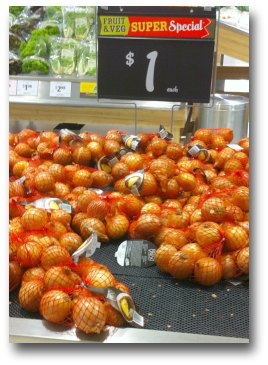
Here is a hint. I purchased the weekend paper in the supermarket and not far from the newspaper stand was a special in the vegetable isle: a net of onions for $1.

That is pristine, firm onions for 15c each.

Good food at great prices. It’s enough to close down the agencies on Madison Avenue. Who needs advertising when the prices are this cheap and the produce so enticing?

The reality is that farmers cannot supply produce sold out of the supermarket at 15c unless they are selling to one buyer who runs a monopoly over them. What is wrong is that the smiling farmer is actually walking a tightrope of viability. If fertilizer prices rise by 20% then they go out of business.

The market is failing them.

The profiteering opportunities and perverse competition of a retail duopoly (two supermarket chains supply most of the food to households across the country) creates huge risks for Australian production systems. Running at the price margin is a challenging way to run any business but in farming the corner cutting and frugality it severely limits sustainability.

It is well known that farmers look after their land best when they are doing well. When they are under pressure they tend to push the land harder to make ends meet.  We are at the point globally where we cannot afford for such structural risk. We need every acre of productive land to produce and to remain productive.

The message of food security provided by your friendly supermarket is false. It fails to take into account the risk that the farmer takes on when he has only one buyer of his produce.

And another thing, most farmers are over 50.

Environmental issues for real

When historians sit to appraise the environmental actions of the baby-boomer generation they will say that they tried, did some good things, but failed to grasp the big picture.

They will also record that the most important consequence of this failure was that people did not see the solutions that were there for the taking.

Instead they focused on issues that they believed were real but turned out, with the benefit of hindsight, to be only partially relevant.

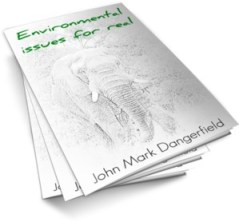
I have just published a short ebook at Smashwords that takes a sideways look at 10 environmental issues and puts them into context. It collates a few examples around one core idea that may be useful to the historians of the future.

And it can be yours for less that the price of  a skim latte.

Environmental issues for real

Bob Brown retires

What is the right thing to say when 67 year old who worked as a doctor for over a decade and devoted another 35 years of his life trying to keep us all environmentally honest with the last 15 of those as a beleaguered minority voice in Federal parliament?

“Thank you,” would seem appropriate.

Or maybe “Thanks Bob, enjoy your retirement. We’ll miss you” if you feel a little more familiar.

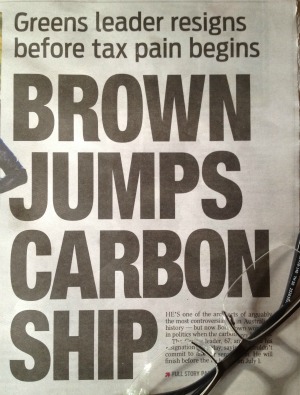
Headlinein Daily Telegraph on Bob Browns retirement

But no. Instead we get this crass headline in the Daily Telegraph.

Using the unexpected retirement of long time Greens leader Bob Brown to chirp about a tax that previously his party had blocked twice is just scraping the bottom of a very dirty barrel.

Your paper may sit as a political opposite to the Greens but there should be some common decency, a nod toward a worthy opponent however far his views may be from your own.

Imagine the uproar at home and overseas if on the back page of the newspaper  the headline was “Tedulkar quits to avoid touring Australia”, when all that happened was it was his time to retire.

In the past I have been critical of the Greens policies, especially when they blocked the CPRS. And I am not that fond of environmentalism either.

I also suspect that a party that in its essence is against things rather than for them will always be at the margins.

But when its leader and shining light decides to retire after a long and no doubt tiring time giving voice to things we would rather not know about, what we should all say is…

“Thank you Bob, it was an honour, enjoy your retirement.”

——–

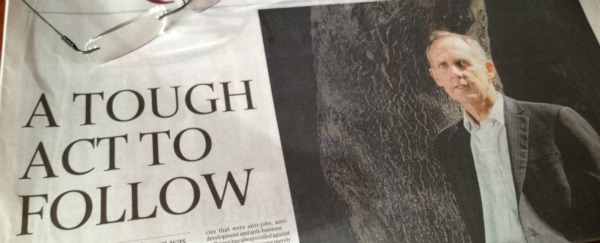
My faith in the rightness of things was partially restored by this headline in the Australian, not noted for their  fondness for tree huggers…

Bob Browne - A tough act to follow

…good on them.