If this is leadership, heaven help us

If this is leadership, heaven help us

At various times I have ranted about the politics of climate change in Australia

The climate change action thing

Climate change policy – does Australia need it?

The Kardashian Index

And I am not alone. Many are tearing out what remains of their hair.

So I thought I would bring to your attention the latest from the current direct action policy option in place in Australia. This is the policy setting that hopes to achieve emission reduction targets through the purchase of greenhouse gas abatement at auctions.

At the end of 2016 the vehicle for this, the Emission Reduction Fund, had paid for 177 million tCO2e of abatement purchased across four auctions at an average price of $12 per tCO2e.

Yes, you read it right. Close to $2 billion, that is $2,000,000,000 or roughly enough to pay the annual salary of 100 cabinet ministers for over 50 years, has been spent to purchase roughly the amount of abatement needed to meet the emission reduction target Australia presented in Paris… for one year.

Let’s make this clear. Emitters of carbon are not paying for this abatement, the taxpayer is.

Now you could be generous and say that the taxpayer is really the economy, so the economy is footing the bill, but that is a very long bow. Industries that were previously under the carbon price and reducing their emissions to save money are not anymore. Instead, various activities from other players in the economy are offered to reduce emissions or to capture carbon into vegetation and the CO2e tonnage presented for sale.

The concept of ‘polluter pays’ that has been so successful in a host of situations, from cleaning up rivers to closing the hole in ozone layer, is not in play here. Polluters carry on polluting as they merrily pass on the externality to the taxpayer.

This is neither good policy nor good governance.

There is no incentive to reduce emissions across the economy only an opportunity for a few to make a fast buck if they have access to some abatement.

At current prices, $2 billion will buy you 400 million tCO2e of offset credit on the international markets, nearly 2.5 times the local option. So not only does the policy fail to incentivise prudence, it pays way over the top for mitigation.

You cannot help think that a few people are laughing all the way to the bank.

Recognising what we know

There is a very funny scene in an episode of the Big Bang Theory where Penny asks Sheldon and Leonard trivia questions about famous American rock bands. Needless to say they are clueless. Not even Sheldon’s eidetic memory could rescue him. Penny’s infamous smirk was never funnier.

So now, do you know what this is?

equation

Don’t worry. A thousand people chosen at random from the population probably wouldn’t know either.

Most folk would be able to tell you that it was ‘some science shit’ and a few of them might know it was an equation for something.

Just one or two would recognise the mathematical notation for the third law of thermodynamics that states all processes cease as temperature approaches absolute zero.

But if more than two out of 1,000 people knew this you would suspect that the sampling was far from random. Perhaps it took place in the coffee break of a theoretical physics congress attended by Dr Coopers.

Now, of course, if you did sample 1,000 delegates from said congress, not all of them would recognise the equation. But I digress from my main point, which is this…

Each of us can only know a tiny fraction of what is known.

Even the eidetic can only remember what they have seen or heard. And for those of us who forget all the time, then our fraction can be small indeed.

The curious thing is that rather than get to know a little about a lot, people specialise. Either by choice or just as a default from our experiences we focus. After a while we all know quite a lot about something.

There are people who know more than seems possible about the cutting tolerances of a lathe or the rules that govern a financial balance sheet. There will be someone who can recite by heart the poems of Keats and someone else who can quote the test batting averages of all players in the current Indian cricket squad and then proceed to tell you why many of them should never have been selected.

This accumulation of specific knowledge is very useful. It gives us great depth in technical and practical matters. How else would an accounting firm provide services or repairs be made to a faulty MRI scanner? Not to mention brewing a decent coffee.

We need people who know the details.

What has struck me of late is just how specialised we have become and how little this means we know when presented with material outside our expertise. Just like Sheldon and Leonard, we are easily at a loss.

And yet we also take for grated what we know.

Because I have been in the guts of ecological science in research, teaching and my consulting practice for far too long, I take scientific knowledge for granted. For example, I can easily see the link between grazing management and soil carbon — graze too hard and soil carbon declines — and the net environmental benefits of changes to grazing practices that stop or even reverse that soil carbon decline.

What I can’t do is assume that a specialist in financial assurance will see or believe that such a link exists. She needs evidence. And as the language and logic flow falls outside her expertise she will need some persuading.

This is usually not a problem because ecology and accounting speak happening in the same room is about as rare as a female financial specialist. Except that they are about to collide.

The next decades will require that food production doubles or a lot of people will go hungry. Hungry people are not easily or righty ignored and the only way to feed them will be to invest in more efficient food production, distribution and storage systems.

It will be a time for specialisms to be recognised and respected. Times approach when the lion will lie down with the lamb… and come to some agreement.

This will only happen if expertise and depth of knowledge is respected. If we have to spend all the time convincing each other we actually know stuff then the solution will slip away.

So be grateful that someone among the 1,000 knows the formula for the third law of thermodynamics and don’t dismiss her for being odd.

It will be smarter to listen to she has to say.

Both sides of the coin

We are told that the universe is fond of opposites: black and white, ying and yang, United and City. And this week gave us a cracker.

In the UK the supermarket chain Asda had its corporate responsibility director come out with a climate change adaptation solution. He said “Businesses and other stakeholders in the food sector need to work with farmers and suppliers on water-related activities to ensure current and future demand for produce is met and to reduce their risk to supply-chain disruption.” Good PR speak as you might expect, only he went on to say, “We launched a water-trickle scheme for celery growers in Spain that provided a water-spray kit to farmers with the aim of ensuring a secure supply of product to our stores.

Asda justified this largess because they believed that global food prices and supply would be affected by “dire droughts” around the world. Not to mention the floods in the UK.

In other words the retailer realized that farmers are critical to their business and although this sounds like a no brainer to a supermarket, it is surprising how modern complexity of the commodity markets makes it easy for them to forget.

And so on to the other side of the coin.

Coles, a similar sized food retailer in Australia, asked its suppliers for cash payments. Yes, they just went out and asked suppliers to pay for the privilege of having their commodities sold in Coles stores. Nominally these payments were to “to help pay for what it claimed was improvements to the super­market’s supply chain”.

The competition watchdog got wind of this cheek and got upset. According to court documents Coles had a $30 million target from their supplies and had penned sales scripts to help their staff get on with it. We will wait and see if they get more than a wrist slap.

Now we could accept that the universe will always throw out some bad with the good on the celestial wind and let it land where it will. Apply this karmic logic to food supply in a commercial world and for every company with a vision there will be another out for a buck. Coles were just not in touch with the good bit.

Except that the world is looking at a doubling of food production by 2050 and I am not sure what the celestial balance makes of that.

Sounds Crazy #11 | Count your beans precisely

0.04122349

Is there anything wrong with this number?

Out of context it hard to tell. Running to 8 decimal places it is a very precise number. So much so that if it was a measurement of mass in metric tons the 9 would be precision to 100th of a gram.

If the number represented the weight of an object it would take an amazingly sensitive balance to reliably measure such a weight range to such precision.

Back in the day I used a 7-place balance to record the mass of woodlice offspring [the sort of weird thing PhD candidates have to do to unpick life history theory] and it required a very steady hand with the weighing trays suspended on the thinnest of wires.

The balance could handle the precision but nowhere near the mass range. And it cost a small fortune.

Now let’s consider the number in context.

It appears in this equation:

EN2O,j=CBB,j×0.04122349

The number is an emissions factor that converts the carbon in the biomass of trees [CBB,j] into nitrous oxide emissions should the biomass burn in a wildfire.

If a tree is measured and found to contain 4.2 tons of carbon, then this equation claims that should the tree burn in a wildfire, 0.173138658 tons of nitrous oxide will be emitted to the atmosphere.

Now it is hard enough to determine the biomass of a tree to the nearest kilo even if you cut it down into pieces and weighed each one. So to then apply an emission factor with 8 digits after the first zero is bizarre.

It is like weighing out grains of salt on a research grade balance when the recipe calls for a pinch.

Be it woodlice offspring or emission modifiers, the first thing you are taught in high school science class is that the number of digits in a number implies its precision.

0.0412 implies two orders of magnitude more precision than 0.04

It’s called the ‘significant figure’ and is a very important rule in science. The number of digits implies the precision with which the information was recorded. If you write 0.04122349 you imply that that last 9 has real meaning.

If you really can be, need to be, or can prove such precision then fair enough.

And it may be meaningful in the engineering of silicon chips but is meaningless in an ecological estimation on something as large as a tree.

This is a classic example of bean counting gone mad — non-scientists playing loose with the basic rules of science and common sense. It is plain crazy. Unfortunately this kind of misplaced precision is sucking the life out of innovation that could help us understand how the environment works and move us towards sustainability.

Except where would we be without the precise number of beans?

Sounds crazy #7 | Hidden hazards in the backyard

produce-01This ‘sounds crazy’ is an absolute ripper.

This bottom column headline and grab appeared on the front page of the weekend Sydney Morning Herald this week…

Hidden hazards in the backyard — Families are unwittingly exposing their children to the risk of sickness and even brain damage from lead hidden in backyard soil and paint… 

Fair enough. No doubt there is many an older inner city property that has not been renovated since the time lead was in most paint stock and some of that old stuff is peeling away and ending up in garden soil across the suburb.

Any city dweller knows that cities are not exactly pristine. The air is heavy with particulates from brake dust to builders waste and on a rainy day it washes all over your shoes. It comes with the territory.

The grab continued…

Lead experts fear the trend towards home vegetable patches and community and verge vegetable gardens is also putting children at risk.   

So at a time when all our electronic conveniences have deprived our youth of knowing anything about life giving soil, we must put the fear of god into those with the umph and initiative to get back to sharing produce they have tended.

Thousands of generations of good folk grew vegetables in their backyards. They planted, watered and cared for their crops and then fed their families wholesome fresh food. The extra they exchanged with their neighbors or sold at a local market helping to create the very essence of community that is so central to our wellbeing.

And they did this even when cars were spitting out lead, when the pipes were made of lead and when DDT was the pesticide of choice.

Did those dangers stop them? Not at all, they prospered and went ahead to multiply by the millions. So much so that today we need to double global food production in the next 30 years just to keep up with demand and will need every square foot of productive space we can find.

All I can say is shame on those ‘experts’, university academics with a career to build, and shame on the media for printing such fear mongering [and this time you can’t even blame Rupert].

For heavens sake, growing veggies in the backyard is a good news story.

I just wish the possums would stop eating mine.

Carbon farming | when to rant and rave

carbon farming farmland

The other day I received an invitation from the Australian government’s Department of Industry, Innovation, Climate Change, Science, Research and Tertiary Education to a forum with the Domestic Offsets Integrity Committee (the DOIC). This is the committee that approves carbon accounting methodologies for the Carbon Farming Initiative (CFI) scheme that was touted as providing Australian farmers with the opportunity to earn carbon credits from land management change.

The invite was keen to point out that “there are now 16 methodologies available for farmers and landholders to undertake carbon offsets projects” and that “The CFI is a ground-breaking scheme offering Australian farmers and landholders the opportunity to earn carbon credits while potentially achieving environmental and productivity benefits”.

What to do?

My first rational thought was not to go. Why should I spend my own funds and contribute to greenhouse gas emissions by travelling from Sydney to Melbourne to attend a 2 hour discussion on a policy that so far has delivered nothing that a farmer could actually use. The 16 approvals to date are for methodologies related to capture of landfill gas [that most landfills had the infrastructure to do anyway], various approaches to growing trees that you cannot cut down, and avoided emissions from a few specialist activities such as piggeries. These have nothing to do with the bulk of real-world farming practices.

My instinct, however, was to attend and at some point in the proceedings stand up and bellow at the top of my lungs a string of obscenities to vent my frustration at what has been a slow and hugely inefficient process of bureaucratic numbness — not to mention the unnecessary reinvention of a wheel already fashioned by international carbon offset schemes.

Unfortunately such actions would only give me temporary relief and would be be swiftly followed by long-term personal damage. Even writing down my thoughts in this post is probably not very smart.

So instead of the rage filled rant, I will reply to the invitation politely saying, “unfortunately I am unable to attend”.

It is worth looking more closely at my frustration [and maybe at my copout].

The frustration

I have never been wholly convinced by the global approach to climate change policy.

I accept that 7 billion humans plus 10,000 years of agriculture and 200 years of global commerce have had an impact on the climate system and I know that we need to take some action.

What has always troubled me is the premise of the chosen policy that we can actually fix the damage we have caused simply by reversing our actions. As I have blogged before, King Canute really had a better chance.  That we can take an engineering solution as naive as emission reduction to a problem of this magnitude seems to be a scandalous inflation of our capability.

Does it also mean we going to fix Milankovich cycles by tweaking the tilt of the planet or take on the variation in the solar wind [both major climate drivers]? Craziness.

That said, emission reduction is prudent for two key reasons: 1) it will help economies transition away from fossil fuel energy sources to sources that are cleaner and less likely to run out and 2) in the short run will help make business more efficient. Both of these are important outcomes that have little to do with the climate.

What is missing from the policy is an understanding of the need to adapt to climate change particularly in the way we manage landscapes. Yes indeed, the very landscapes that supply almost all the food and water for all those people.

So for the CFI not to have methodologies that give farmers an opportunity to sequester carbon into soil, to rehabilitate vegetation in grazing lands, and to obtain co-benefits from more sustainable land management practices is a huge failing of the policy. And not least because these actions will also deliver adaptation as the climate changes.

So carbon, and by extension the CFI, is really about creating more sustainable and resilient landscapes and helping farmers leave behind unproductive practices  – and by the way, there is the potential for around 100,000,000 tCO2e per annum on the positive side of the national carbon account.

What is more, should carbon permit price track the international markets and come in below $10 tCO2e, land management practices that deliver carbon sequestration into vegetation and soil as well as avoiding emissions may still be cost-effective. Most land management activities sit towards the left of most cost-abatement curves and so are cheaper per ton of abatement than many of the engineering solutions.

The cop out

So why did I choose not to accept the invitation when it provided a great opportunity to scream and shout?

There is an element of shooting the messenger. Public servants are there to deliver the policy frame not necessarily to create it. It is likely that there are higher political forces that have chosen to slow down policy delivery and to steer away from the farming sector, higher than those charged with delivery.

Attending only to have a shout at the wrong people makes no sense.

There is also a feeling that attending would both validate a process that I do not agree and have little impact, particularly as providing feedback seems to have had little effect in the past. The system is still slow, lacks focus, and technical clarity.

An example from the many challenges faced by methodology developers is that the positive list cannot actually be a list of activities to take care of additionality if each methodology has to prove the validity of an activity already on the list. That negates the whole concept of a positive list approach [one tried and rejected by other schemes] seems to fall on deaf ears.

Ultimately though, I have folded and chosen not to point out the faults but to stay silent.

This does not make me feel any better.

Postscript

Whilst I was drafting this post I received n update from one of the major laws firms with an interest in the carbon market. Their take on the status of the CFI is quite contrary to mine — it seems that everything is dandy. In fact they must be drinking out of a glass so half full it’s overflowing.

If only I still had the energy to talk it up.

Wot, no politics

It was a momentous day in 1990 when the Australian government decided to permit the broadcast of proceedings in the Australian parliament on free-to-air television.

Since then it has been possible for the electorate to see first hand what elected members get up to in their day jobs.

We can all follow the procedure, the tradition, the ceremony, the banter, the heckling, the bad behaviour, the nodding off after lunch, and the politics.

It is the last bit that interests me.

Tune in to question time and you will see the government field questions on where it stands on the issues of the day. The opposition will poke and prod to unearth the truth, the philosophy that underpins the position. This they will then undermine and deride to make their alternative position seem so much more sensible.

In return the government will fire back proclaiming the logic of their stance and how the alternatives will surely fail.

In short, there will be debate.

And debate will help us all understand the options and form our own opinion. Those of us not able or foolish enough to take in question time live will be able to get a potted summary in the weekend editorials or a sound bite on the news, maybe even head to the blogosphere to see what everyone else thinks.

So what happens when, back in the chamber, you are so afraid of your philosophical position you bury it so far back in your mind that after a while you easily forget what it is.

You now have nothing to defend. No philosophical foundation on which to argue the issue; no weapons or ammunition for a verbal fight and no empathy, compassion or understanding if enlightenment is your gig. You have nothing.

And there is no debate.

Tune in to question time today and what you will witness is a slanging match over nothing more than personality and procedure.

It is simply too painful to watch.

Zoological gardens

Earlier I posted a somewhat acerbic commentary on gardens.

In brief it concluded that we must have them even though we don’t really use them. I am curious to know if the same thought process could be applied to zoological gardens.

Zoos began as collections, or more strictly, menageries.

Some of the wealthy and idle rich, who often liked to collect things, developed a fascination for animals and started to collect them. The more weird, more wonderful, and wilder the better.

It is not hard to imagine the independently wealthy of the early industrial era with access to travel on the new steam ships and trains wandering off to see the wondrous wildlife of Africa, all hurrahs, what ho’s, and gin and tonics. Once they were done with shooting the lions, buffalo, elephants, rhino and leopards it was inevitable that they would want some in their copious back yards at home

It probably started with taxidermy they had done on all the trophies. But stuffed didn’t quite cut if you could have a roaring lion the other side of the rose garden.

Plus, if you could have a botanical garden, then why not a zoological garden?

So live animals became the go and menageries an inevitable consequence of wealth and travel.

And for a long while these were private collections, places where the privileged few showed off their latest acquisitions to a handful of their friends and guests. Even today, the majority of the exotic creatures held in captivity are in private collections.

Only later did the fascination spread to the general public and the notion that there might be a buck in showing the weird and wonderful to the masses.

If you have been fortunate enough to witness wildlife in the wild then even the best zoo is an anathema. You know there is something about a cage, enclosure, display (the noun choice cannot really hide the reality) that strips the zoo animal of its essence.

It does not matter that most animals are not aware of their situation as captives or that a well run zoo is no more cruel than keeping a dog or a cat at home.

And that even all the zoos in the world hold a miniscule fraction of the extant specimens of all but the rarest species. The number of captives is a blip. What is a few hundred elephants when there are hundreds of thousands still alive in the wild?

Then there are the well-rehearsed reasons in favour; various expansions on themes of

  • education
  • conservation
  • preservation
  • enjoyment value

And these all have merit.

The concern I have is an impression that we have not stretched these themes far enough.  Especially to the importance of maintaining viable wild populations of the species that we like to exhibit.

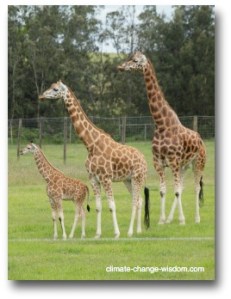
Whilst I find a trip to the local zoo to stand and admire a zebra, giraffe and even a tubby lion rewarding, I cannot escape this feeling that something’s missing.

More on the size of the task

Asleep

Asleep

Just about every couple wants to raise children. It is an innate, inescapable need that is hardwired and natural. All organisms have this requirement to make more.

So when couples face biological challenges to natural conception they seek help that in most western countries now includes the benefits of medical technology. In vitro fertilization (IVF) and related fertility treatments have helped hundreds of thousands of couples create a family with more than 3 million babies born since the techniques were introduced in 1978.

Not surprisingly there was much chuntering at the Australian government for removing subsidies for IVF treatment under the national medicare system. Australian couples now have to find up to $2,000 per treatment in upfront cash.

In the short time since this funding change that has saved the government around $50 million, IVF proponents claim that some 1,500 babies have not been born because many people cannot afford the treatment.

Perhaps I am callous because my first thought was that this good news; 1,500 fewer mouths to feed. But then I am obsessed with 8,000 an hour and sometimes find it hard to empathize with childless couples as I have two sons and a step-daughter.

So I mellowed and clipped my own ear for being so heartless.

Then came the kicker. Advocates were arguing that, in fact, $50 million was a sound investment spurned. Eventually the ROI on the $50 million from taxes paid by those 1,500 kids more than justifies the government spending on the subsidy.

This is where I really despair. There can be no rational argument for taxes being a return on government investment because this is not an investment model. Taxes are a way if distributing wealth for services that are financial beyond most individuals, not an investment scheme. Nor are the accounts complete. The environmental cost of 1,500 omnivores living western lifestyles for 80 years would make $50 million look trivial.

The thinking that makes intelligent people (the proponent in this case was a University professor) misquote economic rationalism is scary.  It suggests that we are just more-making machines unable to pull in the logic to understand what we do. The bigger picture eludes us in our quest for advocacy, especially when that finds us on the moral high ground.

In an earlier post I pointed to the size of the task to support 7 billion humans in practical terms of energy, food and water is gargantuan.

Now I am concerned that the size of the task in the human dimension is even bigger if our logic is stuck with the eventual benefit of babies to the tax system.