It finally happened

After back stabbing, vacuous argument and dithering for long enough for us to have been in and out of the next ice age, and despite (or perhaps because of) a hung parliament, yesterday Australian politicians passed a carbon pricing bill through the lower house by a couple of votes.

Champagne all round for the warmers, gnashing of teeth for the deniers and plenty of “why did they do that?” from the majority of the populace more concerned with their own stuff.

And a wry smile from the historians, for this is truly a moment for them to record.

It is the point at which a conservative country in a remote corner of the western world, bound to a colonial past that created significant wealth by exploiting natural resources, made a tentative, but hugely symbolic step towards accounting for externalities.

A brown economy allowed its politicians to introduce a policy that starts to capture the hidden environmental costs of doing business. Those costs that never make it onto the company accounts, the externalities, or what the policy people prefer to call spillover effects.

On the balance sheets of 500 companies and organisations with the largest greenhouse gas emissions there will now be a line item that will show they have made payments for an environmental impact. Not from a point of pollution into the creek that runs by their factory, or for installing mufflers to counteract machine noise, or the filters and scrubbers to remove particulates from the smoke stack, but for an invisible and diffuse environmental effect.

Truly this is historic.

And what history will record is that on 12th October 2011 Australia made its move down the road of major economic reform. It started the process of converting from a fossil fuel based economy with centralized energy infrastructure built with entrenched investment structures; to a fluid, entrepreneurial, environment friendly era of economic development.

And this happened because it realized that even though a capitalist system fits the human psyche like a glove, capitalism is not sustainable unless profit is real. It cannot be profit declared by hiding costs in the environment. For, in the end, the environment stops absorbing those costs and closes down, cutting off production.

There will, of course, be u-turns and moments of doubt about this historic decision. There will also be kick back from the old ways that claim emissions are just hot air. And those claims may turn out to be true.

Only this path is as inevitable as peak oil, because even if it’s not about emissions, it is about knowing and accounting the true environmental costs of doing business.

Only then we can live well and live within our means.

Enough clean energy

“There are people who believe that unlimited cheap energy is a recipe for disaster in the long run…   But in the short run our problem is not having enough clean energy…”

Peter Gleick of the Pacific Institute as quoted by Thomas L. Friedman in his fascinating book “Hot, flat and crowded

What would happen if there were ubiquitous, cheap, energy?

Likely we would give in to our insatiable desire for stuff and just buy and buy and buy. Our houses would become cluttered with any amount of clothing we couldn’t possibly wear out, gadgets that waste more time than they save, and furniture we only sit on once.

Our stomachs would grow on the copious quantities of food in the fridge.

And the landfills will expand to cope with all the old stuff we (eventually) threw out.

All this would be possible because energy is a big cost to manufacturing and primary production. Make it cheap and available everywhere and no end of opportunities emerge for the production of salable goods.

The only thing holding back commerce would be the availability and cost of raw materials.

This outcome of ubiquitous, cheap, energy we might call the ‘no impulse control’ scenario. Unfortunately it aligns closely with the economic paradigm of growth. In order to keep economies growing we have to create and sell more stuff.

So cheap energy would simply fuel the runaway train.

Now if this energy were dirty in some way, either for the climate or as a more tractable pollutant that created smog or contaminated waterways and land, then there would inevitably be a regulatory check on its consumption. At some point public health concerns will slow the exploitation of a dirty resource. Sometimes environmental concerns can be enough to curb excess.

But what if it was clean? The clean, ubiquitous and cheap energy nirvana that is common in sci-fi novels. There would be nothing to stop rampant capitalism, especially if by ‘clean’ we meant next to no environmental impact, greenhouse or otherwise.

And this may indeed be a problem. Supply of other resources and skills would curtail some of the excess – there is already a global shortage of steel and skilled developers for large-scale infrastructure projects – but the social and economic ills of fast growth would still be a risk.

“But in the short run our problem is not having enough clean energy…” because right now we have cheap energy only it’s dirty and running out. We need the clean stuff and soon.

At the moment we have all the growth problems plus the dirty consequences. So we should be mobilizing our smarts, capital and entrepreneurial talent to find a secure, clean and scalable energy source.

Instead we invest yet more in fossil fuels.

Buying up the land

Land has always been an asset. If you control land you can live on it, grow food, exploit other natural resources on or under it, and even charge people for passing through. Land makes money. We didn’t call the old money upper classes ‘the landed gentry’ for nothing.

What we choose to do with land depends on its potential and the owner’s ability to realise that potential. Assuming, of course, the owner recognises the opportunity.  In turn opportunity is about where the land is and what other people want either from it or from what it can produce.

A hectare that overlooks Sydney harbour to the opera house might have been used to raise sheep 200 years ago before there was such an iconic view. Not even the most recalcitrant planning officer could block development of dwellings on such land today. It simply has orders of magnitude more value as a place for dwellings than as a paddock.

Sheep production will not suffer for a few hectares given up to buildings. Grazing properties in Australia cover more than 4 million km2, more land area than India and seven times the size of France.

Nevertheless the Sydney Morning Herald recently printed a story with the following opening line: “FARMERS fear a new rush of environmental plantings for biodiversity and carbon offsets will accelerate the loss of land for food production”.

The story was about mining companies, energy utilities and investment banks buying up land, often through carbon trading companies, to plant trees that will become biodiversity and carbon offsets under the Australian governments Carbon Farming Initiative.

Much of the land purchased is degraded or marginal with limited production potential – a gentle way of saying uneconomic. The new owners have trees planted and account the carbon that these plants pull out of the atmosphere as they grow. This they can register as credits to offset their obligations to purchase emission permits.

Under the carbon accounting rules the new plantings are expected to be “permanent”. That is they must persist long enough to count as emission reductions on the greenhouse gas balance sheet.

An offset planting is not a plantation or production forest. There is no mechanism to allow for later use of the timber resource.  They are carbon sinks, soaking up CO2 from the atmosphere, and providing habitat for any number of creatures that were under pressure as a result of land clearing.

The green end of town is happy indeed. A good thing you would think.

Farmers and their advocates are less enamoured. The prospect of losing large tracts of agricultural land sends a disturbing message to a community already worried by drought, flood, pests, a strong currency and uncertain terms of trade. Then there is also the buy up of productive land by foreign entities, both companies and sovereign states, looking for food security at home.  More land going out of our control.

With this kind of reporting it is a small psychological step to thinking that the land is being appropriated from under our feet creating a threat to a 200 year old way of life.

This will not happen. Even at their maximum extent offsets will be a tiny percentage of the total land area. After all it takes a lot of plantings to cover an area the size of India. However, the reality is that there will be questions asked of land use in the coming decades. We will need more efficient production, regrow vegetation for its carbon value, pay more attention to conservation efforts and be smarter about water use. There will be changes. And this is what the reporters latch onto. Tradition will not be enough to guarantee persistence of the current use everywhere. We will find new ways of making the land productive. Like the plot of land across from the Opera House values will change in ways that make alternate so attractive that change is inevitable.

And in the shakedown, who owns the land may be less important than what is done with it.

Who’s behaviour are we trying to change?

The Australian government has just released its clean energy future legislation, a long awaited climate change policy framework.

In line with other jurisdictions the focus is emission reduction by putting a price on carbon to change behaviours away from dirty, fossil fuel based energy and industry to a cleaner, more efficient economic system. Clean energy futures is an elaborate, and in many ways clever, market based system for the commercial exchange of what amount to licenses to pollute, is transitioned in through a tax on the 500 heaviest emitters.

Hit commercial entities with a cost and, on the assumption that the hit hurts, they will do their upmost to avoid it. They are expected to be rational after all. Some will cop the cost and simply pass it on to their customers. But this will benefit their competitors who choose to become more efficient and change to less carbon intensive activities. So the market will sift the options and favour the cleaner ones. Exactly what is wanted.

In this case $25 billion over 5 years is the hit – evened out it is $1 million a year per entity – and that sounds like it should hurt enough to prompt a change. Some entities will become more efficient, trade to get the best price for what they must pay for and, eventually, transition to clean practices.

So we have a system to change the behaviour of… the 500 heaviest emitters.

Only why do these companies emit? For the majority it is because they supply energy or goods to the market at a profit. In other words they have customers, ultimately us.

In the formulation of the clean energy future policy, the $25 billion raised from emitters will go back to consumers through raising the tax threshold at a cost $15 billion and another $10 billion to support exposed jobs. This is so that should the emitters pass the cost of their permits on to the consumer or cut costs in the form of jobs, it is not too painful for those on the receiving end. Us again.

No collective hurt there. And so no change in behaviour.

Propping up the consumer also eases the pain on the emitters and reduces the incentive to change.

At some point it will be necessary to try and change our behaviours too; or even the most intricate of policy formulations will be a waste of effort and opportunity.

The missing link

Some years ago I wrote an essay entitled ‘What if it’s not emissions’. I was not in denial or even sceptical about climate change, more concerned that we had become fixated with emission reduction as the solution to climate change. So convinced had we become that it was a given that if emissions came down, we would have fixed that awkward problem and all will be well with the world.

My real issue was that we risked putting all our eggs into the emission reduction basket.

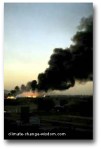
Burning landfill site, GaboroneAfter more years of political inaction than seems decent, the Australian government has just released a clean energy future policy on climate change. And, guess what? We still have the same fixation. The proposal is all about emission reduction, initially through a tax on pollution followed by a cap and trade system to make emitting greenhouse gas so expensive that no rational business could afford such behaviour.

It might be about emissions, but the policy formulation sees only a modest reduction target – 5% below 2000 emission levels by 2020. This means in 2020 Australia is pledging to emit 509 million tCO2e in greenhouse gases or 56 million less than it did in 2009.

Only by 2020, even with the proposed intricate emissions reduction policy fully functional, emissions of 679 million tCO2e are predicted.

Actual emissions will increase because the Australian population will grow in numbers at roughly 890 people per day, the economy will grow and so will affluence. Economic growth will require energy to follow the historical trend of a doubling in consumption every 30 years. And although the policy does talk about energy efficiency and alternative sources, the required capacity increase will inevitably be met by traditional means.

Emissions growth will leave a shortfall in the target of 170 million tCO2e or 30% of current emissions. So it would seem that the emissions reduction basket has few eggs.

This again begs the question ‘What if it’s not emissions?

Let us accept what the science tells us and agree that it is emissions that are a significant driver of the current climate warming. What the policy shows is that, rather like American debt ceiling, we cannot quite admit the severity of the problem. And, more importantly, we lack the courage to tackle the problem head on. It is just too hard and too scary.

And this would actually be ok if we hadn’t missed the critical issue in all this.

We have stopped talking about how 7 billion people are going to sustain growth in affluence on a warming planet. We have forgotten about adaptation. Forgotten that we will need to use water wisely, deliver sustainable production on farms, and manage our landscapes when the temperatures change, rains forget to fall, seasonality shifts, severe weather events become more frequent and the sea levels rise.

Less than $1 billion of the $25 billion revenue generated from the carbon tax will go incentive land management through carbon offset projects. They will mostly be Kyoto compliant activities such as permanent tree plantings and flaring methane – just as the international agreement to proceed with a second commitment period of the Kyoto protocol teeters.

There will be money for biodiversity initiatives. Good stuff, but just more of what we have already been doing.

What happened to incentives to revegetate the landscape and put carbon back into the soil? The critical activities that will help us manage that scarce water, produce reliable quantities of food and help save what is left of nature. Missing, presumed dead.

Seems like we should ask again, ‘What if it’s not emissions?

Forest for the trees

There is a consensus among climate scientists that the net greenhouse gas emission reductions we must achieve to keep warming below dangerous levels cannot happen without the agricultural sector. They are right, it can’t.

There are three reasons for this assertion.

The first is that emission reductions from energy efficiency, mitigation and renewable projects will struggle to keep pace with ever-growing emissions from global energy demand. Mitigation projects in energy sectors will slow emission rates but leave legacy emissions in the atmosphere.

The second reason follows from a need to deal with this legacy. Smart agricultural and forestry practices can suck back CO2 and store it in vegetation and soil – so-called biosequestration. In Australia the sequestration potential in agriculture alone is 100 million tonnes of CO2 emissions (CO2e) per annum, or a quarter of Australian anthropogenic emissions with the bonus that soil with more carbon in it is far better for production that soil with less.

The third reason, and the big one, is land clearing. Globally we are still cutting down forests to grow food at a rate of 35,000 hectares a day, or an area equivalent to the urban footprint of Sydney every five days. On its own, this source accounts for 18 per cent of global emissions.

The problem is how to reduce land clearing.

We have cleared vegetation ever since we invented agriculture some 10,000 years ago and even the Ancient Greeks knew that clearing altered climate. Yet we can’t stop ourselves, because mechanised agriculture has become the engine of prosperity from Persia to Pennsylvania. It is quite something to tell a government minister that his government should forego the economic opportunity and the social security a robust agricultural sector brings. “Why not develop available land,” he will say, “there are mouths to feed.”

It is much easier to sell the idea of keeping the trees to the indigenous land owner, who is pained when forced to fell his trees to fund his children’s education.

And this is the nub of the matter. For what we have cleared are forests – vast stands of carbon locked up in the timber and in the soil that supports the trees (at least 40 per cent of the carbon even in the tallest rainforest is in the soil as plant roots and organic matter). Even where the logs are taken for product, clearing releases the carbon from the tree branches and roots through fire or decomposition and as exposed soil dries out, so the carbon oxidises to the atmosphere.

Enter a hugely contentious solution called REDD, reducing emissions from deforestation and degradation. The text of the Copenhagen accord describes what it means:

We recognise the crucial role of reducing emission from deforestation and forest degradation and the need to enhance removals of greenhouse gas emission by forests and agree on the need to provide positive incentives to such actions through the immediate establishment of a mechanism including REDD-plus, to enable the mobilisation of financial resources from developed countries.”

In short, the west pays to avoid deforestation and so help reduce that 18 per cent slice of global emissions.

REDD, and its latest manifestation REDD-plus (same idea but with wider scope), are criticised for two reasons.

REDD projects amount to welfare payments to the developing countries where the projects reside. And welfare is disliked by both giver and recipient.

Then there is a vociferous green argument against the market approach to delivery as in this case there will be cowboys and governments who rip off the funds before they reach the resource owners. So despite the accord, REDD has been slow to start.

Lost somewhat in this debate on clearing is another mechanism for reducing degradation of forests, Improved Forest Management (IFM).

This is where emission reduction comes from projects on lands designated for forestry. Mitigation is achieved through combinations of longer harvest rotations, improvements to silviculture, better harvest practices and a specific category of protecting forests that would otherwise have been logged.

Whatever the specifics IFM is more like a commercial transaction, industry to industry, and is more comfortable to buyers. The outcome is better managed forests that continue to sequester carbon while emissions are avoided. In the developing countries where these projects are most likely, the forests also remain to supply traditional use.

It would be unfortunate if arguments over REDD derailed or slowed the “immediate establishment of a mechanism …to enable the mobilisation of financial resources from developed countries,” as stated in Copenhagen, because IFM already exists as a mechanism that can deliver.

It would be cheeky to call IFM green, but it is definitely not REDD.


This piece first appeared in Climate Spectator in 2010.

Journeys

In 2009 2.5 billion journeys were taken in aircraft.

Evened out across the global population, every third person on earth took a flight. In reality it is the wealthiest proportion of the 1 billion people in western economies who took most of the journeys.

The projection is that by 2014 there will be 3.3 billion journeys taken.

This represents a 32% increase in 5 years.

Mobility is an inevitable consequence of affluence. As more and more people have disposable income, many will want to use some of those funds to travel. As economies grow, more business is done and so travel to buy, sell and negotiate also increases.

In the mid 1960’s the first Boeing 737s carried 100 passengers up to 2775 km. This was quite a revolution at the time.

The latest Boeing 737-800s carry twice the number of people over 5,500 km and use 23% less fuel.

Suppose it were possible to replace all the aircraft flying in 2009 with the latest fuel efficient models. It would be possible to absorb almost all of the 5 year increase in passenger volume to 2014 through fuel efficiencies that these more efficient vehicles bring.

Future aircraft construction materials that are lighter and still strong enough will see even greater fuel efficiencies. Aircraft built in the next decade or two might only use a third of the fuel guzzled by the earliest models.

Replace all the 737-800s with aircraft of composite material designs and 13 years of growth in passenger numbers could be accommodated without increasing fuel use above that used in 2009.

But even if all these replacements were possible by the mid-2020s, less than a generation from now, fuel use in air travel would begin to increase over 2009 levels.

In half the time since those first Boeing 737 aircraft began flying all the fuel efficiencies would have been used up by the increased volume of traffic.

Clearly instant replacement with the best technology is impossible.

Some of those fuel hungry early models are still in the air on the more remote routes operated by obscure airlines. And it is these cheaper fare options that will be responsible for much of the growth in passenger numbers. The fuel efficiencies will arrive incrementally.

In the absence of some remarkable technology that can replace jet engines running on aviation fuel, greenhouse gas emissions from or air travel will grow along with the airline industry.

PS

There is talk of a jet-rocket vehicle that would travel in the stratosphere, have no emissions because it flies above the atmosphere on hydrogen fuel and could reduce the travel time from Sydney to London to a few hours. Commercial flights might happen by 2040.

By then there will be close to 10 billion journeys per year.

Can you be too green?

Back in 2009 the Australian Greens helped the opposition to vote down the then Labour governments Carbon Pollution Reduction Scheme legislation. They said that it was weak on emission reduction targets; the proposed 5% was too distant from the minimum 25% the Greens wanted.

Now, as a much weaker carbon-tax-to-trading-scheme hybrid proposal is debated, they are prepared to compromise.  The Greens propose to accept a modest carbon price prior to a ramp up later. This is the very same approach they previously rejected. The fundamental premise of a cap-and-trade system is to manipulate supply and demand in a way that changes behaviour. The only difference with the current proposal is it begins with a clunky and hugely unpopular new tax.

After years of delay that has seen debate erode policy options and scarify public support, the Greens are agreeing to an option that is even less likely to achieve the outcomes they support.

It is time to call them on this blunder. Back in 2009 their inability to see that effective climate change policy is a long play, tipped the result over to inaction. Structural economic transitions never happen overnight. Economies adjust, they do not jump, and any policy that forces change too rapidly risks collapsing the system. Wise policy recognizes this and finds a more gentle and expedient path. The rough edges of a CPRS are a compromise worth taking to achieve smooth transition.

In 2009 the Greens missed this reality. The risk they take this time is to botch it again. They may accept the tax now only to balk again at the emission targets set in any subsequent trading scheme. Do so and decades of hard work progressing the environment into the public psyche and onto the political agenda will be undone.

Politicians of all hues need to understand that climate change policy is a once in a millennium opportunity. And for the Greens a carbon market will inject serious funds into the environment and begin the long and necessary process of business accounting for environmental costs. How else, other than through a market approach, will we see manufacturing, development and energy accounting for natural environmental services.

Perhaps when oil hits US$300 a barrel and our continued carbon intensity cripples our exports we will look back to 2009 and say, if only.  Let’s hope the same will not be said of 2011.