Should a country be self-sufficient?

Should a country be self-sufficient?

Photo by Markus Spiske on Unsplash

The other day my youngest son, now in his late-twenties, was very proudly telling me how he was living within his means. He had an account for all his various bills, one for unforeseen expenses, he had his play account and… Basically, he’d bucketed his money. 

He felt he was saving and was asking what I thought would be the best type of investment given his age and where the world was going. He had of course already decided how he was going to invest in a combination of cryptocurrency, shares and eventually, his gold standard, property. 

And good on him. 

It was a proud moment for a father to hear his son getting his shit together. Particularly after several years of it looking a bit dodgy as to what would happen. 

That notion though, of living within your means, is rarely extended beyond our personal affairs. 

A COVID opportunity

The pandemic has given many people pause for thought. The time to think about their own personal means and for many, it’s been a horrific and very scary time. 

Job losses and uncertainty around income causing problems for families all around the world. 

What we haven’t done yet, but we should, is to see what this pause means for jurisdictions and countries living within their means. 

Why can’t we extend the concept to whole economies? 

The kneejerk has been to assume when COVID is over that the old normal will return, as though we’re all just desperate for it to be like it was before. You know, a life full of problems and constraints and difficulties and working all hours God sends just to pay the mortgage. As though that situation of stress is the one we want for the new business as usual. 

Meanwhile, governments rack up debt levels never before seen, not even in wartime, and whistle along as though printing money was actually what they had in mind all along.

In Australia, the politicians are desperate to return to pre-COVID neoliberalism. They are planning everything as though it’s what everyone wants, even to the point of ignoring the opportunity to ramp up structural change to energy, agriculture and what to do when the country can’t sell any more iron ore, coal or gas. 

The immediate challenge is not so much what an alternative normal should look like, more that leaders don’t seem interested in looking for alternatives. Or even imagining what those alternatives would be. And yet this is essential if we are to move forward. 

This is all at a time in human history, the first when resources do not match demand, when we’re already living way beyond planetary means. 

As one measure of this overreach, the day on which the renewable resources of the world are used up for that year has been creeping earlier and earlier for decades.
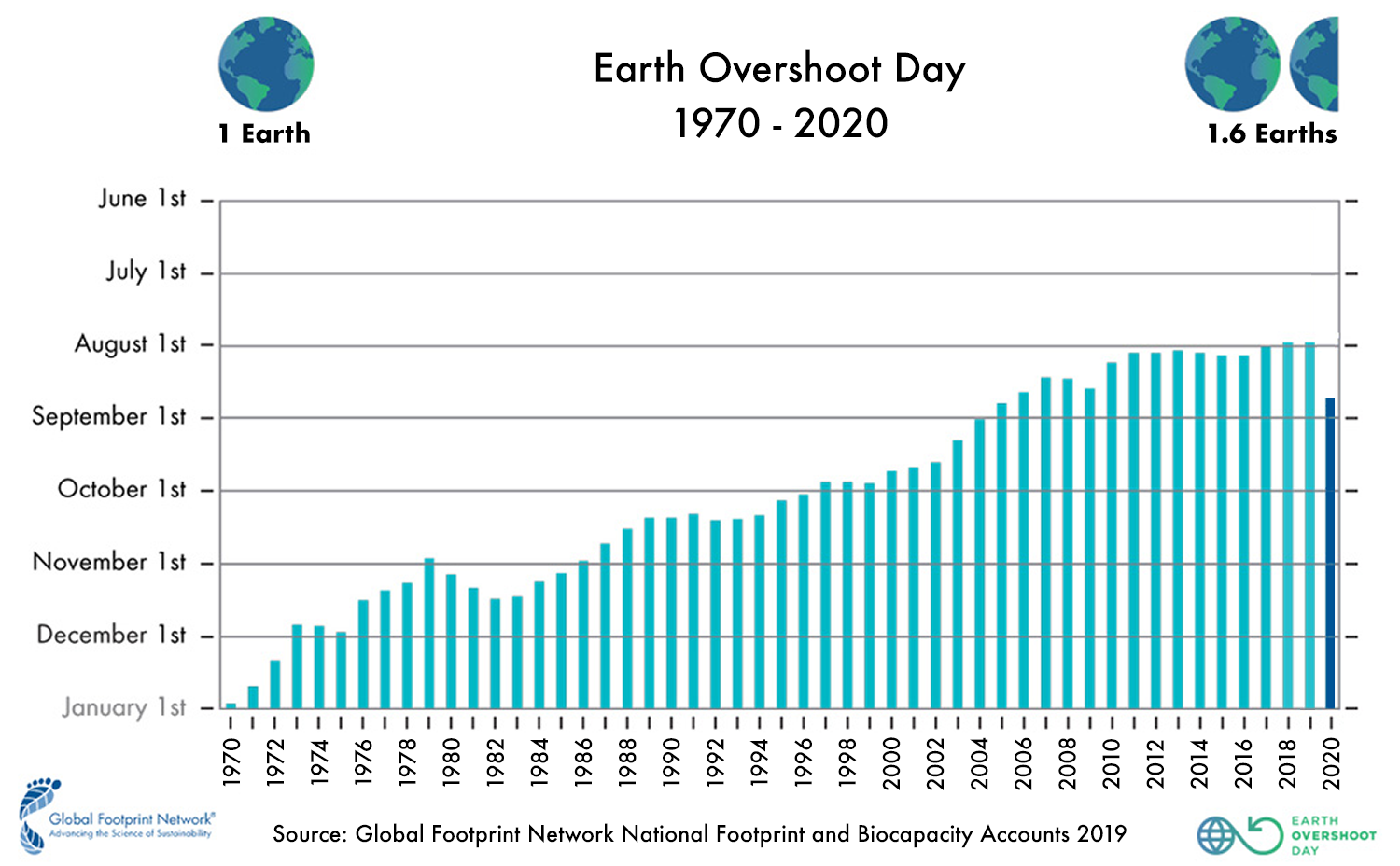
Source: Global Footprint Network 

All those severe lockdowns when most of Europe stayed at home, global travel came to an abrupt halt and tourism tanked, changed the date for overshoot day 2020 by just three weeks

Despite a pandemic slowdown we still need 1.6 planets worth of natural resources to get us all through the year.

Self-sufficiency for countries

Perhaps the numbers for earth overshoot day are too daunting. 

More realistic perhaps is to extend the personal means test to countries or jurisdictions, a city or a county for example. These smaller, more compact economic units should be easier to handle and have more autonomy than the global economy.

Attempts at country level self-sufficiency start with a mindset of wanting to live within means. This will require a shift from a growth model to something that is more about what happens if we didn’t try to live within our means. Collapse is the extreme but shortages and strife are nasty precursors. There has to be a desire to mitigate these risks.

Next would be the inventory of needs and necessities together with the current modes of delivery for goods and services. Then some thoughts on the efficiency of these modes asking what sort of changes would be required? What resources are essential, what resources are a luxury that we could easily live without? Resource use decisions would also require a focus on what is understood by well-being. 

Much of what happens in the West is unnecessary for human well-being. We are over-consuming and stressing out whilst failing to think about and utilize the resources that we have. We don’t imagine resources being the limiting factor because the only limiting factor is our desire and our greed. 

The conversation about living within means requires a shift in thinking away from what we could potentially have, the yacht and that 10-story apartment block bringing in enormous amounts of passive income to fund the luxury villa on the coast. 

Instead discuss and decide on a semblance of what we understand by well-being, especially how well-being can be enhanced by being people rather than consumers.

Self-sufficiency

Any discussion on economic self-sufficiency quickly ends up at the individual. It is self after all. 

It may be that a top down sufficiency is not possible, only from individuals can a collective living within means happen.

Bitcoin then.


Please share or browse around on the many other posts with ideas for healthy thinking

Leadership of the masses

Leadership of the masses

Photo by James Coleman on Unsplash

Think back to October 2020, a few weeks before the US presidential election. According to the polls, the Democrats nominee has the upper hand. In a normal election cycle he would be a shoe in. Instead the media is in a frenzy in case the polls are wrong given that they fooled everyone the last time. 

There’s discussion of what would happen if the result is close and contested or the sitting president chose not to leave even if the voters said otherwise. The US is on tenterhooks and the whole world wants to know what is going to happen. 

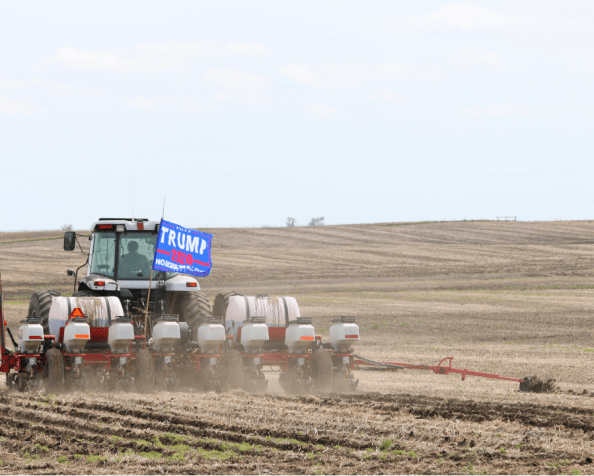
The normally politically lazy Americans would turn out in numbers that would again favour the Democrats, however, it also means the rusted on Trump supporters will be out in force as well. 

Then a few of them took over the citadel.

I’ve been spending a lot of time trying to figure out what makes a ‘rusted on’ Trump supporter. What thinking makes a person vote for a candidate with no ethics, no morals, no substance, no empathy or sense of fairness and has broken every rule there is and got away with it? 

It’s what we used to call back in the day ‘dodgy brothers’, the kind of person you would keep well away from your daughters. 

And yet there he is, the sitting President, running a campaign of disruption and division in order to get voted back in again. Relying on that rusted on core to put him back in office. Arguably, despite the impeachment ruling, inciting them to violence and to deny the result of the democratic process.

What is it that allows that to happen? When does humanity wake up and say ‘no, this is not the kind of guy we want to lead us into our future’? 

Well the Americans did, just. But the divisions are still there, painful and as rusty as ever. 

It could be the power of the fear and loathing that exists in people prepared to back a person who will go against everything rather than build confidence, partnerships and forward thinking. There was a quote just before the election to the effect that  there is this man high on steroids and should any foreign jurisdictions be listening, to keep well away lest they spark something that they didn’t want involving red buttons. 

More scary than funny.

Leadership qualities

Leadership gets more than its fair share of posts on this blog. 

I think I’ve always assumed that we look towards leadership that is progressive and inspires confidence. Leaders pull people together so we can become more than the sum of the parts. 

Such individuals need talent, a lot of energy, commitment, and balls. It takes courage to bridge tribal divisions and innate prejudice from all sides. 

It’s much easier to be a leader who divides and conquers. This has become common practice (Trump, Johnson, Putin, Bolsonaro, Modi et al) but a relatively easy practice. The only real skill needed is to identify the points of difference between people and then just accentuate them. And you have to admit Trump knew exactly the points of difference and played them like a fiddle. 

So my vision of leadership, the egalitarian bringing people together for common cause and making the sum much more than the parts, is not everyone else’s vision of leadership. 

It seems that there are a lot of people who want ‘us against the rest’ leaders, the guy that supports me against them, whoever ‘them’ might be. 

Historically humanity has often fallen for these leaders. Us against them is the main paradigm in wars of conquest. So perhaps what’s ‘rusted on’ is our limbic requirement to fight. And you can’t fight unless there’s something recognizable to fight against. 

I can’t fight time. I can’t fight the planet even though we try. I can’t fight the weather. These are too big and brash to take on, but I can fight my brother. I can fight the neighbor. And I can certainly fight those funny dudes with their crazy religion across the water. 

And maybe I am naive to think that leadership on commonality and of gathering together is our default. It is not. Our default position is exactly what we’re witnessing around the world, the leadership of us and them. The only way that the leadership stays in office is if you have slightly more of us than of them. 

Where do we go from here?

All this begs the question of where humanity goes from here? What type of leadership is possible if everyone is battling a limbic system that wants to fight, flee or freeze?  

At one time I thought the best option was to raise awareness and move people beyond their limbic thinking. Encourage the majority to become more aware, more understanding of the consequences of their choices, and so take more responsibility, especially when they place their ballot. 

I even wrote a book about it, Missing Something, on the premise that a raised awareness would help understand all the various problems that humanity faces including political leadership. 

Self actuation is a huge challenge in itself, especially when it is so comfortable to live off basic instincts. Political leaders understand this and trigger the instinct all the time. Trump is the quintessential embodiment of the approach. He locks onto base fears and fuels them all the time. 

Other political leaders recognise the base instinct and then bend it to their own ends often through authoritarian even military methods. Humans are easily manipulated by our slavery to base instinct with the stick and the carrot. 

Just saying ‘raise awareness’ is naive. Even if it would work, making it happen is daunting and likely not possible.. 

Whilst awareness helps bring people to a heightened sense of self, we need something more. 

The leadership humanity needs to give us a reasonable chance of survival can’t rely on scented candles and incantations. We have to play a ‘Trump light’ game that latches onto limbic responses for the political leverage needed to make progressive changes. 

This sounds horribly like moving to the right rather than the centre left. I am hardening towards the draconian on some of these things. Responses to COVID-19 show that it is possible to impose strict rules on society and get away with it in the public interest. It’s a small step to a benevolent dictatorship that could tackle the equally huge issues of inequity, food security, and a stressed environment. 

The risk in forcing people into decisions that you believe they’re not capable of making due to their basic instincts getting in the way is a slip of the tongue away from control for nefarious purposes. Blink and we are in the dangerous territory of the end justifying the means. 

Horrid as it sounds, such control must be part of the conversation because the limbic system in human brains has got us this far. It will be part of what comes next.


Please have conversations about leadership and benevolent control. Whatever comes next it must be better than populism.

Historians are worried about democracy

Historians are worried about democracy

Photo by Vidar Nordli-Mathisen on Unsplash

It is easy to forget that democracy is not a common way of doing things. 

At the end of 2020 when US citizens queued up at polling booths in record numbers, I was reminded that the right to vote is very recent in historical times. Women in the US, for example, had no such rights until the 19th Amendment to the U.S. Constitution was passed by Congress on June 4, 1919. 

The US had seen 29 of its 45 Presidents before this vital change.

Historically, most societies were run by authoritarian regimes of one sort or another that limited personal freedoms. Democracy, that so many of us take for granted, is actually a mid to late 20th-century phenomenon and by no means universal. 

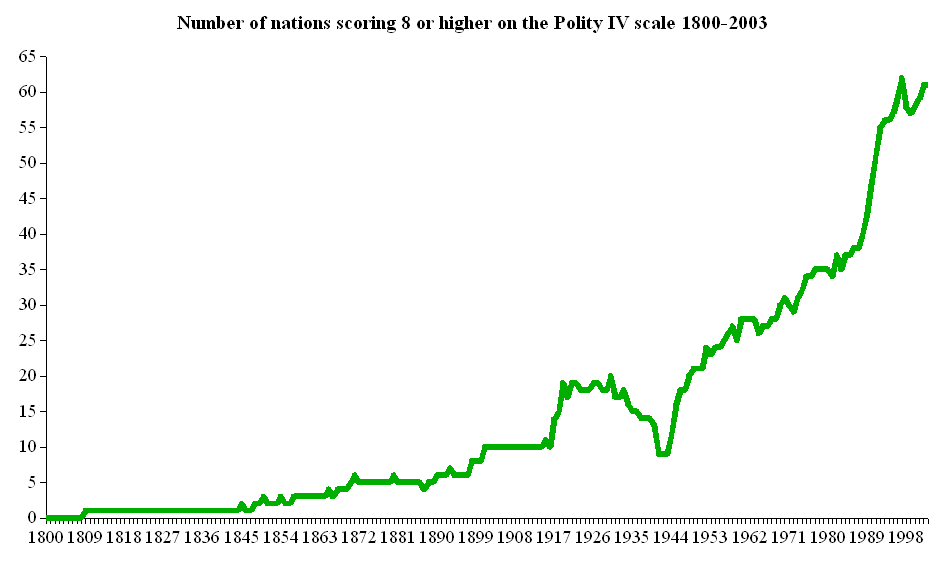
Here is one metric of democracy over time, the Polity scale ranging from -10 (hereditary monarchy) to +10 (consolidated democracy).

number of democratic counties over time

By Ultramarine at en.wikipedia – Own workTransferred from en.wikipedia, Public Domain,

In short, democracy has risen exponentially since the 1800s.

Remarkable as this trend is, many historians know how fragile democracy might be in a modern world.

Democracy is fragile

The dangers to democracy have been around for some time, think how close Donald Trump came to shattering it in the US, and the warning signs, the historians argue, are 

  • the spread of misinformation 
  • inequality 
  • the politics of internal enemies and 
  • politically motivated violence. 

Misinformation

The spread of misinformation is just about everywhere. 

Anybody with a smartphone can record a video on any topic, put it up on Tick-Toc and before you know it, can be peddling all sorts of information that they claim is the truth about anything. All with little or no justification. 

Traditional media, driven by the requirement for clicks, do a similar thing. Jumping on whatever they believe will keep their audience interested and not very much to do with whether or not the information is correct or truthful.

We now know that misinformation is a powerful political weapon and despite the impeachment of a president is hard to diffuse.

Instant access and weak filtering by consumers mean that truth from fiction will be forever contentious. 

We are stuck with it. 

Inequality

Inequality has always been a challenge for society. 

Those in power need to keep those not in power happy for as long as possible and yet at the same time not allow them to become too wealthy such that they might gain power themselves. 

Think subjugation of women over the centuries or the hereditary titles of the aristocracy. 

Can’t have any Tom or Dick getting their grubby mitts on the estate.

At the same time, power and capital will get things done. Most of the global development that delivers wealth and wellbeing to so many people came about because money was concentrated in risk takers.

It is a delicate balance. 

In the old days, the sword was the tool of suppression and to wield it required some noble heritage, a few loyal knights, and gold coins to buy your way into power. Now the same thing happens for those with bitcoin.

However, once sufficiently downtrodden, the masses have little left to lose. Emboldened they rise up and take away your power. 

Currently, the world is in a situation where a handful of people own vast amounts of wealth. And the majority own next to nothing in comparison. This whole idea of inequity is not just within jurisdictions, but also across the world. 

It is incredulous that Forbes lists the richest 400 Americans as owning more than $3.2 trillion in assets and then sobering to know that four billion people live on less than six dollars a day.

That is a wickedly large majority, severely downtrodden.

If this is what democracy delivers it is setting itself up to collapse.

Internal enemies

The machinations of internal enemies are the basics of modern politics. Long gone are adult conversations about policy or what is in the best interests of the electorate. 

In Australia, for example, voters have experienced the removal of multiple sitting prime ministers by their parliamentary colleagues, their own party members, who’ve decided for one reason or another that they’ve had enough and push a spill in the leadership. 

It is one thing to have an eye on the electorate that must decide on your future every four years. It is quite another to watch you back for daggers from your colleagues every four minutes. 

Debate and deliberation followed by legitimate choice in the polling booth seems like ancient history.

Violence

Politically motivated violence is clearly the most insidious of the dangers. 

America stared at violence as it stormed its castle of democracy. Now they must worry about their hugely divided country when every man and his dog has access to firearms. 

Then there is the prominence of extremist groups both on the left and the right who gain more noise than they deserve. Through the various media channels and instant access to video footage of whatever event they care to perpetrate. 

A lot hangs in the balance.

The good news

Precarious as democracy may be, the growth in the number of democracies since WW2 is still exponential. People seem to like it.

Things that are liked are hard to give up and are not easily taken. Expect resistance to anyone that tries.

I know that is what they said in Germany and Italy back then and it failed. But this time around we will be better, more vigilant and prepared.

I hope.


Help me keep it all going by sharing with anyone you think might be interested

Can humanity persist for another 100 years?

Can humanity persist for another 100 years?

Why not? 

A century is not that long a time in the grand scheme of things. All we need to do is stay sane, not throw rocks, and grow enough food without using up all the freshwater. 

Should be easy enough, we have been around a while after all.

Homo sapiens, modern humans, have survived as a species for a long time. The most quoted scientifically based origin is 300,000 years ago in Africa amongst a number of other Hominid species. 

Here is what the Smithsonian says

The species that you and all other living human beings on this planet belong to is Homo sapiens. During a time of dramatic climate change 300,000 years ago, Homo sapiens evolved in Africa. Like other early humans that were living at this time, they gathered and hunted food, and evolved behaviours that helped them respond to the challenges of survival in unstable environments.

Smithsonian Museum of Natural History

The average ‘lifespan’ of a mammal species – origination to extinction – is estimated from the fossil record, genetic evidence and rates of extinction to be about 1 million years, although some species persist for as long as 10 million years. If H. sapiens are an average mammal species then we have 700,000+ years left in us. 

Given our current ‘age’ and these lifespan estimates, the likelihood seems pretty high that we can persist for another 100 years, a minuscule proportion of these timeframes.

However, putting aside the rock-throwing and sanity of the leadership, in order to persist there must be enough food.

Our present complement of 7.7 billion souls each consumes a global average of  2,884 calories per day, give or take, to maintain weight and health assuming that along with the calories comes a balance of nutrients and food types. This is a gigantic amount of food consumed each and every day.

Roughly 22 trillion kcals

Obviously, we have engineered efficient food production systems to meet this demand otherwise there would not be 7.7 billion people and rising in the first place.   

Whilst famine and malnutrition are still prevalent, from a production perspective they are unnecessary. Most of the analysis and modelling suggest enough calories are grown. However, food is unevenly distributed, a great deal of production is wasted, and in many western cultures, people consume far more food than is healthy for the average citizen.  

Then along comes a quote from the United Nations Food and Agriculture Organisation (FAO) that went around the media. Here is how it was headlined in the sustainability section of the Scientific American, an erudite and respected science journal 

Only 60 Years of Farming Left If Soil Degradation Continues

Generating three centimetres of topsoil takes 1,000 years, and if current rates of degradation continue all of the world’s topsoil could be gone within 60 years, a senior UN official said

Scientific American December 5, 2014

The warning was harsh. No doubt designed to shock with numbers that should send shivers up the spines of the young. The quote goes on…

Unless new approaches are adopted, the global amount of arable and productive land per person in 2050 will be only a quarter of the level in 1960, the FAO reported, due to growing populations and soil degradation.

60 harvests left

In other words, to maintain food production per person equivalent to that in 1960 production per hectare would need to quadruple by 2050.

60 harvests left around many parts of the world, a lifetime of harvests, is a great headline. I’m ok then but if there are no harvests after that lifetime, then what are your grandchildren going to eat? Shocking and personal, a copywriters dream.

The degradation is true. Both intensive and shifting agriculture struggle to be gentle on soils.  It is easy for farmers to either mine nutrients or slip into input-output production systems. However, food production from soil is not static or uniform. There is innovation everywhere and not all soil is being degraded or eroded at the same rate. 

Some systems in regenerative agriculture are able to reverse the degradation trends with soil carbon accumulation and more efficient on-farm nutrient cycling.

Soil degradation is a huge problem but to say we have on 60 harvest left is fodder for the doomscroller, a headline fantasy and has been called as such

The soil scientists don’t believe it, mostly because such a number is very hard to calculate with any certainty. There are too many factors at play.

It also fails the pub test. A few sips of Theakston’s Old Peculiar and it is clear that not all farms will fail in little Jaden’s lifetime. Many farms are thousands of years old what makes the next 60 years so special?

Alright, we are down from the hyperbole. So will we persist beyond the next 100 years?

Well yes, but we will have to look after soil much better than we do at present. And this was probably the FAO message, they just got a bit carried away.

Fortunately, we already know how to do this. Combinations of the following can slow or reverse soil degradation: 

  • maintaining groundcover
  • minimum tillage
  • production diversity
  • careful use of livestock
  • irrigation practices
  • crop rotations
  • rest 

These are a few of the many options. 

It is important that degradation does not reach points of no return where rehabilitation or restoration becomes too difficult given the local conditions. The FAO would call this desertification but it can also be salination or other forms of soil degradation. 

The FAO were guilty of hyperbole but that’s all. 

What is true is this.

Outside the people and the politics, soils hold the answer to whether humanity can persist for another 100 years. 

Only this is not a headline in any way and who wants to agree with it anyway.

Humans are all powerful after all.


Go ahead and share this extraordinary missive, you know you want to…

A different message from Sir David

A different message from Sir David

Sir David Attenborough has made another wildlife documentary. No surprise there, the legend has made dozens of them over his long and distinguished career.

What is different about this one is summed up in his final sentence

“What happens next is up to every one of us.”

David Attenborough’s, Extinction: The Facts

For the first time, BBC programmers and Sir David decided we were big enough and brave enough to hear the truth of the matter. All the habitat loss, the pollution, the poaching, climate change impacts, expressed as wildfire impacts, and the inevitable species extinctions.

It is all true.

It is happening every day and in Sir David’s lifetime, there has been more than enough time for even the blind to see the consequences of human appropriation of net primary production, the landscape changes and the, well, the consequences of nearly 8 billion of us.

Of course, we do not want to be told, at least that’s what the TV producers decided.

Only against expectations, the viewing numbers in the UK screening were good and got better as the show progressed. It seemed like we were up for the messages after all. Perhaps we are ready for the reality of what we have done.

The interesting part is the last postulate at the end of the show that will no doubt become a classic

What happens next is up to every one of us

Here is what we need to do next

  • Feed an average of 8 billion souls every day for a hundred years – that means around 23 trillion kcals a day for 36,500 days at least.
  • Change the trajectory of our diets so that this calorie and nutrient challenge is achievable
  • Pay attention to soil and learn all we can about how to keep it healthy everywhere
  • Rewild up to a third of the land area and a third of the surface ocean volume to give the remaining global biodiversity a chance to survive, but also to maintain critical ecosystem services
  • Adapt through innovation to inevitable climate change impacts whilst transitioning to carbon-neutral economies
  • Be positive and hear the messages even when they are frightening, then act

And to achieve all of these there is one more thing…

  • Vote for progressive politicians.

I know this last one is the most difficult, for just now politicians with ideas are like hen’s teeth, exceptionally rare and hard to spot. But with necessity, they will appear and will stand out.

You’ll know them instantly.

Best of luck to us all.

Environmental science degrees in Australia just took a massive hit

Environmental science degrees in Australia just took a massive hit

In the 2020 Federal budget the Australian government, in its wisdom, decided that they would shift funding allocated to particular subjects within the university sector. The media have focused on reductions in the amount of money spent on arts degrees and the promotion of STEM subjects, technical and hard science degrees. 

Only one of the big losers in that story was environmental science. 

The student contribution to environmental studies was cut from $9,698 to $7,700 a year – meaning students will pay less for their degrees. A positive of course.

However, the commonwealth contribution paid to the universities to run these degrees was cut from $24,446 to $16,500 per student per year – meaning that the government will fund each degree less. Unless the university can be remarkably creative, less money received per student means a poorer quality of education.

This is very short-sighted, obviously. 

At a time when the youth are turning their minds towards their futures and what kind of environment they’re going to live in; not to mention their children and grandchildren. They are concerned. They think that the current and previous generations have given them a hospital pass. And they’re about to crash into the opponent with very little protection. 

Many of them are keen to find out more, to engage with environmental problems, and to search for solutions. Apply their sharp and agile minds to make the world safer and more sustainable.

The environmental sciences, one would have thought, are in the best interests of everyone. 

No matter what your value set, not understanding how the environment works is just a massive miss to any economy, society and individual well-being. 

Think about it for a moment.

All modern economic systems are founded on feeding the people. There are only two ways to feed the people: grow enough food or buy food from another grower. Either way, you need a strong system of economic organisation in order to be able to achieve the outcome by either method. 

Failure to feed your population and strife is never far away. 

And here is the thing… whether we like it or not,

The environment is where we grow our food 

Until we have created greenhouses on the moon or vertical gardens on every building in every city, the majority of our food supply will come from the land. It will be grown in soil. That’s going to be the case for at least the next hundred years and beyond. 

Not recognizing this fact just because we seem to have enough food right now, is morally abhorrent. That senior leaders and advisers are not even contemplating future food security is criminal. 

Remember that on any day of the week at least 700 million people are hungry and not all of them live in obscure countries that few know exist.

We have a small window for finding options to grow and distribute food for everyone. A short time to throw alternatives around and have their value debated before landing on the values that take precedent in which locations. 

Soon this window for rational discussions will have passed and will be in crisis mode. 

And a crisis is what it will come to for hungry people are desperate. 

In spending less on environmental science education governments are undermining the capability to even act in crisis mode by making it harder for a youngster to be educated in this area of interest. It is tragic. A small budget item decision that really points to the stupidity of the people in power. 

Not just the government

It may be that the environmental scientists themselves must take some of the responsibility. 

In my hirsute youth way back in the late 1970’s, I completed a degree in environmental science at the University of East Anglia in the UK. It was a new degree at the time and UEA promoted itself as a place of open-ended learning and student-centred inquiry.

A fascinating subject combined with a novel pedagogy fitted my personality to perfection. 

I absolutely loved it.

I spent hours in the library on my open-ended inquiry. And was both fascinated and empowered by the student-centeredness of the whole approach. In one of the courses, I even marked my own assignment, only to be told by the lecturer that I might have undersold myself. 

That this type of degree was available at the time was magical to me. 

The ability to mix and match a whole range of different subject matter, that would otherwise have not gone together or insufficient on their own to merit undergraduate study, was perfect.  Ecology, sedimentology, geochemistry, meteorology, sustainable development… and that was just the first year. 

Later it was Environments in time, more Ecology, Ecosystem Management, Land Resource Development, and Toxic Substances in the Environment. In total a thorough grounding in the bio-physicality of the world with and without humanity.

This STEM version of environmental science was not taken up in every program. 

In many universities, these topics never really came together and environmental science was hijacked by the human end of it. The value-laden decision making by individuals and the consequences of people being involved in the environment more so than the objectivity of the information that you can get about how the environment works. 

In other words, the sociology of the subject risked diluting the objectivity. 

These programs are less able to be precise about the science of the environment being absorbed in the social aspects of it. 

Consequently, environmental scientists are not winning Nobel Prizes. They’re not at the forefront of the men in white coats that governments are now trotting out to explain the COVID crisis. 

The discipline of environmental science does not have the standing needed to attract resources to empower the next generation. I think we have to take some responsibility for that, for not actually putting ourselves forward well enough. 

But if I was a climate actions youngster skipping school in order to protest about my future, then I would be looking closely at that cheaper degree and hoping that the quality of the program was up to scratch. 

Then I would enrol in environmental science.

Society will need what I learn.

One rule for you and one for the politician

One rule for you and one for the politician

There is a debate going on in Australia at the moment about superannuation. In particular, the percentage of superannuation payments that companies must make for each employee. 

Currently, the law says that 9.5% of the base salary is the minimum requirement. 

Some companies go with more than that in order to provide attractive remuneration for staff. For example, the university sector has very generous superannuation levels well into double figures. But overall, weak investment returns and stock market volatility will leave many workers with modest super at retirement.

In response to this future problem, the Federal government promised to raise the minimum rate of employer superannuation contribution to 12%. 

This has benefits to workers but also to the economy as a whole when those workers become retirees and have more money to spend. 

Only the Australian PM Scott Morrison is considering delaying the legislated increase from 9.5 per cent to 12 per cent…  to protect jobs.

It is a boon for politicians to stand up and say “isn’t it wonderful that we are trying to improve the superannuation rate”. Even if they then say that they will delay it to protect jobs in tough times.

When the PM or any of his ministers stands up to speak though, he probably doesn’t tell everybody that his superannuation as a member of Parliament is already 15%. 

Imagine standing up and saying well, ladies and gentlemen, I get 15 per cent you get nine and a bit, but we’re going to raise yours a little bit or maybe not now that COVID-19 has stuffed everything up.

That is really not going to go down too well – one rule for you and one rule for me. 

Please mind the gap

Please mind the gap

Photo by Tim Hüfner on Unsplash

Here are some interesting numbers

  • Jeff Bezos is worth $US183 billion according to Bloomberg’s Billionaires Index.
  • Since March 2020 when the COVID pandemic was declared, Bezos’ wealth has swelled by $US67 billion.
  • His income is roughly $US2,000 per second.

The arrival of the COVID pandemic with its lockdowns, social distancing, and unprecedented hand sanitisation has been a shock. It’s jolted perception of the way the world works and made a few folks think twice about how our societies function.

People are reminding themselves of exactly what goes on in the system of economic production and social organization. The one structured around profit. The successful are those who are able to sniff profit from gaps in the market, new products, and price anomalies — the everyday activity of trade.

And trade makes us all happy from shoppers to shopkeepers, groceries wholesalers or investment bankers who trade in futures, derivatives and their latest invention for a complex financial instrument. It doesn’t matter what type of financial transaction you’re engaged in, ultimately you’re looking for more in return than you give away.

It is often said that the best products are those where the buyer perceives greater value than he’s giving you in payment. Only you must receive from him more than it costs you to deliver the goods or service.

When this happens everyone wins.

So what is there to question given that the pandemic is, after all, just a blip in the never ending growth trajectory? Well, how about the privatization of asset recycling and the fundamental belief that free trade and minimum government will maximize our society and the profit opportunity?

Apparently, the theory of free trade and the mathematical formula that underpin it still holds true. Minimum government is ideal until there is no work for people to do and then maximum government is necessary, spending big by printing money to prevent everything crashing, and, of course, maintaining the opportunity for profit. Governments whose prime agenda had been to balance the books have racked up extraordinary levels of debt. Global debt in US dollars is now pushing US$270 trillion. That’s an increase of $50 trillion in less than five years.

Great success according to Jeff; US$2,000 a second anyone?

Over the years of promoting profit, growth and more growth, many economists jettisoned an equally important concept on the other side of the ledger. They forgot about distribution. What should happen for any system of trade to be sustainable is that the wealth creation is evenly distributed or at least has the potential to flow down to the lower levels of the system. If it doesn’t flow fast or far enough then a critical mass of people might become disgruntled enough to cause a ruckus.

Only what we’ve seen is that the distribution of wealth is now concentrated more and more into fewer and fewer people.

Check out this excellent website that shows just how much wealth is concentrated into first Mr Bezos’ accounts and then those of the 200 most wealthy people in the US.

Take your time, it is hard to fathom.

The gap between the unimaginable levels of wealth of the people controlling the money compared to working-class living is growing and not because living standards in the developed world have declined in recent decades. The decline that fueled the popularism that delivered Trump his presidency.

It is because of wealth creation and concentration.

The liberalization of financial markets has seen debt levels explode at a national corporate and personal level. There’s now so much cash injected into the global financial system by reserve banks that the traditional business cycles have halted. It’s added to our past excesses, rather than curbing them. And all the while the wealth has become ever more concentrated at the top.

The .com crash added debt. The global financial crisis was solved with more debt. Now we have the COVID health crisis shutting down the global economy and the solution is even more debt.

Remember what debt is ”an obligation that requires one party, the debtor, to pay money or other agreed-upon value to another party, the creditor” only a huge chunk of this printed money is making a handful of people… Well, you know what I am saying.

There are only three possible outcomes. One is that central banks wind that an economic recovery allows them to withdraw their stimulus without collapsing asset prices like stocks and housing. The second is that governments take over pick up the slack in jobs and corporate cooperate with each other the solved global poverty and equality. The third is war this yard uses the most likely and the least pleasant outcome.

Victor Schvets, Macquarie group managing director and group head of Asia Pacific.

Go on, read another post or better still share this one on Facebook — they are looking for material these days!

Trump lost but Trumpism didn’t

Trump lost but Trumpism didn’t

Photo by Laura Seaman on Unsplash

We’ve seen that Donald Trump was a bumbling politician, had no idea what he was doing, and had no idea of how to win an election. He fluked the first one on the back of heavy popularism and failed miserably to repeat the exercise.

It’s easy to convince ourselves that the US election result in 2020 was a great win for common sense. For the sensible majority to pat themselves on the back for coming back from the brink of disaster.

Except that, number one, Trump was elected the first time around.

Number two, he still won more votes in the election the second time around than any other President has won bar Biden. Seventy million people plus thought he was still a good idea. Even after four years of total nonsense and chaos.

And it would be very wrong indeed for Democrats to simply assume that it’s all back to business as usual. Bask in the joys of a net majority in the population and win on the back of that whilst hoping that the status quo will return.

Heads up, there is no question that popularism will come back.

The right will continue to develop more competent candidates for future presidential elections. It has happened already in other countries around the world: India, Brazil. Russia, Turkey already have competent politicians who fit what you might loosely call Trumpism. A would-be strong populist stance, only they are much better at it than the Donald.

This problem is that division is not going away just because Trump was removed — well, at the time of writing he still hasn’t actually gone, but we’ll assume that justice will be done and eventually the oval office will be vacated. The reason Trumpism won’t go away is because of what it represents. It’s actually all about resources and access to the wealth that those resources create. For with wealth comes power.

The human instinct is to grab and obtain power, maintain it, and grow it. A reflex that has given us success as a species and will never go away.

Breaking down this approach that is so innate in our biology, if we hadn’t grabbed resources and concentrated them in organised units, then we would not be here having this conversation using this technology. To simply remove that approach is not only difficult biologically, but it’s also near impossible psychologically. Hence the failure of communism, evening things out is simply not how humanity works.

Humans are designed to be competitive and to want winners and losers in the system. Politics is about giving a safe place for those winning and losing wars to be fought and for outcomes to be given at least a little empathy and equity. The reality is that in recent times the wars are being won by the right, by people with a lack of empathy and a very strong sense of that wealth creation gene that leads to power — those of us alive in the UK during the decade of Margaret Thatcher experienced something similar.

So don’t be surprised at all if much more competent Trumps appear. They won’t be orange, they won’t tweet all day, and they won’t play golf when it’s time to make a decision.

They will be as hard and as politically savvy as anything we’ve ever seen. And they will push their agendas as forcefully as any other political party that you could imagine. The only way to win against such candidates is to galvanise the majority who we hope, and I say hope because I’m not convinced of this, are fair-minded and empathic to others. Then for everyone to become aware that wealth is not the be-all and end-all and that there is a moral responsibility to look after the less fortunate.

Ironically, most modern societies actually do this rather well.

In many countries, there is a solid and functioning education system, law enforcement, healthcare of sorts, and realistic infrastructure. Many of these services are provided by the taxpayer so they are paid for before households have discretionary funds. These systems provide opportunity and support people.

Obviously, it is not perfect. There are many who are not supported well enough and do not have sufficient opportunity. The thinking is that these were the Trump base, the disadvantaged and the stagnant, those who lost faith that there was an opportunity.

Maybe so but there are 70+ million of them in the US alone. It’s hard to believe that they nearly made a majority, that is ‘most people’.

It means that the things said and done by governments, even the centrist ones, have failed to maintain the well-being of everyone whilst still allowing the system to continue to progress in technology and wealth. What was working ‘rather well’ isn’t anymore.

Centrists beware. Trump was a was not an aberration. He was lucky and he took advantage of an opportunity. But there will be people who will follow him that have a better grasp of the politics and better grasp of the policy in order to push that right-wing agenda of more rewards for the winners and more pain for the losers.

They are unlikely to appease those who lack opportunity but that does not seem to matter. In the time it takes for their popularity to wain a great deal will change.

Are we ready enough to cope?


Thanks for reading these posts, it really helps to know that they might tweak some healthy thinking

In what universe can you believe that?

In what universe can you believe that?

Photo by Juan Rumimpunu on Unsplash

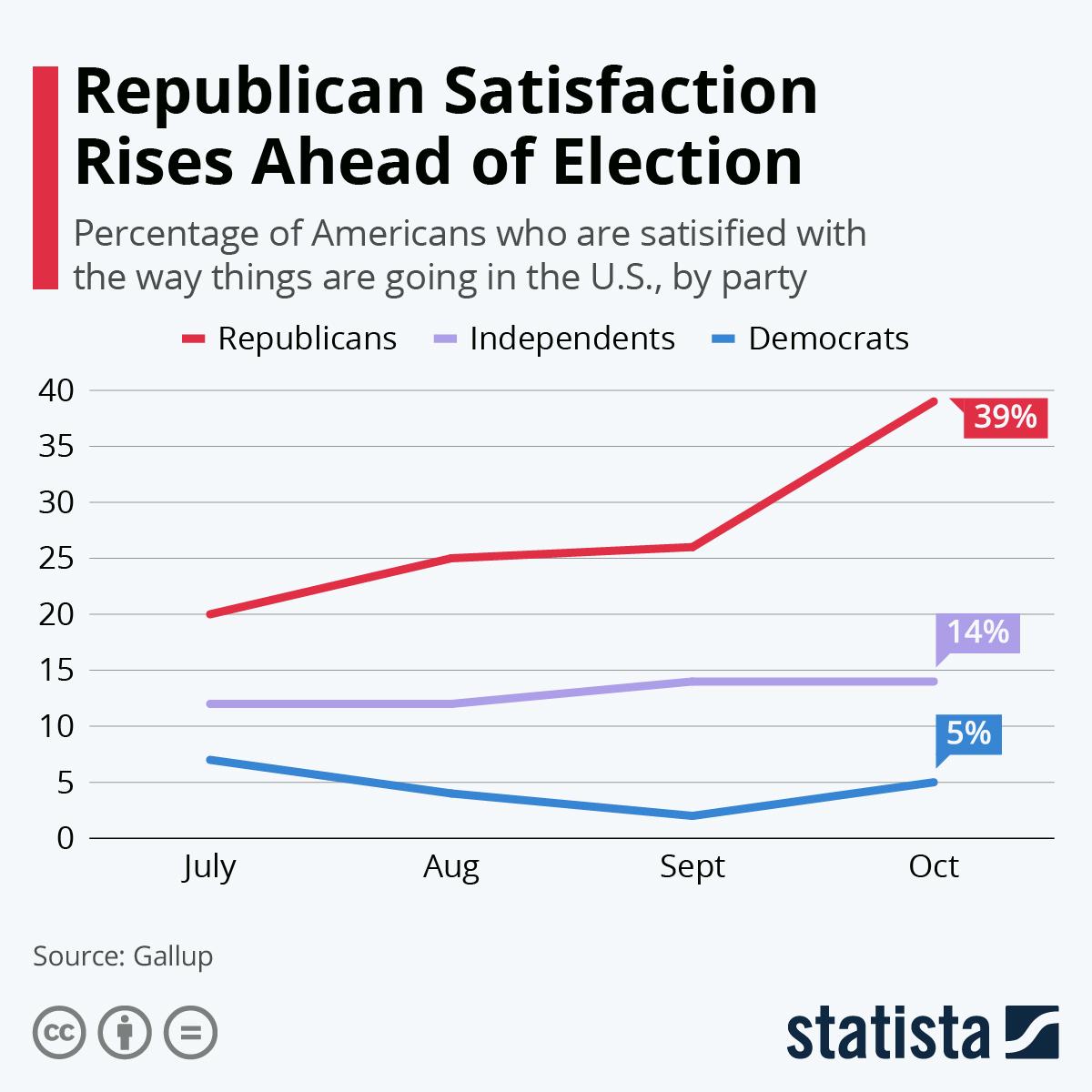
According to a Gallup poll, the proportion of Americans who identify as Republicans and are satisfied with the way things are going in the US reached 39% in October 2020 up from 20% in July. This compares to the October number for Democrats of only 5%.

On what planet does 40% of a particular section of a community agree that the way things are going are satisfactory when the US is in such an incredible mess?

There is the COVID problem with world-leading infection and death rates, the racism problem, the sexism and misogyny, the general incompetence of Trump… What more is there?

Well, there is gun control, climate change including some of the worse bush fires on record, domestic violence, trade tariffs, unemployment, incarceration rates, national debt, and the long, long list of western ills that we don’t seem able to fix.

It doesn’t make any sense as to why 2 in 5 Republicans think that everything is going well. What would it take for them to say that it’s not going well?

More to the point what has happened between July and October to double the satisfaction rate? That 20% increase is bizarre. It could be that the polling technique was flawed or maybe the sample size is small or biased. But it’s hard to imagine that during the course of a major pandemic with substantial hits to the economy and personal freedoms through lockdowns along with job losses and massive debt, that everything is satisfactory. What kind of craziness brings out such a statement in people is really hard to figure out.

Should we take notice of polling? Well, most politicians would argue no. But the stark thing here is that only 5% of respondents identifying themselves as Democrats were satisfied with the way things are going. So Democrats are panicked or at least concerned while Republicans think it’s fine.

This is the growing separation of political view in the US which is interesting after decades of convergence onto centrist type policies on most of the issues that matter. A division in the political stance at least gives people something to adhere to and to be against.

Here is…

another astonishing statistic

Recall what QAnon actually is

At its heart, QAnon is a wide-ranging, unfounded conspiracy theory that says that President Trump is waging a secret war against elite Satan-worshipping paedophiles in government, business and the media.

QAnon believers have speculated that this fight will lead to a day of reckoning where prominent people such as former presidential candidate Hillary Clinton will be arrested and executed.

QAnon: What it is and where did it come from, BBC Reality Check

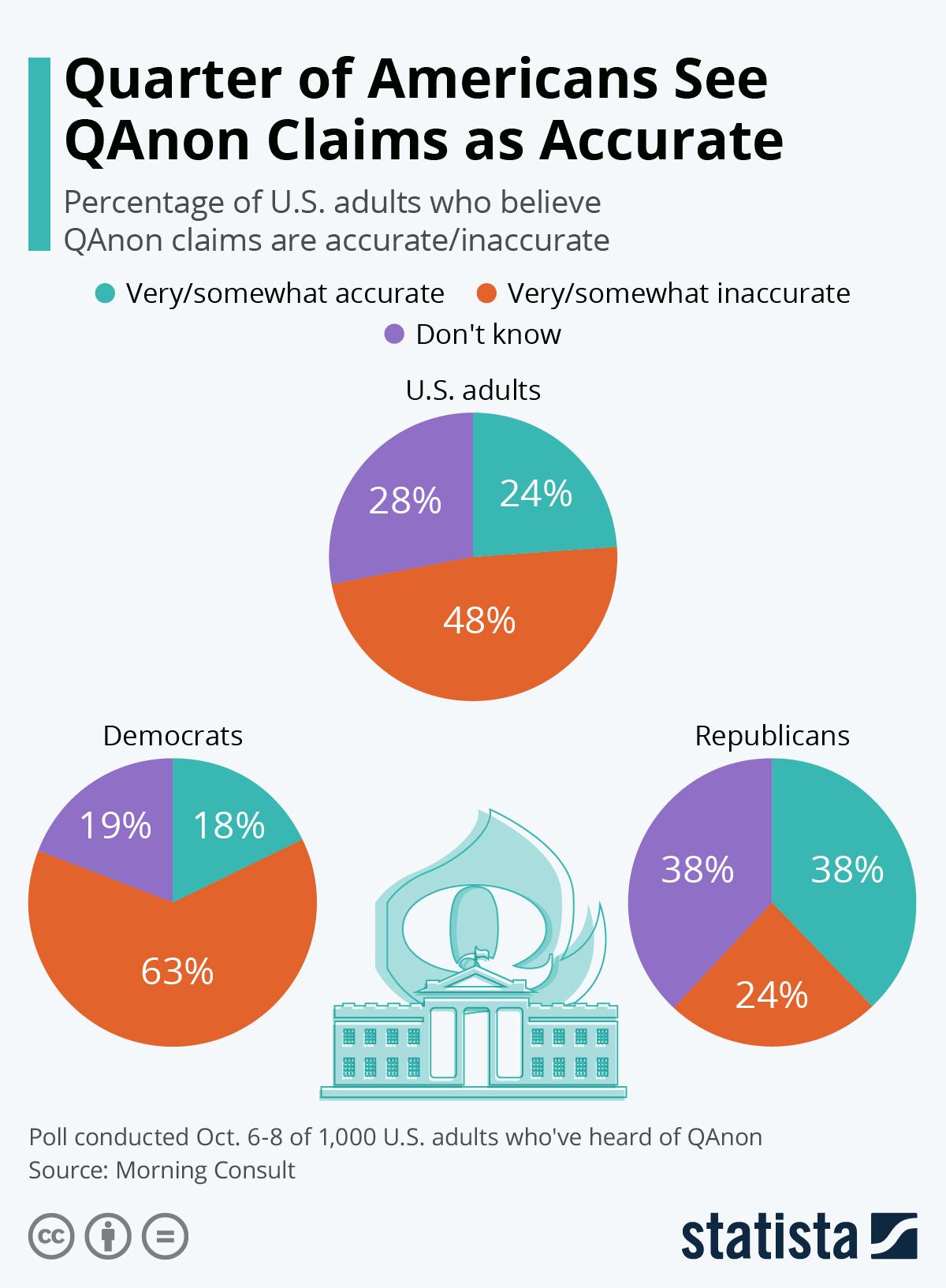
So 2 in 5 Republicans believe in conspiracy theory and nearly 1 in 5 Democrats do too. This is just as alarming. What goes through a person’s mind to allow these two statistics to appear? What were they thinking?

The answer is that they don’t.

There is a dearth of critical thinking on all sides. Instead, it is easier to think fast in the Daniel Kahneman sense, and not force any detailed analysis or appraisal of the evidence, not even a quick reality check.

People can then exist in a kind of bubble that comfortably fits their current world view and only engage with material that supports it. Confirmation evidence is easy to determine because it feels good. Evidence or views that feel off or a bit uncomfortable is just those nasty GOPs or lefties depending on the colour of your own bubble. These views can be just shouted down or, where necessary, trolled. Heck, if that doesn’t work there is always a demonstration.

Ask any of the 40% if they have thought carefully about what they say they agree with and they will confirm that they have, very carefully. This is the elegance of a bubble. It wafts a gentle lullaby over you to make believe that thinking has happened… by someone else. No need for me to do any heavy lifting, if the POTUS tweeted it, it must be true.

And so here we are at the end of 2020. A frantic and genuinely eventful year. When we need to be thinking about what amazing opportunities the circuit breaker of a global pandemic can give us, 24% of Americans think QAnon claims are accurate.

Get thinking people, truly.


Think about it, you have to repost this one.