Have we lost the plot?

This week Colin Barnett, the premier of Western Australia, was quoted in the Australian from a speech at a business leaders forum in Perth as saying that “We’ve lost the plot as to what we are trying to do here” implying there were other ways to reduce emissions than imposing a carbon tax.

“Why would we have a carbon price of $23 when the only somewhat credible trading market in Europe has a market price of $10?” he said.

This is the sort of thing you might expect a premier from the contrary political code to the Federal government to say. More so when it is the colossal revenues from mining that has been the engine of the WA economy for decades. The last thing a Liberal government wants is to dampen that particular fire.

At the same forum and quoted in the same article, the head of Westfarmers, who own a big chunk of Australia’s retail sector, described the carbon tax as “unnecessarily complex” and that “you have to be a rocket scientist to understand this stuff.”

Oh well, you could say, it’s just a couple of browns in a brown newspaper having a go at what they see as a constraint on the golden goose of capitalism. It’s to be expected.

And that would be a big mistake.

What everyone has forgotten to explain is why such a cost is necessary.

A few years ago we knew it was the “biggest moral issue of our time” at least according to Kevin07. Unless we took action global warming would consume us. And the majority believed that action was necessary.

Then the government prevaricated, forgot whose behviour they needed to change and introduced complex legislation that was more about plugging leaks than achieving a result.

It is emission reduction. Remember?

We thought that if we reduced greenhouse gas emissions then there would be fewer of the molecules that can trap long wavelength back radiation in the atmosphere than under business as usual and, if we managed reasonable reductions, we might slow global warming.

And then there is the real and far more critical reason. In a relatively short time we will run out of oil. If we haven’t at least begun the transition away from our dependence on oil for transport and fertilizers then we risk economic collapse everywhere. This is a huge deal, easily as important to the global economy as spiraling sovereign debt. Emission reduction might seem a bit left field as a means to transition away from oil but it starts the process of introducing and incentivizing alternative fuels and it starts to set the price signal that will come in a hurry when supply cannot meet demand.

Australian politicians must know this. They are well-educated, can interpret a graph and have a day job that puts this sort of issue front and centre.

Only they come up with a clunky policy that they have chosen not to explain to any of the people who really matter.

Maybe they think that because we have seemingly endless coal reserves, and now natural gas too, all will be well.

Or they just cannot bring themselves to explain the details behind the necessary pain of a transition – even though we already know that transitions are painful.

Perhaps they can’t explain something that they do not understand themselves.

Whatever the reason no one in the government has stood up to calmly, and with clarity, tell us why.

Then again, perhaps they really have just “lost the plot.”

Greek debt again

I came across this interesting visual presentation on the size of the Greek national debt… maybe staggering is a better adjective.

Recall that the talented presenter was dwarfed by half a trillion dollars. Now let’s go across the pond to the US.

The US national debt is roughly $15,717,900,000,000

That is $15.7 trillion if my conversion is correct – a tad more than Greece and a huge $50,000 for every US citizen.

In principle the US has a better capacity to repay creditors given the debt is 107% of GDP compared to 143% for Greece, but I just can’t get my head around the absolute number. And even though I lay no claim to an understanding of economics I am sure that owing more than you earn is not a good place to be.

You can see why climate change action is neither here nor there when the world has chosen to walk along this kind of fiscal knife edge.

$6 a gallon, heck no!

I came across this quote in a biofuels newsletter

Mad as heck about $5 gasoline? According to new research from Iowa State, the price would have hit $6 per gallon, if the US had not had its ethanol supply

And next to it was a picture of a dude in a white T-shirt with the slogan

“I saved you $1220 last year, ask me how”

in green letters.

Research is suggesting that ethanol production saved US householders $143 billion, or roughly $1220 per household in 2011. And for the headline, a dollar a gallon.

No doubt the transition away from fossil fuels will have to be as gentle as possible. There will be any number of tactics to ease the system through to avoid cost and supply discomfort.

At the same time the oil people will want to keep selling every last barrel at top prices. The dance to oil at $200+ a barrel will be interesting to watch.

So here is the thought.

If we measure the success of our economic system on wealth and lifestyle it generally stacks up. Measure it on the number of people it sustains and its performance is stellar.

And so far that system has been supported by ancient fossilized energy. Power that the sun sent to earth millions of years ago that was captured by plants and stored by quirks of decomposition and sedimentology.

Ethanol is power from today’s sunshine that is captured by plants and converted to a liquid fuel.

Seems like a very clunky way to do things. Why not just harness the power directly?

I am sure you know the answer.


The new gold

You would never call an actuary sexy. Number logic people just don’t have the suave of a James Bond or the sass of a Marilyn. They are just too precise. Absorbed by detail and loving that a + b = c, especially when b is the reciprocal of the square root of f, they just lack that playful oomph.

That said being a good number cruncher was never a bad career. Thanks to the acute need for their skills, especially from insurance companies treading the tightrope of premiums over risk, data people have always been well paid and in reasonable demand. Over the years it has been quite tricky to get a place on an actuarial degree.

Now, however, sexy is in for the statisticians too, because the mad men need them. Or more strictly, there is a new breed of advertiser who have taken the mix of imagery and psychology invented to persuade us all to buy things to a whole new level. Now it is possible to predict as well as persuade.

Thanks to the already huge and rapid accumulating databanks on our online profiles, our offline purchases and even where we are throughout the day (yep, that handy little app in your smartphone does more than tell you where you are and how long it takes to walk three blocks), it is now possible to track behaviours and from that predict what might happen next, or better still intervene with an irresistible offer.

The mad men who want to place that person specific ad on the right device at the right time need the data crunchers to do the sums.

Here is a simple example. Your Facebook profile says that you like the delectable British soul singer Sade (mine does) and your mobile pings a GPS signal that you are in Sydney. Instantly the ticketing website you use puts two and two together and sends you an email with Sade tour dates. Not only that but her Sydney concert listing is flashing with a special offer of 10% off the usual ticket price. Outcome obvious, you have an outstanding night out and can’t wait for her next tour.

Here is another example. Your credit card purchases at the casino hotel, activity at the gaming tables and even what goes out of the mini-bar in your room are monitored in real time. What you buy, win, and loose on your casino weekend break are matched to a predictive model based on thousands of previous punters that tells the hotel staff the optimum time to offer you a free meal voucher or a discounted show ticket for the next evening. That optimum being the point being just before your instinct tells you to cut your losses and check out.

This is just the start of the thousands of uses that analysis of data can support. Take a moment and you will think of plenty yourself.

Usefulness readily translates into products and services that become a new gold, the nuggets that come from data mining. The vast datasets on what people do, where they do it and when trawled, filtered, analysed and modeled to predict what, where and when they will do next. All so that businesses can deliver a timely intervention.

The talk is of a multi-billion dollar industry built around analysis, interpretation, and prediction, followed by delivery of highly targeted suggestion. It is a whole new field for anyone unfazed by terabytes of data and permutation algorithms…. and who are also unfazed by where the money comes from.

I wonder how many of the new gold diggers will dare to ask.

Population clocks

In an idle moment just before Christmas I gave in to my obsession with population growth and checked a few of the world population clocks.

These are neat web enabled algorithms that calculate and display an estimate of the number of people in the world. They tick or scroll along in real time as they make a virtual count of the births and deaths of people around the planet.

At 10.30am Sydney time on the 21 December 2011 a sample of them read

  • 6,880,986,220 on Poodwaddle
  • 6,933,668,504 on Metapath
  • 6,940,632,100 on Tranquileye
  • 6,982,567,212 on US Census Bureau
  • 7,010,439,251 on Worldometers

Clearly the algorithms and the underlying data sources produce some variability in the numbers.

Chances are that the true number is somewhere between 6,906,205,940 and 6,993,111,375 which is the 95% confidence interval for this sample of five estimates.

This confidence interval is 87 million roughly the population of Italy and Poland combined suggesting to the cynic that these clocks are not that precise.

Moving forward 101 days to 1 April 2012 and at 9.30 in the morning Sydney time the population clocks said

  • 6,854,561,707 on Poodwaddle up  26,424,513
  • 6,953,660,825 on Metapath up 19,992,321
  • 6,962,506,474 on Tranquileye up 21,874,374
  • 7,004,421,653 on US Census Bureau up 21,854,441
  • 7,031,948,549 on Worldometers up 21,509,298

This is an average increase of 22,330,989 new people in the world in just 101 days.

That is 221,098 per day or, if you prefer, 9,212 per hour.

I use to say it was 8,000 an hour, maybe I should now say 9,000 although what is another 1,000 between friends?

And yes, there is some uncertainty. It may be only 7,000 per hour. Or it may be the upper end of 11,000. Either way it is a sizable village every hour and a small city each and every day.  Scary.

Read more in my Hubpage article, What do population clocks tell us?

Environmental issues for real

When historians sit to appraise the environmental actions of the baby-boomer generation they will say that they tried, did some good things, but failed to grasp the big picture.

They will also record that the most important consequence of this failure was that people did not see the solutions that were there for the taking.

Instead they focused on issues that they believed were real but turned out, with the benefit of hindsight, to be only partially relevant.

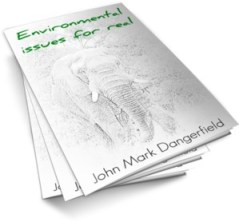
I have just published a short ebook at Smashwords that takes a sideways look at 10 environmental issues and puts them into context. It collates a few examples around one core idea that may be useful to the historians of the future.

And it can be yours for less that the price of  a skim latte.

Environmental issues for real

Leadership is tricky when it comes to carbon

It is easy to see why political leaders are reluctant to let markets run things. Unconstrained buying and selling usually gets away from itself, careering towards the lowest denominator, the financial bottom line.

Even those of a conservative persuasion who often understand how markets work can be wary of the unfettered force of rapid growth. They know that growth increases the risk of collapse when commodities of the day become scarce as they inevitably do. Unleash these volatile forces at your peril.

So here we are in Australia about to embark on a new market mechanism, the carbon price. From 1 July 2012 the top 500 emitters of greenhouse gases will, at the end of each financial year, have to pay for permits to cover their emissions.

At first the government will sell permits at a fixed price of  $24. Then, after three years, permits will be priced by supply and demand through an auction mechanism. And just to make sure the market doesn’t go haywire the government will control the permit supply and set a price floor and a ceiling for at least three years.

If the price bombs, liable emitters will have pay extra to true up to the floor price.

The carbon price mechanism also offers the option of creating credits from approved emission reduction activities under the Carbon Farming Initiative. Naturally it is not really carbon farming as the bulk of activity will be in landfill gas and tree planting.  The problem here is where the money goes. In simple terms emitters buying credits spend their money in the market but they buy permits from government. Too many credits and the revenues fail to match the commitments government has made to ensure passage of the policy in the first place.

Why all the constraints?

The answer is that this is not really a market mechanism, even though it looks like one. It is actually a policy to reduce “pollution” by using financial cost to change behaviour. The market part is just a way to try and wield the policy instrument with an even hand.

The risk, of course, is that keeping all that market power in check takes away most of the benefit too.

It’s a bit like having a guard dog on a chain. The burglar hears the growls and barks but if he trusts the chain will hold, there is no danger and he can pass into the house to pilfer the silver. Soon enough the owner realizes the risk taken by leaving the dog on a leash.

So what should happen? Well some honesty first. Despite the rhetoric, a carbon price is not about the atmosphere or saving the planet from global warming. It is the first of many steps in the transition of the economy away from dependence on fossil fuels.  A vital step it must be said, although not the only one.

Pricing carbon is a way to foreshadow the economic costs of transition, to get us used to the pain before it really starts to hurt, let’s say when oil is $200 a barrel. It also gets the transition started earlier than it might if it were left to unfettered market forces. Ironically, it also protects some of the assets that create the emissions by giving them a longer life. It is a choice of leadership that sees its role as smoothing the inevitable bumps in the economic road.

Obviously reducing emissions is also a smart hedge on the global warming issue.

Now we know what the whole business is about, maybe we can let the mechanism run.

Bob Brown retires

What is the right thing to say when 67 year old who worked as a doctor for over a decade and devoted another 35 years of his life trying to keep us all environmentally honest with the last 15 of those as a beleaguered minority voice in Federal parliament?

“Thank you,” would seem appropriate.

Or maybe “Thanks Bob, enjoy your retirement. We’ll miss you” if you feel a little more familiar.

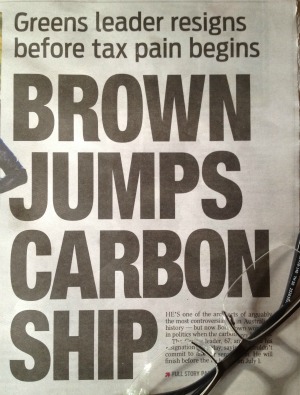
Headlinein Daily Telegraph on Bob Browns retirement

But no. Instead we get this crass headline in the Daily Telegraph.

Using the unexpected retirement of long time Greens leader Bob Brown to chirp about a tax that previously his party had blocked twice is just scraping the bottom of a very dirty barrel.

Your paper may sit as a political opposite to the Greens but there should be some common decency, a nod toward a worthy opponent however far his views may be from your own.

Imagine the uproar at home and overseas if on the back page of the newspaper  the headline was “Tedulkar quits to avoid touring Australia”, when all that happened was it was his time to retire.

In the past I have been critical of the Greens policies, especially when they blocked the CPRS. And I am not that fond of environmentalism either.

I also suspect that a party that in its essence is against things rather than for them will always be at the margins.

But when its leader and shining light decides to retire after a long and no doubt tiring time giving voice to things we would rather not know about, what we should all say is…

“Thank you Bob, it was an honour, enjoy your retirement.”

——–

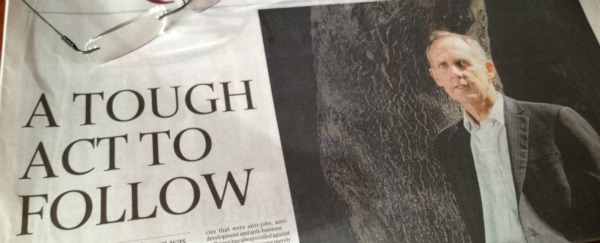
My faith in the rightness of things was partially restored by this headline in the Australian, not noted for their  fondness for tree huggers…

Bob Browne - A tough act to follow

…good on them.

Last chance to see

Stephen Fry is prolific, so much so that it is hard to avoid him. Fortunately this is entirely tolerable for the man is smart, erudite, witty, and has a passion for knowledge that is as important as it is infectious.

I did, however, find one occasion when he might have erred.

An episode of his wildlife series “Last chance to see” was filmed in Madagascar, where the unlikely adventurer went in search of the curious and elusive aye-aye, a type of lemur. The search criss-crossed the island to find the few remaining patches of forest where there might be a sighting, only to finally catch up with one in a coconut palm in a villagers back yard.

Along the way the film crew passed vast swathes of deforested land that clearly left an impression and brought forth laments on the loss of unique biodiversity once the trees are felled.

Much of the cleared land was planted to sisal that grows well in the Malagasy climate and produces a cash crop for farmers. Fibre from sisal is used in packaging in the west that is biodegradable and often labeled as green. The irony was not lost on Mr Fry.

Madagascar produces around 9 million tones of sisal, about 4% of global production, and a seemingly trivial mount in the grand scheme of things.

Surely the unique biodiversity was worth far more.

Not for the farmer, for cash is cash. And if there is, right now, a market for sisal and it is easy enough to grow then it is a profitable use of land. And if it is more profitable to the farmer than an aye-aye, then sisal it is. Not because it is the best use of the land but because, like the rest of us, the Malagasy farmer needs to make a living.

The same happened in Australia. Sheep are not the smartest use of the dry and dusty outback, but at the time there was a market for wool in Europe and wool was durable enough to travel. So like sisal, sheep production was profitable – handsomely so for some on the less marginal country.

The last chance to see is because we all want to make a living and because we make that living from the options available to us. It is hard to make a living from the sale of ecosystem services, or from forest protection or taking people to see an aye-aye; usually far too hard.

What we need to do is to be smart about the available options for making a living so that the one that is easiest does not become the default.