No pain, no gain

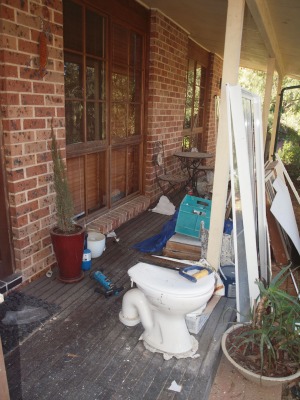
Porch-becomes-building-site

Our house is a shambles.

The dishwasher and the fridge are in the living room, the spare room looks like a bathroom warehouse, the front porch has turned into a building site and the lounges look horribly cute in their drop sheets.

Yep. We are in the middle of renovations, just a small upgrade to the kitchen and bathroom. It seemed so modest a task and yet the disruption has left me asking, “why, oh why did we do it?”

The answer my beloved wife — who has done a fabulous job in designing and managing our little project including sourcing all the materials [go eBay] — is tantalizingly simple.  No pain, no gain.

It is impossible to get a new bathroom and a kitchen upgrade in your house without copping major inconvenience and dust in the nostrils. It has to get worse before it gets better. Sound logic you might say.

But I suspect that this is not how we really think.

I reckon it is human nature to prefer “all gain, no pain”.

This is certainly what drives business. Profit is best arrived at with minimum fuss. Any cost that can be deferred, or better still, sent somewhere else, will be. The simpler the business system the less that can go wrong and so long as the company has enough competitive advantage in the marketplace, simple is good.

If there has to be pain then, reluctantly, businesses insure against its effects. Even though the logic of insurance is to cop the pain initially but be pain out to sooth its effects.

Now that I start to look for it, I cannot seem to find instances of business voluntarily accepting the ‘no pain, no gain’ maxim.

Perhaps this is the flaw in modern day commerce. Decoupled as we now are from a physical cap on monetary wealth [currencies are no longer tagged to gold bullion] business is free to find unlimited profit — and profit is best had without pain.

Parents of today’s teenagers will probably tell me that this phenomenon is not restricted to business. It is spreading through the youth faster than a tweet.

I will need some time for healthy thinking on this topic to develop but worth sharing I hope.

Meantime I can’t wait for the builders to finish.

As always, any comments gratefully received.


The heart of the matter

This article was written back in 2010 and was published online on The Climate Spectator. Nearly three years on it still makes fascinating reading as the rhetoric ramps up ahead of the federal election.

rocky shore NSWRecently the NSW Natural Resources Commissioner, Dr John Williams, hosted a workshop in Canberra on resilience thinking that was attended by a platoon of scientists, agency staffers and consultants, all concerned about the environment.

In his opening remarks, the Commissioner urged the participants to consider a simple enough question: What matters most?

A ripple went around the room as things that matter jostled for space in everyone’s head. No doubt thoughts of happiness, love, friendship, the mortgage and a few thoughts we don’t usually admit to arrived, and it was clear that there was not just one thought. The one thing that mattered did not appear instantly to everyone.

Caught as we are in the policy vacuum on climate change, with backflips and peculiar ideological positions to frustrate us, it might be useful to ask the same question of the climate change debate: What matters most?

Those representing heavy emitters will cry that exposure, unnecessary liability and uncertainty matter. Few of us like threats to business as usual. However, some exposed businesses have used climate change as an opportunity. We have all been offered the option to offset a flight or visit a carbon neutral office, where the most important thing is to be seen to be doing something good. Catastrophe can make for great PR, and so matters most, but for very different reasons.

Unless you install roofing insulation, climate change is of little consequence to small business. There is not much beyond the upward creep in the quarterly energy bill to keep your attention away from more pressing issues of cashflow, customers and the late arrival of a key staffer.

A couple of years ago, the general public in Australia thought climate change itself mattered most. They even elected a new government with a Prime Minister who claimed it was “the biggest moral challenge of our time”. Today polling suggests the majority see climate change as just another opportunity for politicians to renege on a promise. And a third of them think we should not pay a cent to fix it.

Climate scientists, at least those gathered under the banner of the IPCC, reached a consensus that greenhouse gas emissions matter most. Concentrations of gases that absorb reflected radiation, the atmospheric blanket that makes life as we understand it possible, were the key regulators of climate. Human activity was upsetting the delicate balance of greenhouse gas composition and we needed to stop that or risk catastrophic warming.

Emissions matter most because they lead to warming that puts more energy into the cyclical systems of atmosphere and ocean, changing the pattern of circulation, making it wetter, drier, and perhaps more stormy on an increasingly voluminous ocean. In short, having some very specific local climate effects.

The diplomats at the UNFCCC thought this mattered too, but not as much as the necessary diplomacy. So they negotiated at length to agree that net emission reductions matter, but that we need to negotiate some more to agree on the reduction targets and how to achieve them. Clearly, among the policy makers, it is debate that matters most.

Ask residents on the beach front at Byron Bay the question and it’s all about saving their homes from storms. They may not even know that warming will raise sea levels and may make some storm surges more acute, for it has always mattered that the ocean was only a wave away from your beachfront retreat. Save a thought for the 200 million citizens of Bangladesh on the Ganges delta who don’t even know that sea level rise matters most to them.

Irrigators along the Murray River in NSW who, despite having a legal license to extract water, have not seen any reach them for a long time, have another answer. What matters most to them is the real prospect of losing their livelihood altogether.

Clearly, there are as many things that matter most about climate change as if we had asked the question without the qualifier. Climate change is a threat and an opportunity, a challenge and a risk. For some it is real, but for most of us it is not the most important thought in our heads. So perhaps what matters most is not climate change at all.

Perhaps we have missed the real risk, the real challenge that we face, and the hint of what that is comes from all these specific concerns. What matters most is that we have the capacity to adapt and transform to a changing world.

It is critical that we give ourselves the flexibility to make our food production more efficient, ensure our environments will deliver all the services we take for granted and that our economic and social structures remain viable as they transition.

It also matters that we act on that capacity now, for the world is changing rapidly. The shifting climate just makes some of the inevitable the changes more acute and immediate. None of this should be a surprise, given that there are now close to seven billion souls trying to fix what matters most to them.

———

Here in April 2013 I am not sure if the timelessness of the sentiment in this article is what matters most.

Perhaps we should get our arses in gear.
Something unexpected

Teaspoon of soilHere is an interesting situation, almost unimaginable.

You are approaching your 60th birthday and are about to be surprised by an unexpected inheritance from a wealthy relative that you barely remember.

Many years ago your great Aunt, who was always rather odd, left you some money.

She stipulated that you could only access the balance of the funds when you are 60 years old, 40 years on from when the money was deposited.

The good news is that the initial capital she left was $10 million, a huge sum even if nobody quite knew how she came to be so wealthy. The bad news is that the $10 million capital has lost value to the tune of 1.3% a year.

Bummer. Not only did you have to wait to be rich, but also each year there were 1.3% fewer funds. Still, in a few months time when you reach 60 there will be a bank cheque for $6 million in the post, more than enough for a world cruise or two and a luxurious retirement.

Your younger brother was less fortunate. The dowager only bequeathed $1 million to him under the same rules. He has to wait longer for his funds and gets a much smaller cheque of $593,000.

A tidy sum for sure but not quite enough to fund his retirement.

Your three cousins, who soon found out about the unexpected inheritance, were also hoping for something from this distant relative that they only just realized they had. Sure enough, she did not forget them and deposited $100,000 each for when they reach their 60th birthday. They get $59,250 — certainly better than a kick in the teeth but hardly a pension fund.

On the first of your world cruises you mull over the odd situation of financial capital failing to appreciate.

What if your retirement savings, that before your great slice of luck were your only means of support in old age, were being eroded at 1.3% a year?

Each year the amount you had saved up went down a bit, not much admittedly but it went down. Likely you would seek to reinvest your capital quick smart rather than run the risk of not having enough funds for your retirement. Also likely you would fire your investment analyst and rant at everyone you could, looking for a scapegoat for such a fundamental error.

And what bad news it was for your brother. If he had known about that $1 million all those years ago and invested it wisely he would have more money than you right now.

As you sip a G&T on the sundeck you can’t help thinking it funny what we take for granted.


Another unexpected thing

Soil scientists have estimated that the amount of carbon in agricultural soils in Australia has declined by 51% in the last 40 years — that is 1.3% a year.

Soil carbon is a critical environmental asset that drives plant growth because carbon fuels soil biological activity, promotes soil structure, aids infiltration and moisture retention and supports nutrient exchange. Handy material to have and not something to be squandered.

What is worse is that science has little idea about the initial carbon stocks [the capital]. It might have been the equivalent of $10 million in which case we can keep going for a while.

We might even have time to reinvest by adopting smart agricultural practices and get the capital to appreciate again.

The worry is that we may be as uninformed and as poorly off as your cousins.


Here is the original scientific reference for loss of soil carbon [you can find a copy on Google Scholar]:

Zhongkui Luo, Enli Wang, & Osbert Jianxin Sun (2010) Soil carbon change and its responses to agricultural practices in Australian agro-ecosystems: A review and synthesis. Geoderma 155 (2010) 211–223.


And some more articles on soil carbon

Carbon in Soil – Why Organic Carbon is So Important

Soil – the missing carbon sink

Paying more for food

OLYMPUS DIGITAL CAMERA

As regular readers of alloporus will know, posts on food appear quite often on this blog.

Not new recipes for banoffee pie [can be too bananary] or salted caramel tart [delicious with just the right amount of salt] but more about how we are going to consistently grow enough of food to feed the growing and increasingly fussy global human population, not to mention their pets.

Food securityA food security challenge | What we eat

Recently I asked a question in my confused Confucius series on the article site Hubpages to see if food security was something people thought about.

Being confused Confucius the question was just a tad lateral: Would you be prepared to pay more for your food if it meant food supply was secure? [The link takes you to the answers and comments] and there is also a summary Hub

Turns out that there were three main objections

  1. Could not pay more because it was already a struggle to cover the food bill
  2. Paying more would not solve anything
  3. We already pay

Social media is a great tool to canvas opinion but, unlike answers to exam questions from my long-suffering undergraduates, answers to questions are often oblique.

Not being able to pay is fair enough and no doubt very real for many people all around the world.

Paying more not solving anything did not really answer the question by making the assumption that it was not possible to pay for security. Bit of a dodge I think and quite common I suspect in our thinking. We jump onto the polemic in order to avoid searching ourselves for what we truly think.

The ‘we already pay’ because our production system is riddled with externalities, also didn’t really answer the question.

I guess all I was asking is if we would pay to be secure, pay more for our current food to know that we would always have enough food in the future.

So far the answer seems to be either ‘no’ or ‘not something I want to answer thanks’. This I find both curious and just a little disturbing.

It’s not my fault

Every man and his dog has written an ebook and not even those by the dogs sell all that well. So rather than let one of mine languish in the vaults of Smashwords, here is a chapter from Environmental Issues for Real for your reading pleasure.

Chapter 11

Environmental Issues For Real

It’s not my fault

“I am a weapon of massive consumption. It’s not my fault it’s how I’m programmed to function.”

The wonderful Lilly Allen wrote this profound lyric in her song The Fear and it sums up our situation perfectly. This is our way and always has been. We have been successful because at our core we are driven to more making and we cannot help it. It should be no surprise that over time western society has shunned Dickensian poverty and the conservatism of the Victorians for a more generous way of life. We aspire to live like kings, always have and always will.

Innately we are fearful of lack and this explains our conservatism, but we also believe that there is plenty. We default to the notion that even if it is tough now, tomorrow will be much better and good for making hay.

An observation made by a friend of mine who recently retired from a distinguished career as a public servant in agricultural policy gave me pause. After observing the agricultural community in Australia for several decades his comment was that farmers take up practices that improve productivity and sustainability only when times are good. When it’s tough they just do what it takes to stay viable.

One implication of this logical and insightful observation is that future food production is dependent on how well farmers are doing now, in the immediate.

Another is that sustainability is a challenge. Frugality is a learned response for times of hardship and we don’t like it. Despite our best intentions we don’t show restraint naturally.

This collection of essays on environmental issues with their peculiar takes on what we understand by environmentalism came together because we are missing something.

Our debate has been about how the environment is hurting, that we are to blame and only we can do something about it. Only the environment does not hurt, it just responds. Evolution has come about in spite of all the disturbances, atmospheric upheavals and changing climate. And evolution will be ongoing with or without us and the environment will always be there doing its thing.

Real environmental issues are about us. They are about how we will cope with the notion that perhaps we are reaching the limit, that unlike the experience of our ancestors, today, here, there is not a new fertile valley to exploit just across the next ridge, because today that valley already has people in it.

Of course we have been told about all the environmental issues many times. The natural wonders of the world have come into our lounge rooms to inspire us. Vocal advocates for the environment have shouted at us for our excesses. We are even being forced to dip into our pockets to pay for the hidden cost of resource use (what the economists call externalities) through a carbon price. So we know all about the issues.

What we are missing is the awareness of this reality. We have chosen to ignore the consequences of our success.

Fortunately awareness is just a yoga class or two away. But that is another story.

Last rhinoceros

This picture I have used before in an optimistic post on Rhinos.

It was taken in 1988 in the Mana Pools National Park, Zimbabwe — 24 years ago. The skulls are from black rhinos shot by poachers.

At the time the conventional wisdom was that the main market for rhino horn was in the Yemen where the many princes required the matted hair as raw material for artisans to carve ornate dagger handles.

This year a new wave of poaching has hit the species that since the losses in the 1980’s is now spread far and wide, mostly in smaller reserves that are heavily protected. This time the story is that the market is Asia where ‘medicinal’ use is setting high demand.

Maybe it was Asia back in the late 1980’s too as there can only be so many Yemeni princes, but whatever it was then there seems little doubt that today it is a large and powerful market that seeks rhino horn. And market forces are hard to stop. High demand and limited supply generates prices that make for good business and, for some, small fortunes.

But there is something more. Scarcity seems to trigger something primal in us.

As consumers we go to great lengths to sooth that feeling, paying whatever it takes to be in possession of that limited commodity.

The real worry for anyone with empathy for the rhinoceros is that these markets are newly flush with dollars thanks to two decades of double-digit economic growth in many parts of Asia. This economic growth has brought many benefits and it has also dramatically increased the proportion of people with disposable income. There is vastly more money in the system than there was in the 1980’s and as we know it matters little if you come from Chengdu, Chennai or Chicago consumers want to spend their surplus cash on themselves.

Chengdu at a tick over 14 million is the 4th largest city in China and is home to 5 times the number of people living in Chicago. Given there are currently 22 cities in China with more residents than the 2.7 million that live in Chicago, there is no shortage of potential customers for medicinal products.

Protecting the rhino is now a much harder problem than it was in the 1980’s. When you live far away from the rhino and have probably not even seen one, except maybe on television, you don’t even ask the fundamental question: rhino or me?

You just say, “me, thanks”, just like every consumer has done since commerce was invented. And, as the Lilly Allen lyric in her song ‘The Fear’ so profoundly puts it: “I am a weapon of massive consumption, it’s not my fault, it’s how I’m programmed to function.” We simply cannot help it.

So, if you are fond of a bet there would be very short odds on the only living rhino in 2036, another 24 years after the picture was taken, being in a zoo. And maybe this is necessary. Loss on a scale large enough and scary enough will probably be what it takes to change the knee-jerk “me, thanks” to…

“me, once I have thought carefully about the consequences of my choice”.

Here is an idea for the rhino problem.

Why not ban all false advertising across the entire globe.

Any claims made by an advertisement of any kind in any media must be falsifiable according to a strict set of international rules. And the onus of the proof falls on the advertiser, the company or individual who runs the ad.

So you cannot say that rhino horn powder cures any number of ailments and promotes everlasting life unless you have evidence — good, old-fashioned falsifiable evidence.

Failure to comply would result in an on-the-spot $1 million fine payable into a national environmental fund.

This edict need not just apply to wildlife products, but any product where the seller claims it to be what it is not.

Now there’s a thought.

When 24% is really 0.8%

According to the 2010 World Public Opinion Poll, the average American thinks the US spends 27% of the federal budget on foreign aid.

The actual figure is close to 1%. Even with the fickle nature of survey data this is a huge discrepancy, unbelievable really.

Does the average person on the sidewalks of US towns and cities really think that the US government gives a quarter of its money away in foreign aid? One dollar in four, leaving three to pay for everything else at home. Surely not.

Perhaps the perception is there because the US is by far the biggest single contributor to overseas development aid.

In 2010, the OECD reported the US spent $30 billion on aid, more than half as much again as the next most generous country, the UK ($14 billion), and 23% of the global total.

As a percentage of gross national income that $30 billion is just 0.21% and well below the average country effort (0.4%). It is also half a percentage point below the UN target of 0.7%. As it happens only five countries meet the UN target (Norway, Luxemburg, Sweden, Denmark and Netherlands).  The US would need to up the ante to $100 billion to catch up with the Scandinavians.

So the reality is that most countries give away less than half a cent in the dollar of national income to assist other countries develop. And the cynic would chirp that even this tiny percentage is not entirely altruistic as often the money is spent on goods manufactured at home plus some of the recipient countries will become trading partners in the fullness of time.

$30 billion was 0.8c in the dollar of the $3.6 trillion US federal budget of 2010.

Why the huge discrepancy? I must say I am at a loss. It could be because the average person has little notion of just how big the US budget is and so easily thinks that the donor part must be substantial. Or maybe people just don’t realize the huge cost of services at home.

Then again, we all tend to think that we are more generous than we actually are.

Whatever the reason, the numbers suggest there is huge difference between what people think is happening and reality.

The last loaf of bread

Consider the situation if this delicious crusty loaf was the only one on the planet.

More than that, it is the very last loaf of bread there will ever be.

After thousands of years of grinding grains into flour, adding yeast, a little salt and some water, kneading the mixture and applying some heat, the making of bread has stopped. And this loaf is now the last of its kind.

What would you do?

What should you do?

A while ago I wrote a story about Joe who was prescient enough to realize that he had this very conundrum.

You can download Joe’s story from the free downloads page of my Climate-change-wisdom site.

If you like it, why not download my ebook Stories for a change to read some more adventures and anecdotes that will tweak your environmental imagination.

You can get a copy in your preferred ebook format at Smashwords for less than the price of a cup of coffee.

Chance

Back in the day one of the first things I used to teach in my undergraduate biostatistics classes was that correlation is not causation.

For example, there may be a pattern between sun spot activity and the number of storks nesting in northern Europe, but you cannot conclude that sunspots cause nesting success. If it were that easy to assign a cause to all the patterns we see then a whole bunch of professions from currency speculation to climate change science would be unnecessary.

In my classes I used the presence of correlation to introduce the two main theme of my course: the concept of chance and the importance of the scientific method in helping us know when it is reasonably safe to ignore it.

Chance, and its measure probability, is a concept more intuited than taught. It was always fun to see the lights go on for a student who got it. More often though the pain of understanding likelihood was forsaken and students reverted to the age old standby of wrote learning.

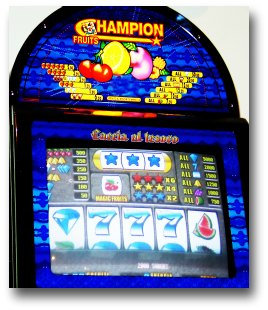
All this recollection came about after I listened to a radio host who was recounting figures showing a significant spike in poker machine revenue in May and June 2012 (up 10 and 7%) across Australia. And in the same breath he reminded listeners that this coincided with cash payments to households from Federal government as compensation for cost of living rises from its introduction of a carbon price.

Now, of course, the radio host was smart. He didn’t imply or even hint that there was a causal relationship between the arrival of free cash and an increase in gambling revenue; but merely placing the two pieces of information together was enough.

My own emotions leapt to confirm gross inefficiency and lack of foresight in the government policy frame. Obviously people spent the money gambling.

Back in the classroom I would have berated my students for making the connection that I made. And really there is no evidence that a one-off cash payment to pensioners and low-income households ended up in slot machines, or even that some of it did.

Except that 10% of monthly poker machine revenue is roughly $100 million. This is a tidy sum and $500 more than usual in each and every poker machine.

Given that roughly 600,000 Australians play pokers machines weekly, that $100 million will be around $167 each.

The cash payments for families were $100 per child and for pensioners $250.

Chance is a fine thing.