More on forest loss

A good friend of mine Alex Nimz who has been devoting his considerable intellect and energies into the development of REDD+ projects in Asia made an interesting observation on my Forest loss post.

Alex suggests that when the western economies converted their forests to agriculture, the products were distributed locally, and economic benefits from agriculture were also kept locally. In many countries were REDD+ is being trialled, the capacity for agriculture development is imported, would-be agriculture products are exported, and most of the economic benefits flow back overseas to the investors in the projects. Consequently from the perspective of a customary landowner of primary rainforest, the opportunity cost of REDD+ is quite low because clearing and development of agriculture does not represent a great economic opportunity locally. Instead the REDD+ opportunity allows them to participate in stewardship and other activities that match their existing capacities.

I agree with this analysis. If the locals take the agriculture development route in the modern world of international markets, not enough of the production stays to stimulate a local economy. Only for me this doubles the twist because I am not sure that locals perceive the opportunity cost as low.

Ask an African from the village if he wants a mobile phone, a BMW and sharp clothes and he says, yes please. In other words I suspect there is an innate human urge to have more, wherever you come from and at whatever level in the economic game you start.

And a forest converted to agriculture would always seem like a start.

A future economy

Over the past 120 years ago the have been an average of 114 million sheep grazing on Australia paddocks producing wool and meat for export. In 1970 the numbers peaked at 180 million. Today there are still 72 million sheep but there are also mines making Australia the 2nd biggest global producer of iron ore and 4th biggest producer of coal. Australia the country has done very nicely out of the natural resources of the world’s largest island.

In time the Australian economy will need to make money from something other than natural resources. This is a significant reality for a society that was created on the back of the sheep and now rides high on coal trucks and ships laden with iron ore.

“No worries, mate,” some say. There is plenty of time. There will be generations of demand for those salable mineral resources from the 4 billion people who still don’t have a washing machine but would dearly like one.

Plus we could always go back to sheep. For soon there will be 10 billion humans to be fed and we have all that wet and wonderful land in the north to turn into a food basket.

I joke not. The latter idea is under serious consideration by the right leaning Federal opposition party. Equally there are those who would see remaining forests in the east paved to provide the living space for 100 million.

And maybe that is enough. There could be another 100 years of wealth in natural resources grown on and dug up from the land and immigration to provide local customers who will buy houses, white goods and visit air-conditioned shopping malls.

But I would think we need something else; at least a couple of alternative sources of external income. Not least because there will be a need to find something for everyone to do. Else the nation becomes a handful of miners and hi-tech farmers supported by millions of shopkeepers (or, more likely, couriers for online stores) and civil servants. And not everyone can be those; and already 3 out of 4 Australians in the workforce are paid for delivering a service of one sort or another.

So what would the else be?

Presumably something that the people are good at, have an aptitude for, and makes sense economically. Sport perhaps.

Commentators in the US have asked the same question of their nation. One of their answers is for the US to drive the technology revolution needed to shift our energy supply away from fossil fuels. They have capital, smarts, institutions, and the all-important entrepreneurial spirit. That they are being left behind in this by China and Germany also supplies plenty of motivation.

Australia lacks the scale of entrepreneurial spirit and risk capital to make innovation become a serious earner. Sole trading we can do, but a desire to build empires from small beginnings is rare. Consequently, the risk capital that runs at close to 10% of commercial investment in the US barely makes it to 0.1% in Australia. This lack of support requires that most innovators with a big vision must find what they need overseas.

So what does Australia have? What it has always had; abundant natural resources.

It makes sense to use the vast landmass, the myriad animals and plants, the minerals in the earth and become a regional, even global, breadbasket. Not least because Australia does have smarts, capital, infrastructure and the experience to overcome the significant practicalities that such a mission presents.

Only water, nutrients and labour are in short supply. Land must be managed carefully to avoid soil degradation and salinity. There has to be a careful eye on the changing weather and an ability to drought proof agricultural production.

Australia has a well-developed system of regional natural resource management, generations of farming experience, research and innovation capacity, a world-class tertiary education system and an emerging culture of prudent agriculture epitomized by the Landcare movement. It has what it takes.

This is not a proposal for turning the tropical savannas into laser leveled rice paddies, at least not everywhere, or to continue with meandering livestock left to their own devices and rounded up once in a while for market. This is a call for a radical change to agriculture that will make it into a smart, sustainable production system that accounts all production costs and harmonises output to the capacity of the landscape. In short, to create a totally new way that requires the engagement of everyone.

Why not do it? Create a robust economy on sustainable use of natural resources.

Green has moved on – it’s no longer about the environment

A flowerFed up and frustrated Green has ended her long-term relationship with environment  and moved on.

We have all seen how Green used to jump out of bed and dance along on the promise of great things. There was a spring in her step and a focus on what needed to be done to better her man.

Green could look at Environment with that sense of knowing born of a lover’s pride.

But for some time now it seems that the buzz had gone. The relationship had clearly lost its spark and begun to disintegrate. The rumour is that it is all because Environment has let himself go. He has been binging to excess, giving in to his mining and agricultural mates, and failing miserably to be romantic.

Insiders say the whole relationship has become quite spiteful.

No longer able to tolerate the angry arguments over resource use and pollution, beaten down by endless rhetoric and false promises, tired of the need to put everything on the line, it’s ended. Yesterday, Green walked out.

Not one to linger, Green hit the clubs and was seen with her Mercedes owning nemesis we know as Economics. That slick Rick famed for drive, determination and dirt. Whilst there are numerous paparazzi photos that suggests they were more than chummy in wee hours, it seems that Green’s new beau is actually the trend setting global bachelor Climate.

This reporter has tried to get an interview with the happy couple without success, but sources close to Climate claim that it was his new-found warmth that has made him more attractive. More likely it is his inevitable breakup with live-in partner Change that tipped things in his favour. Whatever the reason, Green is smiling again and we wish her well.

Environment did not take our calls.

Buying up the land

Land has always been an asset. If you control land you can live on it, grow food, exploit other natural resources on or under it, and even charge people for passing through. Land makes money. We didn’t call the old money upper classes ‘the landed gentry’ for nothing.

What we choose to do with land depends on its potential and the owner’s ability to realise that potential. Assuming, of course, the owner recognises the opportunity.  In turn opportunity is about where the land is and what other people want either from it or from what it can produce.

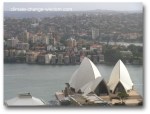
A hectare that overlooks Sydney harbour to the opera house might have been used to raise sheep 200 years ago before there was such an iconic view. Not even the most recalcitrant planning officer could block development of dwellings on such land today. It simply has orders of magnitude more value as a place for dwellings than as a paddock.

Sheep production will not suffer for a few hectares given up to buildings. Grazing properties in Australia cover more than 4 million km2, more land area than India and seven times the size of France.

Nevertheless the Sydney Morning Herald recently printed a story with the following opening line: “FARMERS fear a new rush of environmental plantings for biodiversity and carbon offsets will accelerate the loss of land for food production”.

The story was about mining companies, energy utilities and investment banks buying up land, often through carbon trading companies, to plant trees that will become biodiversity and carbon offsets under the Australian governments Carbon Farming Initiative.

Much of the land purchased is degraded or marginal with limited production potential – a gentle way of saying uneconomic. The new owners have trees planted and account the carbon that these plants pull out of the atmosphere as they grow. This they can register as credits to offset their obligations to purchase emission permits.

Under the carbon accounting rules the new plantings are expected to be “permanent”. That is they must persist long enough to count as emission reductions on the greenhouse gas balance sheet.

An offset planting is not a plantation or production forest. There is no mechanism to allow for later use of the timber resource.  They are carbon sinks, soaking up CO2 from the atmosphere, and providing habitat for any number of creatures that were under pressure as a result of land clearing.

The green end of town is happy indeed. A good thing you would think.

Farmers and their advocates are less enamoured. The prospect of losing large tracts of agricultural land sends a disturbing message to a community already worried by drought, flood, pests, a strong currency and uncertain terms of trade. Then there is also the buy up of productive land by foreign entities, both companies and sovereign states, looking for food security at home.  More land going out of our control.

With this kind of reporting it is a small psychological step to thinking that the land is being appropriated from under our feet creating a threat to a 200 year old way of life.

This will not happen. Even at their maximum extent offsets will be a tiny percentage of the total land area. After all it takes a lot of plantings to cover an area the size of India. However, the reality is that there will be questions asked of land use in the coming decades. We will need more efficient production, regrow vegetation for its carbon value, pay more attention to conservation efforts and be smarter about water use. There will be changes. And this is what the reporters latch onto. Tradition will not be enough to guarantee persistence of the current use everywhere. We will find new ways of making the land productive. Like the plot of land across from the Opera House values will change in ways that make alternate so attractive that change is inevitable.

And in the shakedown, who owns the land may be less important than what is done with it.

Staggering numbers

It is a tick over 1,900 km from Sydney to Melbourne and back again. Two full days of driving are needed to cover this distance if you keep to the speed limits.

Imagine each side of the road lined with oil tanker trucks parked end to end in one giant parking lot. Each of the 98,000 trucks is roughly 18m in length and is carrying 34,000 litres of crude oil.

This amount of oil, roughly 21 million barrels, is the amount of oil burnt in America in a single day.

Two-thirds of this vast amount goes into the engines of cars, trucks, planes buses and trains whilst the rest goes to heat buildings and manufacture chemicals and plastics.

OMG those Americans!

Well, hold on.

Australia uses around 950,000 barrels a day or a line of trucks 60 km long.

Hah, that’s nothing, won’t even get you across the Sydney basin.

Except that in less than a month there would be enough trucks to park along the road to Melbourne and back.  Just like the Americans.


Can we have sustainability?

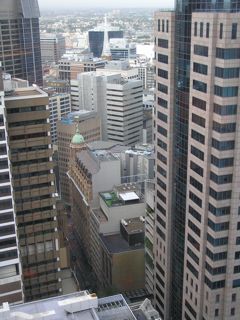
Sydney at four million inhabitants is a moderate sized city by modern standards. It is a similar size to Phoenix, half the size of Chennai, and a suburb compared to the 34 million inhabitants of Tokyo.

But Sydney is plenty big enough to have transport problems. The arterial roads that feed into the harborside CBD are mostly modern freeways, with tunnels and six lane bridges, but they just cannot handle peak flow. Smart commuters travel on the train.

One bonus of train travel is that on the days when you forget your ipod you get to hear people chat. A young couple sat ahead of me on one such day and discussed water.

“No we can’t.”

“Why not” said the husband.

“Those things just spray you with drips that don’t even get your hair wet. I need to get my hair wet.”

“What about the water crisis?”

“What about it?”

“Here, the dams at 39.2%”

It was true; there in the black and white of the morning paper ‘Dam levels at a record low’.

Sydney relies on water storage in a major dam, Warragamba, and the rain sometimes forgets to fall in its catchment in the Blue Mountains some 80km inland from the coast. The significant drought that began in 2006 and broke three years later forced water restrictions on all domestic use. To augment supply and reassure consumers there was drawdown of groundwater together with pumping from catchments further afield. And then, just to be absolutely sure, a desalination plant was commissioned and constructed.

The husband pressed his point.

“If only half the residents of Sydney took a shower this morning that’s two million showers,” he said.

“Ah, you want me to sit next to someone who hasn’t showered. Gross.”

“No, if they all showered for a minute less than usual they would save ten litres a minute, that’s 20 million litres saved.”

He said 20 million as though it was a large number and it certainly sounds impressive. The water from a minute of 2 million showers is 20 megalitres, enough to fill 30 Olympic sized swimming pools, provide 2 million toilet flushes or irrigate several hectares of winter wheat.

“I don’t care if it saves the planet I need a real shower.”

“It would help,” the young man said with hope in his voice.

It is easy to imagine a similar discussion over all sorts of conservation actions that can be done around the home. Recycling kitchen waste for example. All it requires is a sealable tub on the kitchen bench.

“But it smells and clutters up the place, get rid of it. And I hate those ants.”

Yet even in an average household it is easy to generate 10 litres of apple cores, vegetable peels and melon skins every week. Then if everyone in the street did it, say thirty homes, then we might see many tons of green stuff that the garbage men would not have to truck, saving fuel and space in the landfill for the garbage we cannot recycle.

There is a 60 litre black plastic bin in my garden that receives all the kitchen scraps. Every now and then there is a layer of brown leaves added and a bucket of water from the washing machine rinse cycle. All those apple cores and potato peelings decompose readily so that the bin is never full, even in winter. The magic of entropy facilitated by the military style operation conducted by decomposer organisms keeps the breakdown ahead of the household ability to generate waste. In spring the material under the bin is carbon rich compost ready to start off the vegetable patch.

If every second household in Sydney did this then, over a few years, millions of tons in greenhouse gas emissions would be avoided just by not having to shift the waste into landfill. There would be issues around nitrogen runoff into remnant vegetation patches from gardens now replete with green manure, but it is food for thought.

These sustainability actions are all good but surely we can do better. It would be great to do more than change the light bulbs, install a low-flow shower head, manage the compost to help build up the carbon in the stony garden soil, recycle the gray water, install solar panels, grow vegetables and any number of household behaviours for sustainability. Perhaps we could become self-sufficient.

The reality is that there is little prospect of genuine self-sufficiency for most of us. Even with half a hectare of yard and the compost going great guns, most of the vegetables I grow end up feeding the wildlife. There is greenery but not enough to provide for the family. The household members are also used to vigorous hot showers, power on demand, perfect fruit and veggies, the air conditioner in summer and the fireplace lit when it gets chilly.

No longer do we sit in front of smoky coal grates in high backed chairs with wings to keep the draft off our necks. We are acclimated to an even twenty something degrees wherever and whenever we happen to be. This level of comfort has sensitized us to the point where we really feel deviations from our comfort level, not that a few degrees colder or hotter would have any affect at all on our chance of survival.

We have climbed the hierarchy of needs yet, in our minds, we sit as though we are still at the basal level where deviations from what feels safe have the power to upset us.

Does this mean that westerners are desensitized to the problems we have in the environment? Not totally. The media runs stories of environmental challenges and energy saving bulbs are sold in supermarkets. There are energy use ratings on white goods and grants to install water saving devices or solar heating systems.

In Sydney, the Inconvenient Truth made it onto the most watched movie list for a few weeks despite being shown only in selected cinemas; school kids prepare assignments that help them learn about water, land and wildlife challenges; market surveys put the environment high on the list of issues that decide elections hot on the heels of taxes, education, health and the military. Yet whatever we say people still want their needs met. This is their priority.

What we must accept is that our living environment has changed. For better or worse we are sensitized human beings. Most of us really would struggle to survive in the wild and this puts very different parameters on sustainability. Now we must sustain conditions in narrow comfort bands, supply only certain food types and ensure a high level of creature comforts.

The exchange on the train said it all. Not in the words, but the incredulity in the woman’s voice and the despairing logic of her husband.

“Ah, you want me to sit next to someone who hasn’t showered. Gross.”

Sheep

There are 67 million sheep in Australia. This is a lot of sheep, roughly 3 for every Australian resident. Ten years ago there were enough for 6 per person, a small flock per household.

Together with cattle, the current herd grazes across 430 million hectares or 56 percent of the continent.

If averages were a useful thing to quote, then each sheep might have 6 ha each, many times the area of the average suburban housing lot. It would seem that we are happy enough to let livestock roam.

Time will come when we will rethink this decision.