Missing Balinese wildlife

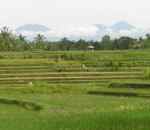
Bali countrysideI have just been to Bali, the tourist capital of what used to be called the East Indies and now part of Indonesia.

I was one of around 2 million visitors that arrive each year to sample the hospitality, culture and warmth of a tropical island that is home to 2.5 million Balinese.

Bali has hotels for every budget, warm oceans, surf beaches, culture, cheap eats and some of the best value for money massages on the planet.

I was amazed at the dexterity needed to guide a scooter through the traffic, marveled at the skill of the many artisans and enjoyed the barbecued seafood served on tables stretched out in rows across the beach.

What I missed was wildlife. Everything was absent. Sure the tourists ooh’d and aah’d at the long tailed macaque’s that reproduce in profusion in monkey forests.

I saw one hotel guest jump at a gecko on a wall.

I looked carefully and spotted a sparrow in a tree and some herons in the rice paddies; but that was about it.

In an essentially rural society I figured that humans do not need industry to reduce biodiversity.

M

A wicked conundrum

A colleague of mine came to a meeting visibly shaken. He had just received a phone call to say that one of the union members he represents had been killed. A dead tree had fallen onto him.

The deceased man was a forester who had been about to begin a harvesting operation. It was a tragic accident.

Although occupational health and safety (OH&S) regulations allow for the removal of dead trees from forests to reduce the likelihood of similar fatalities, it would seem impossible to eliminate all risk to operators felling trees. Trees are large, unwieldy and, in Australia, many species are prone to losing branches and bows without warning. Yet when a person dies there is renewed pressure to tighten regulations.

However, there is a counter pressure. Many mammal and bird species in Australia rely on the holes that form in standing dead and large trees as roost and nest sites. Some of these species are rare and some of these are endangered. The retention of at least some of the larger and standing dead trees is considered a conservation imperative. Separate to those on OH&S, other acts of parliament exist to protect rare and endangered species that inhabit dead trees. Regulations in these acts limit the removal of standing dead and large trees.

What do regulators do with this mixed message?

  • Allow all dead trees to be removed to ensure human life is preserved.
  • Keep the dead trees and force workers to accept the risks.
  • Go away from mixed land use and assign areas to either forestry or conservation and only have dead trees in designated conservation areas.
  • Retain the trees for conservation in all areas but minimise the risk to the foresters with better training, equipment and access constraints.

When the law overlaps and when different government departments administer the regulations, it is not easy to come to a compromise. In the end we lean toward risk management, preserving human life first. We regulate to remove dead trees wherever there is risk and limit retention to the conservation estate. And this is understandable.

We fix the conundrum, but we unwittingly perpetuate the misnomer that conservation happens only in reserves. It doesn’t. It happens everywhere. Soon we must learn to manage whole landscapes, to protect the forester and the tree hollows. Then we will see the old laws and regulations replaced by new ones that promote rather than restrict.

Mark

Is it a weed?

Recently, I spent a night in the bush. A cabin on a farm provided nominal shelter, as humans had not used it for a while. Nature was in residence with weeds making their way across the paved floor and more rodent and bat poo than seemed healthy.

After a little time sweeping out, we took a stroll down to a nearby creek in the hope there was a good swimming hole. A dead fish lying belly up put us off the best spot, so we cooled our feet in the running water near the bank.

As we sat and contemplated we grabbed handfuls of wild blackberries.

The spot was shady, the water running free and the berries as sweet as great-grandmas jam.

Small insectivorous birds were flying in and out of the blackberry thicket, happy to find cover and foraging space.

We sat for half an hour in that idyllic spot. The conversation turned to why the conventional conservation wisdom would have the blackberry bush ripped out. For this was an Australian creek and blackberries (the Rubus fruticosus group) are declared a Weed of National Significance with strategic plans for eradication and control.

Meantime, back at home; my wife had purchased two punnets of blackberries form the grocer for $4. I tasted one of these berries from the store. It looked perfect but compared to those by the creek it was bland and lifeless.

Makes you think.

M

Whose interest do we represent?

When I was a kid my parents would take pains to let me know what was in my best interest. This was because they knew. Of course they knew, they were the experienced ones.

Thirty plus years on and I look at my two sons and I have little idea of what is in their best interest. If I don’t understand the motivation for hardstyle techno music that currently consumes my 14 year old, how can I know if it is in his best interest.

Sure I know more about what might harm my kids than they do and can advise, even police some activities. I can also tell them what I found or have seen to be bad for folk, but can I really know what is in their best interest?

I don’t think so because I am not them. I advise against the bad, caution where there is risk, but I can’t know what is best for them.

The other day I was in a meeting where a representative of a conservation NGO made a remark to the effect that “saving threatened species was in the public interest”.

Wow, I thought, quite a claim. My reflex was to react and mount a challenge. How could one group with, right or wrong, a minority view, claim the public interest was theirs? I calmed my instinct and just smiled.

But now I am curious. If I find it hard, or even illogical, to know the best interest of my sons how can I know the public interest?

Makes you think.
Mark