Sounds Crazy #8 | Wild Planet: North America

Fallow DeerWe all know that Sir David Attenborough has cornered the media market on all things natural history. Especially his TV shows that shine with balanced content, unique delivery and cutting edge camera and sound, all combined expertly to let nature show off.

So anyone trying to compete has to find another way.

We have had the ‘awww, so cute’ approach with every second shot a frolicking offspring of something furry. These shows inevitably spill over into ‘animals are so like us’ commentary to anthropomorphize the world and make us all feel safe and special.

Then we have the ‘OMG its so scary’ take. In this version the world is wild with sharks, lions and venomous biting creatures tugging at the dual thrill of fear and courage in the face of it. This is pretty easy stuff to sell given our innate and now everyday aversion to anything not wrapped in plastic. Nature cannot be anything other than scary from the inside of a McMansion.

Wild Planet: North America is a new natural history series that went to free-to-air in Australia recently. The first episode had more than enough cute and cuddlies with images showing but not telling us that bear cubs are still oh so lovable when they ‘smile’ [don’t get me started].

The narrative, however, was more about the courage and tenacity of nature that, even in the face of extreme hardship, always succeeds without any apparent effort — qualities that humans [or more specifically Americans] also possess in abundance.

Funny enough it was almost believable and I can hear the whoopin’ and hollarin’ along with backslapping and sounds of patriotic zeal bellowing from the lounge rooms of the mid-west even now.

So far so good, especially as some of the footage was excellent [camera technology really has made nature more accessible] and included plenty of unedited raw stuff made with tooth and claw.

Then came the crazy part.

The initially subliminal but in the end overt message of the first episode was that all this nature was out there on our doorstep, wild, untouched, and free. It was still all there doing its thing without threat or risk other than from the teeth of a mountain lion.

Of course I may be jumping the gun here and in fact the producers are softening us to make the punch line stark — nature is in great peril and we need to pay attention to it as we sprawl our cities and fields ever wider. Traditionally of course this ‘save the world’ message is saved for the final episode.

Only I couldn’t help thinking that actually they meant it.

Those who coughed up the cash [perhaps card carrying members of the tea party] really wanted the whoopin’ and zeal they engendered to feel secure. The images of wilderness and wildlife were permanent no matter what. We could go just outside our doorstep and capture such images any time we want — there is nothing we could do to ever lessen Mother Nature.

No need to worry folks, she is still wild and free, just like she has always been.

Now that really is crazy.

Natural capital

Okavango delta Botswana.jpgSuppose you are given $100,000 as an inheritance and told to live off it for a year. You are also told not to worry too much because there would be more money from the estate coming your way in the future.

It would be a pretty safe bet that most of us would happily spend at least some of this $100,000 bonus — perhaps a new car, maybe a nice holiday or two.

The cautious amongst us might put most of the money aside for a rainy day knowing that in the real world such windfalls are rare and we would be right not to be taken in by promises of it being windy again next year.

Now suppose that the $100,000 was definitely a one-off with no unexplained windfalls to follow. Receive the capital as a one off and a few more of us might decide to invest it and only spend the interest — invested wisely $100,000 would yield enough return on investment for a nice vacation each year for years to come.

Now suppose that the relative who left the money to you was not quite so well off or maybe there were a few other relatives to share the legacy and the sum bequeathed was $1,000.

It is unlikely that this amount would be spent on shares, bonds or bullion.

More likely it would be absorbed into the current account of everyday life and barely touch the sides.

Now consider an admittedly rare and unlikely situation where the relative was Buffet-like wealthy and left you a more serious $10,000,000.

You could spend all of this in a year but you would be getting quite a lot of ebay deliveries. Even with the attentions of the taxman, most normal folk would have trouble spending the annual interest on this sum.

If the money didn’t go to your head the interest on investment would see you and your family live like kings indefinitely.

All this makes sense. It has been explained many times over and the subtleties consume the days and nights of many a financier.

So here is a question. Why do we ignore all these fundamentals when it comes to natural capital?

We treat natural capital — the fundamentals of nature that supply useful goods and services — as though it were in the $10 million bracket: infinite, and inexhaustible with endless yield.

Admittedly there is some justification for this. Agriculture has leveraged natural capital most efficiently. We know this because there are now 7 billion of us. The mines and drilling rigs still bring minerals and fossil fuels to help us create goods and power with apparently no end on sight… yet.

Only it is just like the $10 million. It sounds like a huge sum for most people. And yet just like the majority of lottery winners, even big sums can be spent given enough profligacy

It is time that we both learn and accept that natural capital is finite and that we should pay the same attention to nurturing its yields as the investment bankers do attending to their profits.

Tatenda Tuku

OliverMtukudziMangwanani, mararasei?

Excuse the apparent jibberish but I am still in the joyous grip of a surreal experience for last Friday I was transported to Zimbabwe the country of my son’s birth without leaving Australia.

How was this possible to be an ocean away not just in my imagination but actually there really and truly, feeling the pulse of that great and troubled nation?

Well it was quite a surprise.

All I had to do was follow my instinct and purchase online tickets from an unheard of website to a gig by the African guitar legend and true poet Oliver ‘Tuku’ Mutukudzi.

It sounded too good to be true scheduled as it was for an obscure venue in downtown Parramatta, the Roxy.

I had hesitated of course as one does when the internet throws up such a rare gem of uncertain truth.  It took me a few days to commit my credit card digits to the ether except that Mutserendende, one of the great mans songs, is the ring tone on my mobile — how could I not trust to fate?

Satisfied by a phone call to the venue that confirmed that ‘yes, Tuku would be playing on Friday’ the bargain was accepted.

Now when overseas artists play in Sydney that for all of them is very far away from home they will have their hard-core fans who flock to fill the mosh pit or at worst pay the big bucks for front row seats. Elsewhere the auditorium will be sprinkled with all kinds of folk: the young ones who only just discovered Tori Amos, the middle aged who are just amazed that Sade is just as stunning today as she was in 1980, a few old folk who have always known good music when they hear it, and the ‘be seen’ folk who needed somewhere to go that night. In short, an eclectic mix.

Not so Tuku.

In the surreal surroundings of an ancient cinema with its high ornate ceiling, overused seats, and flaking paint the audience was almost entirely Shona. It was as if all the Zimbabweans from that most populous tribe who were living within travel distance had come together for a party.

And what a pleasure it was — for if there is one thing that Africa does it is party. Smiles everywhere big enough to save the world, warmth to melt the coldest heart and, of course, everyone dances.

It is one of life’s true experiences to be in an African nightclub when the latest popular number is spun. A cheer greets the first chord and by the second the room is heaving. There is no need for a dance floor because everyone is on their feet where they are, instantly transported by the rhythm and moves to a very happy place

Now I had been telling my wife about this phenomenon of nature for years and had promised it would be high on the itinerary of our long planned Africa trip for she had not witnessed it for herself — until last Friday.

In that cinema now comfortably full with well dressed Africans showing off their unique style the DJ was warming the room for the support act and chose a track popular all over southern Africa in the 1990’s that brought back a memory rush of balmy nights in the silky dust of the Kalahari.

And there it was, instant recognition, a cheer, and joyous movement.

I looked at Milena and she felt it too for there is great power in such collective spontaneity. And that energy grew through the unknown yet lively support act and then with fervor for the legend himself

Despite only having his voice, guitar a bass player, drummer and percussionist, Tuku worked through, with genius that only few have, two hours of his layered songs selected seemingly at random from his vast catalogue.

The people danced, laughed, sang, chatted and most of all smiled.

They adored the performer without any thought for the performance or sound that the critic would have panned for its lack of second guitar, keyboard and female chorus for these give so much depth to his studio tracks.

It was a party you see.

And it was a chance to be back in Zimbabwe without paying the prohibitive airfare and everyone was grateful for it, me especially.

You see I lived in Harare for two years from 1987 in a country still basking in the glow of independence if wary of its future. Career blinkers meant that I did not see all that I should have back then, but Africa is too infectious not to seep into your pores for even in adversity the people smile. And they dance whenever the music moves them with an optimism that is infectious. You carry that joy away with you, hidden perhaps and clouded by the travails of the west, but it is always there somewhere deep within, an unconcerned syncopation that can catch you unawares.

So you can see why I have Oliver Mutukudzi as my ringtone, play his playlists often, and have wept at his lyrics that speak of suffering, courage and humanity even though I cannot translate the words.

And now I also have the privileged memory of dancing with his countrymen for two sacred hours far away from Africa, in the Roxy, Parramatta.

One million people

Runners in City to SurfConsider a city of roughly 1 million people, Adelaide, Australia for example [Calgary, Canada; Bonn, Germany; Tuscon Arizona; or Bristol in the UK would do equally well]

Adelaide has two Australian Football League teams, a pro soccer team, two professional basketball teams, three Universities, a cathedral, numerous hospitals, many shopping malls, around 440 schools, an International airport, and a zoo.

There are over 400 suburbs arranged around a CBD that has high-rise office blocks that provide a common destination for a metropolitan public transport system includes a fleet of over 1,000 buses.

There are doctors, dentists, lawyers, Artisans and actors; and enough skilled tradesmen to build or engineer almost anything.

In short, Adelaide is a self-contained community surrounded by enough farmland to feed everyone.

Put all the people who live in Adelaide in one place and it would be quite a spectacle. It is hard to imagine what it would look like.

There would people as far as the eye could see. Lay them down head to toe and the line would stretch 1,800 km — 400 km further than a road trip from Adelaide to Sydney.

Stand these people in single file and the line would be 30 km long, similar to the queue at the post office.

Now having conjured the image of so many people in your mind’s eye put them all onto commercial aircraft.

Because 1 million is roughly the number of human beings who are, at any one time, airborne in commercial airliners making vapor trails around the globe.

And we wonder why we have environmental issues?

Bushfire in our back yard | some first thoughts

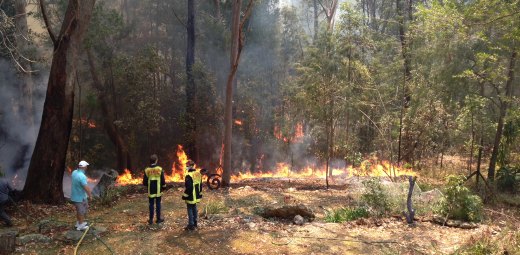
OLYMPUS DIGITAL CAMERAI live in Springwood in the Blue Mountains and we were fortunate to be just south of the horrendous fire front that ripped through on Thursday 18 October 2013 and took out more nearly 200 homes. And I am hugely grateful to brave firefighters and the community spirit that saved all the homes in our street when the fire burnt back on itself on the Friday. The loss of our back fence was an easy trade.

The thing is we were due a fire.

The last one in this patch of bush was in 2007 and the one before that 2001 and any number have been through before then. We had an especially warm winter and a warm, unusually dry and windy spring. And last summer there was an above average wet period in February that the plants used to their advantage. There is nothing exceptional in each of these events, but in combination we ended up with a heavy and highly volatile fuel load. All it needed was a spark and a strong wind. We got that last Thursday.

Bushfire-Banjo-Place-01


And on Wednesday 23rd October 2013…

All afternoon three heavy helicopters have flown over and around our house countless times.  They are ferrying water to drop on the bushfire that has flared again less than a kilometer away.

Illogically the sound is terribly disconcerting.

My ears are constantly reminding my mind of a real and present danger.

Except that it was last Friday that the fire was in our yard, licking its way up the gully to devour our back fence. Dense smoke stacks dwarfed the houses on both sides of the street as tenacious fireman set back burns and hosed their way into the fire fronts saving each property one at a time.

Everyone helped each other without a thought – it was just wonderful to witness.  Courage, generosity, kindness and compassion are words that feel right and yet they are not even close to explaining what it was like.

Today the same fire that nestled in the bush for days is trying to get at another street and the helicopter noise should be reassuring. After all it is the sound of human bravery and endurance, resources being thrown at a force of nature. Whilst logic keeps this thought acute the body reacts to the sound and to the smell of smoke and sets itself on high alert.

Given the option to leave for a safer place, we chose to stay at home today and defend our home should embers be blown our way.

The dustbins full of water on the deck next to me together with the garden hoses placed strategically to spray the perimeter are only mildly reassuring. Is also less brave a choice than it sounds as the prevailing wind from the south-west has sent smoke and any real danger further north.

OLYMPUS DIGITAL CAMERA

What can it mean to have a wildfire too close to your home?

What comes to mind is how privileged I am to live in a World Heritage Wilderness.

Even more so to live in a community that so efficiently and skilfully mobilises emergency services and where people care for each other when it matters.

193 houses were lost in the neighbourhood on the Thursday the closest just a few hundred metres over the ridge so I also feel fortunate and blessed that ours was untouched.

The firefighters, many of them volunteers, were all heroic, tireless and committed. When we needed help they were right there and I thank them all.

Extra special thanks go to the crew of Arcadia 2 who protected our home.


Got any ‘Sounds Crazy’ ideas?

The sounds crazy series on Alloporus has covered topics that bend logic out of shape and makes you wonder if the world is run by the insane…

Take a perusal at some of these and maybe see if you can come up with another, maybe something even crazier.

I am happy to take suggestions or a guest post.

Meantime here is more craziness from the most popular confused Confucius post for September…

OLYMPUS DIGITAL CAMERA

The feature wall

feature-wall.jpg

Apologies to regular readers for the lack of posts on Alloporus in the past few weeks.

As confused Confucius might say “take on renovations only when you are prepared to put the rest of your life on hold”

Good news is that the painting is done, the cleaners are booked in and all that will be left is to wait three months before I get around to that second coat on the patch of cornice that I missed.

Hours with a roller trying to perform the miracle of turning a dark blue feature wall white, is contemplative stuff. It makes for a wandering of the mind into surprisingly reflective places.

I wait variously from the precarious nature of human existence, to the even more perilous prospect of achieving Pincha Mayurasana [Feathered Peacock Pose], pause briefly at the staggering amount of road construction in China, and then to blissful focus on even application of white on blue.

“It is what it is” became more meaningful than ever in those moments.

The recalcitrance of individuals and the crippling inertia of organizations faded away as they should. Not even the necessity of returning to the day job that is full of such frustration was a worry.

So if anyone needs help to return a feature wall to normality, you know who to call.

Contemplation

Venice, ItalyI woke early this morning. It was still dark and the neighbourhood was quiet. At first I thought that blocked sinuses had snagged me awake at an unearthly hour until a kookaburra shattered the silence with a raucous laugh.

It always seems to be the loudest bird that begins the chorus. In Africa its fish eagles that squawk you awake if you camp anywhere near water. In my sleepy Sydney suburb it is kookaburras.

Being an early bird myself, I knew sleep was done, so I propped myself up a little to ease the sinuses and contemplated.

There is nothing wrong with contemplation. As the mind rambles, brushes on the existential, or just chatters along, all that goes on in the brain is made well by even a moment of observation by our true self — the quiet observer all things.

It is a shame that this silent observer is so often drowned out by all our noise that we forget it is there.

In my own early morning quiet I began to imagine the lives of everyone — the almost countless numbers of people that during the day ahead would go about their business.

Those in my street and suburb were easy enough. Almost all of them would be sleeping and coming to the end of another night’s rest in home comfort. My mind’s eye wandered toward the city of Sydney, stretched out on the plain below us as dots of light at this hour. I tried to imagine over 4 million souls, most of them sleeping too. Suburb after suburb of houses, each with one, two or a few folk resting with the doors locked.

Randomly my mind jumped to Haiti, a country on the other side of the world that I have never visited. Why Haiti I did not know for the contemplating mind has a will of its own. There were more people of course, and it would be towards the end of their day, many would be eating and evening meal. I could only guess at the menu other than to let my conditioned imagination suggests there were few banquets.

As you do when contemplating, I asked myself if these people really existed. I have never seen them and can only assume that they were there eating supper. Haiti is labeled on any map of the world and the country will be on Wikipedia lists, so logic says it exists, and by extension, so do the people. And, sure enough, Wikipedia says that today there are 10.1 million people in Haiti, double the number that lived there in 1974.

In the quiet that followed the kookaburra alarm call as my thoughts settled on my imagined Haitian village, I felt the magnitude of us all  — the ever so very many people on earth.

And it was a surprisingly neutral feeling. I was neither scared nor fearful. I did not feel worried, nor was I sad or frightened. Equally I was not jumping with joy at our numerical success. After all, it is what it is.

Many people, living many lives that make more people.

By now the rest of the dawn chorus had joined in as the growing light confirmed the reliability of the kookaburra’s internal clock. The moment passed and it was okay to be worried again, to let my mind chase every petrified thought of lack, and to settle onto a persistent fear for the future.

Sounds crazy #7 | Hidden hazards in the backyard

produce-01This ‘sounds crazy’ is an absolute ripper.

This bottom column headline and grab appeared on the front page of the weekend Sydney Morning Herald this week…

Hidden hazards in the backyard — Families are unwittingly exposing their children to the risk of sickness and even brain damage from lead hidden in backyard soil and paint… 

Fair enough. No doubt there is many an older inner city property that has not been renovated since the time lead was in most paint stock and some of that old stuff is peeling away and ending up in garden soil across the suburb.

Any city dweller knows that cities are not exactly pristine. The air is heavy with particulates from brake dust to builders waste and on a rainy day it washes all over your shoes. It comes with the territory.

The grab continued…

Lead experts fear the trend towards home vegetable patches and community and verge vegetable gardens is also putting children at risk.   

So at a time when all our electronic conveniences have deprived our youth of knowing anything about life giving soil, we must put the fear of god into those with the umph and initiative to get back to sharing produce they have tended.

Thousands of generations of good folk grew vegetables in their backyards. They planted, watered and cared for their crops and then fed their families wholesome fresh food. The extra they exchanged with their neighbors or sold at a local market helping to create the very essence of community that is so central to our wellbeing.

And they did this even when cars were spitting out lead, when the pipes were made of lead and when DDT was the pesticide of choice.

Did those dangers stop them? Not at all, they prospered and went ahead to multiply by the millions. So much so that today we need to double global food production in the next 30 years just to keep up with demand and will need every square foot of productive space we can find.

All I can say is shame on those ‘experts’, university academics with a career to build, and shame on the media for printing such fear mongering [and this time you can’t even blame Rupert].

For heavens sake, growing veggies in the backyard is a good news story.

I just wish the possums would stop eating mine.

Pinnacles of knowledge

Teaspoon of soilSuper-specialization by individuals sets humans apart from all other species — more so even than language and technology.

No other species has a system where individuals can first figure out what their innate skills are and then focus on them to train, strive and perhaps one day become the best at them. It is a luxury afforded by taking away the need to spend our waking hours searching for provisions and we have basked in it. The result is extraordinary greatness in every field of human endeavor from art to archery.

Science is fertile ground for this specialization. Given that what we already know about nature is both broad and deep, advances in science require highly detailed understanding and no small amount of technical expertise.

A visit to any modern analytical laboratory will show you that the lab coated ones must be as adept with electronics and computers as they once were with a pipette and petri-dish. They must be highly focused on their topic and their techniques.

We have also had several generations of this specialization. As each generation passes the body of scientific knowledge broadens thanks to the increasing numbers of focused scientists. The handful of Universities with a five hundred-year plus heritage have been joined by thousands more, most of them in the last 100 years. The lab coat manufacturers are doing pretty well

Specialization has also filtered down the academic system. Modern undergraduates no longer enroll in a general science or even a biology degree. They will major in microbial ecology or wildlife management, specialisms that did not exist in times past. The brightest students that progress through the degrees into research and academia of necessity become super-specialists. The best of them climb steadily onto a pinnacle of knowledge that is often so narrow that only one person can stand on it.

This should be good. The body of knowledge is already vast and all the obvious things are known — it takes focus and tenacity to add anything meaningful to the pile. If the system failed to promote specialization we would rarely find out anything new.

And unless the pinnacle is tall, steep-sided and isolated on the plain of human knowledge he, or these days she who scales it would not be seen by everyone else [just because a person wears a lab coat does not mean they are exempt from normal human needs for adulation and success].

Not surprisingly then, specialization has flourished.

The soil biologist

Suppose that you are want to be a scientist and you happen to be interested in soils, specifically in the importance of biological activity for the delivery of nutrients to plant roots. This is a pretty specialized niche to begin with, albeit essential knowledge at a time when global food production must double again in the next 30 years.

This area of interest may seem quite focused yet it has a number of pinnacles. You might choose to scale the one related to arbuscular mycorrhiza fungi, AMFs. These are a specific type of fungi in the soil that penetrate the roots of vascular plants and make it easier for the plant to capture certain nutrients.

It is easy to see that the AMF specialist will soon be so focused that the biology undertaken by his colleagues who study soil nematodes is very different to his.

Techniques wise the soil biologist will also need to specialize. Instrumentation to uncover patterns in the DNA of those AMFs is not the same as those used to understand what happens to nitrogen that these microbes help to fix. It would take training and many years of experience to be able to drive all the necessary machines to be an AMF generalist.

The downside of the pinnacle

A pastry chef might be able to rustle up a passable vindaloo but it is unlikely that he would be familiar enough with the flavor combinations to create a gourmet curry dish.

Similarly whilst the AMF specialist will know more than most about soil biology

his intellectual comfort zone is narrow. Monitoring for soil quality that is in part determined by the activities of AMF, for example, requires skills in sampling design [what to sample, where, when and how often] that are not usually in the toolbox of the laboratory specialist.

Once perched on the scientific pinnacle of AMF DNA the specialist may have a fine view of the plain of soil biology below and in the distance see the landscape of challenges to apply the hard won skills. Only to do anything about them requires descending once again to the plain of generality.

At this point Sir David would whisper commentary about lemurs not wanting to cross the bare soil between isolated trees and having to first pluck up courage and then dance across the dangerous open space to the safety of the next tree.

You see the point. Complex environmental challenges need the knowledge and skills from many specialisms. In an ideal world this would mean gathering up the requisite specialists into a team and setting them to work.

Our human made world is never ideal and we are at serious risk of super-specializing our way out of the ability to adapt.