Climate change policy: Does Australia need it?

The other day I listened to a presentation from the CEO of a company in the carbon game. Branching out from bio-energy, this company has developed smart technology to grow algae using the CO2 emitted from coal fired power stations.

It was an impressive story. The algae do what algae do in high-tech plastic bags and convert carbon dioxide to plant material at a claimed rate of up to 800 t per hectare (for comparison average wheat yield in Australia hovers around 1.5 t per hectare).  A quarter of the algal biomass harvested is extractable as vegetable oil and the rest as vegetable protein (dry pellets). The potable water byproduct is recycled back into the bags for the next batch of algae.  The list of salable items that can be manufactured from the algal produce was endless.

If I were an investor I would be muscling my way through the heavy hitters already camped outside the guys office and buy whatever shares I could. Not surprisingly the owners see no need to sell shares in the company to the public.

And the thing was that this particular entrepreneur, with a genuine smile on his face, did not care one iota about a carbon price, greenhouse gas emissions or a climate change policy. Why would he? He had salable products (oil and protein) that a host of buyers wanted, and he was making them from industrial waste (CO2) that everybody wants to get rid of. He had found a great win-win. And when that happens it’s all good, including in this case a powerful combination of greenhouse gas abatement and mitigation with the bonus of food production.

No doubt you are thinking, ‘Oh, but there has to be a catch’. And maybe there is in the scalability, sources of nitrogen, finding enough land next to power stations or many others we haven’t conjured up. The point is though, that the combination of smarts, entrepreneurship and willing investors can be a powerful tool when let loose on a problem.

If business actions can fix the climate problem, then why do we need policy? The reason is this. There are only a few courageous entrepreneurs and, especially in Australia, even fewer risk taking investors. This means that the rest, the mainstream who are risk averse and a tad timid, need help to solve the problem; and this is the role of policy. For policy can provide support, encouragement rules for a social climate that help us help ourselves.

Since the Australian government dumped its own Carbon Pollution Reduction Scheme, an emissions trading solution to what Prime Minister Rudd has called ‘the greatest moral challenge of our age’, the media has talked of backflips and the taxi drivers have expressed their disappointment at broken political promises. All the people I have spoken to are just a bit depressed at it all.

These reactions to political weakness are inevitable because we do need policy, we need it to give us confidence and in the case of climate change policy we need it now.
The hip pocket

A young colleague recently claimed that her generation has great concern about environmental ills. She thought that her y-generation all have deep feelings about the woes of our world. They want something done about it, especially climate change. She claimed that late alphabeters will be angry at any government that promised action on climate change but then reneged as the Australian government has just done.

“Are you sure,” I said, ‘won’t they vote with their hip pockets?”

“No they have all they need,” she said, “I mean we all have food and shelter and with those needs met we want to do the right thing.”

I believed her, at least the intent part. And I am sure it is how she feels herself having moved her own career path away from high finance into an environmental company. Unfortunately I don’t think that we have the freedom from basic needs that our apparent wealth implies.

It may be that most westerners are well fed, sleep in a bed, have a wardrobe, watch TV and take the occasional holiday. And it seems that all primary needs are covered (yes, it is true the TV is now a basic need according to the UK social services) and, therefore, higher values should mature. We should think about values beyond the basic, including care for the environment.

But this wealth, that supplies all the basics and more, has not given us emotional freedom. We are not free to think of higher things because we are still struggling to keep our wealth coming. We are locked into long hours of work to pay for large mortgages, excess food and more clothes than we could ever wear. And as we are at work we have to pay for someone else to look after the kids, and someone to do the washing, to mow the lawn and so it goes. In the end we have to keep the kids at home until they are middle aged to help us pay for it all.

And what if we just stopped? If we gave it all up in order to be enlightened, then the monetary flows so essential for our economies would stop as well. Our material world would collapse in a heap. And, well, it just can’t happen. Back to work we go, stressed to the max, a hand checking on the hip pocket.

Let us hope that I am just a cynic, a product of a different generation, and that the youngsters really do have a sense of higher value – although anyone who has seen a Lady Gaga music video may have to search hard for higher value.  Let us hope and believe that these youngsters will vote on their beliefs and give with their voice to help change the way we think.

Let us hope that they won’t vote with their hip pockets.

Greens

Recent raucous debate on climate change In the Australian parliament resulted in the Greens, a minor party with environmental leanings, voting twice with the opposition against a Climate Pollution Reduction Scheme (CPRS) policy proposed by the government.

The CPRS legislation was an emissions trading scheme that would leverage market forces to drive behaviours of consumers and investors to cleaner more efficient energy options to lower emissions. I say ‘was’ because the policy option has just been shelved. This decision means that climate change will not be a central item in either government or opposition campaigns in the upcoming election, handy for both major parties.

And why did the Greens oppose the legislation? Because, they said, it did not go far enough. It was too weak and too kind to the heavy polluters. The reduction targets were a joke, so the rhetoric went.

This is a curious position for green politicians to take. The CPRS was an attempt to restructure the way we generate our energy and a mechanism that would money would be made from climate change adaptation measures. In other words legislation that would push more funds towards environmental benefit than any previous conservation measures in the country’s history. Instead there is no climate change policy and no serious debate on climate change legislation likely for at least another two years, possibly longer. And without a policy there is no emissions target at all.

Someone once said that the perfect can get in the way of the good. After the excesses that brought us anthropogenic climate change, it would be irony indeed if the desire for excess in redress scuppered the good.

Missing Balinese wildlife

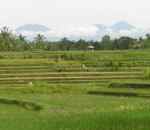
Bali countrysideI have just been to Bali, the tourist capital of what used to be called the East Indies and now part of Indonesia.

I was one of around 2 million visitors that arrive each year to sample the hospitality, culture and warmth of a tropical island that is home to 2.5 million Balinese.

Bali has hotels for every budget, warm oceans, surf beaches, culture, cheap eats and some of the best value for money massages on the planet.

I was amazed at the dexterity needed to guide a scooter through the traffic, marveled at the skill of the many artisans and enjoyed the barbecued seafood served on tables stretched out in rows across the beach.

What I missed was wildlife. Everything was absent. Sure the tourists ooh’d and aah’d at the long tailed macaque’s that reproduce in profusion in monkey forests.

I saw one hotel guest jump at a gecko on a wall.

I looked carefully and spotted a sparrow in a tree and some herons in the rice paddies; but that was about it.

In an essentially rural society I figured that humans do not need industry to reduce biodiversity.

M

Steady as she goes for carbon emissions

actual-emissions-projections2

I love this graph.

It comes from the Australian governments economic modeling of their Carbon Pollution Reduction Scheme (CPRS), the work by their economists that helped them to decide on how to configure the government effort to reduce carbon emissions.

Bear in mind they have set themselves a target of reducing emissions to 60% below 2000 levels by 2050.

That is to reach around 200 Mt CO2e.

What the graph tells us about Australian emissions is this:

  • At present we are at a tick under 600 Mt CO2e
  • If business proceeds as usual with no mitigation (black line), emissions rise steadily until we hit 1,000 Mt CO2e by 2050
  • In the CPRS scenario actual emissions (dark blue line) do not decline at all until 2030
  • The light blue line, that is the purchase of permits from overseas, parallels the business as usual line.

So this CPRS scenario projects is that actual emissions stay as they are now and Australia buys its reduction target through the purchase of overseas credits.

The government is saying that, economically, they need to keep things as they are, change only slowly, get more efficient to avoid increasing emissions too much and buy our way to the target reductions.

Or put another way. Despite great sunshine, wind a plenty, tidal and geothermal options Australia will continue to rely on coal for its energy.

The politicians will parade their CPRS as fantastic green policy, the way to preserve the environment, keep jobs, and deliver peace of mind over climate change.

The trouble is that they are colour blind and must have very sore behinds from their vantage point on the fence. Why act now when you can act later.

Don’t you just love them.

M

Spending on the environment

The Australian government budget outcome for 2008 reported an expenditure of A$280 billion (US$180 billion at time of writing) or 25% of GDP.

Divided equally, 280 billion would give each resident of Australia A$13,340 and that was, more or less, what happened to the money.

Welfare, health and education combined to account for A$161 billion or 58% of the expenditure. People accept taxes as a necessity of life partly because these things, along with infrastructure, defense and other primary needs are best paid for collectively.

It makes sense to also pay for fundamental services such as clean air, fresh water, food and shelter. The food we eat and the roof over our heads we pay for after the taxman has taken his cut. What about paying for the rest?

The government spend on the environment is difficult to estimate. There is no line item in the budget, so we must estimate for the following:

  • A3.8 billion on agriculture, fisheries and forestry
  • A$3.2 billion on recreation and culture
  • A$16.6 on the public service

Let’s be generous and say this adds up to A$10 billion or 3.6% of the federal environment spend. That’s A$10 billion for a land area of 7,692,024 square km.

This rounded amount, A$10 billion, is a curious figure. It suggests that we can get clean air, clean water, conservation, and aesthetic outcomes for 21 million inhabitants, plus extensive natural resource exports, for $13 per hectare.

“Ah,” the skeptic would interject, “what about the monies spent by the state and local government, not to mention the huge amount of input from farmers, resource managers and community groups?”

Fair enough. Let’s double the amount to capture the contribution from all pockets in the government purse – $26 per hectare is now more than the defense budget… by $4 per hectare.

It makes you think that from the government perspective at least, the environment is free.

Mark

A wicked conundrum

A colleague of mine came to a meeting visibly shaken. He had just received a phone call to say that one of the union members he represents had been killed. A dead tree had fallen onto him.

The deceased man was a forester who had been about to begin a harvesting operation. It was a tragic accident.

Although occupational health and safety (OH&S) regulations allow for the removal of dead trees from forests to reduce the likelihood of similar fatalities, it would seem impossible to eliminate all risk to operators felling trees. Trees are large, unwieldy and, in Australia, many species are prone to losing branches and bows without warning. Yet when a person dies there is renewed pressure to tighten regulations.

However, there is a counter pressure. Many mammal and bird species in Australia rely on the holes that form in standing dead and large trees as roost and nest sites. Some of these species are rare and some of these are endangered. The retention of at least some of the larger and standing dead trees is considered a conservation imperative. Separate to those on OH&S, other acts of parliament exist to protect rare and endangered species that inhabit dead trees. Regulations in these acts limit the removal of standing dead and large trees.

What do regulators do with this mixed message?

  • Allow all dead trees to be removed to ensure human life is preserved.
  • Keep the dead trees and force workers to accept the risks.
  • Go away from mixed land use and assign areas to either forestry or conservation and only have dead trees in designated conservation areas.
  • Retain the trees for conservation in all areas but minimise the risk to the foresters with better training, equipment and access constraints.

When the law overlaps and when different government departments administer the regulations, it is not easy to come to a compromise. In the end we lean toward risk management, preserving human life first. We regulate to remove dead trees wherever there is risk and limit retention to the conservation estate. And this is understandable.

We fix the conundrum, but we unwittingly perpetuate the misnomer that conservation happens only in reserves. It doesn’t. It happens everywhere. Soon we must learn to manage whole landscapes, to protect the forester and the tree hollows. Then we will see the old laws and regulations replaced by new ones that promote rather than restrict.

Mark

Is it a weed?

Recently, I spent a night in the bush. A cabin on a farm provided nominal shelter, as humans had not used it for a while. Nature was in residence with weeds making their way across the paved floor and more rodent and bat poo than seemed healthy.

After a little time sweeping out, we took a stroll down to a nearby creek in the hope there was a good swimming hole. A dead fish lying belly up put us off the best spot, so we cooled our feet in the running water near the bank.

As we sat and contemplated we grabbed handfuls of wild blackberries.

The spot was shady, the water running free and the berries as sweet as great-grandmas jam.

Small insectivorous birds were flying in and out of the blackberry thicket, happy to find cover and foraging space.

We sat for half an hour in that idyllic spot. The conversation turned to why the conventional conservation wisdom would have the blackberry bush ripped out. For this was an Australian creek and blackberries (the Rubus fruticosus group) are declared a Weed of National Significance with strategic plans for eradication and control.

Meantime, back at home; my wife had purchased two punnets of blackberries form the grocer for $4. I tasted one of these berries from the store. It looked perfect but compared to those by the creek it was bland and lifeless.

Makes you think.

M

It is very hot today

It has been hot and humid here for the past two weeks. Even the trees are wilting. Needless to say the media are onto it.

‘Is this heat wave global warming?’ they ask Dr David Jones, Acting Head of the National Climate Centre in Australia.

‘It’s a complex discussion. What global warming does is… it increases the frequency of hot events and decreases the frequency or likelihood of a cold event.’

I wonder how many of us know what this solid answer from Dr Jones means?

Is it hot because of global warming? No, it is hot because it is summertime. And in the Australian summer there is a chance that it will not only get hot, but also that it will stay hot for several days. Down under hot means over 40 degrees Celsius. What Dr Jones was saying is that as the globe heats up, so there will be a greater chance of these warm events occurring.

It is like weighting a coin. Spin a normal coin and there is an equal chance that it will fall heads or tails. Put a little extra weight on the head side and it will fall head side down more often than 50% of the time.

So warming weights these hot events, they are more likely to occur.

Global warming is really global climate changing. Especially change in the frequency of certain events.
Dr Jones did a good job. It’s a tough gig being the person everyone asks when there is a question about the climate.

Mark