What predators do

What predators do

I have just seen a wildlife documentary where eco-tourists out whale watching in Monterey Bay had the experience of a lifetime.

They were on the water hoping to catch a glimpse of migrating grey whales, mostly mothers and calves as they journey along the coast to feeding grounds in the Arctic. Only on this particular day, and for the mother and calf they happened to be watching, the laws of nature were graphically applied.

As the tourists stared on in boats tens of meters from the migrating family a pod of killer whales arrived and began to harass, circle and ram to try and separate the calf from the mother.

This is, of course, what predators do. They predate. Usually on the individual that is easiest to catch or subdue thus giving them a meal that keeps them alive at the lowest risk to their own safety.

On the plains of Africa, lions, wild dogs and hyenas will single out the weakest of the grazing herd – why make things any harder than they already are? Chase down predators, as opposed to those that sit and wait, will benefit from making the chase as easy as possible.

The orcas were persistent. Injuries to the calf steadily accumulated and blood became visible in the water, the reality of the event dawning on the faces of the watchers. For the television audience, the narrator embellishes the visuals with “the calf was being eaten alive”.

Marine scientists, who later analysed footage of the event, observed that it was the younger orcas that took the most active roles in the attack whilst the adult animals held back. “Teaching the youngsters how to hunt”, they concluded – or perhaps leaving the dangerous work to the more agile individuals.

The scientists also concluded that this was “not usual behaviour” or “if it is what orcas do, then we have not observed it” and “maybe it was because of the high numbers of grey whales in the bay at the time”. Or maybe, like the lions, hyenas and wild dogs of Africa, predators rarely pass up an opportunity for lean times are more common than times of plenty.

Whatever the reason, the attack was a prolonged event lasting several hours.

Time enough for the storyline with a happy human ending that is so essential to the modern wildlife movie, as “against all the odds” the grey whales swam towards the shore, reached shallower water and the orcas broke off.

No-one could follow the calf to see if it survived its injuries but the looks on the faces of the tourists interviewed for the documentary left the audience in no doubt. Of course it had survived for the sake of all things decent.

The responses of the eyewitnesses were most intriguing. They went to see nature in the wild where wild things happen by definition, yet they were all shocked, not quite able to accept that wildness includes violence and death. Perhaps if the calf had died quickly and became the meal the orca pod was after the onlookers would have been more accepting of the cycle of life.

Instead, the escape and inevitable pain was, for many, too much. The people were visibly affected.

No doubt a few of them went home to enjoy a t-bone steak.
Subsistence

Lately Conservation International have been asking us all to adopt greater personal responsibility toward nature, because mother nature couldn’t care less about us.

Here is their logic


Fair enough. After all there is evidence for this argument. The previous five mass extinctions saw nature come back bigger and more diverse than before. And in time she will again after the current human-induced one.

Meantime there is a snag in the present.

Around half the people on earth grow most of their own food. These are not the new age Nancy types jumping off the grid or the allotment owners escaping their nagging spouses. We are talking about real life people from Bengal to Benin who have few job opportunities, little money, and no choice but to live off the land.

And today there are over 3 billion of them. That’s more than the entire human population in 1950.

These resourceful people perform miracles on tiny parcels of land. Yams, cassava, peanuts, plantains, rice and the like are tended with the care that comes from nurturing your future dinner. Multiple crops are rotated and intermingled to make the most of the soil reserves and to thwart pests and pathogens.

In some places this form of production is fairly secure. It rains enough onto soils that can give and retain nutrients. And with care families can survive on tiny parcels of land for a long time, often for many generations.

Elsewhere no amount of care can prevent soil depletion. And without money for inputs yields decline or become unreliable. Eventually the soil is exhausted and the farmer has to move to pastures new. This is shifting agriculture and it requires an important thing. It needs land.

If your soil is depleted and fails to grow enough food for your family what choice do you have but to move on.

Many move to the cities or send their youngsters in search of a fiscal solution so no surprise that urban populations are expanding. Even a modern city like Sydney is growing at 2,000 people per week. Meantime Lagos, Nigeria has reached 21 million.

Those left behind must either wait for newly urbanised family members to send funds or find a new patch of land to grow some food.

And this is where the Conservation International message of personal responsibility hits a snag. If half the people in the world will need new land sometime soon they will try to find it no matter how much they want to be kind to nature. None can be expected to curl up on their depleted land and sacrifice themselves.

A billion or more people practice shifting agriculture because they have no choice. Starvation is their alternative. Instead they turn to mother nature. They eat from another piece of cleared forest.

The guilt trip of personal responsibility is meaningless when your stomach is empty and your child is malnourished.


Environmental values | A national park should be a national park

EucalyptusForestMany years ago I was driving along a dirt road in rural Zimbabwe.

We had been following a game fence for several miles, a formidable veldspan barrier between a tired looking patchwork of withered maize fields, goats, and clusters of rondavels out the passenger window, and the intact open woodland of a game reserve on the driver’s side.

Dirt roads allow plenty of time to take in the scenery and I couldn’t help but notice how one of my fellow passengers, a former student recently appointed to the wildlife department as a trainee scout, was so captivated by it. Not the savanna with its prospects of a kudu bull framed by an acacia thicket, an elephant ambling along ready to tug at the sweetest smelling grass tussock, or maybe even a leopard draped across the bow of a marula tree; no he watched with great intent the farmland.

“Which do you like best,” I asked him, “the savanna or the lands?” He looked back across at me with eyes wide, forehead furrowed and cheeks raised and said nothing. He turned back to his left to look out of the window and said softly “the lands”.

It was not the only time during a decade in Africa, that included the great fortune of visits to half a dozen countries, where the locals made it very clear how important agricultural land was to their very soul. Fields and pastures are, after all, the source of sustenance to us all and a place of protection and community. Human modification of the wild and dangerous savanna into safer and more comfortable countryside is the achievement that founded our ongoing numerical and lifestyle success.

In the west we sometimes pretend that the wild mountains, forests and windswept moors are our places of true beauty, but actually we too have quite the soft spot for farmland. Countryside would end up as a more popular choice for most than wilderness. Even the words themselves evoke opposites: cozy comfort aside inglenook fireplaces with a slice of apple pie, or gray skies, damp smells and wind that howls.

Given these deep and innate responses it’s no surprise that there is a conflict over what to do with wild areas. Should we set some aside and then keep out of them to be what they are as unfettered cauldrons for nature? Or should we designate them and, with a calming hand, mollify all that that wildness? After all we are under more pressure that ever to make every hectare of the land productive and available to yield fuel and raw materials for our voracious economic engines.

Australia is slipping into the midst of this conundrum.

After many decades of increasing environmental protection with laws set to slow or stop landscape modification, restrict pollution, and set aside close to 7% of the land [529,380 km2] as conservation areas, change is afoot. State governments in Victoria, Queensland, and NSW are variously allowing areas designated as national parks to be used by recreational hunters, mineral prospectors, graziers and even foresters.

Whatever your politics, hunting, livestock grazing, digging big holes and cutting down trees do seem rather odd activities to allow within a national park. Remember that the majority of these areas are either rugged and remote [part of their initial charm] or unproductive for all the usual commercial things we like to do. Allowing them environmental value seems to make perfect sense.

There is also the important ecological reality that once an area of land is grazed by livestock, or cleared, or a road cut through it, or big holes dug into it, then it will never again be as it was. Our modifications are irreversible.

We can [and should] restore landscape after the effects of our worst excesses but, by definition, we cannot return a landscape to pristine wilderness. All we can do is set areas aside for nature to be and preferably areas that we have not messed up too much already.

Recognition of environmental value, so that each set aside area has meaning, is a really smart thing to do.

Yet in doing so we are at odds with our instinct for the safe place that is productive. We all want to look to the left of the dusty road at the brown stalks of the harvested mealies just as the young wildlife scout did, because at core we are all control freaks. We are desperate to keep the nastiness of nature at bay and make the land safe and productive for our families — something inside says that that wild wood must be tamed. Let’s send in the guns, the herders and the chainsaws.

Only we are better than this. Surely there is enough in us to recognize that we do not have to be afraid of lions or wolves anymore and we can let some small proportion of the planet be close to what it was before we swarmed across it.

And surely we don’t have to go back to the trenches of environmental warfare where passion to protect and equal passion to exploit creates sides that throw dirty grenades at each other and the only winner is the peddler of vitriol.

For goodness sake let a national park be a national park.

Protecting Mother Nature

“We must protect mother nature from our worst excesses” is the headline of an article in the Enquirer section of The Weekend Australian this week.

The tagline “We can raise our living standards without destroying the natural world” introduces an opinion piece about growing human numbers and our deepening psychological motivation to keep up with the Joneses. Two things that are leaving us with stress and putting strain on the environment. And yet the ”wonderland of nature” is still there to us inspire the spirit. Natural glories abound that should garner our respect and “a determination to protect Mother Earth from our worst excesses.”

All good stuff you would think.

There are posts a plenty on this blog and by many thousands of other bloggers saying pretty much the same thing. Hey, it is even the main tenet of my latest book Missing Something.

_

Missing Something | get your print on demand copy from Amazon or download a paperless version Missing Something Kindle Edition.

_

So why mention this piece from the sunday paper? Well, the curious thing is that the article is attributed to Craig Emerson, the federal Minister for Trade and Competitiveness in the struggling Labour government.

Now if the juxtaposition of topic and source doesn’t make you smile, then it is worth remembering that the newspaper is as brown as it gets [being owned by News Limited is a bit of a give away] and is always sticking the knife into anything with a green hue.

Clearly the editor was having a laugh and providing a great gotcha opportunity to catch the hapless minister sometime later in the election year.

It is shameful that the sordid media cycle and political agendas do this to such important ideas. We do need to be more mindful of nature, more concerned about our exploitation of natural resources, and even to take time out to feel the wonder for ourselves.

What the Minister did, apart from being suckered, was miss the opportunity. It is not enough to say that there are now very many of us putting the environment under pressure, we have to confess to our dysfunctional desire to exploit and find the emotional fortitude to think before we act.

Maybe my lesson was to enjoy the chuckle I had at reading a green rant from a trade minister and leave it at that.

NEW BOOK | NEW BOOK | NEW BOOK | NEW BOOK | NEW BOOK | NEW BOOK | NEW BOOK

It is true, I do have a new book that is all about how we perceive natural resources and those wonders of nature.

Check out a description here or better still order a print-on-demand copy of Missing Something from Amazon or download the Amazon Kindle edition of Missing Something right now.

Last chance to see

Stephen Fry is prolific, so much so that it is hard to avoid him. Fortunately this is entirely tolerable for the man is smart, erudite, witty, and has a passion for knowledge that is as important as it is infectious.

I did, however, find one occasion when he might have erred.

An episode of his wildlife series “Last chance to see” was filmed in Madagascar, where the unlikely adventurer went in search of the curious and elusive aye-aye, a type of lemur. The search criss-crossed the island to find the few remaining patches of forest where there might be a sighting, only to finally catch up with one in a coconut palm in a villagers back yard.

Along the way the film crew passed vast swathes of deforested land that clearly left an impression and brought forth laments on the loss of unique biodiversity once the trees are felled.

Much of the cleared land was planted to sisal that grows well in the Malagasy climate and produces a cash crop for farmers. Fibre from sisal is used in packaging in the west that is biodegradable and often labeled as green. The irony was not lost on Mr Fry.

Madagascar produces around 9 million tones of sisal, about 4% of global production, and a seemingly trivial mount in the grand scheme of things.

Surely the unique biodiversity was worth far more.

Not for the farmer, for cash is cash. And if there is, right now, a market for sisal and it is easy enough to grow then it is a profitable use of land. And if it is more profitable to the farmer than an aye-aye, then sisal it is. Not because it is the best use of the land but because, like the rest of us, the Malagasy farmer needs to make a living.

The same happened in Australia. Sheep are not the smartest use of the dry and dusty outback, but at the time there was a market for wool in Europe and wool was durable enough to travel. So like sisal, sheep production was profitable – handsomely so for some on the less marginal country.

The last chance to see is because we all want to make a living and because we make that living from the options available to us. It is hard to make a living from the sale of ecosystem services, or from forest protection or taking people to see an aye-aye; usually far too hard.

What we need to do is to be smart about the available options for making a living so that the one that is easiest does not become the default.


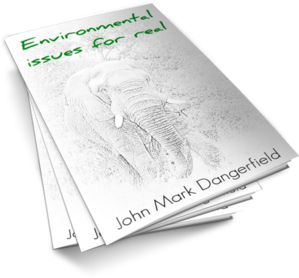
New eBook – Environmental Issues for Real

Not satisfied with haranguing readers of this blog with environmental woes, I have branched out into the dynamic new world of ebook publishing.

Thanks to the amazing people at Smashwords my latest collection of essays on the environmental issues of the day is now available to download in all the usual formats.

Give it a whirl and maybe leave a review on the site. It would be great to hear what you think.

Earthflight

The recent natural history series Earthflight has been interesting to watch.

It follows birds as they fly around the planet, the sort of thing the BBC have done many times. Only this time the idea is to take the bird’s eye view.

And it is amazing where advances in digital, miniaturization and lens technology can take us. Some of the shots would have been unthinkable even a decade ago.

Here is my quick synopsis. Truly staggering photography is spoilt by gratuitous segways (usually to footage of large ferocious animals other than birds) and an inane sales copy narrative. But, hey, not every audience wants to hear Sir David all the time.

The images are so amazing that figuring out how they did it takes the mind away from what the bird sees.

Maybe it is a bit like the experience with flight simulator games. We know we cannot be up in the air because we are holding a game console and so part of us stays attached to that reality. It was similar with images of flight.

My brain said that it was not possible to be 1,000 feet up gliding on thermals across an Andean mountain top and so I did not see the landscape below as the condor might, even though the camera was right there on its back (at least that’s what we are supposed to think is how it was done – I have my doubts).

The footage I remember though was taken in conventional fashion. It was of 40 or so Andean condors chattering around a carcass at the end of a landfill site on the outskirts of Santiago. The narrator tells us that the carcass is provided for the birds so that they are not at risk from the bulldozers that are spreading out the garbage.

It was not so long ago that the Andean condor was classified as an endangered species by the IUCN. It is better off today with a near threatened classification,  but remains susceptible to human influence.

Only here were 40 individuals on a rubbish tip. And this is a good thing?

I’ll leave you to decide.


Zoological gardens

Earlier I posted a somewhat acerbic commentary on gardens.

In brief it concluded that we must have them even though we don’t really use them. I am curious to know if the same thought process could be applied to zoological gardens.

Zoos began as collections, or more strictly, menageries.

Some of the wealthy and idle rich, who often liked to collect things, developed a fascination for animals and started to collect them. The more weird, more wonderful, and wilder the better.

It is not hard to imagine the independently wealthy of the early industrial era with access to travel on the new steam ships and trains wandering off to see the wondrous wildlife of Africa, all hurrahs, what ho’s, and gin and tonics. Once they were done with shooting the lions, buffalo, elephants, rhino and leopards it was inevitable that they would want some in their copious back yards at home

It probably started with taxidermy they had done on all the trophies. But stuffed didn’t quite cut if you could have a roaring lion the other side of the rose garden.

Plus, if you could have a botanical garden, then why not a zoological garden?

So live animals became the go and menageries an inevitable consequence of wealth and travel.

And for a long while these were private collections, places where the privileged few showed off their latest acquisitions to a handful of their friends and guests. Even today, the majority of the exotic creatures held in captivity are in private collections.

Only later did the fascination spread to the general public and the notion that there might be a buck in showing the weird and wonderful to the masses.

If you have been fortunate enough to witness wildlife in the wild then even the best zoo is an anathema. You know there is something about a cage, enclosure, display (the noun choice cannot really hide the reality) that strips the zoo animal of its essence.

It does not matter that most animals are not aware of their situation as captives or that a well run zoo is no more cruel than keeping a dog or a cat at home.

And that even all the zoos in the world hold a miniscule fraction of the extant specimens of all but the rarest species. The number of captives is a blip. What is a few hundred elephants when there are hundreds of thousands still alive in the wild?

Then there are the well-rehearsed reasons in favour; various expansions on themes of

  • education
  • conservation
  • preservation
  • enjoyment value

And these all have merit.

The concern I have is an impression that we have not stretched these themes far enough.  Especially to the importance of maintaining viable wild populations of the species that we like to exhibit.

Whilst I find a trip to the local zoo to stand and admire a zebra, giraffe and even a tubby lion rewarding, I cannot escape this feeling that something’s missing.

Problems for the environment

Here is an interesting thing. Over time, each and every corner of the planet has experienced just about every extreme of environmental condition.

Any given place on the earth will have been really hot, freezing cold, wet, dry, flooded, parched, ravaged by fire, hit by tsunami or earthquake, bathed in toxic gases from volcanic activity and seen the effects of meteorite strikes large enough to send gigatons of dust into the jet stream. It has all happened.

The only thing needed for all of these events to occur in any one place is a very, very long period of time. So long that, although we can write down the length of time in numbers, it is beyond our human perception.

One million years is a yawn in evolutionary time and a blink in geological time.

Certainly when impacts occur, there is a change to the way the environment works. Ecological processes may speed up, slow or shut down for a while and many species may be lost until others arrive more suited to the new conditions.  But over time a new pattern emerges and life continues. No matter the severity or extent of change, disturbance and impact, planet earth has absorbed it and kicked on.

Even when the disturbance is extreme, such as a volcanic eruption sufficient to put the landscape under two feet of caustic ash, there is a period of apparent sterility until rain and the arrival of microbes start to turn the ash layer into something tolerable for bigger organisms. In a few hundred years, a little longer if the climate is cold, the process of succession will return a green mantle to the landscape.

So for the environment, there is no such thing as a problem, only change.

Not only is there change, but change is normal.

Enter Homo sapiens, modern humans, us. Initially we were of minimal consequence to this overall pattern of change. We started out with just a few million individuals spread far and wide in small groups in sync with the grand scheme of predator and prey on the savannas. This arrangement persisted for just shy of a million years, and then, all of a sudden, we figured out novel ways to appropriate resources – lots of them.

In an evolutionary blink we entered an exponential phase of population growth and migrated to all continents. Today we number 7 billion souls, with an additional 8,000 net added every hour (1.3 million per week). Together we appropriate over 40% of the global primary production, modify landscapes everywhere and have even started to change concentrations of atmospheric gases. If Homo sapiens were a species of insect or rodent the description would be ‘plague proportions’.

Still this is not a problem for the environment.

Voracious herbivores have come and gone before.  Appropriation of resources by one species simply leaves less carbon to fuel other species and most plagues pass. For the environment, a plague is just another source of change.

Not so for us. We see change as a problem, a big one if it means that our means of production are compromised, or worse, our primary needs for food, water and shelter might not be met.

Unlike the environment, we have an awareness of self that makes us worry about change. We alter the environment to best produce resources for us and then we want it to stay in that modified state, steadily delivering the resources we require. Except that the very modifications we induce are a driver of change to the ecological processes that support primary production. They are disturbances as severe and widespread as any other.

Not only do we disturb; we have developed a system that allows a handful of us to supply the primary resources for everyone else in return for cash. This has too many consequences to describe here but it means that most of us can bunch up and live far away from the sources of our food and water. We then use energy to move these resources, and ourselves about the place.

As the modified system of production is efficient (initially at least) most of us have time to consider, manufacture and acquire goods that supply our secondary needs – we acquire lots of stuff. These goods use up materials that we have found in the landscape and under the earth. We extract and transform natural resources and further modify the landscape generating by-products as we go.

Even when this goes on for 7 billion humans scrambling for food, water, shelter and wants, the environment does not see this as a problem. It is merely another novel disturbance akin to a meteorite the size of a city crashing into the desert. This is bad news for humans and their needs for food and water but just another bout of disturbance and change for the environment. It will shrug and go on just as it has through deep ice ages, big meteorite impacts and a host of other disturbances that are just the way of things.

So what if there is a mass extinction? This has happened half a dozen times before and over time biodiversity has come back stronger. It will do it again, only maybe not with quite the array of mammal species we have now.

Pretending that the environment has a problem is a deflection. In the long run there are no problems for the environment, only problems for us.