Problems for the environment

Here is an interesting thing. Over time, each and every corner of the planet has experienced just about every extreme of environmental condition.

Any given place on the earth will have been really hot, freezing cold, wet, dry, flooded, parched, ravaged by fire, hit by tsunami or earthquake, bathed in toxic gases from volcanic activity and seen the effects of meteorite strikes large enough to send gigatons of dust into the jet stream. It has all happened.

The only thing needed for all of these events to occur in any one place is a very, very long period of time. So long that, although we can write down the length of time in numbers, it is beyond our human perception.

One million years is a yawn in evolutionary time and a blink in geological time.

Certainly when impacts occur, there is a change to the way the environment works. Ecological processes may speed up, slow or shut down for a while and many species may be lost until others arrive more suited to the new conditions.  But over time a new pattern emerges and life continues. No matter the severity or extent of change, disturbance and impact, planet earth has absorbed it and kicked on.

Even when the disturbance is extreme, such as a volcanic eruption sufficient to put the landscape under two feet of caustic ash, there is a period of apparent sterility until rain and the arrival of microbes start to turn the ash layer into something tolerable for bigger organisms. In a few hundred years, a little longer if the climate is cold, the process of succession will return a green mantle to the landscape.

So for the environment, there is no such thing as a problem, only change.

Not only is there change, but change is normal.

Enter Homo sapiens, modern humans, us. Initially we were of minimal consequence to this overall pattern of change. We started out with just a few million individuals spread far and wide in small groups in sync with the grand scheme of predator and prey on the savannas. This arrangement persisted for just shy of a million years, and then, all of a sudden, we figured out novel ways to appropriate resources – lots of them.

In an evolutionary blink we entered an exponential phase of population growth and migrated to all continents. Today we number 7 billion souls, with an additional 8,000 net added every hour (1.3 million per week). Together we appropriate over 40% of the global primary production, modify landscapes everywhere and have even started to change concentrations of atmospheric gases. If Homo sapiens were a species of insect or rodent the description would be ‘plague proportions’.

Still this is not a problem for the environment.

Voracious herbivores have come and gone before.  Appropriation of resources by one species simply leaves less carbon to fuel other species and most plagues pass. For the environment, a plague is just another source of change.

Not so for us. We see change as a problem, a big one if it means that our means of production are compromised, or worse, our primary needs for food, water and shelter might not be met.

Unlike the environment, we have an awareness of self that makes us worry about change. We alter the environment to best produce resources for us and then we want it to stay in that modified state, steadily delivering the resources we require. Except that the very modifications we induce are a driver of change to the ecological processes that support primary production. They are disturbances as severe and widespread as any other.

Not only do we disturb; we have developed a system that allows a handful of us to supply the primary resources for everyone else in return for cash. This has too many consequences to describe here but it means that most of us can bunch up and live far away from the sources of our food and water. We then use energy to move these resources, and ourselves about the place.

As the modified system of production is efficient (initially at least) most of us have time to consider, manufacture and acquire goods that supply our secondary needs – we acquire lots of stuff. These goods use up materials that we have found in the landscape and under the earth. We extract and transform natural resources and further modify the landscape generating by-products as we go.

Even when this goes on for 7 billion humans scrambling for food, water, shelter and wants, the environment does not see this as a problem. It is merely another novel disturbance akin to a meteorite the size of a city crashing into the desert. This is bad news for humans and their needs for food and water but just another bout of disturbance and change for the environment. It will shrug and go on just as it has through deep ice ages, big meteorite impacts and a host of other disturbances that are just the way of things.

So what if there is a mass extinction? This has happened half a dozen times before and over time biodiversity has come back stronger. It will do it again, only maybe not with quite the array of mammal species we have now.

Pretending that the environment has a problem is a deflection. In the long run there are no problems for the environment, only problems for us.

Stranded assets

My analogue television is a stranded asset. It has perfect picture and sound, plus it has worked this way for years without a flicker. Only now there is no signal for it because we have moved into the digital age.

I could complain. My investment in that analogue TV still had time to run – I expected to get entertainment returns from reruns of the Simpsons for years to come.

Instead I was forced to purchase another asset, either a set-top box to convert the signal or a new digital TV. I chose the second option in plasma. By doing so I wrote off any returns from my stranded asset and made another investment.

And the world did not end.

In fact I did what the economists, politicians and business owners want; I made another purchase.

It would be interesting to see what would happen to the performance of super funds that have invested in fossil fuel power plants if those assets were also stranded. No doubt returns would take a hit, but again, I doubt that the world would end.

We are always told that superfunds, the investment vehicles that take a proportion of our before tax income that in Australia is a compulsory 9% of salary paid by all employers on behalf of their staff, are risk adverse investors. Surely then, they should have balanced portfolios.

Presumably someone has done the sums, but I would guess that the inherent and irrational volatility of the markets is a far bigger hit that the loss of some power stations. And like the banks that chose to lend to the Greek government, they might not be as sure of their returns as they think and they may not get a bailout.

So the noise and bustle over the loss of these assets to accommodate the necessary change to alternative fuels is really vested interest. It comes across as a rail against a redistribution of returns but in really, it is the fear that they might actually have got the investment wrong. That in following what they claimed was conservative investment management they, in actually, were taking a huge punt.

This reality comes for adherence to growth economics 101.

To keep economic growth happening, funds must be mobilized to generate new assets, goods and services. How else are the GDP numbers expected to grow?

In fact we do it all the time. It’s just that we are so under the thumb of the current set of asset holders we forget that as part of normal economic activity some assets will do well while others fail. It is a normal pattern of economic activity. Consequently there will always be stranded assets; and the world will not end.

More importantly we will have to spend to create new assets to allow us to complete the transition from fossil fuels without seeing the end of the economic world.


A future economy

Over the past 120 years ago the have been an average of 114 million sheep grazing on Australia paddocks producing wool and meat for export. In 1970 the numbers peaked at 180 million. Today there are still 72 million sheep but there are also mines making Australia the 2nd biggest global producer of iron ore and 4th biggest producer of coal. Australia the country has done very nicely out of the natural resources of the world’s largest island.

In time the Australian economy will need to make money from something other than natural resources. This is a significant reality for a society that was created on the back of the sheep and now rides high on coal trucks and ships laden with iron ore.

“No worries, mate,” some say. There is plenty of time. There will be generations of demand for those salable mineral resources from the 4 billion people who still don’t have a washing machine but would dearly like one.

Plus we could always go back to sheep. For soon there will be 10 billion humans to be fed and we have all that wet and wonderful land in the north to turn into a food basket.

I joke not. The latter idea is under serious consideration by the right leaning Federal opposition party. Equally there are those who would see remaining forests in the east paved to provide the living space for 100 million.

And maybe that is enough. There could be another 100 years of wealth in natural resources grown on and dug up from the land and immigration to provide local customers who will buy houses, white goods and visit air-conditioned shopping malls.

But I would think we need something else; at least a couple of alternative sources of external income. Not least because there will be a need to find something for everyone to do. Else the nation becomes a handful of miners and hi-tech farmers supported by millions of shopkeepers (or, more likely, couriers for online stores) and civil servants. And not everyone can be those; and already 3 out of 4 Australians in the workforce are paid for delivering a service of one sort or another.

So what would the else be?

Presumably something that the people are good at, have an aptitude for, and makes sense economically. Sport perhaps.

Commentators in the US have asked the same question of their nation. One of their answers is for the US to drive the technology revolution needed to shift our energy supply away from fossil fuels. They have capital, smarts, institutions, and the all-important entrepreneurial spirit. That they are being left behind in this by China and Germany also supplies plenty of motivation.

Australia lacks the scale of entrepreneurial spirit and risk capital to make innovation become a serious earner. Sole trading we can do, but a desire to build empires from small beginnings is rare. Consequently, the risk capital that runs at close to 10% of commercial investment in the US barely makes it to 0.1% in Australia. This lack of support requires that most innovators with a big vision must find what they need overseas.

So what does Australia have? What it has always had; abundant natural resources.

It makes sense to use the vast landmass, the myriad animals and plants, the minerals in the earth and become a regional, even global, breadbasket. Not least because Australia does have smarts, capital, infrastructure and the experience to overcome the significant practicalities that such a mission presents.

Only water, nutrients and labour are in short supply. Land must be managed carefully to avoid soil degradation and salinity. There has to be a careful eye on the changing weather and an ability to drought proof agricultural production.

Australia has a well-developed system of regional natural resource management, generations of farming experience, research and innovation capacity, a world-class tertiary education system and an emerging culture of prudent agriculture epitomized by the Landcare movement. It has what it takes.

This is not a proposal for turning the tropical savannas into laser leveled rice paddies, at least not everywhere, or to continue with meandering livestock left to their own devices and rounded up once in a while for market. This is a call for a radical change to agriculture that will make it into a smart, sustainable production system that accounts all production costs and harmonises output to the capacity of the landscape. In short, to create a totally new way that requires the engagement of everyone.

Why not do it? Create a robust economy on sustainable use of natural resources.

More on the size of the task

Asleep

Asleep

Just about every couple wants to raise children. It is an innate, inescapable need that is hardwired and natural. All organisms have this requirement to make more.

So when couples face biological challenges to natural conception they seek help that in most western countries now includes the benefits of medical technology. In vitro fertilization (IVF) and related fertility treatments have helped hundreds of thousands of couples create a family with more than 3 million babies born since the techniques were introduced in 1978.

Not surprisingly there was much chuntering at the Australian government for removing subsidies for IVF treatment under the national medicare system. Australian couples now have to find up to $2,000 per treatment in upfront cash.

In the short time since this funding change that has saved the government around $50 million, IVF proponents claim that some 1,500 babies have not been born because many people cannot afford the treatment.

Perhaps I am callous because my first thought was that this good news; 1,500 fewer mouths to feed. But then I am obsessed with 8,000 an hour and sometimes find it hard to empathize with childless couples as I have two sons and a step-daughter.

So I mellowed and clipped my own ear for being so heartless.

Then came the kicker. Advocates were arguing that, in fact, $50 million was a sound investment spurned. Eventually the ROI on the $50 million from taxes paid by those 1,500 kids more than justifies the government spending on the subsidy.

This is where I really despair. There can be no rational argument for taxes being a return on government investment because this is not an investment model. Taxes are a way if distributing wealth for services that are financial beyond most individuals, not an investment scheme. Nor are the accounts complete. The environmental cost of 1,500 omnivores living western lifestyles for 80 years would make $50 million look trivial.

The thinking that makes intelligent people (the proponent in this case was a University professor) misquote economic rationalism is scary.  It suggests that we are just more-making machines unable to pull in the logic to understand what we do. The bigger picture eludes us in our quest for advocacy, especially when that finds us on the moral high ground.

In an earlier post I pointed to the size of the task to support 7 billion humans in practical terms of energy, food and water is gargantuan.

Now I am concerned that the size of the task in the human dimension is even bigger if our logic is stuck with the eventual benefit of babies to the tax system.

Size of the task

Opera House, Sydney HarbourIt is desirable to reduce greenhouse gas emissions so that the greenhouse effect doesn’t get out of hand and warm the world by amounts not seen for millions of years.

And should this warming happen too fast for our production systems to adjust, then desire must become an imperative.

Fair enough.

Now let’s consider the size of the task.

If we convert the current global energy use into oil equivalents – that is combine all the coal, oil, gas, hydroelectricity, nuclear and alternative sources and convert the energy we gain from them into the energy we get from a barrel of oil – we use the equivalent of 10 million barrels of oil an hour.

Or, if you prefer, 1,590 million litres an hour.

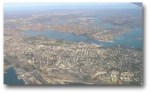
That’s enough to liquid to fill over 15,000 Olympic sized swimming pools every 24 hours or in less than two weeks fill Sydney Harbour, onE of the largest natural harbours in the world.

Plus this number is, believe it or not, getting larger by the day thanks to more people and rapid growth in demand from emerging economies.

10 million barrels an hour is colossal demand. No wonder superannuation funds invest in fossil fuel energy.

Perhaps the next time you lounge with a G&T by a swimming pool, imagine the pool, and a few thousand more, full of oil, and you may glimpse the size of the task.

Our energy demand is simply vast. And thanks to availability, some legacy issues and economics, most of this demand comes from fossil fuels. Partly because of the volume and locked in infrastructure for generation and delivery energy generation is a tough thing to shift, requiring huge investment in alternative sources, a clunky transition period, and unbridled commitment to change.

And because it will take time, any shift will require great tenacity.

It is a big ask and very unlikely that we will take on this transition voluntarily. It will be both difficult and costly. The engineering task alone is staggering: reworking energy grids, distributed generation, engine conversions and replacement. Even the decision to keep the grid or move to a distributed model is a big one.

Then there is the economics. New monies must be found to develop alternatives at scale and monies found to support uptake of what will initially be more expensive energy sources. Then those who have already invested heavily in fossil fuel power risk lost dividends, losing out to new investors. And more of us have invested than we might realize. Superannuation funds that will pay out for many a retirement, like the low risk of traditional energy investments.

The US and Europe are oil and coal dependent because their entrepreneurs and investors backed fossil fuels. New wealth in China, India and South America can be more flexible. They will invest for the far side of the transition, in the new technologies, not the status quo. In 100 years time it is unlikely that the old west will hold the purse strings, which is actually ok, if a little scary for those who have already invested.

Sydney Harbour

So the size of the task is huge, not just because we gobble 10 million barrels an hour, but also because we are not nimble enough economically to act swiftly.

So when the debate on a carbon price uses hip pocket rhetoric, remember the size of the task and know that change to something this big it is not going to be cheap

.

Plan A: Code Green

UK retailer Marks & Spencer’s sustainability statement, 4 May 2007 reads…

Plan A is our five-year, 100-point plan to tackle some of the biggest challenges facing our business and our world. It will see us working with our customers and our suppliers to combat climate change, reduce waste, safeguard natural resources, trade ethically and build a healthier nation. We’re doing this because it’s what you want us to do. It’s also the right thing to do. We’re calling it Plan A because we believe it’s now the only way to do business. There is no Plan B.

I wonder how they are going?

Serious change should be controversial

Back in 1979 when I still needed a hairbrush, I wandered the campus of the University of East Anglia as a sporty nerd. I was the type of student who spent far too long in the library but covered up this flaw with an addiction to team sports and the associated drinking games.

At the time I barely noticed that some of my peers were far trendier. They took to barricading themselves in the University registry – the main administration building that housed the office of the Vice –Chancellor and senior management staff – for days at a time. They would drape sheets out of the windows with slogans denouncing whatever oppression they were feeling. Each time the occupation was for a political, and no doubt, worthy cause that usually involved solidarity (a big word back then).

The longest occupation lasted a week. It was in solidarity with mine workers who were on the receiving end of a crusade by Prime Minister Margaret Thatcher to break the power of trade unions. Both Thatcher and those trendy students were railing for or against a serious change.

Thatcher won of course and sent the country into a market driven phase that arguably brought some prosperity but also eroded much of the traditional political divide and eventually gave the UK ‘New Labour’.

Even nerds got caught up in some of the radicalism of the day, albeit safely. Many of us boycotted Barclays bank because they happened to have a subsidiary of the same name in South Africa. We didn’t realize that undermining banks was probably not all that helpful to the struggle against apartheid but it was a statement we could make on the way to the library. I had my account with the Midland.

Spectacles may be rose tinted when remembering such heady days, but it does seem that, naive as we undoubtedly were, the issues of the time stoked ire and action. Politics was controversial as societies across the world brought about change.

Serious change should be controversial.

It was a big deal to break down union power that itself had come about in a struggle to correct past wrongs in exploiting the workforce; the same kind of wrongs that were fought against in the apartheid struggle.

Today there are still hard and controversial choices to be made, especially about environment, climate and resource use, but we seem to have lost the ire and action that sets up any issue as controversial.

At best we get posturing and egoist rhetoric with an occasional ‘straw man’ to give the appearance of real debate. In short we have argument for the sake of it. Nobody seems to occupy the registry anymore.

As the Harvard philosopher Michael J Sandel puts it:

“When everyone – Democrats, Republicans, corporations and consumers – claim to embrace your cause, you should suspect that you have not really defined the problem, or framed it as a real political question.”

We seem to get this all the time in the age of the sound bite. Noone seems to define the problem.

Rosy or not we need some true controversy back. Real dissention forces us to argue our position from first principles. We must not just react against the alternative view but think it through and become convincing, drawing on as much logic as we can muster.

Do this often enough and we shake hands with our core truths and get to know the problem.

The result will be some argument, perhaps even a demonstration or two, but also some political innovation. There will be thoughts that are outside the narrow middle ground into which the bulk of the west has converged.

A little controversy might help us to find real solutions to the challenge of keeping 7 billion people happy without destroying nature or each other.

Peeled potatoes

In our world of doing it all easy, the latest labour saving option in the kitchen is pre-peeled potatoes.

What an outstanding idea. No need to whip out the peeler and waste time or get mud on your fingers. No more peels to get rid of and litres of water are saved from not having to clean off the grubby bits.

What, you are kidding!

How lazy can we get? It takes no effort at all to peel a potato or two. This has to be consumerism gone mad. ABC radio host Richard Glover thought so and created a funny skit to point out the craziness.

Only there are a couple of things.

First thing. An inevitable consequence of a market mechanism is that new products will emerge. Whatever people will buy, whether they really need it or not, the market will provide. The market will also provide things that they hope people will buy, often well before customers recognize that they might have a need for it. In the end, if a product works for even a few of us then it may be worth manufacturing. Witness, ‘peeled spuds in nitrogen’.

Second thing. There is always an opportunity for more efficiency in they system. If the supplier of the potatoes also recycled the peels into compost, this would be useful second product from the potatoes. Very few of the customers would do this and even if they did there would be no scale benefit.

We are at the stage where every nutrient and kilo of organic material that goes back into our agricultural soils is worth the effort given that fossil fuel based fertilizers are rapidly becoming another of our limited resources.

Our system of resource use is so bloated that there are efficiencies that will help our sustainability just about everywhere. All we have to do is look. One of these efficiencies, conversion of organic waste into fertilizer, will become commonplace. As will novel ways of doing it.

The idea that the recycling happens before the product reaches the kitchen might just be one of the better ones.

Staggering numbers

It is a tick over 1,900 km from Sydney to Melbourne and back again. Two full days of driving are needed to cover this distance if you keep to the speed limits.

Imagine each side of the road lined with oil tanker trucks parked end to end in one giant parking lot. Each of the 98,000 trucks is roughly 18m in length and is carrying 34,000 litres of crude oil.

This amount of oil, roughly 21 million barrels, is the amount of oil burnt in America in a single day.

Two-thirds of this vast amount goes into the engines of cars, trucks, planes buses and trains whilst the rest goes to heat buildings and manufacture chemicals and plastics.

OMG those Americans!

Well, hold on.

Australia uses around 950,000 barrels a day or a line of trucks 60 km long.

Hah, that’s nothing, won’t even get you across the Sydney basin.

Except that in less than a month there would be enough trucks to park along the road to Melbourne and back.  Just like the Americans.


Can we have sustainability?

Sydney at four million inhabitants is a moderate sized city by modern standards. It is a similar size to Phoenix, half the size of Chennai, and a suburb compared to the 34 million inhabitants of Tokyo.

But Sydney is plenty big enough to have transport problems. The arterial roads that feed into the harborside CBD are mostly modern freeways, with tunnels and six lane bridges, but they just cannot handle peak flow. Smart commuters travel on the train.

One bonus of train travel is that on the days when you forget your ipod you get to hear people chat. A young couple sat ahead of me on one such day and discussed water.

“No we can’t.”

“Why not” said the husband.

“Those things just spray you with drips that don’t even get your hair wet. I need to get my hair wet.”

“What about the water crisis?”

“What about it?”

“Here, the dams at 39.2%”

It was true; there in the black and white of the morning paper ‘Dam levels at a record low’.

Sydney relies on water storage in a major dam, Warragamba, and the rain sometimes forgets to fall in its catchment in the Blue Mountains some 80km inland from the coast. The significant drought that began in 2006 and broke three years later forced water restrictions on all domestic use. To augment supply and reassure consumers there was drawdown of groundwater together with pumping from catchments further afield. And then, just to be absolutely sure, a desalination plant was commissioned and constructed.

The husband pressed his point.

“If only half the residents of Sydney took a shower this morning that’s two million showers,” he said.

“Ah, you want me to sit next to someone who hasn’t showered. Gross.”

“No, if they all showered for a minute less than usual they would save ten litres a minute, that’s 20 million litres saved.”

He said 20 million as though it was a large number and it certainly sounds impressive. The water from a minute of 2 million showers is 20 megalitres, enough to fill 30 Olympic sized swimming pools, provide 2 million toilet flushes or irrigate several hectares of winter wheat.

“I don’t care if it saves the planet I need a real shower.”

“It would help,” the young man said with hope in his voice.

It is easy to imagine a similar discussion over all sorts of conservation actions that can be done around the home. Recycling kitchen waste for example. All it requires is a sealable tub on the kitchen bench.

“But it smells and clutters up the place, get rid of it. And I hate those ants.”

Yet even in an average household it is easy to generate 10 litres of apple cores, vegetable peels and melon skins every week. Then if everyone in the street did it, say thirty homes, then we might see many tons of green stuff that the garbage men would not have to truck, saving fuel and space in the landfill for the garbage we cannot recycle.

There is a 60 litre black plastic bin in my garden that receives all the kitchen scraps. Every now and then there is a layer of brown leaves added and a bucket of water from the washing machine rinse cycle. All those apple cores and potato peelings decompose readily so that the bin is never full, even in winter. The magic of entropy facilitated by the military style operation conducted by decomposer organisms keeps the breakdown ahead of the household ability to generate waste. In spring the material under the bin is carbon rich compost ready to start off the vegetable patch.

If every second household in Sydney did this then, over a few years, millions of tons in greenhouse gas emissions would be avoided just by not having to shift the waste into landfill. There would be issues around nitrogen runoff into remnant vegetation patches from gardens now replete with green manure, but it is food for thought.

These sustainability actions are all good but surely we can do better. It would be great to do more than change the light bulbs, install a low-flow shower head, manage the compost to help build up the carbon in the stony garden soil, recycle the gray water, install solar panels, grow vegetables and any number of household behaviours for sustainability. Perhaps we could become self-sufficient.

The reality is that there is little prospect of genuine self-sufficiency for most of us. Even with half a hectare of yard and the compost going great guns, most of the vegetables I grow end up feeding the wildlife. There is greenery but not enough to provide for the family. The household members are also used to vigorous hot showers, power on demand, perfect fruit and veggies, the air conditioner in summer and the fireplace lit when it gets chilly.

No longer do we sit in front of smoky coal grates in high backed chairs with wings to keep the draft off our necks. We are acclimated to an even twenty something degrees wherever and whenever we happen to be. This level of comfort has sensitized us to the point where we really feel deviations from our comfort level, not that a few degrees colder or hotter would have any affect at all on our chance of survival.

We have climbed the hierarchy of needs yet, in our minds, we sit as though we are still at the basal level where deviations from what feels safe have the power to upset us.

Does this mean that westerners are desensitized to the problems we have in the environment? Not totally. The media runs stories of environmental challenges and energy saving bulbs are sold in supermarkets. There are energy use ratings on white goods and grants to install water saving devices or solar heating systems.

In Sydney, the Inconvenient Truth made it onto the most watched movie list for a few weeks despite being shown only in selected cinemas; school kids prepare assignments that help them learn about water, land and wildlife challenges; market surveys put the environment high on the list of issues that decide elections hot on the heels of taxes, education, health and the military. Yet whatever we say people still want their needs met. This is their priority.

What we must accept is that our living environment has changed. For better or worse we are sensitized human beings. Most of us really would struggle to survive in the wild and this puts very different parameters on sustainability. Now we must sustain conditions in narrow comfort bands, supply only certain food types and ensure a high level of creature comforts.

The exchange on the train said it all. Not in the words, but the incredulity in the woman’s voice and the despairing logic of her husband.

“Ah, you want me to sit next to someone who hasn’t showered. Gross.”