Food security | What’s wrong with this ad?

Check out this ad snapped on a recent rip to the local supermarket.

A handsome, young bloke stands with his arms wide to embrace his achievement, another nutritious crop of vegetables for the table. Good on him you think. A warm feeling creeps up on you as though you are being wrapped in a safety blanket. Thanks to strong dudes like this one, I know I am going to be fed with healthy nutritious food.

No doubt the ad, that also appeared as a full page spread in the Sunday magazines, would have cost several hundred thousand dollars to run has nothing much to do with bok choy, or even fresh vegetables for that matter.

It is all about putting the retailer front and centre.

By showing the farmer as a member of the team we are being made to think that our food comes from the supermarket and not the paddock. The retailer is now the supplier.

The messaging appears to be about fresh food, from local farms grown by young and, dare I say, virile farmers who may be in search of a wife. But really it is about the retailer being the source of our food security.

So what is wrong with this particular ad beyond the obvious sexism?

Here is a hint. I purchased the weekend paper in the supermarket and not far from the newspaper stand was a special in the vegetable isle: a net of onions for $1.
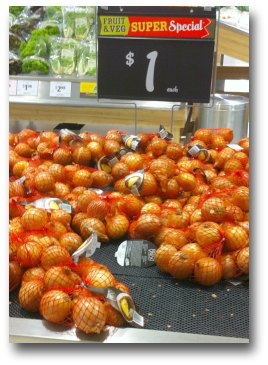
That is pristine, firm onions for 15c each.

Good food at great prices. It’s enough to close down the agencies on Madison Avenue. Who needs advertising when the prices are this cheap and the produce so enticing?

The reality is that farmers cannot supply produce sold out of the supermarket at 15c unless they are selling to one buyer who runs a monopoly over them. What is wrong is that the smiling farmer is actually walking a tightrope of viability. If fertilizer prices rise by 20% then they go out of business.

The market is failing them.

The profiteering opportunities and perverse competition of a retail duopoly (two supermarket chains supply most of the food to households across the country) creates huge risks for Australian production systems. Running at the price margin is a challenging way to run any business but in farming the corner cutting and frugality it severely limits sustainability.

It is well known that farmers look after their land best when they are doing well. When they are under pressure they tend to push the land harder to make ends meet.  We are at the point globally where we cannot afford for such structural risk. We need every acre of productive land to produce and to remain productive.

The message of food security provided by your friendly supermarket is false. It fails to take into account the risk that the farmer takes on when he has only one buyer of his produce.

And another thing, most farmers are over 50.
Environmental issues for real

When historians sit to appraise the environmental actions of the baby-boomer generation they will say that they tried, did some good things, but failed to grasp the big picture.

They will also record that the most important consequence of this failure was that people did not see the solutions that were there for the taking.

Instead they focused on issues that they believed were real but turned out, with the benefit of hindsight, to be only partially relevant.

I have just published a short ebook at Smashwords that takes a sideways look at 10 environmental issues and puts them into context. It collates a few examples around one core idea that may be useful to the historians of the future.

And it can be yours for less that the price of  a skim latte.

Environmental issues for real

New eBook – Environmental Issues for Real

Not satisfied with haranguing readers of this blog with environmental woes, I have branched out into the dynamic new world of ebook publishing.

Thanks to the amazing people at Smashwords my latest collection of essays on the environmental issues of the day is now available to download in all the usual formats.

Give it a whirl and maybe leave a review on the site. It would be great to hear what you think.

Gardens

A garden is a place that humans create from nature.

We carve out a parcel of land around our dwelling, add some landscaping and select plants to display nature’s beauty and bounty. This orderliness of things is pleasing to us. We feel in control as though our effort has tamed the wilderness.

The cleared patch puts some space between our homes, allows us to potter around outside without bumping into the dangers that trigger our fight and flight response and even provides fresh lettuce for a salad.

The first gardens were probably about clearing the vegetation around the hut so that we would not step on an unseen snake and the water would drain away more easily.

Most of us have or would like a small garden, our own small patch of tamed tranquility. We also enjoy visits to grander spaces that surround opulent homes for a garden is also a statement. It says something about the owner.

These spaces are so important to us that when we allow half the land area in the suburbs of many of our cities to be gardens. This makes our cities bigger, city infrastructure more expensive, and our commutes longer.

So why is it that with all these good reasons and commitment to have a garden we actually don’t spend that much time in them?

Obviously during the week we are at work and our kids are at school so we cannot be in two places at once. Then there is homework, the newspaper or TV, and dinner to prepare. At weekends we have shopping and sports and, well, a whole bunch of things to do.

There is some gardening of course; only this is mostly to keep the garden looking good.

And then you can’t be in the garden in the rain.

Take away all the effort in upkeep and we hardly spend any time in the garden at all. Only the kids use it and for them it is an attractive space until they get to high school when other things tweak their interest or the space is just too small for real soccer.

There must be another reason for our love affair.

It could be because all we need is to see evidence of our personal control over nature. A garden is a space close to us that we (or perhaps the landscaper) have tamed and bent to our will if you like. It is a safe buffer between the real world and us.

And yes, we like that space to be beautiful. We like to select and display selections from nature that we especially like or on occasion might even want to eat. Most of all we want it to look good simply because looking at it is what we will do most.

Perhaps it is OK that we do this, that we create this visual buffer. Especially if when we get a spare moment and its not raining we wander around the garden or just sit in it, maybe even on the grass. Maybe we are now so removed from nature that it really is too much for us to be exposed directly to its real tooth and claw and that our modifications of nature are a necessary half way house.

My guess is that these days, gardens get looked at only occasionally and entered for their own sake very rarely. When I travel on the train to the city, a journey of 60km each way, I can count on one hand the times I have seen people in their gardens.

So maybe gardens are actually about that neighbour thing.

Perhaps they are there to demonstrate how wealthy we are. It explains why when we look to buy a house, the size and shape of the garden around it is so important to our purchasing decision.

It would be better if we actually spent more time in our gardens, just because we can.


Easy or not

Meercat taking it easyIn his book ‘Hot, flat and crowded’ Thomas L. Friedman rails against the glorification of easy. His main complaint is that anything we do to support ourselves in an increasingly hot and crowded world is not going to be easy. And those who say there is an easy way are just kidding themselves.

Humans are notoriously hard to motivate without some form of reward. Most of what we need to do to keep producing natural resources and accommodate climate change when there are so many of us will require some sacrifice. The only reward will be the hope that we have done the right thing. Saying it will be easy is at best naive and at worst irresponsible.

To illustrate his point Friedman quotes Michael Maniates of Allegheny College.

Maniates makes the following assertions about what we ask of ourselves and one another:

  • we should look for easy, cost-effective things to do in our private lives as consumers because
  • if we all do them the cumulative effect will be a safe planet, because
  • by nature, we aren’t terribly interested in doing anything that isn’t private, individualistic, cost-effective and, above all, easy.

I reckon Maniates is on the money.

In default mode we are lazy. We would rather not sacrifice but if we have to then please can we do it from the couch. Please do not ask us to actively sacrifice.

Friedman’s frustration is understandable because it was this lazy default mode that has seen us consume with abandon and take ourselves to the edge of the resource use precipice.

In his book ‘Thinking, fast and slow’ Daniel Kahneman even has an explanation for why lazy is the default.

Cognitive research seems to be telling us that we think in a couple of different ways. We intuit most things. This action is easy and fast and works well for the bulk of our everyday decisions.

Only our intuition is not very good at complex thought, especially where we need to analyse for or calculate a result. For this we have to engage the thinking brain. The only problem is that this type of thinking takes work – real physical work apparently – and we find it difficult.

Our environmental challenges are very new and not in the default program. Our intuition has evolved for us to know that food, water and shelter are either here now, or just around the corner. We are not used to thinking about where these things are going to come from; yet we are forced more and more to think analytically about the basics. Indeed we have to think twice: first to tell us that we have a problem and second to figure out some solutions.

Friedman suggests it is irresponsible to say that our environmental challenges are easy to solve when, in fact, they are hard. Potentially more challenging than the problems themselves is that we prefer to solve things in our default mode. We prefer to intuit answers because it is a lot easier that way. Thinking is just too hard.

Take a moment to recall your experiences in the workplace or at home. Ask yourself what proportion of your time and that of your colleagues and family members is spent in default mode

Yep, we prefer not to have to think hard. No surprise that we glorify easy.

Only there is a reason why talking up easy is so common. My guess is that any call to think hard about anything will fall on deaf ears.

Truth

I took this photo on a recent visit to Mogo Zoo on the south coast of NSW.

Although small, the zoo is a neat and well-run establishment that boasts, among a number of interesting exhibits, a pride of white lions bred from individuals with a rare mutation that occurs on occasion in and around the Kruger National Park in South Africa.

Clearly the photo is not of a lion but an advertisement for a zoo experience. For $200 you can spend some time petting a serval (Leptailurus serval), an equally magnificent African cat similar, if somewhat larger and with longer legs, than the domestic variety. Servals are relatively common and widespread in sub-Saharan Africa and specialize in pouncing on rodents in the long grass of the savannas.

And here I have to admit to a huge contradiction in my head, for I have had the privilege of seeing serval in the wild. When in their element they are just as magnificent as any of their bigger cousins.

It was easy to conjure from memory the image of the cat in the grass lit by the orange glow of the sunrise, standing alert with an indescribable sense of belonging.

So my gut response to the advert was that no amount of enclosure landscaping or attention to the visitor experience could come close to the truth of seeing these animals where they should be.

Then I saw the look on the visitors face.

I realized that you do not need to go to Africa to find the truth.

Funny that.